
DGCA CPL Ground Classes
Complete CPL Ground School Preparation
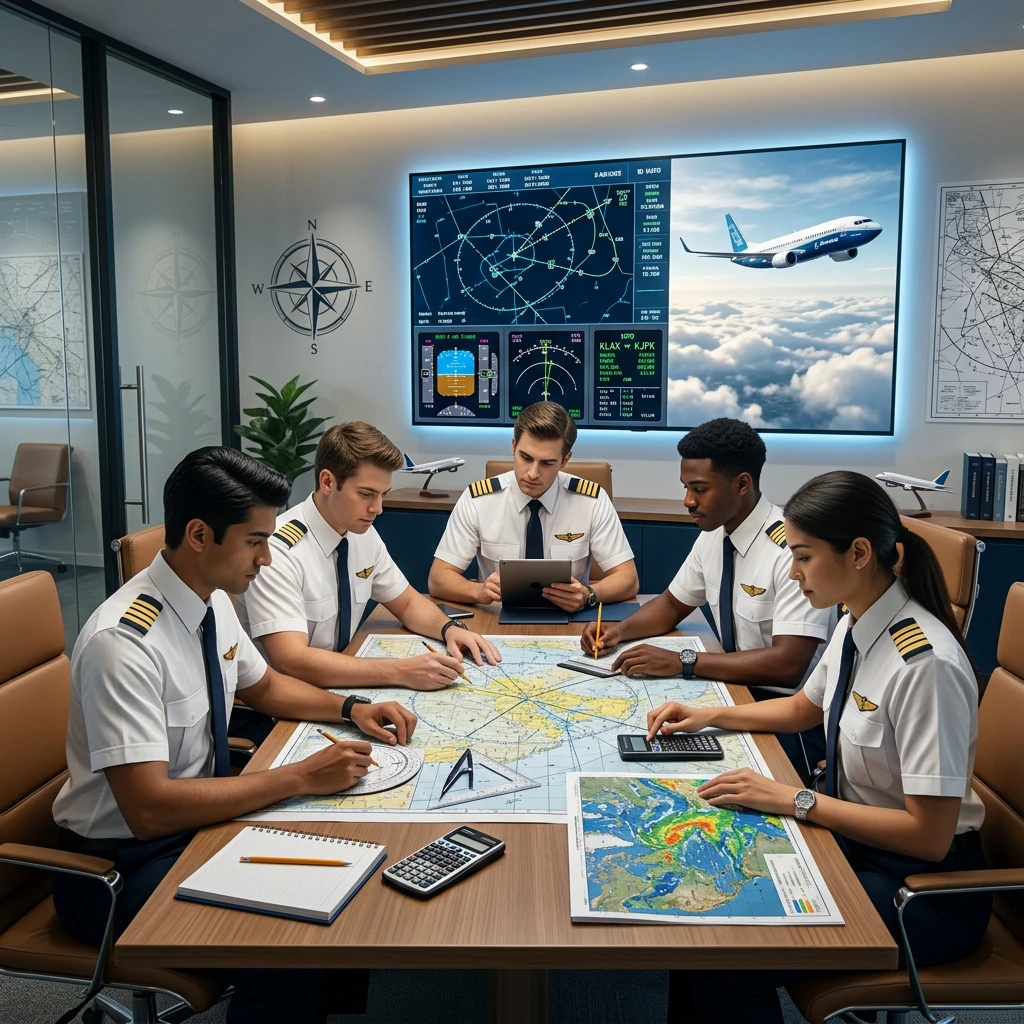
The short version: Yes, you can legally sit for and clear DGCA exams without ground classes. DGCA regulations do not mandate ground school attendance for CPL exam eligibility. However, while memory-intensive subjects like Air Regulations and Technical Specific are manageable via self-study, highly technical subjects like Air Navigation, Aviation Meteorology, and Technical General carry steep learning curves. Without experienced mentorship on navigation chart plotting, flight computers, and Pariksha exam patterns, self-study students face significant hurdles on calculation-heavy papers and often spend 6 to 9 months—roughly 3 to 5 months longer than a 3.5-to-4-month structured ground course—to complete the full syllabus. Explore our DGCA CPL Ground Classes Program for structured, military-mentored coaching.
Key Takeaways
- Legal Eligibility: DGCA ground school is not compulsory by law. Any student with a valid DGCA Computer Number and 10+2 (Physics/Math) can register directly on the Pariksha portal.
- Passing Standard: The DGCA passing mark is 70% in every individual paper with zero negative marking.
- Self-Study Feasibility: High for Air Regulations and Technical Specific; Moderate for Technical General; Low for Air Navigation and Aviation Meteorology; Very Low for RTR(A) Radiotelephony.
- Time Investment: Self-study typically requires 6 to 9 months (5–7 hours daily) compared to 3.5 to 4 months in structured live ground classes.
- The Opportunity Cost: Failing papers delays flight school entry and airline intake cycles, directly impacting lifetime airline seniority.
- Smart Hybrid Strategy: Self-study the law and specific papers at home, and leverage live coaching for calculation-heavy navigation and meteorology.
Quick Navigation
- Is DGCA Ground School Compulsory to Appear for Exams?
- Can You Clear DGCA Exams Through Self-Study? The Reality Check
- DGCA Ground Classes vs Self Study: Head-to-Head Comparison
- Subject-by-Subject Feasibility Breakdown
- The Hidden Costs and Career Risks of Pure Self-Study
- Comprehensive DGCA Self-Study Plan for Beginners
- Best Books & Study Material for DGCA Self-Study
- The Smart Hybrid Strategy: Best of Both Worlds
- Frequently Asked Questions
- Continue Reading & References
Is DGCA Ground School Compulsory to Appear for Exams?
A common question among aspiring commercial pilots is whether they must enroll in a formal ground school or flying training organisation (FTO) before taking the theory papers.
The regulatory reality is straightforward: Under the Directorate General of Civil Aviation (DGCA) Aircraft Rules 1937 and Civil Aviation Requirements (CAR), classroom ground school attendance is not legally mandatory to appear for CPL theory examinations conducted via the DGCA Pariksha portal.
| Requirement | DGCA Rule / Criteria | Mandatory Ground School? |
|---|---|---|
| Minimum Age | 17 Years at the time of exam application | Not required |
| Academic Eligibility | 10+2 with Physics and Mathematics (or NIOS equivalency) | Not required |
| Medical Standard | Class 2 Medical Assessment (Class 1 recommended) | Not required |
| DGCA Portal Setup | Active eGCA Profile & Computer Number | Not required |
| Exam Booking | Online slot booking on DGCA Pariksha Portal (₹2,500 regular / ₹5,000 on-demand) | 100% Self-Study Permitted |
As long as you have an active DGCA Computer Number, you can log in to the portal, pay the official exam fee—₹2,500 per paper for regular quarterly sessions or ₹5,000 per paper for On-Demand Examinations (ODE)—and book your seat. Review our complete guide on DGCA Exam Fees & Portal Costs.
Can You Clear DGCA Exams Through Self-Study? The Reality Check
While the regulatory answer is an unqualified "Yes," the practical answer depends on your learning style, mathematical foundation, and study discipline.
The DGCA passing mark is 70% in each subject (70 out of 100 marks) with no step-marking. Unlike subjective university examinations, the computer-based test (CBT) evaluates exact numerical answers and subtle regulatory differences. Read our in-depth analysis on DGCA Passing Marks & Attempt Rules.
| Parameter | Self-Study Candidates | Live / Structured Ground School Candidates |
|---|---|---|
| Primary Learning Challenge | Navigating complex chart plotting, Dalton flight computer calculations, and formula derivation independently | Guided step-by-step plotting critiques, structured curriculum pacing, and live doubt resolution |
| Preparation Timeline (All 6 Papers) | 6 to 9 Months | 3.5 to 4 Months |
| Daily Study Time Required | 5 to 7 Hours (Self-paced) | 3 to 4 Hours (Instructor-led + 2h revision) |
| Doubt Resolution Mechanism | Self-searching, forums, WhatsApp groups | Immediate live pilot Q&A and screen plotting |
| Question Bank Currency | High risk of outdated scraped PDFs | Real-time DGCA Pariksha pattern alignment |
*Note: Under DGCA regulations (CAR Section 7, Series B, Part I and Aircraft Rules 1937), candidates are evaluated against a standardized 70% passing cutoff per paper with zero negative marking. The DGCA does not publish statistical pass-rate breakdowns by preparation method. Individual clearance timelines depend on daily study discipline, mathematics proficiency, and consistency of practice.
Candidates who successfully clear all papers via self-study share three distinct attributes:
- Strong Mathematical Aptitude: Comfortable with mental trigonometry, drift vectors, and circular slide-rule calculations.
- Strict Daily Discipline: Consistently dedicating 5–6 hours every single day without classroom supervision.
- Primary Reference Manuals: Studying from official Oxford, Keith Williams, and IC Joshi manuals rather than summarized question banks.
For those lacking these habits, self-study often results in repeated attempts, exam exhaustion, and lost momentum.
DGCA Ground Classes vs Self Study: Head-to-Head Comparison
To decide whether to study independently at home or join a live cohort, evaluate the complete trade-offs:
| Evaluation Factor | Self-Study (Preparation at Home) | The Pilot's Compass (Live Ground School) |
|---|---|---|
| Upfront Tuition Cost | ₹0 tuition (books & test subscriptions only) | Structured, transparent batch fee |
| Lead Mentorship | None (Independent research) | Indian Navy & IAF Veteran Pilots (9,000+ flight hrs) |
| Navigation Plotting | 2D book diagrams (high confusion rate) | Real-time interactive WAC/Jeppesen chart plotting |
| Flight Computer (CRP-5/CX-3) | Self-reading manuals | Step-by-step live flight computer demonstration |
| Batch Accountability | Zero tracking; high risk of procrastination | Daily attendance, monitored homework, weekly mocks |
| Course Validity | N/A | Unlimited revision batch validity until exams cleared |
| Administrative Support | Self-managed eGCA & Medicals | End-to-end eGCA Computer Number & Medical guidance |
| Airline Seniority Impact | Delayed by 3 to 6 months per failed exam cycle | Fast-tracked to start flight school immediately |
Learn more about how our structured program works on the DGCA CPL Ground Classes Program Page.
Subject-by-Subject Feasibility Breakdown
The DGCA Commercial Pilot License syllabus consists of 5 core theory papers plus the RTR(A) wireless communication license. Below is the honest breakdown of which papers you can self-study and which ones require coaching:
| Subject | Difficulty | Self-Study Feasibility | Best Preparation Strategy | Detailed Guide |
|---|---|---|---|---|
| Air Regulations | ⭐⭐☆☆☆ | High (9/10) | Memorize CARs, Aircraft Rules 1937, solve 500+ MCQs | Read Air Regs Guide |
| Technical Specific | ⭐⭐☆☆☆ | High (9.5/10) | Master Pilot Operating Handbook (POH/AFM) of your aircraft | Read Tech Specific Guide |
| Technical General | ⭐⭐⭐⭐☆ | Moderate (5/10) | Focus on Jet Engines, Hydraulics, Electrical Schematics | Read Tech General Guide |
| Aviation Meteorology | ⭐⭐⭐⭐☆ | Moderate-Low (4/10) | Decode METAR/TAF, understand monsoons and Tephigrams | Read Meteorology Guide |
| Air Navigation | ⭐⭐⭐⭐⭐ | Low (3/10) | Master 1-in-60 rule, CRP-5 computer, Convergency, Radio Aids | Read Navigation Guide |
| RTR(A) Radiotelephony | ⭐⭐⭐⭐⭐ | Very Low (2/10) | Live two-way cockpit transmission drills with instructors | Read RTR(A) Guide |
1. Air Regulations (Air Law)
- Self-Study Rating: 9/10 (Highly Feasible)
- Why It Works for Self-Study: Air Regulations is essentially a memory-based legal subject. It tests your knowledge of the Bharatiya Vayuyan Adhiniyam, 2024 (enacted by Parliament to replace the colonial Aircraft Act, 1934), the Aircraft Rules 1937, DGCA Civil Aviation Requirements (CAR Section 7 and Section 8), ICAO Annexes (Annex 2, Annex 11, Annex 14), and Air Traffic Services (ATS) airspace classifications.
- Recommended Approach: Read R.K. Bali’s Air Regulations and Trevor Thom’s Aviation Law. Review our complete DGCA Air Regulations Guide. Once you memorize visual flight rules (VFR) minimums, right-of-way hierarchies, and aerodrome light signals, you can score 85%+ on self-study alone.
2. Technical Specific
- Self-Study Rating: 9.5/10 (Highly Feasible)
- Why It Works for Self-Study: This paper evaluates your knowledge of the single-engine aircraft you will operate during your flight training (e.g., Cessna 172 Skyhawk, Piper Archer, or Diamond DA40).
- Recommended Approach: Obtain the official Pilot Operating Handbook (POH) and Aircraft Flight Manual (AFM) for your training aircraft. Memorize V-speeds (V_R, V_X, V_Y, V_SO, V_NE), fuel capacities, engine limitations, and emergency procedures.
3. Air Navigation
- Self-Study Rating: 3/10 (Coaching Highly Recommended)
- Why Self-Study Fails: Air Navigation is the most math-intensive paper in the DGCA syllabus. It includes:
- General Navigation: Great circles, rhumb lines, scale calculation, convergence, conversion angle, departure formula, 1-in-60 rule, and Point of No Return (PNR) / Critical Point (CP) calculations.
- Flight Computers: Circular slide rule and wind triangle mechanics on the Pooleys CRP-5 or ASA CX-3 electronic flight computer.
- Radio Navigation & Instruments: VOR, NDB/ADF, ILS, DME, GNSS, gyroscopic instruments, altimetry temperature corrections, and radar systems.
- The Verdict: Grasping wind vector triangles, drift calculations, and chart projections from static text is notoriously challenging. For detailed syllabus insights, read our DGCA Air Navigation Guide.
4. Aviation Meteorology
- Self-Study Rating: 4/10 (Coaching Highly Recommended)
- Why Self-Study Fails: Meteorology is dynamic atmospheric physics. Aspirants must master:
- Atmospheric pressure systems, dry/wet adiabatic lapse rates, and atmospheric stability.
- Frontal systems (warm fronts, cold fronts, occlusions) and cyclogenesis.
- Indian monsoons (Southwest & Northeast), Western Disturbances, jet streams, and Clear Air Turbulence (CAT).
- Practical interpretation of Indian METAR, SPECI, TAF, SIGMET, and Synoptic Charts.
- The Verdict: While books like Aviation Meteorology by IC Joshi provide thorough information, decoding complex upper-air charts and tephigrams without an experienced aviator who has flown through tropical weather systems is tough. Read our DGCA Meteorology Guide.
5. Technical General
- Self-Study Rating: 5/10 (Moderate Feasibility)
- Why Self-Study Fails: This comprehensive paper covers aerodynamics, airframe structures, piston engines, gas turbine (jet) engines, aircraft electrical systems, hydraulic/pneumatic actuators, and flight controls.
- The Verdict: Students from non-engineering backgrounds frequently struggle with hydraulic schematics, turbine engine spooling, compressor stalls, and high-speed aerodynamics without structured visual breakdowns. Explore our DGCA Technical General Guide.
6. RTR(A) — Radio Telephony Restricted (Aeronautical)
- Self-Study Rating: 2/10 (Coaching Essential)
- Why Self-Study Fails: Conducted by the Ministry of Communications (WPC), RTR(A) is not a written MCQ test. It is a live two-way simulation exam:
- Part 1: Practical transmission exam on an audio headset with live air traffic control routing, emergency callouts, and position reports.
- Part 2: Viva voce with a WPC technical officer and a DGCA representative.
- The Verdict: You cannot master standard ICAO radio phraseology, readbacks, and distress calls (MAYDAY / PAN PAN) without live mock transmission drills. Review our complete DGCA RTR(A) Exam Guide.
The Hidden Costs and Career Risks of Pure Self-Study
Aspirants often choose self-study to save on coaching fees. However, you must evaluate the hidden financial and career costs of delayed exam clearances:
| Hidden Cost / Risk | Impact on Student Pilot | Financial / Career Penalty |
|---|---|---|
| Exam Re-attempt Fees | ₹2,500 per paper (regular) or ₹5,000 (on-demand) | ₹10,000 – ₹25,000 across multiple retakes |
| Exam Session Cycle Delays | Regular sessions occur quarterly (every 3 months); On-Demand slots have very limited regional test center capacity | 2 to 4 months lost per failed paper cycle |
| Lost Airline Seniority | Delayed commercial license pushes airline hiring date | ₹9 Lakh – ₹15 Lakh in forgone First Officer salary |
| Flight School Batch Delays | FTO seat slots deferred due to uncleared theory papers | Flight training price inflation & visa rescheduling |
In commercial aviation, date of joining determines lifetime seniority for wide-body upgrades and command upgrades. A 3-to-6-month delay in clearing theory exams directly pushes back flying training and your eventual airline seniority number.
Comprehensive DGCA Self-Study Plan for Beginners
If you decide to prepare for DGCA exams at home, follow this structured 4-phase, 6-month roadmap:
| Phase | Timeline | Core Focus Subjects | Daily Action Items | Milestone to Advance |
|---|---|---|---|---|
| Phase 1 | Month 1–2 | Air Regulations & Tech Specific | Read CARs, POH limitations, solve 100 MCQs daily | Scoring 85%+ on full-length mock tests |
| Phase 2 | Month 3–4 | Aviation Meteorology | Master IC Joshi, METAR/TAF decoding, Monsoons | Complete all IC Joshi chapter-end exercises |
| Phase 3 | Month 5 | Technical General | Study Oxford AGK & Principles of Flight, draw schematics | Master turbine engines & hydraulic systems |
| Phase 4 | Month 6 | Air Navigation | Practice 1-in-60, CRP-5 flight computer, chart plotting | Consistent 85%+ on timed Navigation CBTs |
Daily 6-Hour Self-Study Framework
- 08:00 AM – 10:30 AM (2.5 Hours): Deep Conceptual Reading. Read official textbooks (Oxford / Keith Williams / IC Joshi) and write handwritten summary notes.
- 11:00 AM – 12:30 PM (1.5 Hours): Numerical Problem-Solving. Work through 1-in-60 calculations, true airspeed conversions, fuel planning, and altimeter errors.
- 03:00 PM – 04:30 PM (1.5 Hours): Timed CBT Question Bank Practice. Solve 100 timed MCQs and document every mistake in a dedicated "Error Log".
- 05:00 PM – 05:30 PM (0.5 Hours): Active Recall & Flashcards. Revise airspace minimums, V-speeds, and regulatory definitions.
Review our step-by-step strategy on How to Clear DGCA Exams in First Attempt.
Best Books & Study Material for DGCA Self-Study
To succeed without coaching, you must study directly from DGCA-recommended reference textbooks:
| Subject | Primary Reference Textbook | Author / Publisher | Key Topics Covered |
|---|---|---|---|
| Air Navigation | General Navigation & Radio Navigation | Oxford Aviation / Keith Williams | Scale, Chart Projections, Drift, VOR/ILS, Altimetry |
| Aviation Meteorology | Aviation Meteorology | IC Joshi / Oxford Met | Monsoons, METAR/TAF, Western Disturbances, Fog |
| Air Regulations | Air Regulations for Pilots & CARs | R.K. Bali / DGCA India Portal | Aircraft Rules 1937, Airspace Class, Logbooks, Visual Limits |
| Technical General | Aircraft General Knowledge & PoF | Oxford Aviation Academy Series | Gas Turbines, Hydraulics, Electrical, Aerodynamics |
| Technical Specific | Pilot Operating Handbook (POH) | Aircraft Manufacturer (Cessna/Piper) | Speeds, Limitations, Fuel & Oil, Weight & Balance |
| RTR(A) | Aeronautical Telecommunications Manual | WPC India / CAP 413 | Standard Phraseology, Distress/Urgency Calls |
For complete textbook details, editions, and purchase links, see our comprehensive DGCA CPL Books List 2026.
The Smart Hybrid Strategy: Best of Both Worlds
You do not have to choose between 100% self-study and expensive full-time offline coaching. The smartest pilot aspirants adopt a Hybrid Preparation Strategy:
| Preparation Track | Recommended Method | Why This Works |
|---|---|---|
| Track 1: Self-Study at Home | Air Regulations + Technical Specific | Zero tuition cost; pure memorization and rule-based reading |
| Track 2: Live Online Coaching | Air Navigation + Meteorology + Tech General + RTR(A) | Interactive plotting, live flight computer problem-solving, live R/T callout drills |
Why Live Online Ground Classes with The Pilot's Compass?
With modern live online coaching, you get top-tier instruction from home without paying high relocation and hostel expenses:
- Direct Mentorship by Military Veterans: Learn under Commander Naveen Pandita (Retd.) (Ex-Indian Navy) and senior IAF veteran Qualified Flying Instructors with over 9,000+ flight hours.
- Interactive Chart Work: Live digital whiteboard demonstrations of CRP-5 flight computers, WAC plotting, and METAR/TAF decoding in small batches under 20 students.
- One-Time Fee with Unlimited Validity: Attend revision batches and doubt-clearing sessions at zero extra charge until you clear every DGCA paper.
- Relocation Savings: Save ₹1.5 Lakh to ₹2.5 Lakh in living expenses compared to physical institutes in Delhi or Mumbai.
Explore our online program: Best Online DGCA Ground Classes in India or read our regional guides for Ahmedabad, Chandigarh, Delhi, and Hyderabad. If you prefer physical classroom coaching in Bengaluru, explore our Best DGCA Ground Classes in Bangalore and Yelahanka North Bangalore Academy Guide.
Continue Reading
- Best Online DGCA Ground Classes in India: Complete Guide
- Best Online DGCA Ground Classes in Ahmedabad
- Best Online DGCA Ground Classes in Chandigarh
- Best DGCA Ground Classes in Bangalore: 2026 Guide
- How to Clear DGCA Exams in First Attempt: Proven Strategy
- DGCA CPL Books List 2026: Recommended Aviation Textbooks
- DGCA CPL Exam Syllabus 2026: Complete Subject Breakdown
- DGCA Exam Pattern & CBT Guide
- DGCA Passing Marks & Attempt Rules
- DGCA Exam Fees, Paper Costs & Pariksha Portal Guide
- DGCA CPL Subjects Explained: All 6 Theory Papers
- Real Commercial Pilot License Cost Breakdown in India
Official Sources & References
- Directorate General of Civil Aviation (DGCA) India: https://www.dgca.gov.in
- DGCA Pariksha Candidate Exam Portal: https://pariksha.dgca.gov.in
- eGCA Aviation Services Portal: https://egca.dgca.gov.in
- Ministry of Communications (WPC Wing) RTR(A) Portal: https://wpc.dot.gov.in
Frequently Asked Questions
Map Your Custom Pilot Training Pathway
Evaluate your compliance across the 4 major DGCA training gates, select training country routes (India vs. USA/Europe), and estimate your CPL timeline month-by-month.