

DGCA CPL Ground Classes
Complete CPL Ground School Preparation
Ask any Commercial Pilot Licence (CPL) student which DGCA theory paper feels the most intimidating, and there's a good chance you'll hear the same answer: Air Navigation.
It introduces flight planning, navigation charts, wind calculations, time conversions, radio navigation, and aircraft positioning—topics that are completely new to most aspiring pilots. For students without an aviation background, Air Navigation can initially seem overwhelming. There are formulas to learn, charts to interpret, calculations to practice, and navigation instruments to understand.
Unlike some theory papers, simply memorizing answers isn't enough. However, Air Navigation isn't difficult because the concepts are impossible; it's difficult because many students study it in the wrong order.
A structured preparation strategy changes everything. Once you understand the basic concepts, every advanced topic starts fitting together naturally. In this guide, we'll explain the complete syllabus, the most important formulas, which books to study, and a proven roadmap for mastering DGCA Air Navigation.
If you want a worked-example practice set with original numerical questions, review our DGCA Air Navigation Practice Questions guide after you finish this syllabus overview.
Before starting your preparation, always review the latest Flight Crew syllabus and examination notifications published by the Directorate General of Civil Aviation (DGCA) to ensure your study material aligns with current standards.
The short version
DGCA Air Navigation is one of the most concept-driven subjects in the CPL syllabus. Instead of memorizing formulas, students should build a strong foundation in navigation basics, charts, time calculations, wind correction, flight planning, and radio navigation. A structured study plan, regular calculation practice on the CRP-5, and targeted mock tests form the most effective preparation strategy.
Key Takeaways
- Calculation Intensive: Air Navigation is widely considered the most calculation-heavy DGCA theory subject.
- Concepts Over Memorization: Understanding underlying principles is far more important than memorizing formulas.
- Sequential Learning: Flight planning and navigation calculations build directly upon earlier foundational chapters.
- Daily Practice: Consistent, daily calculation practice improves speed and confidence significantly.
- Smart Resource Use: Question banks should only be used after you have mastered the conceptual theory.
What Is DGCA Air Navigation?
DGCA Air Navigation is the comprehensive study of how to safely direct an aircraft from one location to another, encompassing flight planning, position fixing, radio navigation, and dead reckoning.
Every commercial pilot must understand how to determine an aircraft's position, calculate efficient routes, estimate flight time, compensate for wind, interpret aeronautical charts, and safely reach the intended destination. Although modern aircraft use advanced GPS and Flight Management Systems (FMS), every pilot is required to understand the foundational principles behind navigation in case of instrument failure.
This theoretical knowledge is essential not only for passing the DGCA examinations but also for conducting safe flight operations throughout your aviation career. Because many of these concepts—such as meteorology, physics, and aircraft performance—are interconnected, learning them in the correct sequence is critical.
Why Is Air Navigation Considered Difficult?
Air Navigation is generally considered the hardest DGCA subject because it is heavily application-based, requiring students to perform real-time mathematical calculations, interpret charts, and use mechanical flight computers rather than simply recalling memorized facts.
Unlike Air Regulations, where many questions are theory-based, Navigation expects students to calculate, interpret, and analyze complex scenarios. Students often find it challenging because it involves:
- Mathematical calculations and time conversions.
- Flight planning and wind correction angles.
- Interpreting dense navigation charts.
- Understanding radio navigation principles (VOR, NDB, ILS).
- Compensating for compass errors (variation and deviation).
Because these concepts are highly interdependent, skipping the basics makes advanced topics like flight planning nearly impossible to grasp. The students who struggle the most are typically those who jump directly into complex numerical problems without first mastering the fundamentals of direction and speed.
What Is the DGCA Air Navigation Syllabus?
The official DGCA Air Navigation syllabus covers Earth geometry, time calculations, chart plotting, dead reckoning, flight planning, compass magnetism, and radio navigation aids.
Before you begin, always cross-reference your textbooks with the official DGCA Exam Syllabus. The syllabus is designed to take you through every stage of planning and conducting a flight. Below is a simplified overview of the major learning areas:
| Topic | What You'll Learn |
|---|---|
| Earth & Navigation Basics | Shape of the Earth, latitude, longitude, and cardinal directions |
| Time | UTC, IST, Local Mean Time (LMT), and solar time calculations |
| Navigation Charts | Aeronautical charts (Lambert, Mercator), plotting routes, and measuring distances |
| Dead Reckoning | Estimating aircraft position using heading, speed, and time |
| Wind Triangle | Calculating wind correction angles (WCA) and effective ground speed |
| Flight Planning | Fuel planning, routing, identifying alternates, and completing flight logs |
| Compass & Magnetism | Magnetic variation, deviation, and compass turning errors |
| Radio Navigation | VOR, NDB, DME, ILS, and GNSS/GPS basics |
| Flight Computer | Performing calculations using the CRP-5 / E6B |
Although the syllabus appears extensive, every topic builds directly upon the previous one. Learning them in a structured sequence makes the entire subject far easier to digest.
Which Chapters Are the Hardest?
The most calculation-intensive and challenging chapters in DGCA Air Navigation are typically the Wind Triangle, Flight Planning, and Dead Reckoning, as they require combining multiple concepts simultaneously.
Not every Navigation chapter requires the same amount of effort. Here is a practical estimate of topic difficulty and calculation intensity, based on feedback from successful CPL candidates:
| Topic | Difficulty | Calculation Level |
|---|---|---|
| Earth & Latitude/Longitude | ⭐⭐☆☆☆ | Low |
| Time Calculations | ⭐⭐⭐☆☆ | Medium |
| Navigation Charts | ⭐⭐⭐☆☆ | Medium |
| Compass & Magnetism | ⭐⭐⭐☆☆ | Medium |
| Radio Navigation | ⭐⭐⭐☆☆ | Medium |
| Dead Reckoning | ⭐⭐⭐⭐☆ | High |
| CRP-5 / E6B | ⭐⭐⭐⭐☆ | High |
| Wind Triangle | ⭐⭐⭐⭐⭐ | Very High |
| Flight Planning | ⭐⭐⭐⭐⭐ | Very High |
Many instructors recommend that you do not avoid the difficult chapters. Instead, start them early and practice regularly. Small, consistent practice sessions yield far better results than trying to master complex calculations in the final week before the exam.
What Is the Best Logical Learning Roadmap?
The most effective way to learn Air Navigation is sequentially: start with Earth geometry and time, move to charts and magnetism, progress to the Wind Triangle and dead reckoning, and finish with flight planning and radio navigation.
Instead of studying topics randomly or in the exact order of a textbook, a practical preparation strategy follows a logical progression where each chapter supports the next.
- Earth & Directions: Understand the globe, latitude, and longitude.
- Time Calculations: Learn how the Earth's rotation affects time and solar positioning.
- Navigation Charts: Learn how a 3D globe is projected onto a 2D map.
- Compass & Magnetism: Understand how to determine direction using magnetic north.
- Wind Triangle: Learn how wind affects your intended flight path.
- Dead Reckoning: Combine direction, speed, and time to estimate your position.
- Flight Planning: Bring all previous concepts together to plan a complete flight route.
- Radio Navigation: Learn how to use electronic aids to verify your dead reckoning position.
- CRP-5 Practice: Integrate mechanical flight computer practice throughout all numerical chapters.
How to Master the CRP-5 / E6B Flight Computer
To master the CRP-5 or E6B flight computer, practice using it alongside each chapter as you learn the theory, rather than waiting until the end of the syllabus.
The CRP-5 (or E6B) is a circular mechanical slide-rule device used to perform rapid aviation calculations. Even though electronic flight computers and apps are common today, understanding manual calculations strengthens your core navigation fundamentals and is heavily tested in the DGCA examination.
Students primarily use the CRP-5 to calculate:
- Ground Speed and True Air Speed (TAS)
- Wind Correction Angle (WCA) and Heading
- Fuel Consumption and Flight Time
- Unit Conversions (e.g., Nautical Miles to Kilometers)
- Density Altitude
While the device initially appears intimidating, most students become highly proficient after guided, repetitive practice. Don't wait until the final week; integrate flight computer exercises into your daily study routine.
Which Formulas Are Important for Air Navigation?
Instead of memorizing isolated formulas, you must understand the core relationships between Speed, Distance, Time, Wind Vectors, and Fuel Consumption, as DGCA questions often require combining these concepts.
Students often ask which formulas they should memorize, but the better question is which formulas they should understand. Understanding the logic behind an equation makes it much easier to recall during the pressure of an examination.
Core formula areas include:
- Speed = Distance ÷ Time (The foundation of dead reckoning)
- True Air Speed (TAS) vs. Ground Speed (GS)
- Heading vs. Track (Accounting for drift and wind correction)
- Estimated Time of Arrival (ETA)
- Specific Fuel Consumption
- Rate of Climb & Descent
A practical study strategy: Instead of creating a separate notebook just for formulas, write each formula directly beside the concept where it is used in your notes. This helps you associate the mathematical equation with its real-world flight application.
Which Books Should I Study for Air Navigation?
For DGCA Air Navigation, Trevor Thom’s Air Navigation is highly recommended for building foundational concepts, while Oxford ATPL Navigation provides the advanced numerical depth required for complex calculations.
Choosing the right study material can significantly impact your preparation. As detailed in our comprehensive guide to Best DGCA Books for 2026, you should focus on one primary reference to build your concepts, and use additional resources only for numerical practice.
| Resource | Best For |
|---|---|
| Trevor Thom (Vol 3) | Excellent for beginners building foundational concepts |
| Oxford ATPL Navigation | Advanced explanations, instrument specifics, and deep calculations |
| DGCA Question Banks | Chapter-wise practice and understanding exam framing |
| CRP-5 Manual | Step-by-step practical mechanical calculations |
If you have no prior aviation background, starting with Trevor Thom is an excellent choice because it breaks down complex geometry into student-friendly explanations before introducing heavy mathematics.
How Should I Prepare? (An 8-Week Study Plan)
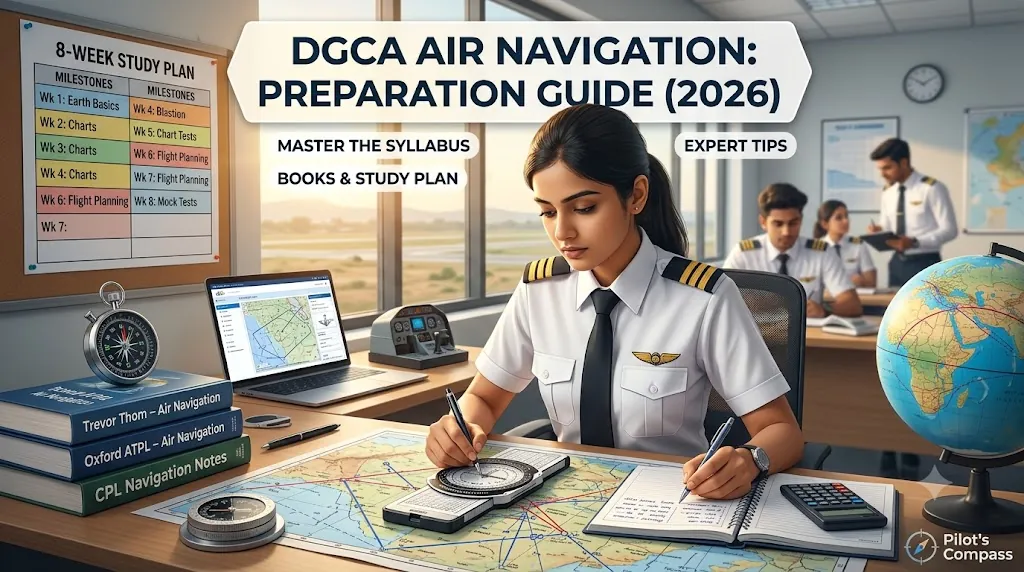
A practical preparation strategy for Air Navigation involves dedicating 8 weeks to structured study: spending the first 4 weeks on theory and basics, and the final 4 weeks on advanced flight planning, radio aids, and mock tests.
Breaking the syllabus into smaller, weekly milestones makes preparation far more manageable and prevents burnout. If you are preparing for multiple DGCA CPL Subjects, you can adjust the pace of this plan to fit your schedule.
| Week | Primary Goal | Focus Areas |
|---|---|---|
| Week 1 | Foundations | Earth geometry, Latitude, Longitude, and Directions |
| Week 2 | Time & Charts | UTC conversions, LMT, and Map Projections (Mercator/Lambert) |
| Week 3 | Magnetism | Magnetic Variation, Deviation, and Compass Errors |
| Week 4 | Wind Vectors | The Wind Triangle, Drift, and Wind Correction Angles |
| Week 5 | Dead Reckoning | Speed/Distance/Time calculations and position estimating |
| Week 6 | Flight Planning | Fuel calculations, routing, and completing flight logs |
| Week 7 | Radio Navigation | VOR, NDB, ILS, DME, and integrating the CRP-5 |
| Week 8 | Exam Readiness | Full syllabus revision, error analysis, and full-length mock tests |
Mastering one topic completely before moving to the next usually leads to better long-term retention and higher examination scores.
How Should I Use Question Banks and Mock Tests?
Use question banks for chapter-wise revision only after mastering the theory, and take full-length mock tests during your final weeks to build speed, accuracy, and time management skills.
Question banks are excellent tools, but they should never replace studying the actual textbooks. DGCA frequently introduces new, application-based questions, meaning that rote memorization of question banks is a high-risk strategy.
A practical mock test strategy:
- Weeks 1–4: Take topic-wise quizzes immediately after finishing a chapter to reinforce learning.
- Weeks 5–6: Focus on mixed-topic numerical practice tests to build calculation speed.
- Weeks 7–8: Attempt full-length, timed DGCA-style mock exams.
After every mock test, review every incorrect answer, revisit the related concept in your textbook, and update your revision notes. Learning from your mistakes is far more valuable than simply rushing to complete another practice paper.
Common Mistakes Students Make in Air Navigation
Many students struggle with Air Navigation because of avoidable study habits. Instructors frequently observe the following common mistakes:
1. Memorizing formulas without understanding them
Attempting to rote-learn formulas without visualizing the aircraft's movement leads to confusion when a question is phrased differently in the exam. Always focus on why a formula works.
2. Skipping basic concepts
Advanced chapters like the Wind Triangle and Flight Planning become incredibly frustrating if your foundational knowledge of Latitude, Time, and Charts is weak. Do not rush the early chapters.
3. Practicing too few calculations
Navigation is a skill-based, numerical subject. The more problems you physically solve on paper and on your CRP-5, the more confident you will become. Reading a solved example is not the same as solving it yourself.
4. Leaving Navigation until the end
Because Navigation requires consistent mathematical practice and logical progression, it is highly recommended to start it early in your preparation cycle rather than treating it as a final subject to cram.
How The Pilot's Compass Helps You Master Air Navigation
Air Navigation is often the subject students worry about the most. At The Pilot's Compass, our comprehensive DGCA Ground Classes focus on building confidence step-by-step rather than overwhelming students with formulas on day one.
Under the direct guidance of Commander Naveen Pandita (Retd.), students begin with foundational concepts before progressing to advanced flight planning calculations. Our structured program provides:
- Live, interactive online classes covering the entire official syllabus.
- Step-by-step, guided mechanical flight computer (CRP-5) practice.
- Topic-wise numerical assignments and regular doubt-solving sessions.
- Full-length, DGCA-style mock examinations to ensure exam readiness.
If you are struggling with your preparation, book a free counselling session with us to learn how you can approach Air Navigation with clarity and confidence.
Continue Reading
Explore more of our comprehensive pilot training and preparation guides:
- DGCA CPL Subjects Explained
- How to Prepare for DGCA CPL Exams
- Best DGCA Books for CPL Exams
- DGCA Exam Pattern Explained
- DGCA Passing Marks & Rules
- Best DGCA Ground Classes in India
Sources
Official References
- Directorate General of Civil Aviation (DGCA)
- DGCA Pariksha Portal
- ICAO Annex 2 – Rules of the Air
- ICAO Annex 4 – Aeronautical Charts
Educational Recommendations
- Trevor Thom: The Air Pilot's Manual Vol 3 - Air Navigation
- Oxford Aviation Academy: ATPL Training Manual - General Navigation
Frequently Asked Questions
Map Your Custom Pilot Training Pathway
Evaluate your compliance across the 4 major DGCA training gates, select training country routes (India vs. USA/Europe), and estimate your CPL timeline month-by-month.