DGCA CPL Ground Classes
Complete CPL Ground School Preparation
One of the first questions every aspiring commercial pilot asks is:
"What subjects do I have to study for the DGCA CPL exams?"
It's a simple question—but the answer is much more important than just knowing the names of the subjects.
Each DGCA theory subject builds a different skill you'll need throughout your aviation career.
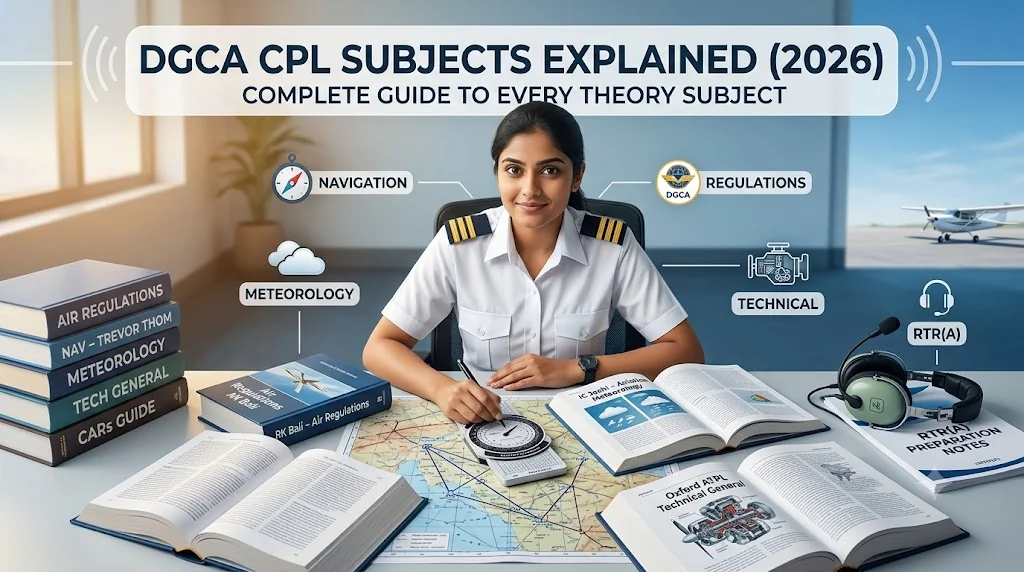
Air Regulations teaches you the legal framework that governs flight operations.
Air Navigation develops the planning and calculation skills required to fly safely from one destination to another.
Meteorology helps you understand weather and its impact on flight safety.
Technical subjects explain how aircraft systems work, while RTR(A) prepares you for professional radio communication.
Together, these subjects form the theoretical foundation of every Commercial Pilot Licence (CPL) holder in India.
Unfortunately, many students begin preparing without understanding:
- What each subject actually covers.
- Which subject is the most challenging.
- How long each one takes to prepare.
- Which books to use.
- The best order to study them.
This often leads to confusion, poor planning, and unnecessary stress during preparation.
In this guide, we'll explain every DGCA CPL subject in detail, compare their difficulty levels, recommend preparation strategies, and help you build a smarter study plan.
Before you begin studying, it's always a good idea to review the latest Flight Crew syllabus and examination notices published by the Directorate General of Civil Aviation (DGCA). These official resources define the current syllabus and examination requirements for CPL candidates.
The short version
DGCA CPL theory preparation consists of six core areas: Air Regulations, Air Navigation, Aviation Meteorology, Technical General, Technical Specific, and RTR(A) preparation. Each subject develops different knowledge and skills required for commercial pilots. Understanding the purpose, difficulty, and recommended study strategy for each subject makes your preparation far more structured and effective.
Key Takeaways
- DGCA CPL preparation includes six major theory subjects.
- Each subject focuses on a different aspect of aviation knowledge.
- Air Navigation is generally considered the most calculation-intensive paper.
- Technical General and Technical Specific explain aircraft systems and operations.
- Air Regulations forms the legal foundation of aviation.
- Studying the subjects in the right sequence can improve understanding and retention.
Quick Navigation
- How Many DGCA CPL Subjects Are There?
- Subject Overview Table
- Air Regulations Explained
- Air Navigation Explained
- Aviation Meteorology Explained
- Technical General Explained
- Technical Specific Explained
- RTR(A) Explained
- Which Subject Is the Most Difficult?
- Best Order to Study DGCA Subjects
- Best Books for Every Subject
- FAQs
How Many DGCA CPL Subjects Are There?
Before applying for a Commercial Pilot Licence (CPL), every aspiring pilot must develop a strong understanding of aviation theory.
The DGCA theory syllabus is designed to ensure that pilots have the knowledge required to operate aircraft safely, understand aviation regulations, interpret weather conditions, and make informed decisions during flight operations.
Most students preparing for the CPL examinations study the following core subjects:
| Subject | Primary Focus |
|---|---|
| Air Regulations | Aviation rules, CARs, licensing, operational regulations |
| Air Navigation | Flight planning, navigation calculations, radio navigation |
| Aviation Meteorology | Weather systems, forecasts, METARs, TAFs, aviation weather |
| Technical General | Aircraft systems, engines, aerodynamics, instruments |
| Technical Specific | Aircraft-specific systems, limitations, performance |
| RTR(A) Preparation | Aviation radio communication and phraseology |
Although these subjects are taught separately, they complement one another throughout a pilot's training.
For example:
- Air Navigation relies on accurate weather information from Meteorology.
- Flight operations must comply with Air Regulations.
- Technical knowledge helps pilots understand aircraft performance during flight planning.
- RTR(A) ensures pilots communicate clearly with Air Traffic Control.
Instead of treating each paper as an isolated exam, think of them as different pieces of the same aviation puzzle.
That perspective makes learning more meaningful—and much easier to retain.
DGCA CPL Subjects at a Glance
Before exploring each subject in detail, here's a quick comparison.
| Subject | Difficulty | Calculations | Memory-Based | Typical Preparation Time |
|---|---|---|---|---|
| Air Regulations | ⭐⭐☆☆☆ | Low | High | 2 Weeks |
| Air Navigation | ⭐⭐⭐⭐⭐ | Very High | Medium | 3–4 Weeks |
| Aviation Meteorology | ⭐⭐⭐☆☆ | Medium | Medium | 2–3 Weeks |
| Technical General | ⭐⭐⭐⭐☆ | Medium | Medium | 3 Weeks |
| Technical Specific | ⭐⭐⭐☆☆ | Low | High | 2 Weeks |
| RTR(A) | ⭐⭐☆☆☆ | Low | Medium | 1–2 Weeks |
Note: Difficulty varies based on your educational background, study habits, and familiarity with technical concepts.
Air Regulations Explained
Air Regulations is often the first subject recommended for DGCA CPL aspirants because it introduces the legal and operational framework of aviation.
Before a pilot learns how to navigate or operate an aircraft, they must understand the rules that govern every flight.
This subject covers the regulations issued by the Directorate General of Civil Aviation (DGCA), Civil Aviation Requirements (CARs), ICAO standards, pilot licensing requirements, airspace classifications, and operational procedures.
Although Air Regulations doesn't involve complex calculations, it requires careful reading and regular revision because many concepts are definition-based.
What You'll Learn
Some of the major topics include:
- Civil Aviation Requirements (CARs)
- Rules of the Air
- Aircraft documents
- Pilot licensing requirements
- Airspace classifications
- Flight rules (VFR & IFR)
- Operational procedures
- ICAO Annexes
- DGCA regulations
- Aviation safety requirements
Understanding these topics is important because every commercial pilot is expected to apply these regulations throughout their career—not just during examinations.
Difficulty Level
⭐⭐☆☆☆
Air Regulations is generally considered one of the easier DGCA theory subjects.
The challenge lies in remembering regulations accurately rather than solving difficult problems.
Best Study Strategy
- Read one chapter at a time.
- Make concise revision notes.
- Highlight important definitions.
- Revise weekly.
- Solve chapter-wise MCQs after completing each topic.
Avoid trying to memorize the entire CAR documents. Focus on understanding the purpose behind each regulation.
Recommended Books
| Resource | Why It's Recommended |
|---|---|
| RK Bali – Air Regulations | Most widely used DGCA preparation book |
| DGCA Civil Aviation Requirements (CARs) | Official reference |
| ICAO Annexes | Useful for understanding international aviation standards |
Air Navigation Explained
If there's one subject that students consistently describe as the most challenging, it's Air Navigation.
Unlike Air Regulations, Navigation is highly application-based.
You'll perform calculations, interpret navigation charts, understand radio navigation aids, and learn how pilots determine their position and plan safe flights.
Strong conceptual understanding is essential because many topics build upon one another.
Rather than memorizing formulas, students should understand why each calculation is performed.
What You'll Learn
Major topics include:
- Latitude and Longitude
- Great Circle & Rhumb Line Navigation
- Time Calculations
- Dead Reckoning
- Wind Triangle
- Airspeed Calculations
- Flight Planning
- Radio Navigation
- Navigation Charts
- CRP-5 / E6B Flight Computer
- Compass Errors
- Magnetic Variation & Deviation
Many of these concepts later become part of actual flight planning during flying training.
Difficulty Level
⭐⭐⭐⭐⭐
Air Navigation is widely regarded as the most demanding DGCA theory subject.
Not because it's impossible—but because it combines mathematics, physics, geography, and aviation concepts into one paper.
Best Study Strategy
Instead of solving MCQs immediately:
- Learn the concepts.
- Understand the formulas.
- Practice calculations.
- Solve examples.
- Attempt chapter-wise MCQs.
- Take navigation mock tests.
Consistent practice is more effective than long study sessions.
Recommended Books
| Resource | Why It's Recommended |
|---|---|
| Trevor Thom – Air Navigation | Internationally respected reference |
| Oxford ATPL Navigation | Excellent conceptual explanations |
| DGCA Question Bank | Revision and practice |
Aviation Meteorology Explained
Weather plays a major role in aviation safety.
Aviation Meteorology teaches pilots how to interpret weather conditions before and during flight so they can make informed operational decisions.
Rather than treating weather as a collection of definitions, this subject explains why weather changes and how those changes affect aircraft operations.
What You'll Learn
Topics generally include:
- Atmosphere
- Pressure Systems
- Winds
- Clouds
- Fog
- Thunderstorms
- Turbulence
- Icing
- METAR
- TAF
- Weather Charts
- Tropical Weather
- Indian Monsoon
- Aviation Weather Hazards
Learning to decode weather reports becomes especially useful during flight training.
Difficulty Level
⭐⭐⭐☆☆
Meteorology sits in the middle.
The calculations are limited, but understanding weather systems takes time.
Students who connect theory with real METARs and TAFs generally find the subject much easier.
Best Study Strategy
- Study one weather phenomenon at a time.
- Practice decoding aviation weather reports.
- Draw diagrams for pressure systems and cloud formation.
- Revise weather symbols regularly.
Understanding weather patterns is much more valuable than memorizing textbook definitions.
Recommended Books
| Resource | Why It's Recommended |
|---|---|
| IC Joshi – Aviation Meteorology | Popular among DGCA aspirants |
| Oxford Meteorology | Strong conceptual explanations |
| Official METAR & TAF references | Practical weather interpretation |
Technical General Explained
Technical General explains how an aircraft works.
Instead of focusing on one specific aircraft, this subject teaches the principles common to most airplanes.
For many students without an engineering background, this initially appears difficult.
However, once aircraft systems are understood conceptually, the subject becomes much easier.
What You'll Learn
Topics include:
- Aircraft Structures
- Aerodynamics
- Piston Engines
- Propellers
- Fuel Systems
- Hydraulic Systems
- Electrical Systems
- Landing Gear
- Flight Instruments
- Aircraft Performance
- Weight & Balance
This knowledge later becomes invaluable during flight training and simulator sessions.
Difficulty Level
⭐⭐⭐⭐☆
Technical General is concept-heavy rather than memory-heavy.
Students who understand diagrams and system operation generally perform much better than those who try to memorize descriptions.
Best Study Strategy
- Draw aircraft system diagrams.
- Understand system flow.
- Learn the purpose of each component.
- Watch animations where possible.
- Practice topic-wise MCQs after every chapter.
Technical Specific Explained
Unlike Technical General, which teaches universal aircraft principles, Technical Specific focuses on the exact aircraft you'll fly during your training.
Every aircraft has its own systems, limitations, procedures, and performance characteristics. As a commercial pilot, you're expected to understand not only how the aircraft operates but also its operational limitations and emergency procedures.
The aircraft covered depends on your flying school. Common training aircraft in India include:
- Cessna 172
- Diamond DA40
- Diamond DA42
- Tecnam P2006T
- Piper Archer (at some schools)
Your training material is generally based on the Pilot's Operating Handbook (POH) or Aircraft Flight Manual (AFM) for the aircraft you'll be flying.
What You'll Learn
Technical Specific typically includes:
- Aircraft limitations
- Engine operation
- Fuel system
- Electrical system
- Hydraulic system
- Flight controls
- Landing gear
- Weight & Balance
- Performance charts
- Normal procedures
- Emergency procedures
- Aircraft checklists
Unlike Technical General, you'll study these topics specifically for your aircraft rather than as general aviation concepts.
Difficulty Level
⭐⭐⭐☆☆
Students usually find Technical Specific easier than Technical General because it focuses on one aircraft instead of multiple aircraft systems.
The biggest challenge is remembering limitations and procedures accurately.
Best Study Strategy
- Study directly from the POH.
- Understand each aircraft system.
- Learn limitations with logic rather than memorization.
- Practice cockpit flow using diagrams.
- Revise emergency procedures regularly.
Recommended Resources
| Resource | Why It's Recommended |
|---|---|
| Aircraft POH / AFM | Official aircraft reference |
| Flying School Notes | Simplified explanations |
| Instructor Briefings | Practical understanding |
RTR(A) Explained
Although the Restricted Radio Telephony (Aeronautical) Licence, commonly known as RTR(A), is an essential requirement for becoming a Commercial Pilot, it is now administered directly by the DGCA (previously conducted by the WPC Wing).
RTR(A) assesses your ability to communicate clearly and professionally with Air Traffic Control (ATC).
Good communication is critical for safe flight operations, especially in busy or complex airspace.
What You'll Learn
Topics generally include:
- Standard aviation phraseology
- Radio communication procedures
- ATC communication
- Emergency communication
- Distress and urgency messages
- Radio discipline
- Practical oral communication
Rather than solving written theory questions, students practice speaking confidently using standard aviation terminology.
Difficulty Level
⭐⭐☆☆☆
Students who regularly listen to aviation communications and practice phraseology generally find RTR(A) manageable.
Confidence and consistent practice matter more than memorization.
Best Study Strategy
- Listen to real ATC communications.
- Practice standard phraseology aloud.
- Attend oral practice sessions.
- Simulate ATC conversations.
- Learn standard ICAO terminology.
Recommended Resources
| Resource | Why It's Recommended |
|---|---|
| RTR(A) Notes | Exam-focused preparation |
| ICAO Phraseology | International standard communication |
| Instructor Mock Orals | Confidence building |
Which DGCA CPL Subject Is the Most Difficult?
There's no universal answer because every student has different strengths.
However, based on feedback from CPL aspirants, the subjects are often ranked like this:
| Subject | Overall Difficulty | Why Students Find It Challenging |
|---|---|---|
| Air Navigation | ⭐⭐⭐⭐⭐ | Calculations, flight planning, formulas |
| Technical General | ⭐⭐⭐⭐☆ | Aircraft systems and engineering concepts |
| Aviation Meteorology | ⭐⭐⭐☆☆ | Weather interpretation and aviation application |
| Technical Specific | ⭐⭐⭐☆☆ | Aircraft limitations and procedures |
| Air Regulations | ⭐⭐☆☆☆ | Large amount of theory and regulations |
| RTR(A) | ⭐⭐☆☆☆ | Oral communication practice |
Difficulty is highly personal.
Students from engineering backgrounds may find Technical General easier, while others with strong mathematics skills often adapt quickly to Air Navigation.
Best Order to Study DGCA CPL Subjects
One of the most common mistakes students make is choosing subjects randomly.
A structured sequence helps concepts build naturally.
We recommend the following order:
Air Regulations
        ↓
Aviation Meteorology
        ↓
Air Navigation
        ↓
Technical General
        ↓
Technical Specific
        ↓
RTR(A)
        ↓
Full Revision & Mock Tests
This progression allows students to build confidence with foundational subjects before tackling more technical and calculation-heavy topics.
Best Books for Every DGCA CPL Subject
Choosing the right study material is just as important as following the right study plan.
Instead of buying multiple books for each subject, use one trusted resource and revise it thoroughly.
| Subject | Recommended Book |
|---|---|
| Air Regulations | RK Bali |
| Air Navigation | Trevor Thom + Oxford ATPL |
| Aviation Meteorology | IC Joshi |
| Technical General | Oxford ATPL |
| Technical Specific | Aircraft POH / AFM |
| RTR(A) | RTR(A) Preparation Notes |
If you'd like a detailed comparison of these resources, read our guide to the Best DGCA Books for CPL Exams.
How The Pilot's Compass Covers Every Subject
Learning six theory subjects can seem overwhelming without a structured plan.
At The Pilot's Compass, the curriculum is designed to help students understand concepts first and build confidence through regular practice.
Students learn under the guidance of Commander Naveen Pandita (Retd.), whose practical aviation experience helps bridge the gap between classroom theory and real-world flying.
The preparation journey typically follows this structure:
Air Regulations
        ↓
Meteorology
        ↓
Air Navigation
        ↓
Technical General
        ↓
Technical Specific
        ↓
Weekly Revision
        ↓
Topic-wise MCQs
        ↓
Mock Tests
        ↓
DGCA Examination
The emphasis is on conceptual learning, interactive classes, doubt-solving sessions, and consistent revision rather than simply memorizing question banks.
Final Verdict
Understanding the DGCA CPL subjects is the first step toward becoming a commercial pilot.
Rather than viewing each paper as a separate hurdle, think of them as interconnected building blocks that prepare you for safe and professional flight operations.
A structured preparation strategy should include:
- Learning concepts before memorizing answers.
- Following the official DGCA syllabus.
- Using trusted study resources.
- Revising consistently.
- Practicing with topic-wise MCQs and mock tests.
With the right study plan and guidance, these theory subjects become much more manageable and lay a strong foundation for your flight training.
Ready to Begin Your DGCA Preparation?
If you're looking for expert guidance across all DGCA CPL subjects, The Pilot's Compass offers structured online ground classes taught by Commander Naveen Pandita (Retd.).
Students receive:
- Live interactive classes.
- Comprehensive subject coverage.
- Recorded lectures for revision.
- Weekly assessments.
- Mock tests.
- Guidance for DGCA exams, medicals, and flying school selection.
Book a free counselling session to understand the best preparation roadmap for your CPL journey.
Continue Reading
You may also like:
- Best DGCA Ground Classes in India
- How to Prepare for DGCA CPL Exams
- Best DGCA Books for CPL Exams
- DGCA CPL Exam Pattern Explained
- DGCA CPL Exam Syllabus
- DGCA Exam Fees
- CPL Cost in India
- How to Become a Pilot in India
Sources
Official References
- Directorate General of Civil Aviation (DGCA)
- DGCA Flight Crew Standards
- DGCA Pariksha Portal
- Civil Aviation Requirements (CAR)
- Ministry of Civil Aviation
- ICAO Annex 1 – Personnel Licensing
Frequently Asked Questions
Map Your Custom Pilot Training Pathway
Evaluate your compliance across the 4 major DGCA training gates, select training country routes (India vs. USA/Europe), and estimate your CPL timeline month-by-month.