DGCA CPL Ground Classes
Complete CPL Ground School Preparation
Key takeaway for Tricity candidates: Aspiring pilots across Chandigarh, Mohali, Panchkula, and Zirakpur can bypass daily traffic jams along Madhya Marg and Tribune Chowk by choosing live virtual ground school. Learning directly under veteran Indian Navy and IAF aviators provides rigorous charting practice, small interactive batches, and complete syllabus mastery from home.
Quick Navigation
- Why Tricity Aspirants Are Choosing Online Ground School
- Mastering Shivalik Weather & Complex Military Airspace Navigation
- How DGCA Theory Papers Connect to Northern Flight Operations
- Why Veteran Military Mentorship Matters in Northern Airspace
- Comparison: Chandigarh Physical Academies vs. The Pilot's Compass Live Online
- Balancing College at PEC or Panjab University with Ground School
- Tricity Pilot Roadmap: From 10+2 to Flight Training in Punjab & Haryana
- Frequently Asked Questions
- Explore Regional Ground School Guides
Why Tricity Aspirants Are Choosing Online Ground School
The Chandigarh Tricity region has a proud aviation tradition, serving as a primary recruitment hub for both the Indian Armed Forces and commercial carriers. With premier state flying facilities nearby—including the Patiala Aviation Club at Patiala Civil Aerodrome and the Haryana Institute of Civil Aviation (HICA) aerodromes at Pinjore and Karnal—hundreds of young candidates across Punjab, Haryana, and Himachal Pradesh set out each year to earn their Commercial Pilot License (CPL).
Yet, preparing for the demanding DGCA theoretical examinations through physical coaching centers in Sectors 17, 34, or Mohali presents practical challenges:
- Commuting Fatigue Across Urban Corridors: Candidates traveling daily from Panchkula, Zirakpur, Kharar, or Mohali lose up to two hours caught in bottlenecks along Tribune Chowk, the Zirakpur flyover, and Madhya Marg. Spending that transit time in traffic depletes mental stamina needed for multi-step navigation calculations and flight planning drills.
- Crowded Lecture Halls: Commercial physical classes in the region frequently crowd 40 to 60 students into a single room. In such large groups, instructors cannot individually inspect each student's Douglas protractor alignments, scale measurements, or dead reckoning track plots on a 1:1,000,000 World Aeronautical Chart (WAC).
- High Living Overheads for Regional Students: Aspirants arriving from Ludhiana, Jalandhar, Bathinda, or Shimla must pay for paying-guest accommodation and daily living expenses in Chandigarh merely to attend basic lectures that can be delivered more interactively online.
Live online DGCA ground classes solve these challenges completely. Instructors share digital plotting camera feeds, inspect calculations in real time, and answer questions directly. If you are weighing whether to prepare independently or join structured training, read our objective guide on clearing DGCA exams without ground classes.
Mastering Shivalik Weather & Complex Military Airspace Navigation
Flying in the northern plains and foothills requires an exacting understanding of tactical airspace and mountain meteorology:
- Shivalik Orographic Winds & Mountain Waves: As prevailing winds strike the Shivalik and Himalayan ranges, they generate rotor turbulence, mountain waves, and severe downdrafts. In Aviation Meteorology, students examine why visual flying near foothill terrain requires strict minimum safe altitudes (MSA).
- Military Airspace Corridors & Prohibited Areas: The Punjab-Haryana corridor is dense with active Indian Air Force operational bases, including Ambala, Halwara, and Adampur. Ground classes train students in Air Regulations and Navigation on military low-flying routes, danger areas (D-areas), and strict flight plan filing protocols.
- Winter Radiation Fog & Temperature Inversions: Students learn the atmospheric physics of thick winter valley fogs and western disturbances that periodically drop flight visibility below VFR minima across the northern plains.
- Dalton & CX-3 Computer Drills for Northern Corridors: Solving wind triangles on the mechanical Dalton/CRP-5 and digital CX-3 flight computers to calculate magnetic heading drift in strong mountain winds, fuel reserves for diversions, and altimeter temperature corrections in cold northern winter air.
How DGCA Theory Papers Connect to Northern Flight Operations
To secure your Commercial Pilot License under the Aircraft Rules 1937, you must pass five core DGCA theory examinations plus the Radiotelephony RTR(A) license. Our curriculum links each subject directly to operational flying in the northern sector:
-
- Northern corridor plotting: Plotting tracks along the Delhi–Chandigarh–Amritsar route using 1:1,000,000 WAC charts.
- Polar and northern latitude convergence calculations, 1-in-60 rule track error corrections, and magnetic variation adjustments across Punjab and Haryana.
- Radio navigation procedures: Intercepting VOR radials for Chandigarh (CHG) and Dehradun (DPN), understanding NDB cone of confusion, and GNSS waypoint RNAV navigation.
-
- Winter fog dynamics: Radiation cooling mechanisms, temperature-dewpoint spread, and interpreting Runway Visual Range (RVR) reports during Low Visibility Procedures (LVP).
- Western Disturbances: Tracking upper-air jet streams and cold-front squall lines sweeping from the northwest during winter and spring.
- Mountain weather: Valley breezes, katabatic and anabatic wind systems, altimeter subscale pressure errors during cold-temperature operations, and decoding METAR, TAF, and SIGMET advisories.
-
- Civil enclave operations: Rules governing flights at joint-user civil/military aerodromes such as Chandigarh Airport (12 Wing IAF).
- Airspace classifications: Class D control zones, Special VFR (SVFR) weather minima, and mandatory ATC clearances before crossing military Temporary Segregated Areas (TSAs).
- Compliance frameworks: Aircraft Act 1934, Aircraft Rules 1937, and DGCA CAR Section 7 requirements for pilot licensing and flight time limitations.
-
- Cold-weather propulsion: Carburetor icing risks in cool, humid morning air and the correct application of carburetor heat on Lycoming and Continental engines.
- Aircraft systems: Electrical buses, pitot-static anti-icing heaters, hydraulic landing gear systems, and weight-and-balance loading envelopes.
-
Technical Specific:
- Detailed systems study, emergency memory items, and Aircraft Flight Manual (AFM) performance charts for your intended training aircraft (such as the Cessna 172R, Diamond DA40 NG, or Piper Archer II).
-
- Standard ICAO voice phraseology for coordinating departure and arrival procedures with Chandigarh Tower, Ambala Radar, and Delhi Information.
- Comprehensive coaching for both Part 1 (computer-based exam) and Part 2 (practical radio transmission drill and oral viva with WPC/DGCA examiners).
Read our complete breakdown of DGCA CPL subjects and exam patterns to structure your preparation timetable, and consult our DGCA recommended books guide for essential reference literature.
Why Veteran Military Mentorship Matters in Northern Airspace
Northern airspace demands disciplined cockpit airmanship. Flying in high-traffic military enclaves alongside mountain terrain leaves zero margin for superficial guesswork:
- Instruction by Veteran Military Aviators: Our ground school is headed by Commander Naveen Pandita (Retd.) (Ex-Indian Navy, 4,000+ flying hours) together with veteran Indian Air Force Qualified Flying Instructors Wing Commander Sunil Dhankhar (Retd.) and Wing Commander Anubhav Vyas (Retd.). Having flown extensively across Northern airfields, our instructors explain airspace rules through real operational scenarios rather than rote memorization.
- Capped Interactive Batches (Under 20 Candidates): Unlike mass-market coaching centers, our online cohorts are strictly limited to under 20 students. Every student participates actively, presents chart plotting live on camera, and receives line-by-line correction.
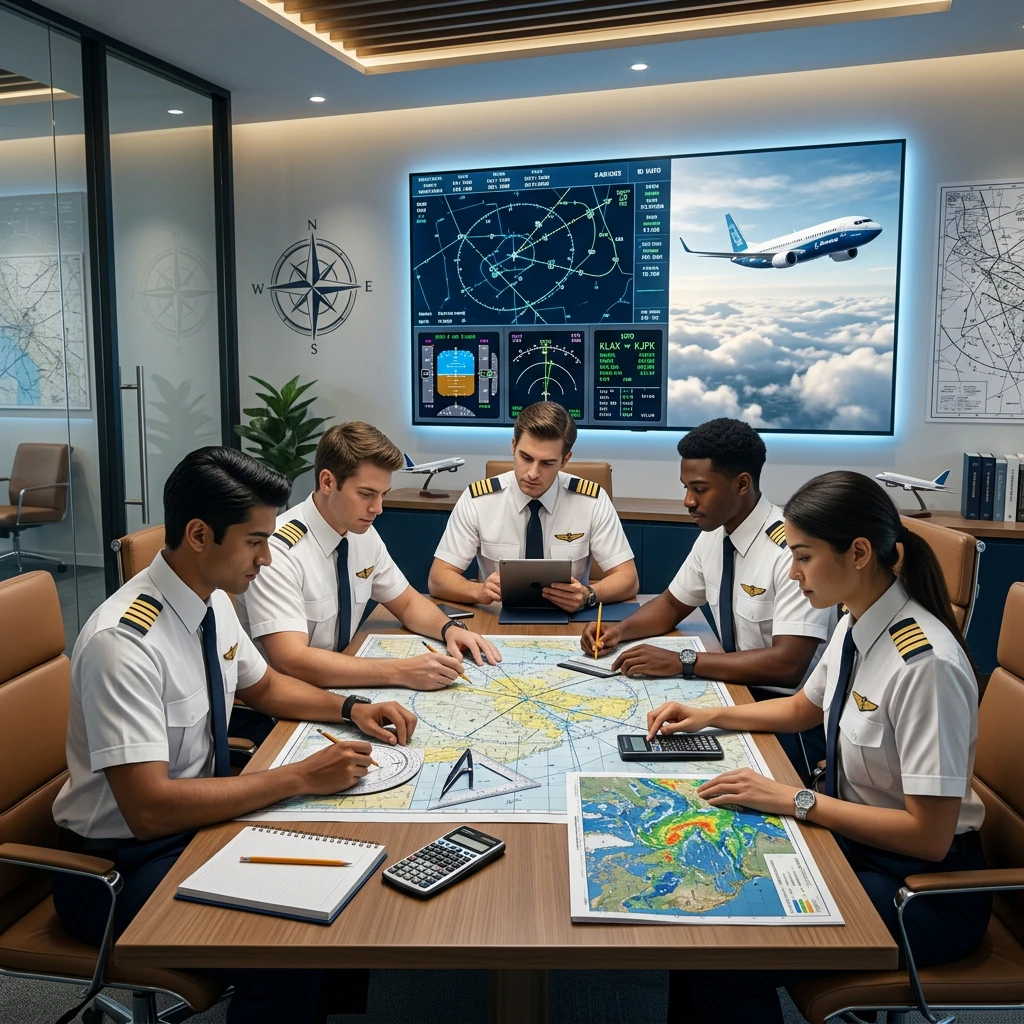
- Screen-to-Desk Plotting Verification: We do not simply project slides. Students display their actual chart work on camera, allowing instructors to verify Douglas protractor alignment, pencil lead thickness, and calculation accuracy on Dalton flight computers.
- Flexible Revision Validity: You enroll once and retain live access until you clear your papers. If your DGCA exam cycle is deferred, you can rejoin live revision batches without re-enrollment fees.
- Regulatory & Documentation Mentorship: Navigating the eGCA system, obtaining your Computer Number, and coordinating medical appointments can feel overwhelming. Our team guides you step-by-step through every administrative milestone.
Comparison: Chandigarh Physical Academies vs. The Pilot's Compass Live Online
| Training Parameter | Traditional Tricity Physical Academies | The Pilot's Compass Live Online |
|---|---|---|
| Cohort Size | 40 to 60 students per classroom | Strictly capped under 20 students |
| Instructor Pedigree | Junior civilian CPL holders or part-time tutors | Military veteran aviators (Navy & IAF QFIs) |
| Plotting Oversight | Board demonstrations with limited personal review | Individual camera-based chart inspection and correction |
| Daily Travel Overhead | 60–90 minutes lost to Madhya Marg / Tribune Chowk traffic | Zero commute; 100% of study time protected at home |
| Outstation Living Costs | ₹12,000–₹18,000/month for Tricity PGs and boarding | ₹0 additional living expenses; study from your hometown |
| Class Schedule | Rigid daytime slots conflicting with college hours | Evening live batches (7:30 PM–9:30 PM) tailored for college students |
| Exam Validity | Access typically expires after 3 to 4 months | Continuous live revision access until all subjects are passed |
Balancing College at PEC or Panjab University with Ground School
A significant portion of pilot aspirants in the Tricity are currently enrolled in undergraduate engineering, computer science, or general degree programs at Punjab Engineering College (PEC), Panjab University, Chandigarh University, or Thapar Institute of Engineering & Technology.
Taking an academic gap year solely to study for pilot theory papers is unnecessary. Our structured evening schedule (7:30 PM to 9:30 PM) lets you attend regular college classes by day, return home, and dedicate two focused hours to ground school. By the time you graduate with your university degree, you can have all five DGCA papers cleared, enabling an immediate transition to full-time flying training at an FTO.
Tricity Pilot Roadmap: From 10+2 to Flight Training in Punjab & Haryana
If you are beginning your pilot training journey from Chandigarh, follow this clear regulatory pathway:
- Verify Your 10+2 Qualifications: Confirm completion of 10+2 with Physics and Mathematics. If you did not take these subjects in school, register for them through the National Institute of Open Schooling (NIOS).
- Obtain Your DGCA Computer Number: Register on the eGCA portal, upload your board verification certificates, identity credentials, and address documentation, and obtain your permanent computer number.
- Undergo DGCA Class 2 Medicals: Book an initial medical exam with an empaneled DGCA Class 2 doctor in Chandigarh or Mohali. Once approved, the DGCA issues your Class 2 assessment letter.
- Schedule Your DGCA Class 1 Medical: Through eGCA, apply for an initial Class 1 appointment at a designated military centre. For Chandigarh residents, AFCME (Air Force Central Medical Establishment) in New Delhi is the most convenient facility, easily accessible via the Shatabdi Express.
- Complete Ground Training Before Flight School: Clear Air Navigation, Aviation Meteorology, and Air Regulations first. Arriving at Patiala Aviation Club, Pinjore, or an overseas flight school with ground theory already cleared ensures you fly uninterrupted without grounding for exam cycles.
For a comprehensive study methodology, review our guide on how to clear DGCA exams in your first attempt.
Explore Regional Ground School Guides & Resources
Preparing from another aviation hub or planning your complete training path? Explore our related guides:
- Best Online DGCA Ground Classes in India: Comprehensive Guide — Discover how our live virtual ground school operates nationwide.
- Best Online DGCA Ground Classes in Ahmedabad — Learn how Gujarat aspirants master hot-weather aerodynamics and density altitude.
- Best Online DGCA Ground Classes in Delhi — Guide for student pilots in Delhi-NCR preparing for airline careers.
- Best Online DGCA Ground Classes in Hyderabad — Deccan aviation hub guide for Telugu student pilots.
- Best DGCA Ground Classes in Bangalore (Flagship Academy) — Our in-person ground school near Jakkur Aerodrome.
- How Tier-2 Cities Are Fuelling India's Aviation Boom — Why non-metro students from Punjab & Haryana are leading commercial aviation hiring.
- Real Commercial Pilot License Cost in India — Complete financial budgeting breakdown from DGCA papers to flight training.
Ready to start your flying career? Explore our DGCA CPL Ground Classes or contact our team to speak directly with an active flight instructor.
Frequently Asked Questions
Map Your Custom Pilot Training Pathway
Evaluate your compliance across the 4 major DGCA training gates, select training country routes (India vs. USA/Europe), and estimate your CPL timeline month-by-month.