
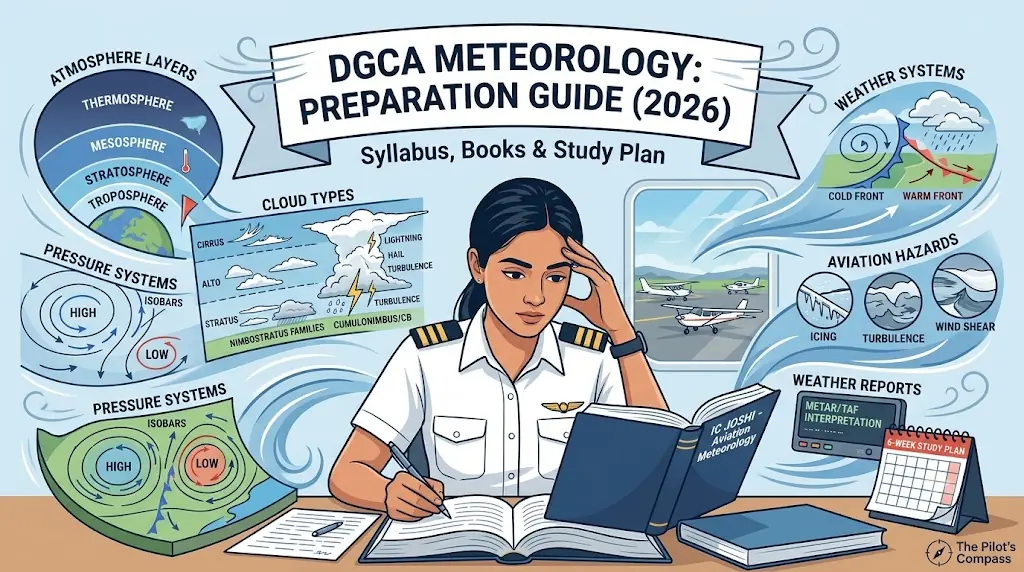
DGCA Meteorology Preparation Guide (2026): Syllabus, Books & Study Plan
Weather influences every flight.
Whether it's a clear summer morning, dense winter fog, powerful thunderstorms, or strong crosswinds during landing, pilots make important operational decisions based on meteorological conditions.
That's why DGCA Meteorology is one of the most important theory subjects in Commercial Pilot Licence (CPL) training.
Unlike subjects that focus on aircraft systems (Technical General) or aviation regulations (Air Regulations), Meteorology teaches you why weather behaves the way it does and how it affects flight safety.
Many students initially think Meteorology is a subject filled with definitions to memorize.
In reality, it's about understanding how the atmosphere works.
Once you understand the relationship between temperature, pressure, moisture, clouds, and winds, the subject becomes much easier and far more interesting.
The biggest mistake students make is trying to memorize cloud names or weather phenomena without understanding the science behind them.
This guide takes a different approach.
Instead of rote learning, you'll learn:
- The complete DGCA Meteorology syllabus.
- Which chapters deserve the most attention.
- The best order to study the subject.
- Recommended books and study resources.
- Practical preparation strategies.
- Common mistakes to avoid before the exam.
Before beginning your preparation, always review the latest Flight Crew syllabus and examination notifications published by the Directorate General of Civil Aviation (DGCA), as these define the official topics and examination requirements.
The short version:
DGCA Meteorology is a concept-driven subject that explains atmospheric processes and their impact on aviation. Students should build a strong foundation in atmospheric science before moving to winds, clouds, weather systems, and aviation weather. Regular revision using diagrams and weather charts is far more effective than memorizing isolated facts.
Key Takeaways
- Meteorology explains how weather affects aircraft operations.
- Understanding concepts is more valuable than memorizing definitions.
- Weather topics are interconnected and should be studied in sequence.
- Cloud formation, winds, and weather systems form the foundation of the syllabus.
- Aviation weather charts should be practiced regularly.
- Question banks are best used after completing the theory.
Quick Navigation
- What is DGCA Meteorology?
- Why Meteorology Is Important for Pilots
- DGCA Meteorology Syllabus
- Topic-by-Topic Explanation
- Best Books
- 6-Week Study Plan
- Mock Test Strategy
- Common Mistakes
- FAQs
What Is DGCA Meteorology?
DGCA Aviation Meteorology is the scientific study of the Earth's atmosphere, weather phenomena, and their direct impact on aviation operations. For commercial pilots in India, it is a mandatory CPL theory subject that tests a pilot's ability to interpret weather reports, understand atmospheric processes, and make safe operational decisions.
For pilots, it goes beyond predicting whether it will rain tomorrow.
Aviation Meteorology helps pilots understand:
- Why clouds form.
- How winds change.
- Why turbulence occurs.
- How thunderstorms develop.
- What creates fog and poor visibility.
- How weather influences aircraft performance.
- Which conditions are safe for flight.
Every flight begins with a weather briefing.
Pilots analyze meteorological reports and forecasts before departure to determine whether conditions are suitable for the planned route.
Understanding these weather principles is essential not only for passing the DGCA examination but also for making safe operational decisions throughout a flying career.
Why Is Meteorology Important for CPL Students?
Weather affects every phase of flight.
From take-off and climb to cruise, descent, and landing, atmospheric conditions influence aircraft performance and pilot decision-making.
Some examples include:
- Strong crosswinds affecting landings.
- Thunderstorms causing severe turbulence.
- Fog reducing runway visibility.
- Icing affecting aircraft performance.
- Wind altering flight time and fuel planning.
Unlike Air Navigation, Meteorology involves fewer mathematical calculations.
Instead, students are expected to understand weather processes and apply that knowledge to practical aviation scenarios.
That's why conceptual understanding is so important.
DGCA Meteorology Syllabus
The DGCA Meteorology syllabus introduces students to both general weather science and aviation-specific weather phenomena.
Below is a simplified overview of the major topics.
| Topic | What You'll Learn |
|---|---|
| Atmosphere | Structure, composition, atmospheric layers |
| Temperature | Heating, cooling, lapse rates, inversions |
| Atmospheric Pressure | Pressure systems, pressure measurement |
| Wind | Wind formation, Coriolis effect, local winds |
| Moisture | Humidity, condensation, dew point |
| Clouds | Cloud classification and formation |
| Precipitation | Rain, snow, hail, drizzle |
| Fog & Visibility | Types of fog and visibility reduction |
| Thunderstorms | Formation, hazards, lightning |
| Air Masses & Fronts | Weather systems and frontal activity |
| Turbulence & Icing | Aviation hazards |
| Aviation Weather Services | METAR, TAF, SIGMET basics |
Although this appears to be a large syllabus, most topics build naturally on one another.
Learning the subject in the correct order makes revision much easier.
DGCA Meteorology Learning Roadmap
Rather than studying random chapters, follow a logical sequence.
Atmosphere
      ↓
Temperature
      ↓
Pressure
      ↓
Wind
      ↓
Moisture
      ↓
Cloud Formation
      ↓
Precipitation
      ↓
Fog & Visibility
      ↓
Thunderstorms
      ↓
Air Masses & Fronts
      ↓
Turbulence & Icing
      ↓
Aviation Weather Reports
      ↓
Mock Tests
Each topic prepares you for the next.
For example, understanding moisture makes cloud formation easier, while cloud formation helps explain precipitation, thunderstorms, and fog.
Topic Difficulty Overview
Not every Meteorology chapter requires the same level of effort.
Based on feedback from CPL aspirants, here's a practical estimate.
| Topic | Difficulty | Concept Level |
|---|---|---|
| Atmosphere | ⭐⭐☆☆☆ | Easy |
| Temperature | ⭐⭐⭐☆☆ | Medium |
| Atmospheric Pressure | ⭐⭐⭐☆☆ | Medium |
| Wind | ⭐⭐⭐⭐☆ | Medium-High |
| Moisture | ⭐⭐⭐☆☆ | Medium |
| Clouds | ⭐⭐⭐☆☆ | Medium |
| Fog & Visibility | ⭐⭐⭐☆☆ | Medium |
| Thunderstorms | ⭐⭐⭐⭐☆ | High |
| Air Masses & Fronts | ⭐⭐⭐⭐☆ | High |
| Turbulence & Icing | ⭐⭐⭐⭐☆ | High |
| Aviation Weather Reports | ⭐⭐⭐☆☆ | Medium |
Study Tip: Weather is easier to remember when you understand why it happens. Instead of memorizing cloud names or fog types, focus on the atmospheric processes that create them. Diagrams, weather maps, and flowcharts are excellent revision tools.
Atmosphere Explained
Everything that happens in aviation weather begins with one thing:
The Earth's atmosphere.
The atmosphere is a layer of gases surrounding the Earth that protects life and creates the weather conditions pilots encounter every day.
Without the atmosphere, there would be:
- No clouds
- No wind
- No rain
- No thunderstorms
- No weather changes
Understanding how the atmosphere behaves forms the foundation of DGCA Meteorology.
Composition of the Atmosphere
The atmosphere consists primarily of:
- Nitrogen (approximately 78%)
- Oxygen (approximately 21%)
- Argon
- Carbon Dioxide
- Water Vapour
- Trace gases
Although water vapour makes up only a small percentage of the atmosphere, it plays the biggest role in weather formation.
Layers of the Atmosphere
Pilots should understand the characteristics of each atmospheric layer.
| Layer | Approx. Height | Importance in Aviation |
|---|---|---|
| Troposphere | 0–11 km | Almost all weather occurs here |
| Stratosphere | 11–50 km | Contains the ozone layer |
| Mesosphere | 50–85 km | Meteors burn here |
| Thermosphere | Above 85 km | High-energy solar radiation |
For DGCA examinations, the Troposphere receives the greatest attention because nearly all commercial flights and weather systems operate within or near this layer.
Difficulty
⭐⭐☆☆☆
Study Tip
Instead of memorizing layer names, understand what happens in each layer and why pilots care about it.
Temperature & Heat Transfer
Temperature affects almost every aspect of aviation weather.
It influences:
- Air density
- Pressure
- Wind formation
- Cloud development
- Aircraft performance
Understanding temperature changes helps explain many later Meteorology topics.
Topics Covered
- Solar Heating
- Terrestrial Radiation
- Conduction
- Convection
- Radiation
- Advection
- Environmental Lapse Rate
- Adiabatic Lapse Rate
- Temperature Inversion
One of the most important concepts is the lapse rate, which describes how temperature changes with altitude.
Pilots use this knowledge to understand cloud formation, atmospheric stability, turbulence, and aircraft performance.
Difficulty
⭐⭐⭐☆☆
Study Tip
Draw simple diagrams showing how warm air rises and cool air sinks.
Visualizing the process makes lapse rates much easier to understand.
Atmospheric Pressure
Air has weight.
The weight of the atmosphere creates atmospheric pressure, which changes continuously with altitude, temperature, and weather systems.
Pressure is one of the key drivers of weather.
Without pressure differences, wind would not exist.
Topics Covered
- Atmospheric Pressure
- Pressure Measurement
- Isobars
- High Pressure Systems
- Low Pressure Systems
- Pressure Gradient
- Standard Atmosphere
- Altimeter Settings (QNH, QFE, QNE)
Pressure systems influence:
- Wind direction
- Cloud formation
- Visibility
- Weather conditions
Pilots rely on accurate pressure information to ensure safe altitude indications during flight.
Difficulty
⭐⭐⭐☆☆
Study Tip
Remember the relationship:
- High Pressure → Generally stable weather
- Low Pressure → Increased cloud formation and unsettled weather
Understanding this concept makes many weather charts easier to interpret.
Wind Formation
Wind is simply moving air.
But why does air move?
Because differences in atmospheric pressure cause air to flow from regions of higher pressure toward regions of lower pressure.
The Earth's rotation then modifies this movement through the Coriolis Effect.
Understanding wind is essential because it directly affects:
- Take-off
- Landing
- Cruise performance
- Flight planning
- Fuel consumption
Topics Covered
- Pressure Gradient Force
- Coriolis Force
- Friction
- Geostrophic Wind
- Gradient Wind
- Local Winds
- Sea Breeze
- Land Breeze
- Mountain & Valley Winds
These concepts help explain why wind behaves differently at various altitudes and locations.
Difficulty
⭐⭐⭐⭐☆
Study Tip
Rather than memorizing every wind type separately, understand the forces that cause air to move.
Once you understand pressure and the Coriolis Effect, many wind concepts become much easier.
Moisture & Humidity
Water vapour is responsible for almost every visible weather phenomenon.
Without moisture, there would be:
- No clouds
- No fog
- No rain
- No thunderstorms
Understanding how moisture behaves is essential before studying cloud formation.
Topics Covered
- Water Vapour
- Humidity
- Relative Humidity
- Absolute Humidity
- Dew Point
- Saturation
- Condensation
- Evaporation
One of the most important concepts is the dew point, which indicates the temperature at which air becomes saturated and condensation begins.
Pilots use dew point information to assess the likelihood of fog, clouds, and icing.
Difficulty
⭐⭐⭐☆☆
Study Tip
Instead of memorizing humidity definitions, understand how temperature changes affect the amount of moisture air can hold.
Cloud Classification
Clouds are one of the most recognizable weather features.
For pilots, however, clouds provide much more than a visual indication of weather.
Different cloud types indicate:
- Atmospheric stability
- Turbulence
- Rainfall
- Thunderstorm potential
- Icing conditions
Recognizing cloud types helps pilots anticipate changing weather conditions during flight.
Main Cloud Families
| Cloud Family | Typical Altitude | General Characteristics |
|---|---|---|
| High Clouds | Above 20,000 ft | Thin, icy clouds |
| Middle Clouds | 6,500–20,000 ft | Mixed water droplets and ice crystals |
| Low Clouds | Surface–6,500 ft | Rain, fog, low ceilings |
| Clouds with Vertical Development | Multiple altitudes | Strong convection and thunderstorms |
You'll also learn common cloud names such as:
- Cirrus
- Cirrostratus
- Cirrocumulus
- Altostratus
- Altocumulus
- Stratus
- Stratocumulus
- Nimbostratus
- Cumulus
- Cumulonimbus
Among these, Cumulonimbus (CB) is especially important because it is associated with severe aviation hazards.
Difficulty
⭐⭐⭐☆☆
Study Tip
Learn clouds through pictures and classification charts rather than text alone.
Visual recognition is much more effective for long-term retention.
Precipitation
Clouds don't always produce precipitation.
Specific atmospheric conditions must exist before water droplets or ice crystals become heavy enough to fall to the Earth's surface.
Understanding precipitation helps pilots anticipate reduced visibility, runway contamination, and changing weather conditions.
Topics Covered
- Rain
- Drizzle
- Snow
- Sleet
- Hail
- Freezing Rain
- Formation Mechanisms
Each type of precipitation develops under different atmospheric conditions.
Knowing these differences helps pilots make safer operational decisions.
Difficulty
⭐⭐⭐☆☆
Study Tip
Instead of memorizing precipitation types individually, relate each one to the cloud and temperature conditions that produce it.
Fog & Visibility
Reduced visibility is one of the most common operational challenges in aviation.
Fog can delay flights, reduce runway visibility, and sometimes make take-offs or landings impossible.
Understanding how fog forms allows pilots to better interpret weather reports and forecasts.
Topics Covered
- Radiation Fog
- Advection Fog
- Upslope Fog
- Steam Fog
- Frontal Fog
- Mist
- Haze
- Visibility
Different types of fog form under different weather conditions.
DGCA examinations frequently test both their formation and operational significance.
Difficulty
⭐⭐⭐☆☆
Study Tip
Group fog types by how they form rather than trying to memorize their names independently.
Once you understand the mechanism, identifying each fog type becomes much easier.
Thunderstorms Explained
Among all weather phenomena, thunderstorms pose one of the greatest hazards to aviation.
A thunderstorm isn't simply heavy rain—it can produce:
- Severe turbulence
- Lightning
- Hail
- Wind shear
- Microbursts
- Heavy rainfall
- Reduced visibility
- Icing
For this reason, pilots are trained to avoid thunderstorms rather than attempt to fly through them.
How Thunderstorms Form
Three ingredients are necessary:
- Moisture
- Atmospheric instability
- A lifting mechanism
When these conditions exist together, warm moist air rises rapidly, forming towering Cumulonimbus (CB) clouds.
Stages of a Thunderstorm
| Stage | Characteristics |
|---|---|
| Cumulus Stage | Strong updrafts, cloud growth |
| Mature Stage | Heavy rain, lightning, turbulence, hail |
| Dissipating Stage | Downdrafts dominate, storm weakens |
The Mature Stage presents the greatest danger to aircraft because it combines powerful updrafts and downdrafts with severe weather.
Aviation Hazards
Thunderstorms can cause:
- Severe turbulence
- Wind shear
- Hail damage
- Lightning strikes
- Heavy precipitation
- Reduced visibility
- Microbursts
Modern aircraft are designed to withstand many weather conditions, but avoiding active thunderstorm cells remains the safest practice.
Difficulty
⭐⭐⭐⭐☆
Study Tip
Instead of memorizing the three stages, understand what happens inside the cloud during each stage.
This makes the entire chapter much easier to remember.
Air Masses & Fronts
Weather doesn't remain the same everywhere.
Large bodies of air with similar temperature and moisture characteristics are known as air masses.
When different air masses meet, they create fronts, which are responsible for significant weather changes.
Types of Air Masses
Students should understand:
- Continental Polar (cP)
- Maritime Polar (mP)
- Continental Tropical (cT)
- Maritime Tropical (mT)
- Arctic Air Masses
Each air mass has different characteristics depending on where it forms.
Types of Fronts
| Front | Typical Weather |
|---|---|
| Cold Front | Thunderstorms, heavy showers |
| Warm Front | Continuous rain, layered clouds |
| Stationary Front | Prolonged unsettled weather |
| Occluded Front | Complex weather systems |
Pilots use frontal weather forecasts to anticipate cloud cover, turbulence, visibility, and precipitation.
Difficulty
⭐⭐⭐⭐☆
Study Tip
Create a comparison table for each front instead of studying them separately.
This makes revision much faster before the exam.
Turbulence & Icing
Not every aviation hazard is visible.
Some of the most dangerous conditions occur in seemingly clear skies.
Understanding turbulence and icing helps pilots make informed operational decisions and avoid unnecessary risks.
Turbulence
Turbulence refers to irregular air movement that causes sudden changes in an aircraft's attitude or altitude.
Common Causes
- Convective activity
- Mountain waves
- Jet streams
- Thunderstorms
- Wind shear
- Frontal systems
- Mechanical turbulence
Icing
Aircraft icing occurs when supercooled water droplets freeze upon contact with the aircraft.
Ice accumulation can:
- Reduce lift
- Increase drag
- Affect aircraft control
- Increase stall speed
- Reduce engine performance
Understanding icing conditions is essential for safe flight planning.
Difficulty
⭐⭐⭐⭐☆
Study Tip
Instead of memorizing icing types, understand the atmospheric conditions under which icing is most likely to occur.
Aviation Weather Reports
Before every flight, pilots review weather information prepared by meteorological services.
DGCA Meteorology introduces students to the most commonly used aviation weather reports.
METAR
METAR provides the current weather observations for an airport.
Typical information includes:
- Wind
- Visibility
- Cloud cover
- Temperature
- Dew Point
- Pressure
- Weather conditions
TAF
TAF (Terminal Aerodrome Forecast) provides the forecast weather for an airport over a specified period.
Pilots use TAFs during flight planning to anticipate future weather changes.
SIGMET
SIGMET informs pilots about significant hazardous weather, including:
- Severe turbulence
- Severe icing
- Thunderstorms
- Volcanic ash
- Tropical cyclones
Understanding when each report is used is more important than memorizing every abbreviation.
Difficulty
⭐⭐⭐☆☆
Study Tip
Read real METAR and TAF reports during your preparation.
Regular exposure makes decoding aviation weather reports much easier.
Best Books for DGCA Meteorology
Using the right study resources saves time and improves conceptual understanding.
Rather than collecting multiple books, choose one primary reference and supplement it with question banks and class notes.
| Resource | Best For |
|---|---|
| IC Joshi – Aviation Meteorology | Core concepts |
| Oxford ATPL Meteorology | Detailed explanations |
| DGCA Question Bank | Practice & revision |
| Classroom Notes | Last-minute revision |
Students should complete the theory before relying heavily on MCQs.
6-Week Meteorology Study Plan
A structured schedule helps students revise consistently without feeling overwhelmed.
| Week | Goal |
|---|---|
| Week 1 | Atmosphere, Temperature & Pressure |
| Week 2 | Wind & Moisture |
| Week 3 | Clouds & Precipitation |
| Week 4 | Fog, Visibility & Thunderstorms |
| Week 5 | Air Masses, Fronts, Turbulence & Icing |
| Week 6 | METAR, TAF, SIGMET, Revision & Mock Tests |
Daily revision of diagrams and weather charts is just as important as reading theory.
Mock Test Strategy
Mock tests help transform theoretical understanding into exam readiness.
A recommended approach is:
| Stage | Practice Strategy |
|---|---|
| Week 1–2 | Chapter-wise MCQs |
| Week 3–4 | Mixed-topic quizzes |
| Week 5 | Weather chart interpretation |
| Week 6 | Full-length DGCA mock tests |
After every mock test:
- Review incorrect answers.
- Identify weak concepts.
- Revise related diagrams.
- Attempt similar questions again.
Improvement comes from analyzing mistakes—not simply taking more tests.
Common Mistakes Students Make
Many students lose marks because of ineffective study habits rather than difficult questions.
❌ Memorizing cloud names without understanding formation
Focus on the atmospheric process behind each cloud type.
❌ Ignoring diagrams
Weather concepts become much easier when studied visually.
❌ Studying chapters independently
Pressure, temperature, wind, and clouds are closely connected.
Understanding one topic makes the next easier.
❌ Leaving weather reports until the end
Practice reading METARs and TAFs throughout your preparation.
❌ Depending only on question banks
MCQs are valuable for revision, but conceptual understanding should always come first.
How The Pilot's Compass Teaches Meteorology
Weather is one of the most practical subjects in aviation.
At The Pilot's Compass, students are taught to understand weather logically rather than memorize isolated facts.
Under the guidance of Commander Naveen Pandita (Retd.), the course follows a structured progression from basic atmospheric science to aviation weather interpretation.
The learning journey typically follows this sequence:
Atmosphere
      ↓
Temperature
      ↓
Pressure
      ↓
Wind
      ↓
Moisture
      ↓
Cloud Formation
      ↓
Precipitation
      ↓
Fog & Visibility
      ↓
Thunderstorms
      ↓
Weather Reports
      ↓
Mock Tests
      ↓
DGCA Examination
Students also receive:
- Live online classes.
- Recorded lectures for revision.
- Topic-wise doubt-solving sessions.
- Weather chart discussions.
- Full-length mock examinations.
- Personalized preparation guidance.
The goal is to help students develop the ability to interpret aviation weather confidently, both for the DGCA examination and real-world flight operations.
Frequently Asked Questions
Is DGCA Meteorology difficult?
Meteorology is generally considered a moderate-difficulty subject. Students who understand atmospheric processes usually find it much easier than those who rely only on memorization.
Which book is best for DGCA Meteorology?
IC Joshi's Aviation Meteorology is one of the most popular books among DGCA aspirants. Oxford ATPL Meteorology is another excellent reference for detailed explanations.
How long does it take to prepare Meteorology?
Most students complete Meteorology preparation in 2–3 weeks, depending on their daily study schedule and revision plan.
Should I memorize cloud classifications?
No. Understanding how clouds form and the weather they indicate is far more effective than memorizing names alone.
Are METAR and TAF important for DGCA exams?
Yes. Students should understand the purpose of METAR, TAF, and SIGMET and learn how to interpret basic aviation weather reports.
Final Verdict
DGCA Meteorology is much more than a theory paper—it's a subject that helps pilots make safer decisions throughout every stage of flight.
Success in Meteorology comes from understanding the atmosphere as a connected system rather than a collection of unrelated chapters.
If you:
- Learn concepts before definitions,
- Practice using weather diagrams,
- Revise weather reports regularly,
- Solve chapter-wise MCQs,
- Take full-length mock tests,
you'll build the confidence needed to perform well in the DGCA examination and develop practical weather awareness for your aviation career.
Ready to Master DGCA Meteorology?
If you're preparing for your CPL theory exams, The Pilot's Compass provides structured Meteorology training through live online classes led by Commander Naveen Pandita (Retd.).
Students receive:
- Concept-based teaching.
- Visual weather explanations.
- Topic-wise revision.
- Mock tests.
- One-on-one doubt-solving.
- Complete DGCA exam preparation support.
Bonus: Book a counselling session.
Sources
Official References
Map Your Custom Pilot Training Pathway
Evaluate your compliance across the 4 major DGCA training gates, select training country routes (India vs. USA/Europe), and estimate your CPL timeline month-by-month.