
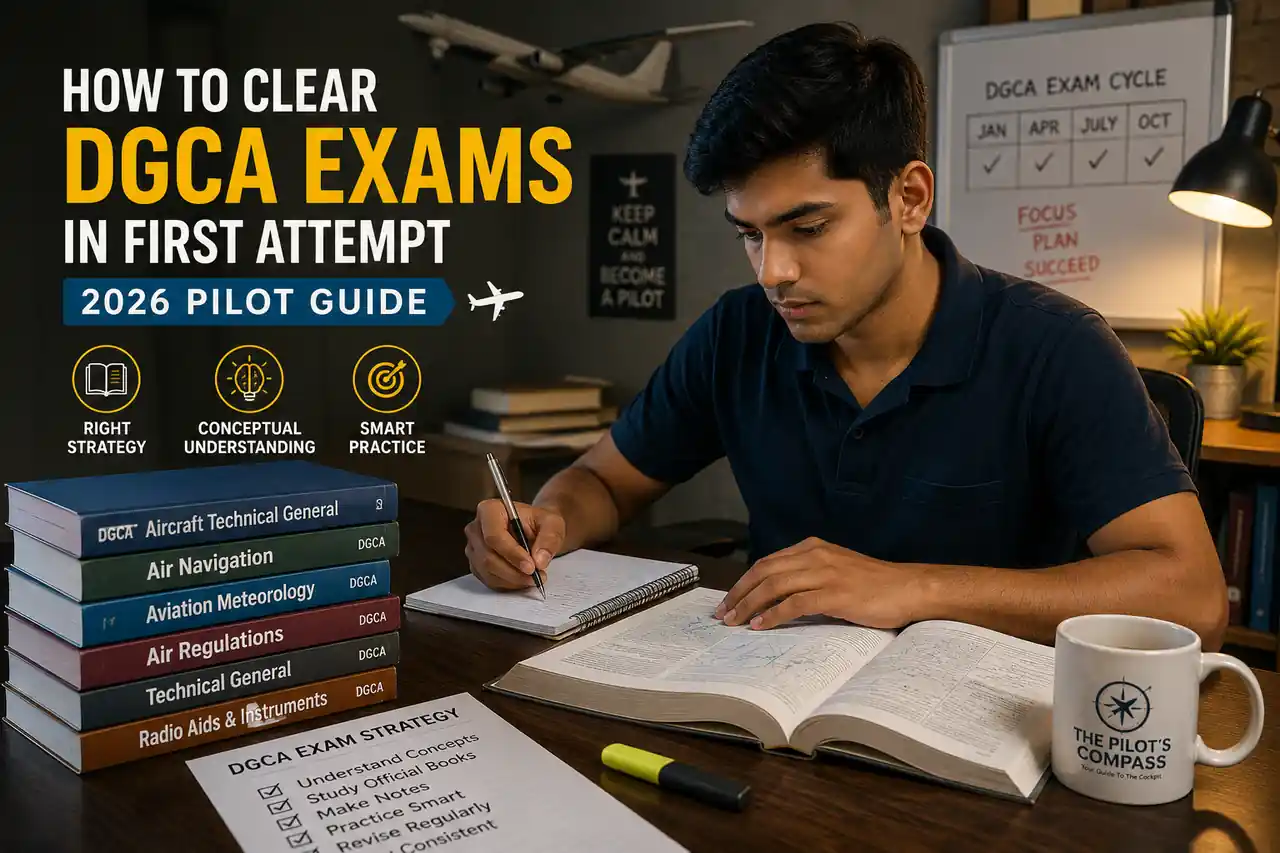
Preparing for the Directorate General of Civil Aviation (DGCA) flight crew theory examinations is one of the most demanding phases of pilot training in India.
Many student pilots begin their ground studies with high enthusiasm, only to face difficulties on calculation-intensive papers like Air Navigation or Aviation Meteorology. These hurdles arise not because the material is impossible to understand, but because candidates often study backwards—relying on outdated question banks instead of building a solid conceptual foundation from official reference books.
Failing a DGCA exam does not just hurt your morale; it stretches your flight training timeline and increases your overall expenses. Because official exams are conducted in cycles only four times a year, a single failed paper can delay your flight training by three to six months.
When you account for additional examination fees, extra ground school tuition, and the opportunity cost of delaying your airline entry, failing a single subject can cost upwards of ₹50,000 in direct and indirect expenses.
To clear these exams on your first try, you need a repeatable strategy. This guide outlines the exact framework, study sequences, and textbook recommendations used by successful candidates.
The short version
To clear DGCA exams in your first attempt, you must shift from raw memorisation of question banks to a structured 3-phase study model. Focus on primary reference textbooks first, maintain a daily revision schedule, and do not book your official exam slot until you are consistently scoring above 85% on timed mock tests.
Where Should I Start My DGCA Preparation?
To start preparing for DGCA exams, your very first step must be to download the latest Flight Crew syllabus from the official DGCA website. Do not open a textbook until you understand the exact scope of the examination.
Before planning your preparation, make sure you understand the baseline requirements:
- Exam registration: All candidates must register, apply, and book slots through the official DGCA Pariksha Portal.
- Passing requirements: The DGCA passing marks are fixed at 70% (70 out of 100 marks) for all licensing exams as detailed on the DGCA Pariksha Portal.
- Exam timeline: Examinations are conducted in regular quarterly sessions (four times a year) according to the published schedules on the DGCA Pariksha Portal.
- Results validity: Once passed, a theory exam paper remains valid for 5 years to complete your flying training and obtain your Commercial Pilot Licence (CPL), as detailed in DGCA CAR Section 7 Series B Part I.
Why Do 70% of Candidates Fail on Their First Try?
Many trainees treat DGCA exams like school or college tests where cramming the night before works. The DGCA exam database is vast, and questions are frequently updated to test practical airmanship rather than simple recall.
The three primary failure points are:
- Reliance on outdated question banks: Memorising answers from online PDFs or mobile apps from 2018 is a guaranteed way to fail. The exam database shifts constantly, and options are regularly scrambled or reworded to prevent memorisation.
- Poor subject sequencing: Attempting to clear all five subjects in one session without a clear plan leads to cognitive overload. Booking Air Navigation and Technical General in the same exam cycle without prior preparation frequently leads to failure across both.
- Weak reference material: Studying from secondary summary notes or commercial coaching booklets instead of the primary manuals recommended by the DGCA.
If you are unfamiliar with the layout of the exams, read our detailed guide on the DGCA Exam Pattern and DGCA Exam Syllabus before beginning.
The 3-Phase DGCA Exam Prep Framework
Successful candidates follow a structured preparation timeline divided into three distinct phases: Concept Sourcing, Mock Drilling, and Exam-Day Execution.
| Phase / Step | Core Action | Requirement for Next Stage | Next Stage |
|---|---|---|---|
| Phase 1: Concept Sourcing | Master primary reference textbooks and establish conceptual foundations | Ensure you can explain core concepts without references | Phase 2: Mock Drilling |
| Phase 2: Mock Drilling | Practice timed mock exams and review incorrect answers | Score above 85% on three consecutive timed mock tests | Phase 3: Exam-Day Execution |
| Phase 3: Exam-Day Execution | Execute strategic time management during the exam | Secure a passing mark of 70% or higher | Licence Ready |
Phase 1: Concept Sourcing (Weeks 1–6)
During the first six weeks of your preparation, do not look at a single multiple-choice question (MCQ). Your sole focus should be reading the primary textbooks to understand the core physics, regulations, and mathematics behind every concept.
If you do not understand the mechanics of a pressure altimeter, the layout of pressure systems, or the mathematics of a 1-in-60 calculation, you will struggle with the multi-step questions that appear in the actual exam.
- Action: Read one chapter at a time, draw the diagrams manually in a study journal, and write out your own summary notes.
- Check: Ensure you can explain the core concept of a chapter to a peer without referencing the book.
Phase 2: Mock Drilling (Weeks 7–10)
Once you have built a strong conceptual foundation, transition to timed mock tests. Use a reputable, updated online practice platform.
- Rule: Never memorise the answers. When you get a question wrong during a practice session, go back to your Phase 1 reference books, locate the topic, and identify the root cause of your error.
- Standard: Do not book your official DGCA exam slot unless you are scoring above 85% on three consecutive full-length mock tests under timed conditions.
Phase 3: Exam-Day Execution (Exam Week)
Managing your time and stress during the official test is critical. The DGCA exam consists of multiple-choice questions, and there is no negative marking.
- Tactic: Move through the paper in three distinct passes.
- Pass 1: Go through the entire paper and answer all direct, non-numerical questions that you know instantly.
- Pass 2: Work on the numerical questions you understand well but require basic calculations.
- Pass 3: Spend the remaining time on complex navigation and flight planning calculations.
Recommended Reference Textbooks
Using the right study material is half the battle. The table below lists the primary reference texts for the core CPL subjects:
| Subject | Primary Reference Text | Alternative / Support |
|---|---|---|
| Air Navigation | General Navigation (Oxford ATPL Series) | Air Navigation by Capt. H. Puri |
| Aviation Meteorology | Aviation Meteorology by IC Joshi | Oxford Aviation Meteorology |
| Air Regulations | DGCA CAR Section 7 (dgca.gov.in) | Air Regulations by RK Bali |
| Technical General | Aircraft General Knowledge (Oxford) | Manufacturer flight manuals |
If you are planning your book purchases, read our detailed comparison of the Best DGCA Books for CPL Exams to make sure you select the correct editions.
How to Sequentially Book Your Exam Papers
Attempting to clear all five exams in a single session is highly challenging and rarely necessary. A structured sequencing plan reduces stress and increases your first-attempt success rate.
Step 1: Start with Air Regulations and Aviation Meteorology
These two subjects are content-heavy but do not require complex mathematical calculations.
- Air Regulations involves learning aviation law, airspace classifications, licensing rules, and search-and-rescue procedures. For a deep dive into this subject, review our complete DGCA Air Regulations Guide.
- Aviation Meteorology requires understanding global and local weather systems, cloud formations, and interpreting METAR and TAF coding. For a detailed breakdown of the meteorology syllabus, see our DGCA Meteorology Guide.
Step 2: Book Technical General and Technical Specific
Once you have cleared the regulations and weather papers, focus on the technical systems of aircraft.
- Technical General covers flight instruments, aircraft structures, engines, and aerodynamics. Study this subject thoroughly using the guidelines in our DGCA Technical General Guide.
- Technical Specific focuses on the exact aircraft type you will fly during your flight training (such as the Cessna 172 or Diamond DA40).
Step 3: Tackle Air Navigation Last
Air Navigation is the most math-intensive paper. It requires using a flight computer (CX-3 or slide rule) to calculate wind triangles, drift, heading, and fuel burn. By saving this subject for last, you can dedicate your entire study focus to its calculations without distraction. Learn more about the syllabus in our DGCA Air Navigation Guide.
Preparing for the Radio Telephony Restricted (Aeronautical) License
In addition to the five core DGCA exams, commercial pilot candidates in India must obtain a Radio Telephony Restricted (Aeronautical) license, commonly known as RTR(A).
In a major regulatory change effective 1 December 2025, the Directorate General of Civil Aviation (DGCA) took over the entire administration, slot booking, and examination of RTR(A) certificates and licences from the Wireless Planning & Coordination (WPC) Wing of the Department of Telecommunications. Candidates must complete all registrations, slot bookings, and applications via the official eGCA Portal.
Critical WPC-to-DGCA Transition Timelines
- Licence acceptance window: Older RTR certificates or licences issued or renewed by the WPC Wing will be accepted for regulatory licensing and examination purposes only until 15 July 2026.
- Post-deadline requirements: After 15 July 2026, all candidates must hold a DGCA-issued certificate/licence or go through the new transition procedures.
The New Examination Format
The exam process is divided into two parts under eGCA rules:
- Part A (Written Exam): A computer-based Multiple Choice Question (MCQ) examination conducted via the Pariksha portal. It requires a minimum passing score of 70% and is valid for 3 years.
- Part B (Practical Assessment): A simulated radio-telephony environment test where candidates are assessed on six real-world flight scenarios (clearances, flight plans, weather, and emergencies), requiring a passing mark of 50%.
Because the RTR(A) license is mandatory to operate aircraft flight deck radios in India, prepare for it alongside your Air Regulations and Air Navigation studies, as the airspace and procedural concepts overlap significantly. For a step-by-step prep strategy, refer to our DGCA RTR Exam Guide.
Conclusion & Stated Methodology
This guide is an editorial assessment compiled by The Pilot's Compass ground school review team. Our recommendations are based on a study of DGCA syllabus requirements, verified exam calendars, and published guidance from chief flight instructors. Exam fee structures, transition timelines, and licensing validity schedules are verified against official DGCA public notifications and eGCA circulars as of August 2026. For complete methodological transparency regarding our database reviews and study stats, see the Pilot's Compass Methodology.
If you are preparing for your flight crew papers, start by mapping out your study schedule. For comprehensive guidance on flight training steps and ground classes, read our detailed guide on DGCA Ground Classes, explore our nationwide Online DGCA Ground Classes in India, or read our regional guides for Ahmedabad, Chandigarh, Delhi, and Hyderabad.
Frequently Asked Questions
Map Your Custom Pilot Training Pathway
Evaluate your compliance across the 4 major DGCA training gates, select training country routes (India vs. USA/Europe), and estimate your CPL timeline month-by-month.