
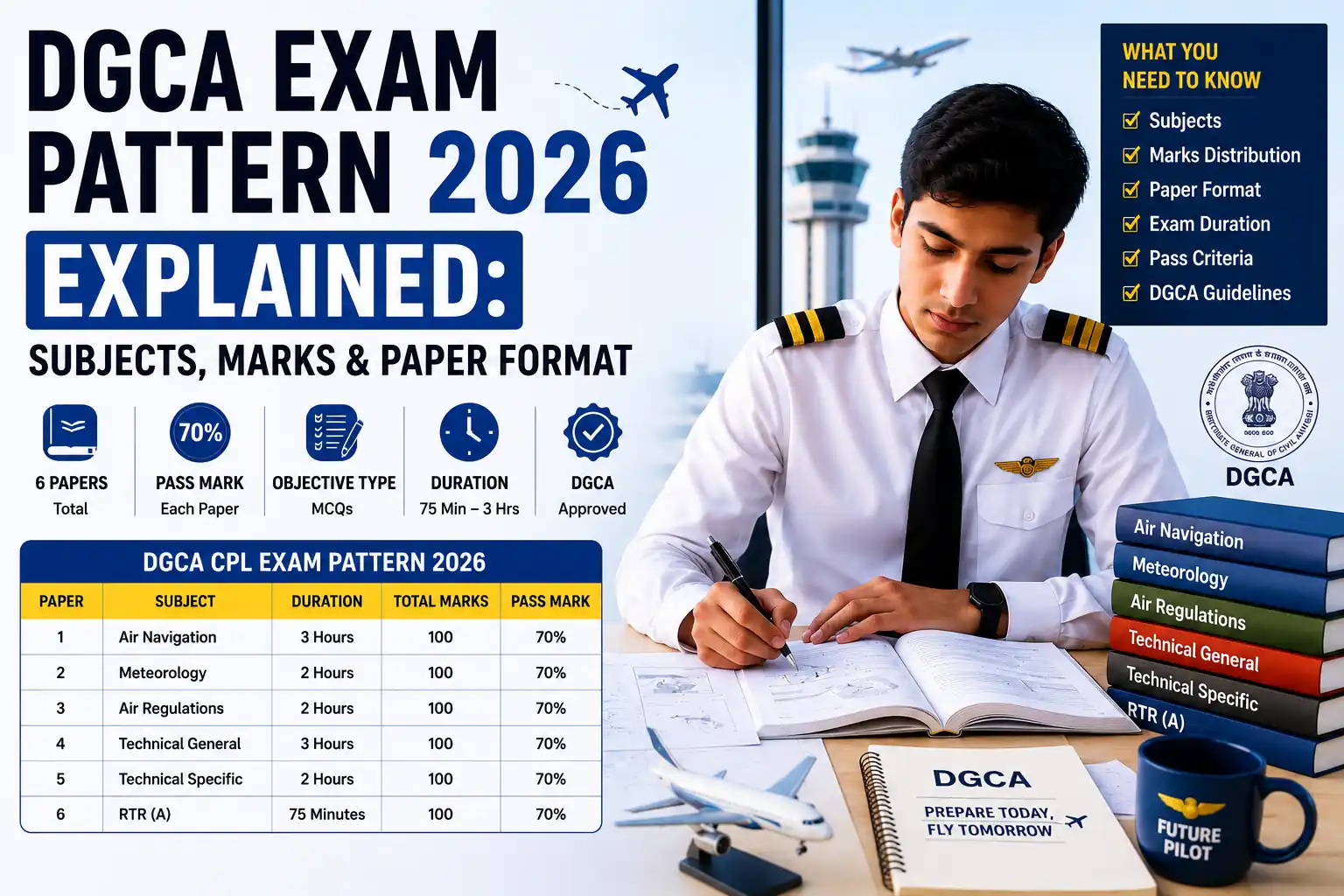
Every aspiring commercial pilot eventually reaches the same stage.
You've chosen a flying school, understand the DGCA CPL Requirements, and now everyone starts talking about "clearing DGCA papers."
But what exactly are these papers?
How many subjects are there? Are they difficult? Is there negative marking? How many marks do you need to pass? And what does the actual exam look like?
These questions confuse almost every student because information is scattered across YouTube videos, coaching institutes, and discussion forums.
This guide brings everything together using the latest DGCA examination framework and official guidance so you know exactly what to expect before registering for your first paper.
The short version: DGCA CPL theory exams are computer-based multiple-choice examinations conducted through the DGCA Pariksha portal. Candidates must pass each subject individually with at least 70% marks. There is currently no negative marking, and passed subjects remain valid for five years for CPL licensing.
Key Takeaways
- DGCA theory examinations are conducted online through the DGCA Pariksha system.
- The exams follow a multiple-choice question (MCQ) format.
- Every subject must be cleared separately.
- The minimum passing score is 70% in each paper.
- There is currently no negative marking.
- Subject passes generally remain valid for five years for CPL licence requirements.
Quick Navigation
- Methodology and Data Sources
- What is the DGCA exam?
- DGCA exam pattern
- The Five Things Every Student Should Know Before Attempting DGCA Exams
- DGCA exam subjects
- Exam mode and question format
- Passing marks and validity
- Regulatory Milestones and Exam Strategy
- Common mistakes students make
- Frequently asked questions
Methodology and Data Sources
The exam parameters and procedures presented in this guide are compiled from official civil aviation publications. This information is derived from:
- The Directorate General of Civil Aviation (DGCA) Civil Aviation Requirements (CAR).
- The official DGCA Pariksha Portal and examination notices.
- Directives and policy publications from the Ministry of Civil Aviation, Government of India.
- International standards under ICAO Annex 1 (Personnel Licensing).
- Official DGCA circulars, notifications, and examination instructions.
While this guide aggregates these guidelines for clarity, exam procedures, fees, center lists, and registration timelines may change through future DGCA notifications. Candidates should always verify the latest schedules and announcements directly on the official DGCA Pariksha portal before applying. No proprietary or first-party survey data was used to compile this information.
What Is the DGCA Exam?
The DGCA examination is the theory assessment that commercial pilot trainees must pass before they can obtain a Commercial Pilot Licence (CPL) in India.
These examinations are conducted by the Central Examination Organisation (CEO) under the Directorate General of Civil Aviation (DGCA) through the official DGCA Pariksha portal. Rather than testing flying skills, the exams measure your understanding of aviation regulations, aircraft systems, navigation, meteorology, and operational procedures required for safe flight operations.
Think of them as the academic foundation of pilot training.
Even the most skilled pilot cannot receive a CPL without successfully clearing the required theory papers and meeting the basic CPL Eligibility rules.
DGCA Exam Pattern at a Glance
Before opening your first textbook, it's useful to understand how the examinations are structured.
The overall pattern remains straightforward, but every paper has to be passed individually.
| Particular | Details |
|---|---|
| Conducting Authority | Directorate General of Civil Aviation (DGCA) |
| Exam Portal | DGCA Pariksha |
| Mode of Examination | Computer-Based Test (CBT) |
| Question Type | Multiple Choice Questions (MCQs) |
| Passing Marks | 70% in each subject |
| Negative Marking | No |
| Language | English |
| Subject Validity | Generally 5 Years |
| Purpose | Commercial Pilot Licence (CPL) Theory Requirements |
Unlike many competitive entrance examinations, DGCA papers don't rank candidates against one another.
Your objective is simply to meet or exceed the required passing standard in every subject.
That changes how you should prepare.
Scoring 95% in one paper doesn't compensate for scoring 68% in another. Each subject stands on its own and must be cleared independently.
The Five Things Every Student Should Know Before Attempting DGCA Exams
To navigate the licensing process successfully, candidates must understand how the regulatory system operates. These five core factors define the framework of the theory papers:
| Factor | Why It Matters |
|---|---|
| 1. Subject Selection | Candidates must choose which papers to sit for depending on their training pathway (e.g., domestic training vs. foreign CPL conversion, which requires specific conversion exams). |
| 2. Passing Criteria | The strict 70% passing threshold applies to each subject individually, meaning high marks in one paper cannot offset a failing score in another. |
| 3. Validity | A passed theory paper is generally valid for five years. This requires matching your exam schedule with your actual flying training timeline to avoid results expiring. |
| 4. Registration | Roll number generation and exam booking are strictly controlled through the DGCA Pariksha portal, requiring careful submission of educational and medical documentation. |
| 5. Preparation Strategy | Rote learning of past question banks is insufficient. The computer-based test format requires strong conceptual understanding of navigation math, meteorology patterns, and regulatory clauses. |
What Are the DGCA Exam Subjects?
Students often hear that there are "five DGCA papers."
That's broadly correct for the CPL theory stage, although one additional examination—RTR(A)—is now administered directly by the DGCA (previously conducted by the WPC Wing) as part of the licensing process.
The core DGCA theory subjects are:
| Subject | What You'll Study |
|---|---|
| Air Regulations | Aviation law, CAR, ICAO regulations, licensing rules, operational procedures |
| Air Navigation | Navigation principles, charts, flight planning, radio navigation, calculations |
| Aviation Meteorology | Weather systems, forecasts, clouds, winds, aviation weather interpretation |
| Technical General | Aircraft systems, engines, aerodynamics, instrumentation, performance |
| Technical Specific | Aircraft-specific technical knowledge based on your training aircraft |
Each paper focuses on a different aspect of professional aviation.
Together, they build the theoretical knowledge expected from a commercial pilot before progressing to licence issuance. The exact syllabus for each subject is prescribed by DGCA and may be updated through Civil Aviation Requirements or examination notifications. For a detailed breakdown of what each subject covers, you can check our comprehensive DGCA Exam Syllabus guide.
How Does the DGCA Exam Actually Work?
One question I hear repeatedly from students is whether the exam feels like a typical board examination.
It doesn't.
DGCA theory papers are conducted as computer-based examinations, where candidates answer multiple-choice questions on a computer at an approved examination centre. Instead of writing long descriptive answers, you'll select the correct option for each question.
That doesn't necessarily make the papers easy.
Many questions test whether you can apply aviation concepts rather than simply memorise definitions. Subjects such as Air Navigation require calculations, while Air Regulations expects you to understand the intent behind aviation rules instead of recalling isolated facts.
The lack of negative marking encourages candidates to attempt every question, but relying on guesswork rarely works because the passing requirement is relatively high at 70%.
DGCA Passing Marks and Result Criteria
One of the biggest misconceptions about DGCA theory exams is that your overall average matters.
It doesn't.
Every paper is evaluated independently, and you must pass each subject separately. Scoring exceptionally well in one paper cannot compensate for failing another.
Here's what you need to know.
| Criteria | Requirement |
|---|---|
| Minimum Passing Marks | 70% in each subject |
| Overall Aggregate | Not Applicable |
| Grace Marks | Not Provided |
| Subject-wise Passing | Mandatory |
For example:
| Subject | Marks |
|---|---|
| Air Navigation | 82% ✅ |
| Meteorology | 75% ✅ |
| Air Regulations | 69% ❌ |
| Technical General | 91% ✅ |
| Technical Specific | 88% ✅ |
Even though the overall average is well above 70%, the candidate still has to reappear for Air Regulations because every subject must individually meet the passing requirement.
Is There Negative Marking in DGCA Exams?
No.
At present, DGCA CPL theory examinations do not have negative marking. Every correct answer adds to your score, and incorrect answers do not reduce your marks.
That doesn't mean you should guess randomly.
Many questions contain closely related answer choices that test whether you actually understand aviation concepts rather than simply recognising familiar terms.
Since unanswered questions also earn zero marks, most instructors recommend attempting every question after eliminating the options you know are incorrect.
How Long Is Each DGCA Paper?
The exact duration varies slightly between subjects, but most CPL theory papers are completed within 2 to 3 hours, depending on the examination. The number of questions also varies by subject.
Here's a general overview.
| Feature | Typical Pattern |
|---|---|
| Mode | Computer-Based Test (CBT) |
| Question Type | Multiple Choice Questions (MCQs) |
| Duration | Around 2–3 Hours |
| Questions | Subject dependent |
| Calculator | As permitted under DGCA examination instructions |
Rather than memorising exact question counts, focus on understanding concepts. DGCA may update examination formats or question distribution without changing the syllabus itself. Official notifications published through the DGCA Pariksha portal should always take priority.
How Long Are DGCA Exam Results Valid?
Passing a DGCA paper doesn't mean you need to apply for your CPL immediately.
The theory passes remain valid for a defined period, giving students time to complete flying training, accumulate the required flight hours, and finish the remaining licensing requirements.
For CPL applicants, a passed DGCA theory subject is generally valid for five years from the applicable date under DGCA regulations.
This flexibility is especially useful for students who:
- Complete theory before beginning flight training.
- Train overseas and later convert their licence in India.
- Need additional time to complete flight-hour requirements.
- Experience delays due to medical, financial, or operational reasons.
Although five years sounds generous, it's still wise to complete your CPL training within that period rather than leaving large gaps between theory and flying.
How Often Does DGCA Conduct Exams?
DGCA theory examinations are conducted through scheduled examination sessions announced on the official DGCA Pariksha portal.
Registration windows, examination dates, and result announcements are published online, and candidates must apply within the specified timelines.
Instead of relying on coaching institutes or social media announcements, always verify:
- Examination schedule
- Registration dates
- Admit card availability
- Examination centre details
- Result notifications
directly through the official DGCA Pariksha portal.
Official notices are the only source that should guide your planning.
Where Does RTR(A) Fit Into the DGCA Exam Pattern?
Many students assume RTR(A) is one of the five DGCA theory papers.
Not exactly.
The Restricted Radio Telephone Operator's Licence (Aeronautical)—commonly called RTR(A)—is a separate licensing requirement for commercial pilots. Historically, it has been administered separately from the core DGCA theory examinations, even though it remains mandatory for CPL issuance.
RTR(A) evaluates your ability to:
- Communicate using standard aviation phraseology.
- Understand radio procedures.
- Handle practical RT communication.
- Demonstrate knowledge of radio regulations.
Because it follows a different examination process, students should prepare for RTR(A) separately rather than treating it as another DGCA theory paper.
When Should You Attempt the DGCA Papers?
There's no single approach that works for everyone.
Some students prefer clearing all theory papers before beginning flight training. Others complete subjects alongside flying.
Both approaches can work.
In my experience, students who finish most of their theory early often find flight training less stressful because they can concentrate on flying rather than switching constantly between cockpit lessons and theory preparation. Some students prefer clearing all theory papers before beginning flight training to accelerate their How to Become a Pilot journey.
That said, everyone's circumstances are different.
If you're already enrolled in a flying school with an integrated academic schedule, following the school's examination plan may be the more practical option.
The important point isn't when you write the papers.
It's making sure you understand the concepts well enough to pass each subject confidently rather than relying on repeated attempts.
Regulatory Milestones and Exam Strategy
How Long Does It Take to Clear All DGCA Papers?
The timeline varies widely based on individual study habits, preparation consistency, and the number of subjects attempted per session. While some candidates clear all five papers in 6 to 12 months, others may take longer depending on their training schedules and exam frequency.
Can You Prepare Without Joining a Ground School?
Yes, self-study is entirely possible if a candidate is disciplined and utilizes standard aviation textbooks. However, many students opt for structured coaching or ground schools to simplify complex topics like navigation calculations and meteorology charts.
Should You Complete DGCA Exams Before Flight Training?
Clearing theory papers before beginning flight training is highly recommended. It allows you to focus exclusively on cockpit operations and flying hours without the added pressure of preparing for regulatory exams during flight training.
Which DGCA Paper Is Usually Considered the Hardest?
Most student pilots consider Air Navigation the most challenging paper due to its emphasis on mathematical calculations, flight planning computer (CX-3/E6B) usage, and chart plotting. Technical General is also considered difficult because of the extensive systems knowledge required.
How Many Attempts Are Allowed?
Currently, there is no regulatory limit on the number of attempts allowed to clear the DGCA theory papers. Candidates can keep appearing in subsequent examination sessions until they pass, provided their registration remains active and valid.
Common Mistakes Students Make Before the DGCA Exams
Most students don't fail DGCA theory papers because the syllabus is impossible.
They struggle because they underestimate how the questions are framed.
Here are the mistakes instructors see repeatedly.
Treating the syllabus like a board examination
Memorising definitions isn't enough.
DGCA questions often test whether you understand why a regulation exists or how an aviation concept applies during flight operations. Subjects such as Air Navigation and Meteorology reward conceptual understanding much more than rote learning.
Ignoring Air Regulations
Many students spend weeks solving navigation calculations while leaving Air Regulations until the last minute.
That's risky.
Although the syllabus appears smaller, Air Regulations contains numerous Civil Aviation Requirements (CARs), licensing rules, operational procedures, and ICAO concepts that require careful reading.
Studying only previous question papers
Previous papers are helpful.
They aren't the syllabus.
DGCA regularly updates questions, and relying entirely on memory-based question banks leaves gaps in understanding. Use previous papers to identify important topics, but always study the official syllabus first.
Waiting until flight training is complete
Some students postpone every theory paper until after finishing flight training.
That can create unnecessary pressure because you'll need to revise multiple technical subjects together while also preparing for licence applications and airline recruitment.
If your schedule allows, spreading theory preparation across your training usually feels more manageable.
Not checking official notifications
Exam dates, registration windows, and procedural updates are announced through the DGCA Pariksha portal.
Depending only on WhatsApp groups or social media can result in missed deadlines.
Always verify important announcements using official DGCA notifications.
Typical DGCA Examination Timeline
The exact sequence varies slightly between flying schools, but most CPL students follow a similar path.
| Stage | What Happens |
|---|---|
| Step 1 | Register on the DGCA Pariksha portal |
| Step 2 | Complete eligibility requirements and document verification |
| Step 3 | Apply for the desired examination session |
| Step 4 | Download the admit card |
| Step 5 | Appear for the computer-based examination |
| Step 6 | Check results through the DGCA portal |
| Step 7 | Clear remaining theory subjects |
| Step 8 | Complete flying training and other CPL requirements |
| Step 9 | Apply for CPL issue after meeting all DGCA requirements |
The theory examinations are only one part of becoming a commercial pilot.
You'll also need to satisfy flying hour requirements, medical standards, RTR(A), English language proficiency requirements, and other licensing conditions prescribed by DGCA.
Common Myths vs Reality
Myth 1: DGCA exams are entrance examinations.
They aren't.
DGCA theory papers are licensing examinations, not entrance tests. You're demonstrating that you've achieved the required theoretical knowledge for commercial pilot training.
Myth 2: Passing one paper means you've cleared the DGCA exam.
No.
Every required subject must be passed individually before meeting the CPL theory requirement.
Myth 3: There is negative marking.
At present, there isn't.
Candidates are not penalised for incorrect answers, although accurate preparation remains essential because the passing requirement is relatively high.
Myth 4: You only need previous year papers.
Previous papers help you understand question styles, but they shouldn't replace the official syllabus or DGCA publications.
Myth 5: DGCA papers are impossible to clear.
Thousands of students clear these examinations every year.
Most successful candidates follow a structured study plan, practise calculations regularly, and understand concepts instead of memorising isolated facts.
Continue Exploring
If you're preparing for your CPL, these guides may help next:
- DGCA CPL Requirements
- DGCA Exam Syllabus Explained
- RTR(A) Exam Guide
- How to Become a Commercial Pilot in India
- CPL Eligibility After 12th
- Best DGCA Ground Schools in India
References
Official Sources
- Directorate General of Civil Aviation (DGCA)
- Ministry of Civil Aviation, Government of India
- International Civil Aviation Organization (ICAO)
Reference Material
- DGCA Examination Circulars and Notices
- DGCA Approved FTO Guidance Material
- DGCA Examination Instructions
Final Thoughts
Understanding the DGCA exam pattern before you begin studying gives you a significant advantage.
Instead of worrying about rumours or conflicting advice, focus on the official examination process. Learn the syllabus, understand each subject, practise consistently, and monitor updates through the DGCA Pariksha portal.
The goal isn't simply to pass a theory paper.
It's to build the knowledge you'll rely on throughout your career as a commercial pilot.
Frequently Asked Questions
Map Your Custom Pilot Training Pathway
Evaluate your compliance across the 4 major DGCA training gates, select training country routes (India vs. USA/Europe), and estimate your CPL timeline month-by-month.