Introduction
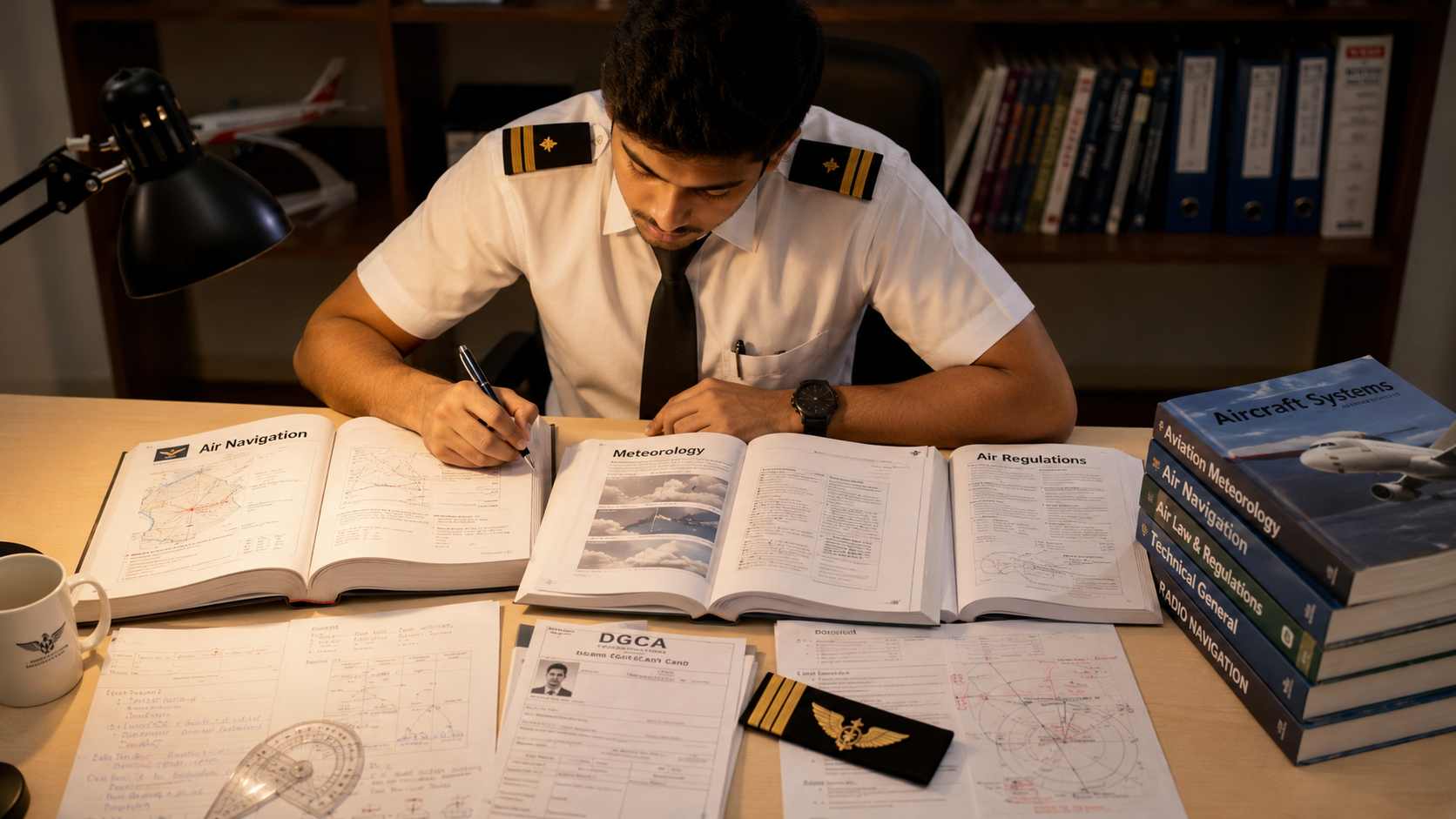
Six written papers. 70% in each, no exceptions. These are the DGCA CPL ground exams standing between you and a commercial pilot license in India.
Students routinely underestimate the written exams — they treat them as something to clear between simulator sessions. That's a mistake. Air Navigation alone covers topics that take serious study time. The regulations paper references documents most students have never opened.
This is the complete subject-wise breakdown for 2026, including what each paper actually tests, how DGCA structures the questions, and where most students lose marks.
The short version: DGCA CPL requires passing six written papers — Air Navigation, Meteorology, Air Regulations, Technical General, Technical Specific, and RTR — with 70% in each. No averaging. Total realistic prep time is 290–420 hours spread across your flight training.
🎯 Check Your Exam Readiness: Wondering if you need structured DGCA ground classes or want to see what the exams actually look like? Take our Free Pilot Test to evaluate your baseline knowledge instantly.
Key Takeaways
- 6 papers total: Air Navigation, Meteorology, Air Regulations, Technical General, Technical Specific, and RTR
- Passing mark: 70% in each paper individually — no averaging
- Validity: 5 years from passing your first paper to completing all six
- Governing document: CAR Section 7, Series B, Part I (available on dgca.gov.in)
- Sequence matters: Most successful students tackle Air Navigation first — it's the heaviest paper and sets the foundation for others
Quick Navigation
- DGCA CPL Exam Overview
- Paper 1: Air Navigation
- Paper 2: Meteorology
- Paper 3: Air Regulations
- Paper 4: Technical General
- Paper 5: Technical Specific
- Paper 6: RTR (Radio Telephony)
- Subject-wise difficulty and marks breakdown
- How to sequence your preparation
- Common myths vs. reality and FAQ
DGCA CPL Ground Exam Overview
The CPL written exams are conducted by DGCA under CAR Section 7, Series B, Part I. All six papers are objective-type (multiple choice) with occasional calculation-based questions, particularly in Air Navigation.
You register for exams through the DGCA CAS (Civil Aviation Security) portal. Exams are held at designated examination centres across India.
Who can appear: Students enrolled at a DGCA-approved flying training organisation (FTO), or individuals who have completed their flying hours at approved schools abroad. You don't need to finish flying hours before attempting written exams — most students take papers during their flight training.
| Paper | Subject | Duration | Total Marks | Pass Mark |
|---|---|---|---|---|
| 1 | Air Navigation | 180 min (3 hrs) | 100 | 70 |
| 2 | Meteorology | 120 min (2 hrs) | 100 | 70 |
| 3 | Air Regulations | 120 min (2 hrs) | 100 | 70 |
| 4 | Technical General | 180 min (3 hrs) | 100 | 70 |
| 5 | Technical Specific | 120 min (2 hrs) | 100 | 70 |
| 6 | RTR (Radio Telephony) | CBT (Part 1) + Practical (Part 2) | ~50 Qs | 70% |
Paper 1: Air Navigation
Air Navigation is the longest and, for most students, the hardest paper. Expect calculation-heavy questions — you can't memorise your way through this one.
Earth and great circles
Shape of the earth, great circles vs. rhumb lines, convergency, conversion angle.
Charts and projections
Lambert conformal, Mercator, polar stereographic. DGCA tests your ability to identify which projection to use and read chart properties.
Magnetism and compasses
Variation, deviation, compass errors (acceleration/turning errors), magnetic dip.
Dead reckoning navigation
Track, heading, wind correction angle, ground speed calculations using the navigation computer (whiz wheel).
Radio navigation
VOR, DME, ADF/NDB bearings, ILS components, GNSS/GPS basics.
Time and flight planning
UTC, local mean time, standard time, date line, sunrise/sunset calculations. Point of equal time (PET), point of no return (PNR), fuel calculations, alternates.
Radar and flight plans
Primary vs. secondary radar, transponder codes (SSR). Reading and completing a standard ICAO flight plan form.
The calculation questions require a navigation computer. DGCA allows mechanical whiz wheels in the exam hall. Practice with it until the calculations are automatic — time pressure is real in this paper.
Paper 2: Meteorology
Meteorology tests your understanding of the atmosphere and how weather affects flight. Roughly 60% theory, 40% application.
Topics covered: the ICAO standard atmosphere, temperature lapse rate, ISA deviations; pressure (QNH, QFE, QNE, density altitude, altimeter errors); dewpoint and air mass stability; surface vs. upper winds, jet streams, wind shear, mountain waves; cloud types and cumulonimbus development; precipitation hazards; thunderstorm cell structure and embedded CB detection; icing types (clear, rime, mixed), carburettor icing, anti-icing vs. de-icing; radiation fog, advection fog, sea fog; warm, cold, and occluded fronts. METARs and TAFs are tested directly — you decode them in the exam.
One honest note: DGCA meteorology questions sometimes come from older editions of textbooks that use slightly different terminology than current ICAO standards. Cross-reference with Jeppesen or Oxford Aviation Academy manuals, not just one source.
Paper 3: Air Regulations
The regulations paper is entirely reference-based. Nothing in this paper requires calculation — but it requires reading the actual documents, not summaries.
ICAO Annexes
Annex 1 (Personnel Licensing), Annex 2 (Rules of the Air), Annex 6 (Operation of Aircraft), Annex 11 (Air Traffic Services). Questions pull directly from annex text — paraphrased versions in study guides sometimes get the detail wrong.
Rules of the air
Right of way (powered vs. unpowered aircraft), collision avoidance, lights required at night, hemispherical cruising altitudes.
CAR — Civil Aviation Requirements
DGCA's own regulations. CAR Section 7 covers pilot licensing: medical standards, log book requirements, licence validity, recent experience currency.
Air traffic services and airspace
ATC service types, airspace classification A through G, controlled vs. uncontrolled airspace, NOTAM reading, AIP India structure (GEN, ENR, AD sections).
Other tested areas
AAIB India accident investigation and reporting procedures; IATA dangerous goods classification and pilot responsibilities; flight crew licensing medical classes.
Most students fail this paper by relying on summaries. The actual DGCA questions reference specific CAR paragraphs. Read the source documents. The DGCA website publishes all CARs under Publications → Civil Aviation Requirements.
Paper 4: Technical General
Technical General covers principles that apply across aircraft types — not specific to any single aircraft you'll fly.
Topics covered: piston engine principles (four-stroke cycle, carburetion, fuel injection, ignition); turbine engine basics (jet, turboprop, turbofan) at introductory CPL level; hydraulics, pneumatics, landing gear and braking systems; fuel types (AVGAS vs. Jet-A), contamination and management; DC and AC electrical systems, alternators, circuit protection; pitot-static instruments (ASI, altimeter, VSI) and their errors; gyroscopic instruments (AI, DI, turn coordinator) and their errors; fixed vs. variable pitch propellers, constant speed unit (CSU), propeller effects (torque, P-factor, slipstream, gyroscopic precession); de-icing and anti-icing systems; pressurisation basics and hypoxia.
This paper has significant overlap with what you'll use in actual flying. Students who read the aircraft POH (Pilot's Operating Handbook) alongside textbooks do noticeably better.
Paper 5: Technical Specific
Technical Specific is the one paper where your actual training aircraft matters. It covers the systems of the specific aircraft type you're training on.
The DGCA syllabus framework is the same for all aircraft types, but the answers differ based on what you flew. Expect questions on: aircraft performance charts (takeoff distance, landing distance, climb, range, endurance); weight and balance (CG calculation, moment arms, loading limits); aircraft-specific fuel, electrical, and avionics systems; normal and emergency procedures from your POH; and limitations (Vne, Vno, Vfe, Vso, max crosswind, temperature limits).
Your FTO will prepare you for the specific aircraft you're flying. If you trained on Cessna 172, your Technical Specific paper focuses on the C172's systems. Students who trained on Piper PA-28 or Diamond DA40 will have different exam content under the same paper heading.
Read your aircraft POH until you know it cold. This is the one paper where the study material is handed to you.
Paper 6: RTR (Radio Telephony)
RTR stands for Radio Telephony Restricted (Aeronautical). The RTR exam and licensing are now administered directly by the DGCA (previously conducted by the WPC Wing) as part of the CPL qualification process.
Written component
Standard phraseology per ICAO Doc 9432 and AIP India ENR 1.1; VHF, HF, UHF frequency bands and their aviation uses; communication failure procedures in VMC and IMC; MAYDAY and PAN-PAN; ATC readback requirements; ATIS; transponder codes, Mode C, emergency squawks (7500, 7600, 7700); NATO phonetic alphabet and ICAO numeral pronunciation.
Oral component
This is where the paper surprises students. You'll be tested on live R/T phraseology with an examiner — not just ticking answers on paper. Students who memorised the text but never practised speaking under pressure fail this part. Daily radio calls during flight training build the habit; treating RTR as a written-only exam does not.
Subject-wise Difficulty and Preparation Time
Based on typical student experience at Indian FTOs — these are realistic estimates, not minimums to aspire to.
| Paper | Relative Difficulty | Avg. Study Hours Needed | Common Failure Reason |
|---|---|---|---|
| Air Navigation | High | 80–120 hours | Calculation errors, unfamiliarity with nav computer |
| Meteorology | Medium | 50–70 hours | Confusing similar cloud types, METAR decoding errors |
| Air Regulations | Medium-High | 60–80 hours | Not reading source CARs, relying on summaries |
| Technical General | Medium | 50–70 hours | Weak on instrument errors and propeller effects |
| Technical Specific | Low-Medium | 30–50 hours | Not reading the actual POH |
| RTR | Low-Medium | 20–30 hours | Poor spoken R/T practice |
Total realistic preparation: 290–420 hours across all six papers. Students who spread this across their flying training (typically 18–30 months) find it manageable. Students who try to cram it in the last 3 months before their licence application do not.
How to Sequence Your Preparation
There's a logical order. The papers build on each other.
Start with Air Navigation. It's the hardest and takes the longest. Starting early means you can revisit concepts multiple times. Navigation concepts (magnetic variation, tracks, winds) also appear in Meteorology questions.
Take Meteorology second. After Air Navigation, atmospheric concepts click faster. The pressure/altimeter content connects directly to what you covered in navigation.
Air Regulations third. By this point in your training, you've been flying with ATC and have mental hooks for the regulatory framework. Regulations learned early (before you've flown) don't stick as well.
Technical General and Technical Specific together. By the time you're 60–80 hours into your flight training, you know your aircraft's systems personally. The textbook content maps to real experience.
RTR last. Your R/T improves naturally throughout flight training. The written component is easier if you've been doing proper radio calls daily. The oral exam requires accumulated confidence that builds over months, not weeks.
One thing most students don't know: you can attempt any paper at any time — DGCA doesn't enforce this sequence. But instructors at most Indian FTOs recommend this order for a reason.
Common Myths vs. Reality and Frequently Asked Questions
Common Myths vs. Reality
Myth 1: Ground exams are easy — just clear them and focus on flying.
- Reality: 70% is not a given. Students who underinvest in ground study fail individual papers and delay their CPL issuance by months. Air Navigation has a meaningful failure rate at Indian FTOs.
Myth 2: One standard textbook is enough for all six papers.
- Reality: No single textbook covers all DGCA-specific content accurately. Most students use Jeppesen or Oxford manuals plus the actual DGCA CARs for regulations, and their specific aircraft POH for Technical Specific.
Myth 3: The RTR is just a formality.
- Reality: The oral component catches students. R/T phraseology under examiner pressure is different from what you do on the frequency during daily training flights. It needs dedicated practice.
Myth 4: Passing all six papers means you're ready to fly commercially.
- Reality: Passing the written exams is one requirement among several. You still need 200 flight hours, a valid DGCA Class 1 medical, and a skills test (flight test with an examiner). Ground exams alone don't issue a CPL.
Sources
Frequently Asked Questions
Map Your Custom Pilot Training Pathway
Evaluate your compliance across the 4 major DGCA training gates, select training country routes (India vs. USA/Europe), and estimate your CPL timeline month-by-month.