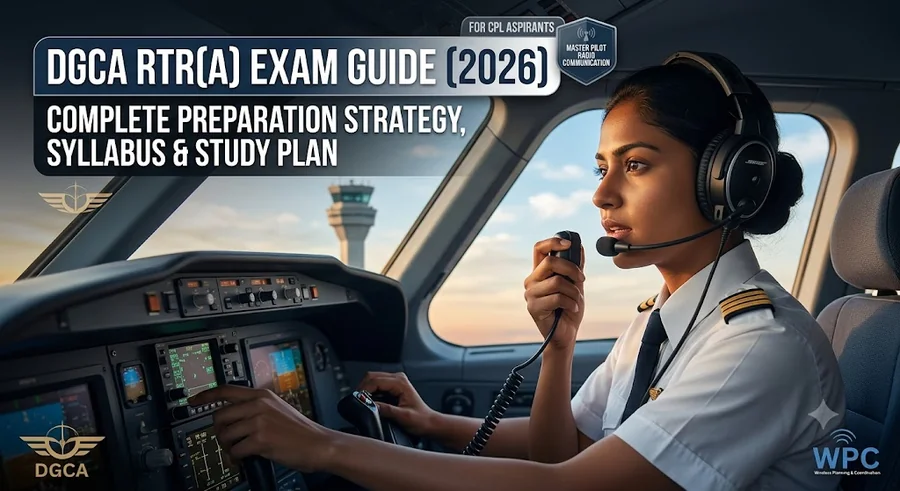
DGCA RTR(A) Exam Guide (2026): Complete Preparation Strategy, Syllabus & Study Plan
Among all the examinations required during Commercial Pilot Licence (CPL) training, RTR(A) is one that many students find intimidating.
Whether you're requesting taxi clearance, reporting your position, declaring an emergency, or communicating with Air Traffic Control (ATC), clear and professional radio communication is an essential pilot skill.
That's why passing the Radio Telephony Restricted (Aeronautical) — RTR(A) examination is mandatory before obtaining an Indian Commercial Pilot Licence.
This guide explains everything you need to know about the new exam structure, including:
- What the RTR(A) examination is
- Who conducts the examination
- eGCA Registration process
- Complete syllabus for Part 1 and Part 2
- Exam pattern
- Exemptions
- Preparation strategy
The Short Summary: As of November 2025, the RTR(A) examination is conducted by the DGCA (civil aviation regulator), having transitioned from the WPC. Passing it is mandatory to hold an Indian CPL. Registration happens entirely via the eGCA portal using a DGCA Computer Number. The exam consists of two parts: Part 1 (Written Exam), which is now a computer-based multiple-choice test, and Part 2 (Practical Exam), which is a structured, scenario-based simulated radio-telephony oral evaluation.
Key Takeaways
- DGCA Authority: The exam is now administered directly by the Directorate General of Civil Aviation (DGCA).
- eGCA Integration: Registration, fee payment, and certificate issuance are handled online through the eGCA portal (egca.gov.in).
- Two-Part Structure: Candidates must clear Part 1 (Written), a computer-based multiple-choice test (~50 questions), before taking Part 2 (Practical), a 30-minute simulated radio-telephony session.
- Exemptions: Certain experienced candidates, such as armed-forces pilots (1,500+ hours) and holders of old WPC or foreign RTR licenses, can apply for exemptions from the written exam.
Quick Navigation
- Who Needs RTR(A) & Eligibility
- Registration & eGCA Process
- RTR(A) Exam Pattern
- The RTR(A) Syllabus
- Exemptions
- How to Prepare
- FAQs
Who Needs RTR(A) & Eligibility
The RTR(A) certification is essential for pilots operating in Indian airspace:
- Commercial Pilot Licence (CPL) Candidates: It is compulsory. You cannot exercise commercial pilot privileges without it.
- Private Pilot Licence (PPL) Holders: Required if operating an aircraft fitted with radio equipment.
To be eligible to sit for the exam, you must have:
- A DGCA Computer Number (required to register through eGCA).
- Basic English proficiency (RTR(A) is closely linked to the separate ICAO English Level 4 language requirement pilots must also meet).
Registration & the eGCA Process
With the move to DGCA, the entire application workflow now happens online through the eGCA portal.
Here is the typical path:
- Obtain a Computer Number: Get your DGCA Computer Number via the eGCA portal (egca.gov.in) if you don't already have one.
- Register & Pay: Log in to eGCA, register for the RTR(A) written examination (Part 1), and pay the applicable fee online.
- Take Part 1: Appear for the computer-based written exam at your chosen centre (Written exams are held in Delhi, Mumbai, Hyderabad, Kolkata, and Chennai; practicals initially in Delhi, but expanding).
- Take Part 2: On passing the written exam, register for the practical/oral examination (Part 2).
- Issue of Certificate: After clearing both parts, apply for the issue of the RTR(A) certificate through eGCA. The certificate is issued digitally.
Note: Exams are scheduled to be held every 3 months initially, with a goal of moving to every 2 months. Always check the exact examination calendar and fees published by DGCA on the eGCA portal.
The Exam Pattern — Two Parts
The DGCA RTR(A) exam consists of two parts. You must clear both to be issued the certificate.
Part 1 — Written
- Format: Computer-based, multiple-choice, in English.
- Details: The exam typically features 50 questions with zero negative marking. Like other DGCA theory exams, it requires a strict 70% passing mark.
- Exam Fee: ₹2,500 per attempt, payable via the eGCA portal.
- Verification: Computer numbers and application verifications are managed digitally via DigiLocker integration.
- What it covers: Regulations & procedures, radio principles & practice, and radio-telephony communication procedures.
Part 2 — Practical
- Format: A simulated radio-telephony session of roughly 30 minutes.
- Details: The practical consists of about six sequential scenarios of ~5 minutes each, run in order (you cannot go back to a skipped scenario). Only on-screen materials (charts, METAR, NOTAMs) may be used.
- What it covers: Live handling of the phases of flight (parked/start-up, taxi, departure, en route, approach/arrival, and emergency).
The Golden Rule of the Practical: Standard ICAO phraseology is mandatory. Non-standard or casual language costs marks. Examiners assess how precisely and clearly you communicate, especially in the emergency scenario. Readbacks must be accurate and complete.
The RTR(A) Syllabus
The DGCA RTR(A) syllabus is organised into approximately 23 chapters falling into three broad domains. (For a breakdown of the other five theory exams, see our guide on DGCA CPL Subjects):
1. Regulations & Procedures
- International telecommunication conventions (ITU) and ICAO standards (notably Annex 10).
- Q-codes (QNH, QFE, QDM...), the phonetic alphabet, and the transmission of numbers and time.
- Standard radio-telephony procedures; distress, urgency and safety communications.
- Licensing rules and aircraft radio-equipment regulations.
- Indian Flight Information Regions (FIRs) and frequencies; AFTN, AIS and the AIP; NOTAMs and meteorological codes (METAR/TAF).
2. Radio Principles & Practice
- Basic electrical units: voltage, current, resistance, and power.
- The wavelength–frequency relationship and radio-wave propagation; HF and VHF communication.
- Aircraft intercommunication systems; microphones, headphones, and squelch.
- Radio navigation aids: VOR, DME, ILS, NDB/ADF, GPS/GNSS and GAGAN, and radar; SELCAL.
3. Radio-Telephony Communication Procedures
- Transmission technique and standard aviation phraseology.
- Call signs and their abbreviation; ATC clearances and read-back discipline.
- Aerodrome control (start-up, taxi, take-off, circuit, landing); approach & area control (IFR/VFR departures and arrivals, radar vectoring, position reporting).
- Transfer of communication between control units; communication-failure and emergency procedures.
Exemptions — Who May Skip the Written Exam
Certain experienced candidates can apply through eGCA for an exemption from the RTR(A) written examination. According to current reports, these include:
- Armed-forces pilots with substantial flying experience (reported at around 1,500+ hours).
- Holders of a valid earlier WPC-issued RTR licence.
- Holders of certain foreign flight radio-telephony licences (e.g., Commonwealth or other specified countries).
Exemption requests must be made directly on the eGCA portal. Always confirm exact eligibility conditions against the current DGCA notice.
How to Prepare
To prepare for this exam alongside regular flight training, read our article on DGCA Ground Classes. For a broader strategy covering all subjects, see the DGCA Exam Preparation Guide.
- Master the phraseology, not just the theory. The practical is won by clean, standard ICAO phraseology and accurate readbacks. Practise them out loud until they are automatic.
- Rehearse the phases of flight. Walk through a whole flight — start-up, taxi, departure, en route, arrival, and an emergency — so each of the six scenarios feels familiar.
- Build the radio-physics basics. A little Class 11–12 physics (waves, frequency, simple electricity) makes the propagation and equipment topics easy.
- Practise emergency calls. Be fluent with MAYDAY and PAN-PAN — the emergency scenario carries real weight.
- Use realistic simulation. Structured practice with an experienced instructor, in a simulated ATC environment, closes the gap between knowing and doing.
Frequently Asked Questions
Who conducts the RTR(A) exam now?
The DGCA, since November 2025. It was previously conducted by the WPC wing of the Ministry of Communications.
Is RTR(A) compulsory?
Yes — it is mandatory for a Commercial Pilot Licence, and required for PPL holders who fly radio-equipped aircraft.
Where do I register?
On the DGCA eGCA portal (egca.gov.in). You need a DGCA Computer Number to register for either part.
How many parts are there?
Two — a computer-based multiple-choice written paper, and a scenario-based practical (viva) of about six sequential five-minute radio-telephony scenarios.
Can the written exam be exempted?
Yes, for certain experienced candidates — including eligible armed-forces pilots, old WPC RTR licence holders, and holders of certain foreign licences — via an exemption request on eGCA.
This guide reflects the DGCA RTR(A) syllabus and exam procedure updates (2025–26).
Map Your Custom Pilot Training Pathway
Evaluate your compliance across the 4 major DGCA training gates, select training country routes (India vs. USA/Europe), and estimate your CPL timeline month-by-month.