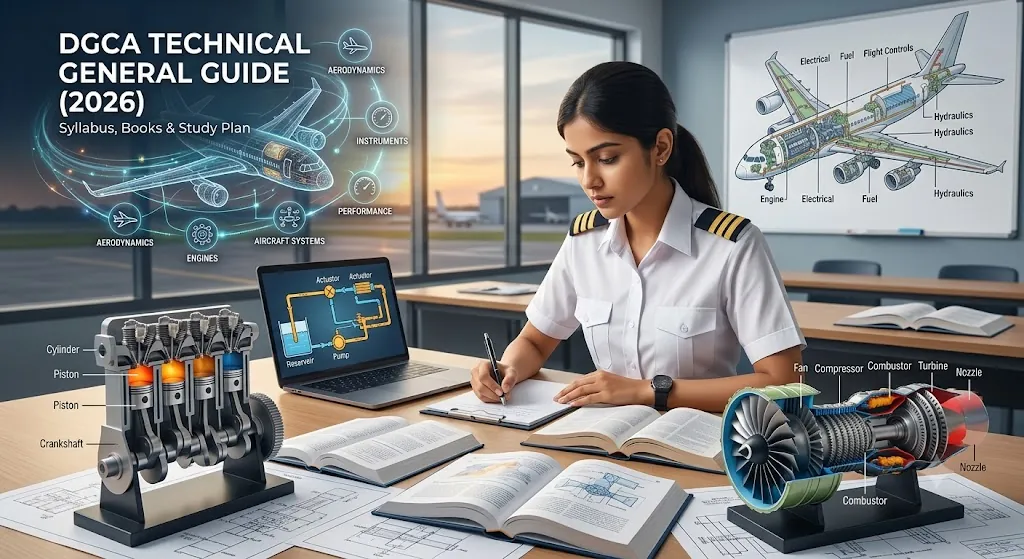
DGCA Technical General Guide (2026): Syllabus, Books & Study Plan
Every time an aircraft takes off, hundreds of mechanical, electrical, hydraulic, and aerodynamic systems work together to keep it flying safely.
As a commercial pilot, you don't need to design these systems—but you must understand how they work, why they work, and what happens when something goes wrong.
That's exactly what DGCA Technical General teaches.
Unlike Air Regulations, which focuses on aviation law, or Meteorology, which explains weather, Technical General introduces the engineering principles behind aircraft operation.
You'll study topics such as:
- Aircraft structure
- Aerodynamics
- Piston engines
- Turbine engines
- Fuel systems
- Hydraulic systems
- Electrical systems
- Flight instruments
- Aircraft performance
- Landing gear
- Flight controls
For many students, Technical General initially feels overwhelming because of the number of technical terms and diagrams.
However, once you understand the basic engineering principles, every chapter becomes easier to follow.
The biggest mistake students make is trying to memorize aircraft components without understanding their function.
Technical General isn't about remembering hundreds of parts.
It's about understanding how different aircraft systems work together to keep an aircraft flying safely.
In this guide, you'll learn:
- The complete DGCA Technical General syllabus.
- Which chapters deserve the most attention.
- The best order to study every topic.
- Recommended books and study resources.
- Practical preparation strategies.
- Common mistakes to avoid before the examination.
Before beginning your preparation, always review the latest Flight Crew syllabus and examination notifications published by the Directorate General of Civil Aviation (DGCA), as these define the official topics and examination requirements.
The short version:
DGCA Technical General is a concept-based subject covering aircraft construction, aerodynamics, engines, aircraft systems, instruments, and performance. Students should understand how aircraft systems operate rather than memorize isolated definitions. Diagrams, animations, and regular revision make preparation significantly easier.
Key Takeaways
- Technical General explains how aircraft systems function.
- Understanding concepts is more important than memorizing technical terms.
- Aircraft systems are interconnected and should be studied logically.
- Engine and system diagrams improve long-term retention.
- Question banks should be used after completing theory.
- Regular revision strengthens technical understanding.
Quick Navigation
- What is DGCA Technical General?
- Why Technical General Is Important
- DGCA Technical General Syllabus
- Topic-by-Topic Explanation
- Best Books
- 8-Week Study Plan
- Mock Test Strategy
- Common Mistakes
- FAQs
What Is DGCA Technical General?
DGCA Technical General is a core theoretical subject in Indian Commercial Pilot Licence (CPL) training that covers the engineering, aerodynamic, and mechanical principles of aircraft operations. It bridges the gap between flying an aircraft and understanding the intricate systems—such as hydraulics, electrical, and propulsion—that keep it airborne.
Instead of focusing on one aircraft model, Technical General teaches concepts that apply across many different aircraft types.
Students learn about:
- Aircraft design
- Lift generation
- Engine operation
- Fuel delivery
- Hydraulic power
- Electrical systems
- Flight controls
- Navigation instruments
- Aircraft performance
These concepts form the technical foundation that every commercial pilot needs before progressing to aircraft-specific training.
Why Is Technical General Important for CPL Students?
Pilots constantly interact with aircraft systems during every phase of flight.
For example:
- Why does an aircraft generate lift?
- What happens if hydraulic pressure is lost?
- How do piston and turbine engines differ?
- How do flight instruments obtain their information?
- Why are aircraft electrical systems designed with redundancy?
A pilot doesn't repair these systems.
However, understanding their operation helps pilots:
- Detect abnormal indications.
- Follow emergency procedures.
- Communicate effectively with engineers.
- Make safer operational decisions.
Technical General therefore bridges the gap between flying an aircraft and understanding how it works.
DGCA Technical General Syllabus
The DGCA Technical General syllabus introduces students to the major engineering systems found in modern aircraft.
Below is a simplified overview.
| Topic | What You'll Learn |
|---|---|
| Aircraft Structure | Fuselage, wings, empennage, materials |
| Aerodynamics | Lift, drag, thrust, weight, stability |
| Flight Controls | Primary & secondary control surfaces |
| Piston Engines | Components and operating principles |
| Turbine Engines | Turbojet, turbofan, turboprop basics |
| Fuel System | Fuel storage, pumps, delivery |
| Hydraulic System | Hydraulic components and operation |
| Electrical System | Batteries, generators, alternators |
| Aircraft Instruments | Pitot-static and gyroscopic instruments |
| Landing Gear | Types, operation, braking systems |
| Ice & Rain Protection | Anti-icing and de-icing systems |
| Aircraft Performance | Take-off, climb, cruise, landing fundamentals |
Although the syllabus appears extensive, most topics are interconnected.
Understanding the fundamentals first makes advanced systems much easier to understand.
DGCA Technical General Learning Roadmap
Instead of jumping between unrelated chapters, follow a logical progression.
Aircraft Structure
        ↓
Aerodynamics
        ↓
Flight Controls
        ↓
Piston Engines
        ↓
Turbine Engines
        ↓
Fuel System
        ↓
Hydraulic System
        ↓
Electrical System
        ↓
Flight Instruments
        ↓
Landing Gear
        ↓
Ice Protection
        ↓
Aircraft Performance
        ↓
Mock Tests
Each chapter builds upon the previous one.
For example, understanding aerodynamics makes flight controls easier, while engine knowledge supports aircraft performance concepts.
Topic Difficulty Overview
Not every chapter requires the same level of effort.
Based on feedback from CPL aspirants, here's a practical estimate.
| Topic | Difficulty | Concept Level |
|---|---|---|
| Aircraft Structure | ⭐⭐☆☆☆ | Easy |
| Aerodynamics | ⭐⭐⭐⭐☆ | High |
| Flight Controls | ⭐⭐⭐☆☆ | Medium |
| Piston Engines | ⭐⭐⭐⭐☆ | High |
| Turbine Engines | ⭐⭐⭐⭐☆ | High |
| Fuel System | ⭐⭐⭐☆☆ | Medium |
| Hydraulic System | ⭐⭐⭐⭐☆ | High |
| Electrical System | ⭐⭐⭐⭐☆ | High |
| Flight Instruments | ⭐⭐⭐⭐⭐ | Very High |
| Landing Gear | ⭐⭐⭐☆☆ | Medium |
| Ice Protection | ⭐⭐⭐☆☆ | Medium |
| Aircraft Performance | ⭐⭐⭐⭐☆ | High |
Study Tip: Technical General is easiest to understand when you study with diagrams. Every time you learn a new aircraft system, visualize how it works instead of relying only on text. Videos, cutaway illustrations, and labeled schematics can significantly improve retention.
Aircraft Structure Explained
Every aircraft is built around a carefully designed structure that provides strength while keeping weight as low as possible.
A strong yet lightweight airframe improves performance, fuel efficiency, and safety.
Understanding aircraft structure helps pilots appreciate how loads are distributed during take-off, flight, turbulence, and landing.
Major Components of an Aircraft
A typical aircraft consists of five primary structural components:
- Fuselage
- Wings
- Empennage (Tail Section)
- Landing Gear
- Powerplant
Each component performs a specific function while working together as a complete system.
Fuselage
The fuselage forms the main body of the aircraft.
It accommodates:
- Flight deck
- Passengers
- Cargo
- Fuel (on some aircraft)
- Avionics
- Structural attachments
Modern aircraft generally use:
- Semi-monocoque construction
- Aluminum alloys
- Composite materials
Semi-monocoque structures provide excellent strength while minimizing weight.
Wings
The wings generate lift.
Important structural parts include:
- Spars
- Ribs
- Stringers
- Skin
- Wing Tips
The wing's shape (airfoil) enables airflow to create lift during flight.
Empennage
The empennage provides aircraft stability and control.
It includes:
- Vertical Stabilizer
- Rudder
- Horizontal Stabilizer
- Elevator
Without the empennage, controlled flight would not be possible.
Difficulty
⭐⭐☆☆☆
Study Tip
Instead of memorizing aircraft parts individually, understand what each structure contributes to safe flight.
Aerodynamics Fundamentals
Aerodynamics explains why an aircraft flies.
It is one of the most important chapters in Technical General because nearly every later topic depends upon these principles.
Four Forces of Flight
Every aircraft experiences four fundamental forces.
| Force | Function |
|---|---|
| Lift | Supports the aircraft in the air |
| Weight | Pulls the aircraft toward Earth |
| Thrust | Moves the aircraft forward |
| Drag | Opposes forward motion |
Understanding how these forces interact is essential for pilots.
Lift
Lift is produced when air flows over and under the wing.
Several factors influence lift:
- Airspeed
- Wing Shape
- Air Density
- Angle of Attack
Lift must equal or exceed weight for sustained flight.
Drag
Drag resists aircraft motion.
Two major types include:
- Parasite Drag
- Induced Drag
Reducing unnecessary drag improves aircraft efficiency and fuel economy.
Angle of Attack
The Angle of Attack (AOA) is the angle between:
- Wing chord line
- Relative airflow
Increasing AOA generally increases lift—up to a critical point.
Beyond that point, airflow separates and the wing stalls.
Aircraft Stall
A stall occurs when the wing exceeds its critical angle of attack, causing a significant loss of lift.
Important point:
A stall can occur at any airspeed if the critical angle is exceeded.
Understanding this concept is far more important than memorizing definitions.
Difficulty
⭐⭐⭐⭐☆
Study Tip
Draw the four forces repeatedly until you can explain them without looking at notes.
Aerodynamics becomes much easier when you visualize airflow.
Flight Controls
Pilots control aircraft movement using flight control surfaces.
These allow movement around three axes.
Primary Flight Controls
| Control Surface | Function |
|---|---|
| Ailerons | Roll |
| Elevator | Pitch |
| Rudder | Yaw |
Every pilot must understand which control surface produces each movement.
Secondary Flight Controls
These improve aircraft performance.
Examples include:
- Flaps
- Slats
- Spoilers
- Trim Tabs
- Speed Brakes
Secondary controls improve:
- Take-off
- Landing
- Climb
- Fuel efficiency
Aircraft Axes
Pitch  → Lateral Axis

Roll → Longitudinal Axis

Yaw → Vertical Axis
Understanding aircraft axes helps explain both flight controls and stability.
Difficulty
⭐⭐⭐☆☆
Study Tip
Imagine sitting inside the cockpit.
Visualizing aircraft movement makes Pitch, Roll, and Yaw easy to remember.
Piston Engines
Most flying schools use piston-engine aircraft during initial flight training.
Understanding how these engines work provides the foundation for learning turbine engines later.
Major Components
Students generally study:
- Cylinder
- Piston
- Connecting Rod
- Crankshaft
- Spark Plug
- Valves
- Carburetor / Fuel Injection
- Lubrication System
Four-Stroke Cycle
The piston engine operates through four strokes.
Intake

↓

Compression

↓

Power

↓

Exhaust
Each stroke contributes to producing useful mechanical power.
Engine Systems
You'll also learn:
- Ignition
- Fuel
- Lubrication
- Cooling
- Starting
These systems work together to keep the engine operating safely.
Difficulty
⭐⭐⭐⭐☆
Study Tip
Instead of memorizing the engine cycle, draw the piston movement for each stroke.
Diagrams improve retention significantly.
Turbine Engines
Modern commercial aircraft primarily use turbine engines.
Compared to piston engines, turbine engines provide:
- Higher thrust
- Greater efficiency at altitude
- Improved reliability
- Better performance
Types of Turbine Engines
Students generally study:
- Turbojet
- Turbofan
- Turboprop
- Turboshaft
Understanding the differences between these engine types is more important than memorizing specifications.
Major Components
Most turbine engines include:
- Air Intake
- Compressor
- Combustion Chamber
- Turbine
- Exhaust Nozzle
Together, these components convert fuel energy into thrust.
Basic Engine Flow
Air Intake

↓

Compression

↓

Combustion

↓

Expansion

↓

Exhaust

↓

Thrust
Difficulty
⭐⭐⭐⭐☆
Study Tip
Compare piston and turbine engines side by side.
Understanding how they differ makes revision much easier.
Fuel System
The fuel system stores, filters, and delivers fuel safely to the engine.
A failure in fuel delivery can quickly affect engine performance, making this one of the most important aircraft systems.
Topics Covered
Students typically learn:
- Fuel Tanks
- Fuel Pumps
- Fuel Lines
- Filters
- Fuel Quantity Indicators
- Fuel Selectors
- Venting Systems
The primary goal is to ensure a continuous supply of clean fuel under all flight conditions.
Difficulty
⭐⭐⭐☆☆
Study Tip
Study the fuel system as a flow process:
Fuel Tank

↓

Fuel Pump

↓

Filter

↓

Fuel Control

↓

Engine
Flow diagrams help simplify complex system questions.
Hydraulic System
Hydraulic systems allow pilots to operate heavy aircraft components with minimal physical effort.
Instead of relying on mechanical force alone, hydraulic pressure multiplies force to move large control surfaces and landing gear efficiently.
Where Hydraulics Are Used
Typical hydraulic applications include:
- Landing Gear Extension & Retraction
- Brakes
- Flight Controls
- Flaps
- Spoilers
- Nose Wheel Steering
Large commercial aircraft depend heavily on hydraulic systems for normal operation.
Major Components
Students should understand:
- Hydraulic Reservoir
- Hydraulic Pump
- Hydraulic Fluid
- Filters
- Valves
- Actuators
- Hydraulic Lines
Rather than memorizing component names, focus on how hydraulic pressure flows through the system.
Basic Hydraulic Flow
Reservoir

↓

Pump

↓

Pressure Lines

↓

Control Valve

↓

Actuator

↓

Return Line

↓

Reservoir
Understanding this sequence makes troubleshooting questions much easier.
Difficulty
⭐⭐⭐⭐☆
Study Tip
Imagine hydraulic fluid as the "muscle" of the aircraft.
Visualizing how pressure moves through the system is far more effective than rote memorization.
Electrical System Explained
Every aircraft relies on electricity to power essential equipment.
From engine starting and cockpit lighting to radios, navigation systems, and flight instruments, the electrical system ensures aircraft systems operate reliably throughout the flight.
Modern aircraft are designed with redundant electrical systems, meaning backup power sources are available if one component fails.
Major Components
Students generally study:
- Battery
- Alternator
- Generator
- Bus Bars
- Circuit Breakers
- Voltage Regulator
- Inverters
- Electrical Wiring
Each component performs a specific role in generating, distributing, or protecting electrical power.
How the Electrical System Works
The electrical system follows a simple sequence.
Battery

↓

Engine Starts

↓

Alternator / Generator

↓

Bus Bar

↓

Aircraft Systems

↓

Flight Instruments
Navigation Equipment
Lighting
Communication Systems
Once the engine starts, the alternator or generator supplies electrical power while also charging the battery.
Why Pilots Study Electrical Systems
Understanding electrical systems helps pilots:
- Recognize abnormal indications.
- Respond to electrical failures.
- Manage battery usage.
- Operate emergency equipment.
Difficulty
⭐⭐⭐⭐☆
Study Tip
Instead of memorizing electrical components individually, understand how electrical power flows through the aircraft.
Flow diagrams make troubleshooting questions much easier.
Flight Instruments
Flight instruments provide pilots with the information required to safely control an aircraft.
Rather than relying only on outside visual references, pilots continuously monitor cockpit instruments during every phase of flight.
Understanding how these instruments work is one of the most important parts of Technical General.
Pitot-Static Instruments
These instruments obtain information from the Pitot-Static System.
Students study:
- Airspeed Indicator (ASI)
- Altimeter
- Vertical Speed Indicator (VSI)
Each instrument depends upon pressure measurements.
Understanding the Pitot and Static ports is essential for interpreting instrument indications correctly.
Gyroscopic Instruments
Gyroscopic instruments provide information about aircraft attitude and direction.
Common instruments include:
- Attitude Indicator
- Heading Indicator
- Turn Coordinator
- Turn-and-Slip Indicator
Gyroscopes provide stable reference information even when outside visibility is poor.
Modern Glass Cockpits
Many modern aircraft use digital displays instead of traditional analog gauges.
Students should understand:
- Electronic Flight Instrument System (EFIS)
- Primary Flight Display (PFD)
- Multi-Function Display (MFD)
Although technology has advanced, the underlying principles remain the same.
Difficulty
⭐⭐⭐⭐⭐
Study Tip
Draw each instrument and label:
- What information it displays.
- Which system provides that information.
- What happens if the system fails.
This approach improves both understanding and revision.
Landing Gear Systems
The landing gear supports the aircraft during taxi, take-off, and landing.
It absorbs landing loads while allowing the aircraft to move safely on the ground.
Types of Landing Gear
Students generally study:
- Tricycle Landing Gear
- Tailwheel Landing Gear
- Fixed Landing Gear
- Retractable Landing Gear
Each design offers different operational advantages depending on the aircraft.
Landing Gear Components
Typical components include:
- Shock Absorbers
- Wheels
- Tyres
- Brakes
- Steering Mechanism
- Retraction System
- Position Indicators
Understanding the purpose of each component is more valuable than memorizing technical terminology.
Braking Systems
Students also learn about:
- Hydraulic Brakes
- Anti-skid Systems
- Parking Brake
- Emergency Brake Systems
These systems improve aircraft control during landing and taxi operations.
Difficulty
⭐⭐⭐☆☆
Study Tip
Visualize the complete landing sequence from touchdown to taxi.
Understanding how each landing gear component functions during this process makes revision much easier.
Ice & Rain Protection Systems
Weather can significantly affect aircraft performance.
Ice accumulation changes the shape of the wing, increases drag, reduces lift, and may affect engine operation.
Rain can reduce visibility and influence aircraft performance during take-off and landing.
For these reasons, aircraft are equipped with systems that minimize weather-related risks.
Anti-Icing vs De-Icing
Students should understand the difference between:
- Anti-Icing – Prevents ice from forming.
- De-Icing – Removes ice that has already accumulated.
This distinction appears frequently in DGCA examinations.
Common Ice Protection Systems
Aircraft may use:
- Heated Leading Edges
- Pneumatic Boots
- Electrical Heating
- Windshield Heating
- Propeller Heating
- Pitot Heat
Each system protects different aircraft components.
Rain Protection
Students also study:
- Windshield Wipers
- Rain Repellent Systems
- Heated Windscreens
These systems improve pilot visibility during adverse weather.
Difficulty
⭐⭐⭐☆☆
Study Tip
Group systems according to what they protect rather than trying to memorize every component separately.
Aircraft Performance
Aircraft performance explains how efficiently an aircraft flies under different conditions.
Performance depends on several variables, including:
- Aircraft weight
- Temperature
- Pressure altitude
- Wind
- Runway conditions
- Engine performance
Pilots use performance calculations before every flight to ensure the aircraft can operate safely.
Topics Covered
Students generally study:
- Take-off Performance
- Landing Performance
- Climb Performance
- Cruise Performance
- Range
- Endurance
- Service Ceiling
- Performance Charts
Understanding these concepts helps pilots determine whether an aircraft can safely complete a planned flight.
Why Performance Matters
Performance calculations help answer questions such as:
- Is the runway long enough?
- Can the aircraft clear nearby obstacles?
- How much fuel is required?
- What is the expected climb rate?
These calculations contribute directly to flight safety.
Difficulty
⭐⭐⭐⭐☆
Study Tip
Relate performance topics to Air Navigation and Meteorology.
Understanding how weather, aircraft weight, and runway conditions interact makes this chapter easier to grasp.
Best Books for DGCA Technical General
Choosing the right study material is essential because Technical General covers a wide range of engineering concepts.
Rather than studying from multiple books simultaneously, focus on one trusted reference and reinforce your learning with diagrams and MCQs.
| Resource | Best For |
|---|---|
| Oxford ATPL Technical General | Comprehensive concepts |
| Jeppesen Technical General | Additional explanations |
| DGCA Question Bank | Chapter-wise revision |
| Classroom Notes | Quick revision before exams |
| Aircraft System Diagrams | Visual understanding |
For technical subjects, diagrams are often more valuable than lengthy text.
8-Week Technical General Study Plan
Breaking the syllabus into smaller milestones helps students build confidence gradually.
| Week | Goal |
|---|---|
| Week 1 | Aircraft Structure & Aerodynamics |
| Week 2 | Flight Controls & Stability |
| Week 3 | Piston Engines |
| Week 4 | Turbine Engines |
| Week 5 | Fuel, Hydraulic & Electrical Systems |
| Week 6 | Flight Instruments |
| Week 7 | Landing Gear, Ice Protection & Aircraft Performance |
| Week 8 | Full Revision & Mock Tests |
Review diagrams every day instead of waiting until the final week.
Mock Test Strategy
Technical General is a concept-based subject, so mock tests should focus on understanding rather than memorization.
A practical revision plan is:
| Stage | Practice Strategy |
|---|---|
| Week 1–2 | Chapter-wise MCQs |
| Week 3–5 | Diagram-based questions |
| Week 6–7 | Mixed-topic practice tests |
| Week 8 | Full-length DGCA mock examinations |
After every mock test:
- Review incorrect answers.
- Revisit the related aircraft system.
- Practice drawing diagrams.
- Update your revision notes.
Understanding why an answer is correct is more valuable than simply remembering it.
Common Mistakes Students Make
Many students find Technical General difficult because of ineffective study habits rather than the syllabus itself.
❌ Memorizing aircraft parts without understanding their function
Always ask:
"What does this component do?"
❌ Ignoring diagrams
Aircraft systems are easier to understand visually than through text alone.
❌ Studying systems independently
Aircraft systems interact continuously.
For example:
- Hydraulic systems affect landing gear.
- Electrical systems power instruments.
- Engines influence aircraft performance.
Understanding these relationships improves long-term retention.
❌ Skipping Instrument Systems
Flight instruments are among the most frequently tested areas and should not be left until the end.
❌ Depending only on Question Banks
MCQs reinforce learning but cannot replace a solid conceptual understanding of aircraft systems.
How The Pilot's Compass Teaches Technical General
Technical General becomes much easier when students understand how aircraft systems work together instead of treating each chapter separately.
At The Pilot's Compass, Commander Naveen Pandita (Retd.) teaches Technical General using a practical, system-based approach.
The learning journey typically follows this sequence:
Aircraft Structure
        ↓
Aerodynamics
        ↓
Flight Controls
        ↓
Piston Engines
        ↓
Turbine Engines
        ↓
Fuel System
        ↓
Hydraulic System
        ↓
Electrical System
        ↓
Flight Instruments
        ↓
Landing Gear
        ↓
Aircraft Performance
        ↓
Mock Tests
        ↓
DGCA Examination
Students also receive:
- Live interactive online classes.
- Recorded lectures for revision.
- Diagram-based explanations.
- Topic-wise doubt-solving sessions.
- Full-length DGCA mock examinations.
- Personalized guidance throughout CPL theory preparation.
The focus is on helping students understand how aircraft systems interact, making technical concepts easier to retain and apply.
Frequently Asked Questions
Is Technical General difficult in DGCA?
Technical General is generally considered a moderately difficult subject because it introduces engineering concepts unfamiliar to many students. Studying with diagrams and understanding system functions makes it much easier.
Which book is best for DGCA Technical General?
Oxford ATPL Technical General is one of the most recommended books for concept building. Many students also use classroom notes and DGCA question banks for revision.
How long should I study Technical General?
Most CPL aspirants spend 3–4 weeks preparing Technical General, followed by regular revision and mock tests.
Should I memorize aircraft systems?
No. It's better to understand how each system works and how it interacts with other aircraft systems rather than memorizing isolated components.
Are diagrams important for Technical General?
Yes. Aircraft structures, engines, hydraulic systems, electrical systems, and flight instruments are much easier to understand and remember through diagrams.
Final Verdict
DGCA Technical General provides the engineering foundation every commercial pilot needs.
Although the syllabus covers many aircraft systems, success comes from understanding how those systems function together rather than memorizing technical terminology.
If you:
- Build a strong foundation in aerodynamics,
- Learn aircraft systems step by step,
- Practice using diagrams,
- Solve chapter-wise MCQs,
- Take full-length mock tests,
you'll be well prepared for the DGCA examination and develop the technical knowledge expected of a professional pilot.
Ready to Master DGCA Technical General?
If you're preparing for your CPL theory exams, The Pilot's Compass offers structured Technical General classes led by Commander Naveen Pandita (Retd.).
Students receive:
- Concept-based teaching.
- System-by-system explanations.
- Diagram-focused learning.
- Topic-wise revision.
- Mock tests.
- Complete DGCA examination guidance.
Bonus: Book a counselling session.
Sources
Official References
Map Your Custom Pilot Training Pathway
Evaluate your compliance across the 4 major DGCA training gates, select training country routes (India vs. USA/Europe), and estimate your CPL timeline month-by-month.