DGCA CPL Ground Classes
Complete CPL Ground School Preparation
Choosing the right books is one of the first critical decisions you will make while preparing for the Directorate General of Civil Aviation (DGCA) Commercial Pilot Licence (CPL) theory examinations.
Search online, and you will find dozens of conflicting recommendations. One forum suggests Oxford ATPL manuals, another recommends coaching institute notes exclusively, while students on aviation message boards insist that solving question banks alone is sufficient.
It is easy to become overwhelmed before you have opened your first chapter.
The reality is that there is no single perfect DGCA book that covers all subjects comprehensively.
Different books serve distinct educational purposes. Some explain complex aerodynamics or navigation formulas exceptionally well, others are ideal for quick pre-exam revision, while a few closely mirror how DGCA frames its examination questions.
That is why high-scoring CPL candidates rarely depend on a single resource.
Instead, successful candidates combine official DGCA references, trusted commercial aviation textbooks, and practice question banks to build a thorough understanding of each paper.
Before purchasing any study material, it is essential to cross-check your choices against the official DGCA CPL Exam Syllabus. This ensures your books cover the exact topics prescribed for current examinations rather than obsolete circulars.
Official examination notices, circulars, and syllabus updates are published directly on the eGCA and DGCA Pariksha portals.
The short version/ Quick Summary
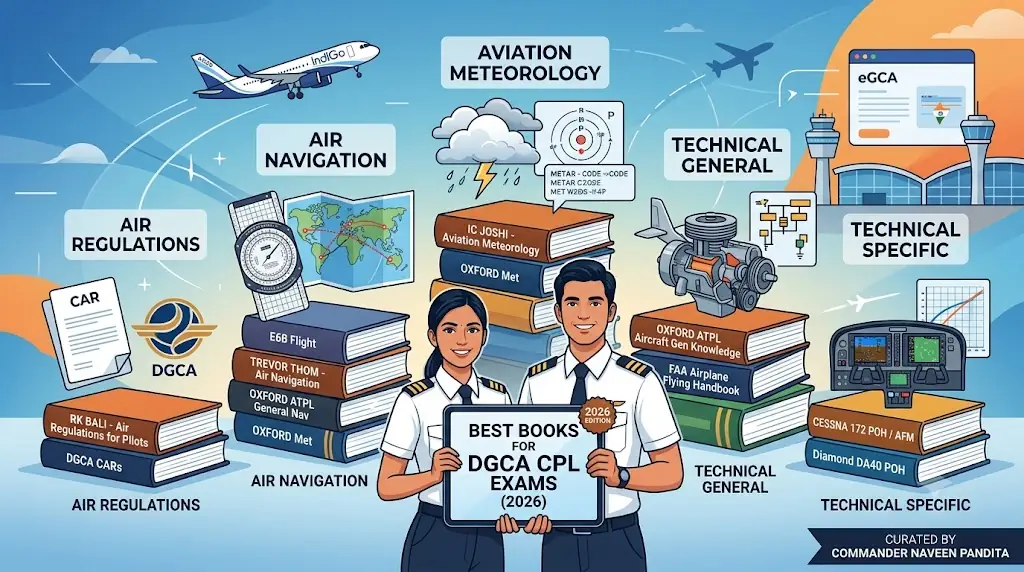
The best books for DGCA CPL exams depend on the specific subject paper:
- Air Regulations: Air Regulations for Pilots by Capt. R.K. Bali, supplemented by official DGCA Civil Aviation Requirements (CARs).
- Air Navigation: Air Navigation by Trevor Thom (for fundamentals) and Oxford ATPL General Navigation (for advanced calculations).
- Aviation Meteorology: Aviation Meteorology by Capt. I.C. Joshi.
- Technical General: Oxford ATPL Aircraft General Knowledge & Systems, supported by the free FAA Airplane Flying Handbook.
- Technical Specific: The official Pilot’s Operating Handbook (POH) and Aircraft Flight Manual (AFM) for your specific training aircraft (e.g., Cessna 172, Diamond DA40/DA42).
- RTR(A): RTR(A) Question Bank (legacy WPC compilation) and ICAO Manual of Radiotelephony (Doc 9432).
Always verify rule changes against official DGCA publications before beginning your study sessions.
Key Takeaways
- No Single All-in-One Book: No single textbook covers all five DGCA theory papers perfectly.
- Syllabus First: Always align your study topics with the official DGCA CPL Exam Syllabus.
- Distinguish Official vs. Commercial Material: Official DGCA documents (CARs, AIP, Circulars) define the law; commercial textbooks explain the concepts.
- Concepts Over Rote Memorization: Understanding underlying principles is crucial for clearing application-based DGCA questions and passing subsequent airline selection assessments.
- Combine Resources: Most successful candidates use one core conceptual textbook alongside practice question banks for each subject.
- Verify Currency: Aviation regulations change periodically; ensure your regulatory study material reflects the latest CAR updates.
Why Choosing the Right DGCA Books Matters
Many beginner student pilots believe clearing DGCA theory exams is simply a matter of memorizing thousands of Multiple Choice Questions (MCQs).
That approach often fails when DGCA introduces new, application-based questions during computer-based examinations.
DGCA examinations do not merely test whether you have memorised facts; they evaluate whether you understand aviation concepts well enough to apply them in operational flight scenarios.
For example:
- Air Navigation: Questions require you to calculate track, heading, drift, and groundspeed using a flight computer (E6B or CRP-5) after factoring in wind velocity vectors.
- Air Regulations: Questions test which Civil Aviation Requirement (CAR) or airspace classification rule applies in a specific flight scenario.
- Meteorology: Questions test your ability to interpret METAR/TAF weather codes and pressure systems rather than defining simple terms.
A quality aviation textbook explains why a physical law or rule exists—not just the correct option key. That conceptual understanding is the difference between passing on your first attempt and struggling through multiple examination sessions.
Start With the Official DGCA Syllabus
Before purchasing any books, download and review the official DGCA Flight Crew examination syllabus.
The syllabus outlines the exact learning objectives, subject topics, and examination scope expected of Commercial Pilot Licence candidates.
Rather than buying books based solely on recommendations, compare every book’s table of contents against the syllabus topics. This prevents spending time and money on textbooks that cover irrelevant international material while omitting topics tested in India.
You can review the exam format and structure in our detailed guide on the DGCA Exam Pattern 2026.
Expert Tip: Keep a PDF copy of the official DGCA syllabus saved on your device. As you complete each chapter in your textbook, check off the corresponding topic in the syllabus to guarantee zero coverage gaps.
How We Selected These Books
Our recommendations are evaluated based on objective educational criteria:
1. Syllabus Alignment
Every recommended book aligns directly with the learning objectives prescribed in the latest DGCA CPL Flight Crew syllabus.
2. Instructor Acceptance
The recommended titles are widely accepted by ground instructors, chief flying instructors (CFIs), and aviation academies across India due to their technical accuracy and clarity.
3. Student Feedback & Proven Track Record
Selected titles—including RK Bali, Trevor Thom, Oxford ATPL, and IC Joshi—have consistently helped thousands of CPL candidates pass their DGCA papers over past examination cycles.
4. Practical Utility
We distinguish between books built for foundation concept building, books for quick revision, and official regulatory documentation.
Best DGCA Books at a Glance
| Subject | Recommended Primary Book | Secondary / Reference Material | Primary Focus | Recommended Stage |
|---|---|---|---|---|
| Air Regulations | Air Regulations for Pilots (Capt. R.K. Bali) | DGCA CARs (Section 7), AIP India | Regulatory Rules & Laws | Beginner to Advanced |
| Air Navigation | Air Navigation (Trevor Thom) | Oxford ATPL General Navigation | Concepts & Numerical Calculations | Beginner to Advanced |
| Aviation Meteorology | Aviation Meteorology (Capt. I.C. Joshi) | Oxford ATPL Meteorology | Weather Systems & METAR Interpretation | Beginner to Advanced |
| Technical General | Oxford ATPL Technical General | FAA Airplane Flying Handbook | Aircraft Systems & Engines | Intermediate to Advanced |
| Technical Specific | Official Pilot's Operating Handbook (POH) | Aircraft Flight Manual (AFM) | Aircraft-Specific Systems & Performance | Mandatory |
| RTR(A) | RTR(A) Question Bank (legacy WPC compilation) | ICAO Doc 9432 Radiotelephony Manual | RT Communication Phraseology | Beginner to Advanced |
Best Book for Air Regulations
Air Regulations is usually the first subject student pilots tackle because it establishes the legal and operational framework of Indian civil aviation.
The paper covers licensing procedures, Civil Aviation Requirements (CARs), ICAO Annexes, airspace classifications, rules of the air, and pilot responsibilities.
Because civil aviation regulations undergo periodic amendments, candidates should distinguish between commercial explanatory textbooks and official government regulatory publications.
1. Capt. R.K. Bali — Air Regulations for Pilots
Why it's recommended
Capt. R.K. Bali’s Air Regulations for Pilots is the most popular commercial study guide used across Indian ground schools. It translates dense legal and regulatory text into structured, accessible explanations tailored for student pilots.
Rather than quoting legal sections verbatim, it explains how operational rules, airspace divisions, and licensing conditions apply during real-world training and flight operations.
Best for
- First-time DGCA CPL candidates
- Ground school classroom preparation
- Quick pre-exam revision
Strengths
- Comprehensive coverage of Indian aviation laws and ICAO Annexes.
- Simple, structured language suitable for beginners.
- Includes review questions at the end of chapters.
- Tailored specifically to the DGCA examination format.
Limitations
- Printed editions may not reflect recent amendments to Civil Aviation Requirements (CARs).
- Must be cross-referenced with official DGCA notifications to verify current rules.
Official Reference: DGCA Civil Aviation Requirements (CARs)
While commercial textbooks like RK Bali provide an easy entry point, official regulatory publications remain the final authority for examination questions.
Candidates should reference key sections of the DGCA Civil Aviation Requirements (CARs) published on the DGCA portal:
- CAR Section 7 (Flight Crew Standards): Licensing, medical requirements, logbook maintenance, and currency rules.
- CAR Section 2 (Airworthiness): Aircraft documentation and maintenance schedules.
- AIP India (Aeronautical Information Publication): Airspace structure, flight rules, aerodrome data, and altimeter setting procedures.
- ICAO Annexes: Annex 2 (Rules of the Air), Annex 11 (Air Traffic Services), and Annex 14 (Aerodromes).
Best Air Navigation Books
Air Navigation is widely considered one of the most challenging DGCA theory papers. It demands a strong grasp of mathematical calculations, vector diagrams, flight planning, dead reckoning, radio navigation aids, instrument systems, and flight computer (E6B / CRP-5) operations.
1. Trevor Thom — Air Navigation (The Air Pilot's Manual Vol. 3)
Why it's recommended
Trevor Thom’s Air Navigation is a world-renowned foundational textbook. It introduces navigation principles step-by-step, explaining the underlying physics and geometry before introducing complex flight planning formulas.
Best For
- Beginner student pilots
- First-principles conceptual understanding
- Self-study candidates
Strengths
- Clear diagrams and step-by-step vector illustrations.
- Logical progression from basic maps and charts to advanced navigation.
- Excellent explanations of triangle of velocities, wind corrections, and pressure altimetry.
Limitations
- Written for general international aviation; requires supplementary practice with DGCA-specific numerical question banks.
2. Oxford ATPL Training Series — General Navigation & Radio Navigation
Why it's recommended
For advanced numerical calculations, radio aids (VOR, NDB, ILS, DME, GNSS), and high-altitude flight planning, the Oxford ATPL Navigation manuals provide airline-grade depth.
Best For
- Intermediate to advanced candidates
- Deep numerical practice and instrument system understanding
- Candidates preparing for airline technical assessments
Essential Navigation Equipment
In addition to textbooks, every student preparing for Air Navigation must practice with physical tools:
- Flight Computer (CRP-5 or E6B): For calculating wind correction angles, groundspeed, density altitude, fuel burn, and compressibility.
- Navigation Plotter / Scale & Protractor: For plotting tracks, bearings, and fixes on aeronautical charts.
Best Aviation Meteorology Books
Aviation Meteorology is a vital subject that directly impacts flight safety. The DGCA exam tests your understanding of atmospheric thermodynamics, weather fronts, pressure systems, cloud formations, icing conditions, microbursts, and aviation weather reports (METAR, TAF, SIGMET).
Capt. I.C. Joshi — Aviation Meteorology
Why it's recommended
Capt. I.C. Joshi’s Aviation Meteorology is the standard textbook used across India for DGCA meteorology preparation. It breaks down complex meteorological phenomena into clear explanations tailored to the Indian subcontinent's weather patterns (such as the Southwest and Northeast Monsoons, Western Disturbances, and Tropical Cyclones).
Best For
- DGCA Meteorology paper preparation
- Ground school classes and self-study
- Decoding METAR, TAF, and synoptic weather charts
Strengths
- Comprehensive coverage of the DGCA syllabus.
- Dedicated sections on Indian climatology, monsoon behavior, and seasonal weather trends.
- Clear diagrams showing frontal systems, lapse rates, and stability.
- Practice MCQs matching DGCA exam formats.
Best Technical General Books
Technical General covers aircraft structures, systems, engines, electrical grids, hydraulics, flight controls, instruments, and aerodynamics. Because the syllabus spans multiple engineering disciplines, using a high-quality technical reference is essential.
1. Oxford ATPL Training Series — Aircraft General Knowledge & Systems
Why it's recommended
The Oxford ATPL Technical General manuals provide clear, illustrated explanations of modern aircraft systems, piston engines, jet engines, hydraulic networks, electrical buses, and flight instruments (gyroscopes, altimeters, airspeed indicators, AHRS, glass cockpits).
Best For
- Comprehensive conceptual mastery
- In-depth understanding of aircraft mechanics and engine systems
2. FAA Airplane Flying Handbook & Pilot's Handbook of Aeronautical Knowledge
Why it's recommended
Published for free by the US Federal Aviation Administration (FAA), the Airplane Flying Handbook (FAA-H-8083-3C) and Pilot's Handbook of Aeronautical Knowledge (FAA-H-8083-25B) explain principles of flight, aerodynamics, weight and balance, and aircraft stability with outstanding full-color illustrations.
Best Technical Specific Books
Unlike general theory subjects, Technical Specific tests your knowledge of the exact aircraft type you will operate during flight training.
There is no general commercial textbook for Technical Specific. Your primary study material MUST be the official documentation for your training aircraft.
Aircraft Pilot's Operating Handbook (POH) & Aircraft Flight Manual (AFM)
Your primary study reference is the official POH / AFM issued by the aircraft manufacturer for your specific training type:
- Cessna 172R / 172S NAV III (G1000)
- Diamond DA40 NGW / DA42 VI
- Piper PA-28 Archer
- Tecnam P2006T / P2008
Core POH Sections You Must Master:
- Section 2 (Limitations): Airspeed limits (V_NE, V_NO, V_FE, V_A), engine operational limits, weight limits, and G-load limits.
- Section 3 (Emergency Procedures): Engine failure in flight, engine fire, electrical failures, and forced landings.
- Section 4 (Normal Procedures): Pre-flight inspection, engine start, taxi, takeoff, cruise, and landing checklists.
- Section 5 (Performance): Takeoff and landing distance charts, fuel consumption tables, climb performance, and density altitude corrections.
- Section 7 (Airplane & Systems Description): Fuel system schematic, electrical bus distribution, landing gear mechanism, and engine design.
Best RTR(A) Books
The Radio Telephony Restricted (Aeronautical) examination is now administered directly by the Directorate General of Civil Aviation (DGCA) (previously conducted by the WPC Wing).
It consists of two parts: Part 1 (Practical Transmission & Communication) and Part 2 (Oral Examination on Radio Regulations and Aviation Terms).
Recommended RTR(A) Resources:
- RTR(A) Question Bank (legacy WPC compilation) & Notes: Covers standard aviation transmission procedures, distress/urgency calls (MAYDAY, PAN PAN), and flight plan transmission.
- ICAO Doc 9432 (Manual of Radiotelephony): The international standard for aviation radio phraseology.
- DGCA / ITU Radio Regulatory Notes: Covers international telecommunication treaties, frequency bands (VHF, HF), and aeronautical radio regulations.
Free Official DGCA Resources You Should Use
Many candidate pilots spend substantial sums on commercial books while ignoring the free official resources provided by aviation authorities.
| Resource Name | Publishing Body | Key Contents & Purpose | Link / Access |
|---|---|---|---|
| DGCA Flight Crew Syllabus | DGCA India | Official topic list and exam scope for CPL/ATPL papers | Available on eGCA / DGCA portal |
| Civil Aviation Requirements (CARs) | DGCA India | Regulatory framework (Section 7: Licensing & Operations) | DGCA Official Portal |
| Aeronautical Information Publication (AIP) | Airports Authority of India / DGCA | Airspace rules, routes, aerodrome codes, and nav facilities | AAI AIP Portal |
| DGCA Public Notices & Circulars | DGCA India | Latest exam dates, syllabus updates, and rule changes | DGCA Pariksha Portal |
| FAA Handbooks (PHAK / AFH) | US FAA | Free high-quality textbooks on aerodynamics & systems | FAA Official Website (PDFs) |
Can You Prepare Without Coaching?
Yes. Many candidates clear all five DGCA theory examinations through disciplined self-study using quality textbooks, official references, and structured revision.
Self-Study vs. Ground School Coaching
| Aspect | Self-Study | Ground Classes Coaching |
|---|---|---|
| Flexibility | High — Study at your own pace | Fixed schedule and structured lectures |
| Cost | Low — Expenses limited to books & tests | Higher tuition fees |
| Doubt Resolution | Requires independent research & forums | Immediate access to experienced ground instructors |
| Structure | Demands high personal discipline | Pre-set routine and regular class assessments |
Whether you choose self-study or structured coaching, reviewing options in our comprehensive guide on DGCA CPL Ground Classes can help you decide which environment fits your learning style.
Books You Should Avoid
Avoid the following common purchasing traps:
- Outdated Regulations Books: Avoid buying older, second-hand Air Regulations books without checking whether the CAR sections or airspace rules have been updated.
- Relying Solely on Unverified Question Banks: Question banks test memory, not understanding. Relying exclusively on answer keys without studying theoretical concepts often leads to failure when DGCA updates its question database.
- Generic Hobbyist Aviation Books: Books written for flight simulator enthusiasts or general aviation readers usually lack the technical depth required for commercial pilot examinations.
A Complete 6-Month DGCA Study Roadmap
A structured timeline prevents burnout and ensures equal preparation across all subjects:
| Month | Primary Subject Focus | Key Milestones & Activities |
|---|---|---|
| Month 1 | Air Regulations | Read RK Bali; cross-reference CAR Section 7; complete topic-wise MCQs. |
| Month 2 | Aviation Meteorology | Study IC Joshi; master METAR/TAF decoding and weather chart interpretation. |
| Month 3 | Air Navigation (Part 1) | Study Trevor Thom for navigation theory; practice CRP-5 / E6B flight computer calculations. |
| Month 4 | Air Navigation (Part 2) & Radio Aids | Study Oxford ATPL Navigation; solve numerical problems on plotting, track line, and radio aids. |
| Month 5 | Technical General & Technical Specific | Study Oxford ATPL Technical General and your aircraft's POH (C172/DA40). |
| Month 6 | Revision & Full-Length Mock Exams | Solve full-length practice papers; review weak topics; check DGCA Passing Marks and exam guidelines. |
Recommended Study Order
For most beginner pilots, studying subjects in this sequential order builds knowledge logically:
1. Air Regulations ➔ 2. Aviation Meteorology ➔ 3. Air Navigation ➔ 4. Technical General ➔ 5. Technical Specific ➔ 6. RTR(A)
- Air Regulations: Introduces aviation terminology, airspace divisions, and legal definitions.
- Aviation Meteorology: Builds an understanding of atmospheric physics and weather, which supports navigation planning.
- Air Navigation: Uses concepts from meteorology and regulations for flight planning and drift calculations.
- Technical General: Builds technical knowledge of aircraft engines, hydraulics, and instruments.
- Technical Specific: Applies technical general concepts to your specific flight training aircraft type.
- RTR(A): Prepares you for radio communication procedures before starting actual flight training.
Common Mistakes & Myths vs Reality
Common Mistakes
- Buying Too Many Books: Purchasing multiple textbooks for the same subject causes confusion when authors use different phrasing. Stick to one core textbook and one reference manual per subject.
- Neglecting the Flight Computer: Postponing E6B/CRP-5 flight computer practice until the last month creates unnecessary pressure during Air Navigation preparation.
- Ignoring Exam Rules: Candidates sometimes miss updates regarding exam duration, marking schemes, or computer-based formats. Review our breakdown on DGCA Exam Fees 2026 and exam structures.
Myth vs. Reality
| Myth | Reality |
|---|---|
| Myth: One single book is enough for all DGCA papers. | Reality: DGCA exams cover five distinct disciplines requiring subject-specific textbooks. |
| Myth: Memorizing question bank answers guarantees a pass. | Reality: DGCA frequently introduces new, application-based questions that require conceptual clarity. |
| Myth: Commercial textbooks are officially published by DGCA. | Reality: DGCA publishes official CARs and syllabi, while commercial books (RK Bali, IC Joshi) are independent educational guides. |
| Myth: You cannot clear DGCA exams without enrolling in expensive coaching. | Reality: Thousands of student pilots clear DGCA papers every year through disciplined self-study. |
Final Recommendations
Here is the ideal book combination for DGCA CPL examination success:
- Air Regulations: Air Regulations for Pilots (Capt. R.K. Bali) + DGCA CARs
- Air Navigation: Air Navigation (Trevor Thom) + Oxford ATPL Navigation + CRP-5 / E6B
- Aviation Meteorology: Aviation Meteorology (Capt. I.C. Joshi)
- Technical General: Oxford ATPL Technical General + FAA Airplane Flying Handbook
- Technical Specific: Aircraft Pilot's Operating Handbook (POH)
- RTR(A): RTR(A) Question Bank (legacy WPC compilation) + ICAO Doc 9432 Radiotelephony Manual
Consistency, structured study, and concept-building will always impact your examination performance far more than the number of books on your desk.
Continue Reading
Continue exploring our comprehensive pilot training guides:
- DGCA Exam Pattern Explained
- DGCA Exam Syllabus 2026
- DGCA Passing Marks & Validity Rules
- DGCA CPL Ground Classes Guide
- DGCA Exam Fees 2026
- Real Cost of CPL Pilot Training in India
- How to Become a Commercial Pilot in India
- Best Flying Schools in India
Sources
Official Regulatory Sources
- Directorate General of Civil Aviation (DGCA) India: https://www.dgca.gov.in
- DGCA Pariksha Portal: https://pariksha.dgca.gov.in (Flight Crew Examination Cell Notices & Syllabi)
- DGCA Civil Aviation Requirements (CAR): DGCA CAR Section 7 — Flight Crew Standards & Licensing
- International Civil Aviation Organization (ICAO): https://www.icao.int (Annex 1: Personnel Licensing, Annex 2: Rules of the Air, Doc 9432: Manual of Radiotelephony)
- US Federal Aviation Administration (FAA): FAA Aviation Handbooks & Manuals (Airplane Flying Handbook FAA-H-8083-3C and Pilot's Handbook of Aeronautical Knowledge FAA-H-8083-25B)
Educational Textbooks & Industry References
- Capt. R.K. Bali: Air Regulations for Pilots
- Trevor Thom: The Air Pilot's Manual: Air Navigation (Vol. 3)
- Capt. I.C. Joshi: Aviation Meteorology
- Oxford Aviation Academy: Oxford ATPL Training Manual Series
- Cessna Aircraft Company / Diamond Aircraft: Pilot's Operating Handbooks (POH)
Frequently Asked Questions
Map Your Custom Pilot Training Pathway
Evaluate your compliance across the 4 major DGCA training gates, select training country routes (India vs. USA/Europe), and estimate your CPL timeline month-by-month.