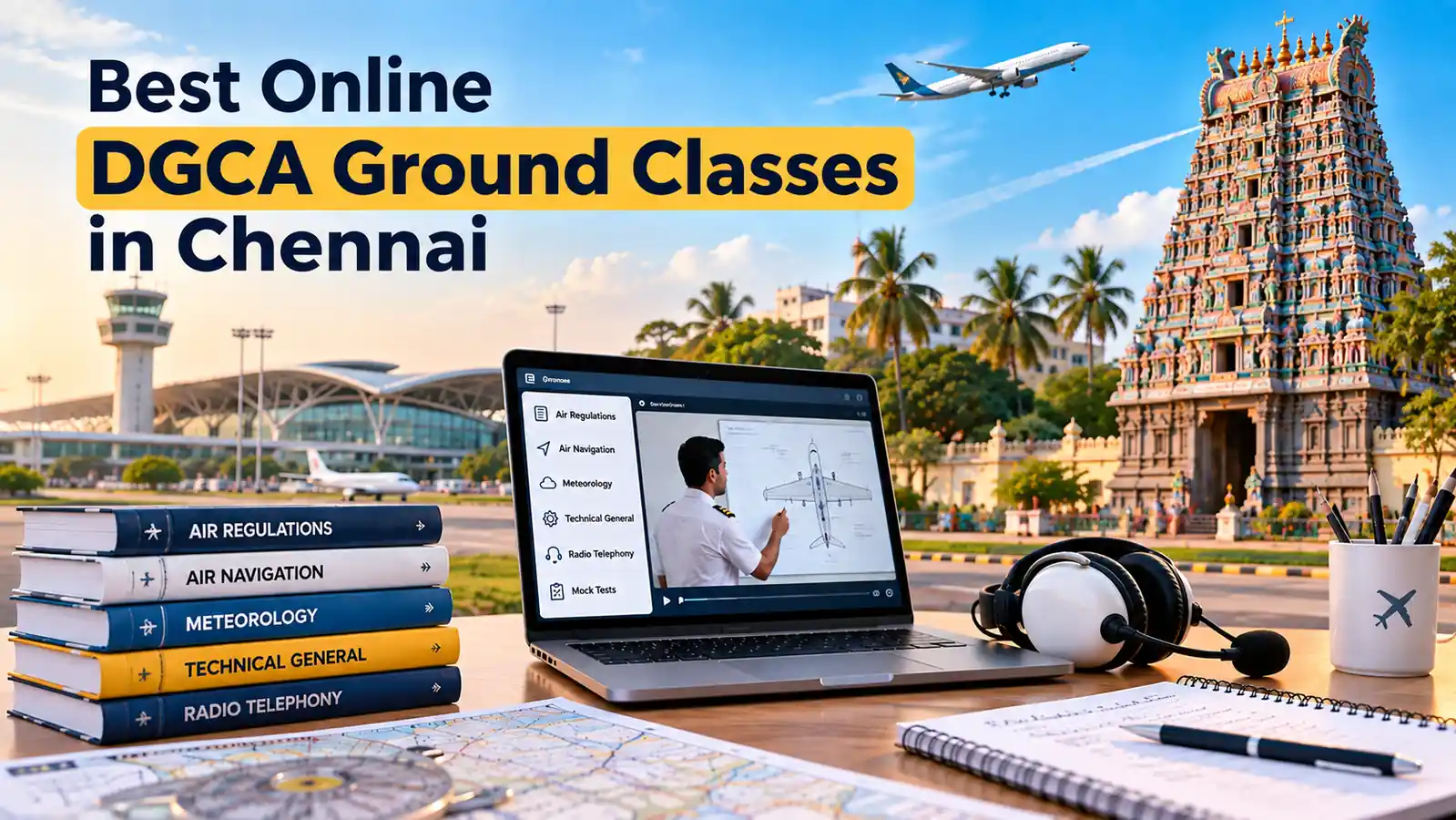
Key takeaway for Tamil Nadu candidates: Student pilots across Chennai, Coimbatore, Madurai, and Tiruchirappalli can eliminate exhausting two-hour commutes along Anna Salai, GST Road, and OMR in humid traffic. Interactive online ground school led by veteran Indian Navy and IAF flight instructors provides personalized plotting supervision, Coromandel coastal aerodynamics coaching, and complete syllabus preparation directly from home.
Quick Navigation
- Why Tamil Nadu Aspirants Are Choosing Online Ground School
- Mastering Coromandel Meteorology & Oceanic Airway Navigation
- How DGCA Theory Papers Connect to Maritime Sector Flight Operations
- Why Maritime Aviator Mentorship Gives You an Edge in Tamil Nadu
- Comparison: Chennai Physical Institutes vs. The Pilot's Compass Live Online
- Balancing College at Anna University, MIT, or SRM with Ground School
- Tamil Nadu Pilot Roadmap: From Academic Eligibility to Cockpit Training
- Explore Regional Ground School Guides
Why Tamil Nadu Aspirants Are Choosing Online Ground School
Chennai has an illustrious aviation legacy. From the pioneering days of the historic Madras Flying Club (established in 1930) to the aerospace engineering heritage of the Madras Institute of Technology (MIT Chromepet)—where Dr. APJ Abdul Kalam studied aeronautical engineering—the city attracts dedicated aviation aspirants from across Tamil Nadu, Puducherry, and Kerala.
However, preparing for the strict DGCA written examinations through traditional physical coaching academies in Chennai introduces severe friction:
- Exhausting Transit in Humid Coastal Conditions: Students travelling from Velachery, Anna Nagar, Adyar, Tambaram, Porur, or along Old Mahabalipuram Road (OMR) routinely spend 90 to 120 minutes navigating extreme peak-hour bottlenecks along Anna Salai, GST Road, and the Kathipara flyover. Spending hours in sweltering commute conditions drains the cognitive sharpness needed to work through complex navigation triangles, wind drift vectors, and atmospheric lapse rates.
- Impersonal Batch Sizes in Physical Lecture Halls: Commercial physical institutes in Chennai frequently crowd 40 to 60 students into a single room. In that setting, an instructor cannot stand behind every desk to check whether your track line on a 1:1,000,000 World Aeronautical Chart is off by two degrees. A two-degree track error translates to missing an airfield by several nautical miles, leading directly to failed exam attempts.
- Rigid Classroom Timetables: Many aspirants across Tamil Nadu are enrolled in undergraduate engineering or science programs. Physical coaching centres enforce daytime attendance that clashes with college semesters, forcing students to consider unnecessary gap years.
Live online DGCA ground classes eliminate these transit barriers. Instructors share high-definition digital plotting feeds, inspect student chart workings live on screen, and provide immediate personalized feedback. If you are weighing self-study against structured training, read our analysis on clearing DGCA exams without ground classes.
Mastering Coromandel Meteorology & Oceanic Airway Navigation
Studying aviation in coastal South India introduces unique meteorological and navigation concepts that standard textbooks rarely contextualize for real flying:
- Northeast Monsoon Dynamics: Unlike northern and central India, which experience primarily the southwest monsoon, Tamil Nadu and coastal Andhra Pradesh receive their heaviest precipitation between October and December during the retreating Northeast Monsoon. In Aviation Meteorology, students examine convective cloud mechanisms, tropical depressions forming in the Bay of Bengal, and torrential rain bands that cause sudden diversions at Chennai (VOMM) and Tiruchirappalli (VOTR).
- Sea Breeze Fronts & Low-Level Shear: Coastal aviators must understand thermal contrast circulations. Ground classes explore how afternoon sea breezes pushing inland from the Bay of Bengal interact with prevailing land winds, creating sharp temperature inversions, sudden crosswinds, and localized gusty shear on runway 07/25 and 12/30.
- Oceanic Airway Navigation (VOMF FIR): Chennai Air Traffic Control manages one of India's major Flight Information Regions, controlling critical oceanic routes connecting the subcontinent to Southeast Asia and Australasia. Students learn oceanic position reporting procedures, RNAV/RNP specifications, and GNSS waypoint navigation across maritime corridors.
- Dalton & CX-3 Computer Drills for Coastal Humidity: Solving wind triangles on the mechanical Dalton/CRP-5 and digital CX-3 computers to calculate true airspeed corrections, high-humidity density altitude compensations, and critical fuel burn reserves when flying over South Indian coastal sectors.
How DGCA Theory Papers Connect to Maritime Sector Flight Operations
To earn your Commercial Pilot License under the Aircraft Rules 1937, the DGCA mandates passing five core written papers along with the radiotelephony license. Our curriculum connects every subject directly to operational South Indian airspace:
-
- South India chart plotting: Plotting tracks along the Chennai–Bengaluru–Coimbatore–Madurai corridor using 1:1,000,000 WAC charts.
- Low-latitude convergency calculations, 1-in-60 rule track error corrections, and magnetic variation adjustments across peninsular India.
- Radio navigation procedures: Intercepting VOR radials for Chennai (MMV), Tiruchirappalli (TRV), and Coimbatore (CBE), along with ILS localizer and glide path tracking.
-
- Bay of Bengal cyclonic systems: Cyclogenesis tracking, eye wall structures, storm surge dynamics, and severe tropical weather advisories.
- Coastal moisture mechanics: High relative humidity, dewpoint depressions, low-altitude maritime stratus clouds, and sea fog formation along the Coromandel coastline.
- Decoding weather reports: Thorough practice analyzing METAR, TAF, SPECI, and SIGMET bulletins for Chennai (VOMM), Madurai (VOMD), and Coimbatore (VOCB).
-
- Major terminal airspace procedures: Regulations governing operations within the complex Chennai Terminal Control Area (TMA) and dual-runway sequencing.
- Airspace classifications: Class D aerodrome traffic zones, Special VFR (SVFR) weather limits, and military airspace coordination around Arakkonam (INS Rajali) and Tambaram.
- Regulatory frameworks: Aircraft Act 1934, Aircraft Rules 1937, and DGCA Civil Aviation Requirements (CARs) Section 7 for flight crew licensing and FDTL.
-
- High-humidity engine performance: Carburetor icing risks in warm, saturated tropical air and airframe corrosion prevention in marine salt environments.
- Aerodynamics and aircraft systems: Lift and drag polars, electrical distribution buses, pitot-static instrument errors, and weight-and-balance loading envelopes.
-
Technical Specific:
- Operational limitations, fuel system schematics, and Aircraft Flight Manual (AFM) performance charts for your training aircraft, such as the Cessna 172R, Diamond DA42, or Piper Archer.
-
- Standard ICAO phraseology for interacting with Chennai Tower, Chennai Approach, Chennai Radar, and Oceanic Control.
- Comprehensive preparation for the DGCA-administered RTR(A) examination, covering both the Part 1 computer-based written test and Part 2 scenario-based practical transmission evaluation.
Read our complete breakdown of DGCA CPL subjects and exam patterns to structure your preparation timetable, and consult our DGCA recommended books guide for essential reference literature.
Why Maritime Aviator Mentorship Gives You an Edge in Tamil Nadu
Many coaching centers hire fresh civilian CPL graduates who teach temporarily while waiting for airline vacancy calls. When hiring resumes, those instructors depart mid-batch. The Pilot's Compass operates on an entirely different foundation:
- Instruction by Veteran Military Aviators: Classes are led by Commander Naveen Pandita (Retd.) (Ex-Indian Navy, 4,000+ flight hours) with extensive carrier and maritime flight background, alongside Indian Air Force Qualified Flying Instructors Wing Commander Sunil Dhankhar (Retd.) and Wing Commander Anubhav Vyas (Retd.). Our faculty teaches professional airmanship, operational decision-making, and flight discipline rather than mere exam shortcuts.
- Capped Interactive Cohorts Under 20 Candidates: Unlike physical coaching halls that seat 50 students, we limit cohorts strictly to under 20. Every student speaks up, asks questions, and receives personal plotting critiques.
- Live Camera-Based Plotting Checks: Students present their chart workings during live video sessions. The instructor checks their Douglas protractor alignments and pencil markings to correct drift calculations on the spot.
- Guaranteed Batch Re-attendance: You enroll once. If you need to re-attend live lectures before an upcoming DGCA examination attempt, you rejoin active batches without paying additional tuition fees.
- Regulatory Navigational Guidance: From setting up your profile on the eGCA portal to booking your initial DGCA Class 2 medical certificate and coordinating DGCA Class 1 medical appointments at authorized centres (such as IAM Bengaluru or AFCME New Delhi), our operational team assists you through every regulatory step.
Comparison: Chennai Physical Institutes vs. The Pilot's Compass Live Online
| Training Parameter | Traditional Chennai Coaching Center | The Pilot's Compass Live Online |
|---|---|---|
| Cohort Size | 40 to 60 students per classroom | Strictly limited under 20 students |
| Faculty Profile | Fresh civilian license holders or part-time tutors | Military veteran aviators (Navy & IAF QFIs) |
| Chart Plotting Correction | Generic board demonstrations with minimal 1-on-1 review | Live digital camera inspection of individual student charts |
| Commute Stress | 90–120 minutes lost to Anna Salai, GST Road, and OMR traffic | Zero commute; study comfortably from home |
| Living Expenses | ₹15,000+/month for outstation students relocating to Chennai | ₹0 additional boarding costs; study from your hometown |
| Timings & Flexibility | Rigid daytime schedules that interrupt university lectures | Live evening batches (7:30 PM–9:30 PM) designed around college hours |
| Batch Validity | Fixed access period; extra fees to re-attend after 3 months | Continuous live batch access until all DGCA exams are passed |
Balancing College at Anna University, MIT, or SRM with Ground School
Many ambitious student pilots in Tamil Nadu pursue undergraduate degrees at Anna University (CEG Campus), MIT Chromepet, SRM Institute of Science and Technology, or VIT Chennai while preparing for their commercial pilot licenses.
Our evening live classes (7:30 PM to 9:30 PM) allow students to complete their daytime academic lectures, return home, and dedicate two focused hours to navigation and meteorology without missing college obligations. Clearing your DGCA theory examinations prior to college graduation allows you to enter flight training without subject backlogs or training delays.
Tamil Nadu Pilot Roadmap: From Academic Eligibility to Cockpit Training
To embark on your pilot licensing journey from Chennai or across Tamil Nadu, follow this systematic regulatory roadmap:
- Confirm Academic Eligibility: Ensure you hold a 10+2 certificate with Physics and Mathematics from a recognized board, or complete them via the National Institute of Open Schooling (NIOS).
- Apply for DGCA Computer Number: Register on the eGCA portal with your educational credentials, birth certificate, and government identification documents.
- Complete Your DGCA Class 2 Medical: Schedule an initial medical examination with an empaneled DGCA Class 2 examiner in Chennai (available in Anna Nagar, Adyar, and Nungambakkam).
- Book Your DGCA Class 1 Medical: Apply through eGCA for an initial Class 1 appointment at an authorized examination centre, such as the Institute of Aerospace Medicine (IAM) in Bengaluru, AFCME New Delhi, or empanelled civil aeromedical hospitals.
- Clear Ground Subjects Before Reporting to Flight School: Complete Air Navigation, Aviation Meteorology, and Air Regulations first. Candidates who report to flight training organizations (whether in India or abroad) with ground exams cleared complete their 200 flight hours much faster without quarterly exam disruptions.
For structured study strategies, explore our comprehensive guide on how to clear DGCA exams in your first attempt.
Explore Regional Ground School Guides & Resources
Preparing from another aviation hub or planning your complete training path? Explore our related guides:
- Best Online DGCA Ground Classes in India: Comprehensive Guide — Discover how our live virtual ground school operates nationwide.
- Best Online DGCA Ground Classes in Bangalore (Flagship Academy) — Our in-person and hybrid ground school near Jakkur Aerodrome.
- Best Online DGCA Ground Classes in Hyderabad — Deccan aviation hub guide for student pilots across Telangana and Andhra Pradesh.
- Best Online DGCA Ground Classes in Ahmedabad — Hot-weather flying guide for Western India candidates.
- Best Online DGCA Ground Classes in Chandigarh — Pilot training guide for candidates across Punjab and Haryana.
- Real Commercial Pilot License Cost in India — Complete financial budgeting breakdown from DGCA papers to 200 flight hours.
Ready to start your flying career? Explore our DGCA CPL Ground Classes or contact our team to speak directly with an active flight instructor.
Frequently Asked Questions
Map Your Custom Pilot Training Pathway
Evaluate your compliance across the 4 major DGCA training gates, select training country routes (India vs. USA/Europe), and estimate your CPL timeline month-by-month.