
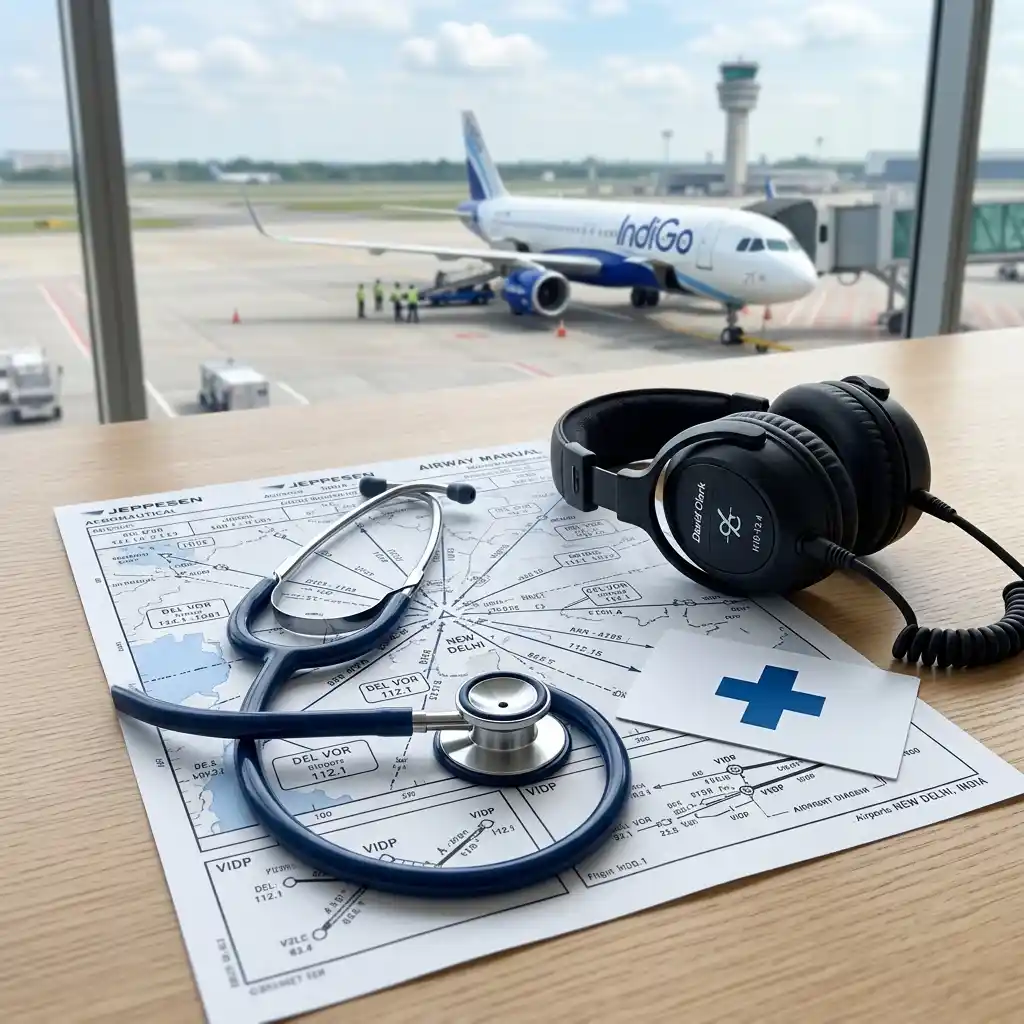
What is the DGCA Class 1 Medical? It is the mandatory, highest-level health certification required to hold a Commercial Pilot License (CPL) or Airline Transport Pilot License (ATPL) in India. Securing this certificate is the most critical milestone for any aspiring aviator; it involves passing rigorous physical, visual, and pathological tests that prove you are physically and psychologically fit to safely operate commercial aircraft in the Indian airspace.
Before you invest lakhs of rupees into flight training, there is one absolute non-negotiable hurdle you must clear: the DGCA Class 1 Medical examination.
Unlike the basic Class 2 evaluation, the initial Class 1 medical is an intensive, multi-day screening process conducted exclusively at specialized military medical boards or approved civil centres. It is designed to proactively rule out any latent health conditions that could potentially impact flight safety.
This guide provides an exhaustive breakdown for 2026, covering strict eligibility criteria, required tests, costs, and essential administrative tips to help you sail through the process without delays.
Key Takeaways
- Mandatory for CPL: You cannot fly commercially in India without an active Class 1 Medical assessment. It is the legal foundation of your license.
- Class 2 is a Prerequisite: You must possess a valid, finalized Class 2 Medical assessment before applying for your initial Class 1.
- Book Early: Wait times for initial appointments at IAF centres can exceed 3 to 4 months due to high demand, though civil centres might offer faster slots.
- Cost Expectation: The initial medical examination costs approximately ₹5,000 to ₹7,000, payable directly to the hospital.
- Corrective Lenses are Allowed: Wearing glasses does not disqualify you, provided your corrected vision reaches the required 6/6 standard.
Quick Navigation
- What is the Class 1 Medical?
- How Do You Become Eligible?
- How Much Does the Examination Cost?
- How Does the Process Work?
- What Tests Are Conducted?
- Where Can You Take the Test?
- Initial vs. Re-initial vs. Renewal
- Understanding Temporary and Permanent Unfitness
- Documents Required for Class 1 Medical
- Class 1 vs. Class 2 Medical
What is the Class 1 Medical?
The DGCA Class 1 Medical evaluates your physical and mental fitness to operate commercial aircraft. The Directorate General of Civil Aviation enforces strict standards to ensure pilots can handle the physiological demands of flying without compromising passenger safety.
A standard Class 1 assessment is valid for 12 months. This 12-month validity period remains the same even after you cross the age of 40, requiring you to undergo screenings once a year to maintain your commercial flying privileges.
The initial examination is significantly stricter than the renewal examinations. It establishes your baseline health record, which the DGCA and airlines will reference throughout your entire career.
How Do You Become Eligible?
You cannot jump straight into a Class 1 examination. The DGCA mandates a sequential approach to pilot medicals.
First, you must complete and pass the Class 2 Medical examination. The Class 2 acts as a preliminary filter. Once the DGCA reviews your Class 2 reports and issues your final Class 2 assessment letter, you become officially eligible to apply for your initial Class 1 appointment.
You must also have an active eGCA account with your PMR (Personal Medical Record) number generated. Your PMR number is your unique medical identity code, and you will use it for every medical appointment for the rest of your career.
How Much Does the Examination Cost?
Budgeting for the medical process involves standard hospital fees and travel expenses, as initial centers are limited to 13 locations.
The medical tests at an IAF centre or an empanelled civil hospital typically range from ₹5,000 to ₹7,000 (though civil hospitals may charge differently). You will pay this directly to the hospital during your visit, usually via online payment or demand draft depending on the specific center's current guidelines.
Keep in mind that if the medical board detects an anomaly (like an irregular heartbeat or a high BMI) and requests additional specialist consultations or advanced scans outside the standard battery of tests, the total cost will increase significantly. You are responsible for all external testing costs.
How Does the Process Work?
Getting your certificate requires navigating the eGCA portal and hospital schedules. The entire workflow is now digitized.
- Obtain Class 2: Secure your final Class 2 assessment from the DGCA. Ensure it is currently valid.
- Apply on eGCA: Log into the eGCA portal, navigate to the medical section, and select an available date at one of the 13 approved centres (3 IAF or 10 civil centres). Submit your application online.
- Attend the Examination: Travel to the center on your allotted date. You must arrive early (often by 7:00 AM) while fasting for your blood tests. The evaluation usually takes two full days, so book your accommodation accordingly.
- Board Evaluation: After all tests are completed, the medical board reviews your results collectively.
- Issue of Assessment: If everything is clear, the board forwards the results to the DGCA. The DGCA processes the findings and issues your digital Class 1 Medical assessment via the eGCA portal.
What Tests Are Conducted?
The initial Class 1 evaluation is essentially a full-body audit. It covers every major bodily system to ensure absolute fitness.
- Cardiovascular System: Doctors will conduct a resting ECG to check heart function. For older pilots or those with a family history, a stress test (TMT) may be required.
- Hearing (Audiometry): You will sit in a soundproof booth and undergo an audiometry test to verify your hearing across specific high and low frequencies. Pilots must be able to hear standard radio communications clearly over engine noise.
- Neurological (EEG): An EEG is performed to detect any neurological abnormalities or susceptibility to seizures.
- Pathology: They perform full blood and urine panels. This checks for diabetes, kidney function, liver health, and lipid profiles.
- Radiology and Imaging: An ultrasound of your abdomen checks your internal organs, and an X-ray of your chest ensures lung health.
- Vision: The eye examination is particularly strict. It checks for color blindness (using Ishihara plates), depth perception, field of vision, and visual acuity. Corrective lenses are permitted, but you must bring your current prescription and a spare set of glasses.
Where Can You Take the DGCA Class 1 Medical?
Initial Class 1 Medical examinations are conducted at 13 designated centres — 3 Indian Air Force Boarding Centres and 10 DGCA-approved civilian Aeromedical Evaluation Centres.
The 3 IAF Boarding Centres are AFCME Subroto Park, New Delhi; MEC (East) at 5 AFH Jorhat, Assam; and MEC at IAM, Bangalore.
The 10 civilian centres provide additional options for initial/re-initial examinations. Always check the latest DGCA centre list before planning your travel, as the list can change.
Initial vs. Re-initial vs. Renewal
The process and available centre depend on whether you are undergoing an initial, re-initial, or renewal Class 1 Medical.
Initial Class 1 Medical: Required when someone holding a valid Class 2 applies for a Class 1 for the very first time. You must visit one of the 13 specific centres listed above.
Re-initial Class 1 Medical: If your last Class 1 Medical is more than two years old, you undergo the initial process again. This can be done at an IAF Boarding Centre or an empanelled civil hospital, and an NOC from the Medical Directorate, DGCA is required through eGCA.
Renewal Class 1 Medical: Renewals have much wider access, with 18 IAF centres and 55 DGCA-empanelled civil Class 1 Medical Examiners. Renewals can be done from 45 days before expiry through the expiry date, with post-expiry renewal permitted subject to the applicable two-year limit.
Understanding Temporary and Permanent Unfitness
Not everyone walks out with a clear certificate on the first try. The board issues specific rulings if they find an issue.
Temporary Unfitness (TU): If the board finds a correctable issue—such as high blood pressure, temporary overweight status (BMI outside the acceptable range), or a minor infection—they will declare you Temporarily Unfit. You will be given a specific timeframe (e.g., 4 to 12 weeks) to correct the issue and return for a review. Once you demonstrate the issue is resolved, your TU status is lifted.
Permanent Unfitness (PU): If the board detects a disqualifying condition that cannot be cured or safely managed in a flight environment (such as severe color blindness, a history of epilepsy, or certain congenital heart defects), they will issue a Permanent Unfitness ruling. While you can appeal a PU ruling through a specific DGCA medical review board, overturning it is difficult without substantial medical evidence proving the initial diagnosis was incorrect.
Documents Required for Class 1 Medical
Before heading to your appointment, make sure you carry the following physical documents and their photocopies:
- Identity and Age Proof: Original government photo ID (Aadhaar Card, Passport, or Voter ID) and Date of Birth Proof (Class 10 Mark Sheet or birth certificate).
- Photographs: 4 to 6 recent passport-size color photographs.
- Appointment & Fees: Printout or digital copy of the eGCA Portal appointment confirmation, and printed copies of the online payment receipt generated through eGCA.
- Previous Assessments & Forms: Original and photocopies of your previous Class 2 assessment (CA-35) along with your file/PMR number. Two copies of duly filled and signed CA-34 and CA-35 forms (for initial examinations) or CA-34A/CA-35 (for renewals).
- Vision Aids: Up-to-date prescription copy if you wear glasses or contact lenses, along with the spectacles themselves.
- Medical History: Prescription slips, discharge summaries, test reports for any past surgeries or major illnesses, and any specific specialist reports requested during prior medicals.
Class 1 vs. Class 2 Medical
To help understand where the Class 1 fits in, here is a quick comparison:
| Feature | DGCA Class 2 Medical | DGCA Class 1 Medical |
|---|---|---|
| Who Needs It? | Student Pilots (SPL) and Private Pilots (PPL). | Commercial Pilots (CPL) and Airline Transport Pilots (ATPL). |
| Prerequisites | None. | Must hold a valid Class 2 Medical assessment. |
| Examiners (Initial) | Any DGCA-approved Class 2 civil doctor. | Restricted to 13 specialized IAF and civil centres. |
| Validity | 24 months. | 12 months. |
| Strictness | Standard physical health check. | Exhaustive full-body audit (stricter vision/hearing standards). |
Official Resources
For the most up-to-date and comprehensive guidelines, please refer to the Official DGCA Class 1 Medical Document.
Frequently Asked Questions
Map Your Custom Pilot Training Pathway
Evaluate your compliance across the 4 major DGCA training gates, select training country routes (India vs. USA/Europe), and estimate your CPL timeline month-by-month.