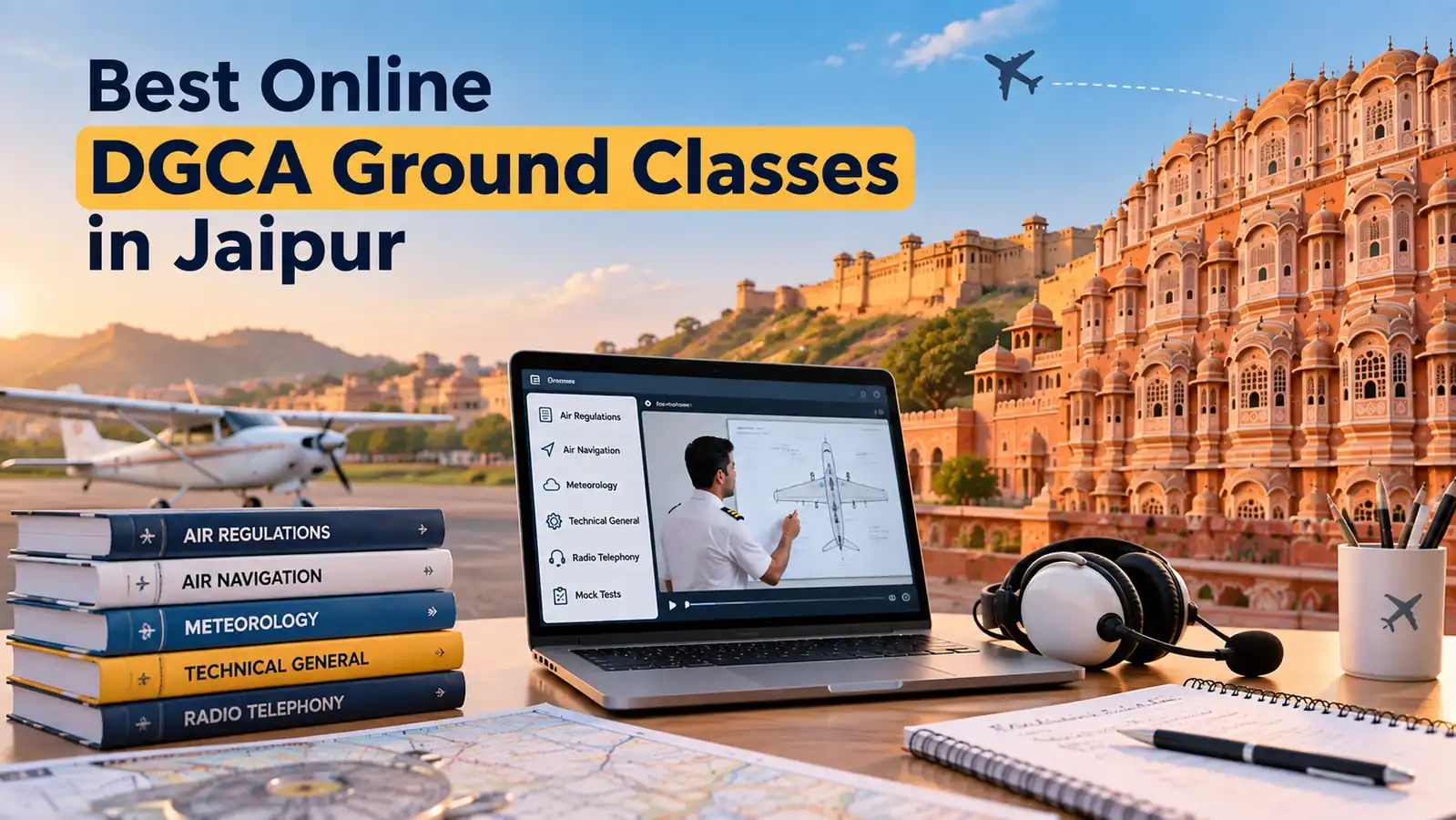
Key takeaway for Rajasthan candidates: Student pilots across Jaipur, Jodhpur, Kota, and Udaipur can eliminate exhausting commutes along Tonk Road, JLN Marg, and Ajmer Road in 45°C summer heat. Interactive online ground school led by veteran Indian Navy and IAF flight instructors provides personalized plotting supervision, desert aerodynamics coaching, and complete syllabus preparation directly from home.
Quick Navigation
- Why Rajasthan Aspirants Are Choosing Online Ground School
- Mastering Desert Dead Reckoning & High-Density Altitude Aerodynamics
- How DGCA Theory Papers Connect to Northwestern Sector Flight Operations
- Why Desert & Tactical Airspace Mentorship Matters for Rajasthan Aspirants
- Comparison: Jaipur Classroom Coaching vs. The Pilot's Compass Live Online
- Balancing College at MNIT or Manipal Jaipur with Ground School
- Rajasthan Pilot Roadmap: From Academic Eligibility to Cockpit Training
- Explore Regional Ground School Guides
Why Rajasthan Aspirants Are Choosing Online Ground School
Rajasthan possesses a storied flying tradition. Blessed with over 300 clear visual flying (VFR) days annually, the state serves as one of India's premier flight training landscapes. From historic aviation academies like Banasthali Vidyapith Flying Club to active flying training organizations operating out of Kishangarh, Alwar, and the wider desert corridor, hundreds of ambitious youth from Jaipur, Jodhpur, Bikaner, and Kota train for commercial airline cockpits.
However, preparing for the strict DGCA written examinations through traditional physical coaching academies in Jaipur brings substantial obstacles:
- Exhausting Transit in Extreme Desert Heat: Students commuting from Mansarovar, Vaishali Nagar, Malviya Nagar, Raja Park, Sitapura, or Jagatpura regularly spend 60 to 90 minutes stuck in congestion along Tonk Road, Gopalpura Bypass, and JLN Marg. Enduring rush-hour traffic in intense summer temperatures exceeding 45°C drains the cognitive stamina needed for intricate flight computers, wind drift vectors, and navigation plotting.
- Impersonal Batch Sizes in Physical Centers: Commercial physical institutes in Jaipur frequently pack 40 to 60 students into a single lecture room. In that setting, an instructor cannot review every student's navigation chart to ensure their 1:1,000,000 World Aeronautical Chart plot is accurate to within a single degree. A minor plotting error translates to missing a remote desert airfield by several nautical miles.
- Rigid Classroom Timetables: Many aspirants across Rajasthan are enrolled in engineering or undergraduate degree colleges. Daytime physical classes force candidates to choose between falling behind in university attendance or postponing their pilot examinations.
Live online DGCA ground classes eliminate these transit barriers. Instructors share high-definition digital plotting feeds, inspect student chart workings live on screen, and provide immediate personalized feedback. If you are deciding whether to self-study or join formal training, read our analysis on clearing DGCA exams without ground classes.
Mastering Desert Dead Reckoning & High-Density Altitude Aerodynamics
Operating aircraft in Northwestern India requires specialized mastery of desert flight mechanics and arid atmospheric phenomena:
- Dead Reckoning over Featureless Terrain: Flight training routes stretching across the Aravalli range and the Thar desert border offer few distinctive ground checkpoints or prominent water bodies. In Air Navigation, students learn pure dead reckoning—measuring true track, solving wind triangles on the Dalton computer, and calculating groundspeed checks to maintain precise positional awareness over barren terrain.
- Extreme Density Altitude & Summer Performance: Summer temperatures across Rajasthan routinely climb past 45°C. High ambient temperatures sharply reduce air density, resulting in sluggish climb rates, extended takeoff rolls, and reduced propeller thrust. Ground classes teach student pilots how to calculate density altitude penalties accurately for both DGCA Technical General exams and real flight operations.
- Thermal Convection & Convective Dust Storms (Andhi): Intense daytime surface heating triggers severe vertical thermals extending up to 8,000+ feet AGL. In Aviation Meteorology, students examine how dry adiabatic lapse rates create severe low-level turbulence, thermal updrafts, and blinding convective dust storms (Andhi) that abruptly drop flight visibility below legal VFR minima.
- Dalton & CX-3 Computer Drills for Desert Corridors: Solving wind triangles on the mechanical Dalton/CRP-5 and digital CX-3 flight computers to calculate magnetic heading drift in turbulent crosswinds, density altitude corrections, and fuel reserves for diversions across vast desert sectors.
How DGCA Theory Papers Connect to Northwestern Sector Flight Operations
To earn your Commercial Pilot License under the Aircraft Rules 1937, the DGCA mandates passing five core written papers along with the radiotelephony license. Our curriculum connects each subject directly to operational flying in Rajasthan and the northern plains:
-
- Northwestern corridor chart plotting: Plotting tracks along the Jaipur–Kishangarh–Jodhpur–Udaipur routes using 1:1,000,000 WAC charts.
- High-temperature true airspeed corrections, 1-in-60 rule track error corrections, and magnetic variation adjustments across Rajasthan.
- Radio navigation procedures: Intercepting VOR radials for Jaipur (JAI) and Kishangarh, understanding NDB cone of confusion, and GNSS waypoint RNAV navigation.
-
- Desert thermal dynamics: Strong daytime lapse rates, thermal updrafts, dust devils, and squall line mechanics.
- Western Disturbances & Winter Fog: Tracking mid-latitude troughs sweeping from the northwest during winter, along with radiation cooling fogs that impact morning operations.
- Decoding weather reports: Systematic practice decoding METAR, TAF, SPECI, and SIGMET bulletins for Jaipur (VIJP), Kishangarh (VIKG), and Jodhpur (VIJO).
-
- Tactical airspace rules: Navigating within airspace corridors bordering active Indian Air Force operational bases, such as Jodhpur, Uttarlai, Suratgarh, and Nal (Bikaner).
- Airspace classifications: Class D control zones, Special VFR (SVFR) weather minima, and military Temporary Segregated Areas (TSAs).
- Regulatory frameworks: Aircraft Act 1934, Aircraft Rules 1937, and DGCA Civil Aviation Requirements (CARs) Section 7 for pilot licensing and flight duty limitations.
-
- Hot-weather engine operations: Vapor lock risks in fuel lines during intense desert ground idle, oil cooler efficiency, and cylinder head temperature management.
- Aerodynamics and aircraft systems: Lift and drag polars, electrical distribution systems, pitot-static instrument errors, and weight-and-balance loading envelopes.
-
Technical Specific:
- Detailed systems study, emergency memory items, and Aircraft Flight Manual (AFM) performance charts for your training aircraft, such as the Cessna 172R, Diamond DA40 NG, or Piper Archer.
-
- Standard ICAO voice phraseology for coordinating departures and arrivals with Jaipur Tower, Delhi Information, and regional military radar controllers.
- Thorough coaching for the DGCA-conducted RTR(A) examination, covering both Part 1 (computer-based test) and Part 2 (practical radio transmission drill and oral evaluation).
Read our complete breakdown of DGCA CPL subjects and exam patterns to structure your preparation timetable, and consult our DGCA recommended books guide for essential reference literature.
Why Desert & Tactical Airspace Mentorship Matters for Rajasthan Aspirants
Operating in high-temperature airspace alongside active military border bases requires disciplined flight deck preparation:
- Instruction by Veteran Military Aviators: Ground school is headed by Commander Naveen Pandita (Retd.) (Ex-Indian Navy, 4,000+ flight hours) alongside Indian Air Force Qualified Flying Instructors Wing Commander Sunil Dhankhar (Retd.) and Wing Commander Anubhav Vyas (Retd.). Having operated high-performance aircraft across northern and western border sectors, our instructors emphasize airmanship, flight safety, and regulatory compliance.
- Small Interactive Cohorts Under 20 Candidates: Unlike mass-market coaching halls that seat 50 students, we limit cohorts strictly to under 20. Every student participates in discussion, solves live plotting scenarios, and receives personal instructor critique.
- Screen-to-Desk Plotting Corrections: Direct visual validation of dead reckoning charts, true airspeed circles, and Douglas protractor alignments via live video feeds, guaranteeing your chart calculations meet DGCA precision standards.
- Perpetual Live Batch Validity: You study with active instructor support until all examinations are cleared. If your exam cycle is delayed or you need a refresher before a test sitting, rejoin active batches at zero extra cost.
- Administrative Milestones Support: Dedicated operational assistance for eGCA portal submissions, Class 2 examiner bookings, and AFCME New Delhi or IAM Bengaluru medical board coordination.
Comparison: Jaipur Classroom Coaching vs. The Pilot's Compass Live Online
| Training Parameter | Conventional Jaipur Coaching Institutes | The Pilot's Compass Live Online |
|---|---|---|
| Batch Strength | 40 to 60 students per lecture hall | Capped strictly under 20 candidates |
| Instructor Experience | Junior civilian CPL holders waiting for airline openings | Military veteran aviators (Navy & IAF QFIs) |
| Chart Inspection | Whiteboard formulas without desk-level verification | Screen-to-desk live camera review of Douglas protractor work |
| Commute Overhead | 60–90 minutes lost to Tonk Road and JLN Marg traffic in 45°C heat | 100% of study time protected in air-conditioned comfort |
| Accommodation Costs | ₹12,000–₹16,000/month for students moving from Kota or Jodhpur | ₹0 hostel or PG expenses; study directly from home |
| Timetable Alignment | Fixed daytime schedules that interfere with university courses | Interactive evening sessions (7:30 PM–9:30 PM) after college hours |
| Validity Period | Access expires after 3 to 4 months; re-enrollment fees required | Unlimited live batch access until all DGCA papers are cleared |
Balancing College at MNIT or Manipal Jaipur with Ground School
Many ambitious student pilots in Rajasthan pursue undergraduate degrees at Malaviya National Institute of Technology (MNIT Jaipur), Rajasthan University, Manipal University Jaipur, or Amity University while preparing for their commercial pilot licenses.
Our evening live classes (7:30 PM to 9:30 PM) allow students to complete their daytime academic lectures, return home, and dedicate two focused hours to navigation and meteorology without missing university obligations. Clearing your DGCA theory examinations prior to college graduation allows you to enter flight training without subject backlogs or training delays.
Rajasthan Pilot Roadmap: From Academic Eligibility to Cockpit Training
To embark on your pilot licensing journey from Jaipur or across Rajasthan, follow this systematic regulatory roadmap:
- Verify 10+2 Educational Criteria: Confirm completion of Class 12 with Physics and Mathematics, or clear equivalent papers through the National Institute of Open Schooling (NIOS).
- Secure Your DGCA Computer Number: Register your candidate profile on the eGCA portal by submitting attested marksheets, identity verification, and police clearance records.
- Complete Your DGCA Class 2 Medical: Schedule an initial medical examination with an empaneled DGCA Class 2 examiner in Jaipur (available in Malviya Nagar, Mansarovar, and C-Scheme).
- Book Your DGCA Class 1 Medical: Apply through eGCA for an initial Class 1 appointment at a designated examination centre. Air Force Central Medical Establishment (AFCME) New Delhi is conveniently accessible via direct Vande Bharat trains or the Delhi-Mumbai Expressway.
- Clear Ground Subjects Before Reporting to Flight School: Complete Air Navigation, Aviation Meteorology, and Air Regulations first. Candidates who report to flight training organizations (whether in Rajasthan, across India, or abroad) with ground exams cleared complete their 200 flight hours much faster without quarterly exam disruptions.
For structured study strategies, explore our comprehensive guide on how to clear DGCA exams in your first attempt.
Explore Regional Ground School Guides & Resources
Preparing from another aviation hub or planning your complete training path? Explore our related guides:
- Best Online DGCA Ground Classes in India: Comprehensive Guide — Discover how our live virtual ground school operates nationwide.
- Best Online DGCA Ground Classes in Delhi — Guide for student pilots in Delhi-NCR preparing for airline careers.
- Best Online DGCA Ground Classes in Ahmedabad — Hot-weather flying guide for Western India candidates.
- Best Online DGCA Ground Classes in Chandigarh — Pilot training guide for candidates across Punjab and Haryana.
- Best DGCA Ground Classes in Bangalore (Flagship Academy) — Our in-person and hybrid ground school near Jakkur Aerodrome.
- Real Commercial Pilot License Cost in India — Complete financial budgeting breakdown from DGCA papers to 200 flight hours.
Ready to start your flying career? Explore our DGCA CPL Ground Classes or contact our team to speak directly with an active flight instructor.
Frequently Asked Questions
Map Your Custom Pilot Training Pathway
Evaluate your compliance across the 4 major DGCA training gates, select training country routes (India vs. USA/Europe), and estimate your CPL timeline month-by-month.