
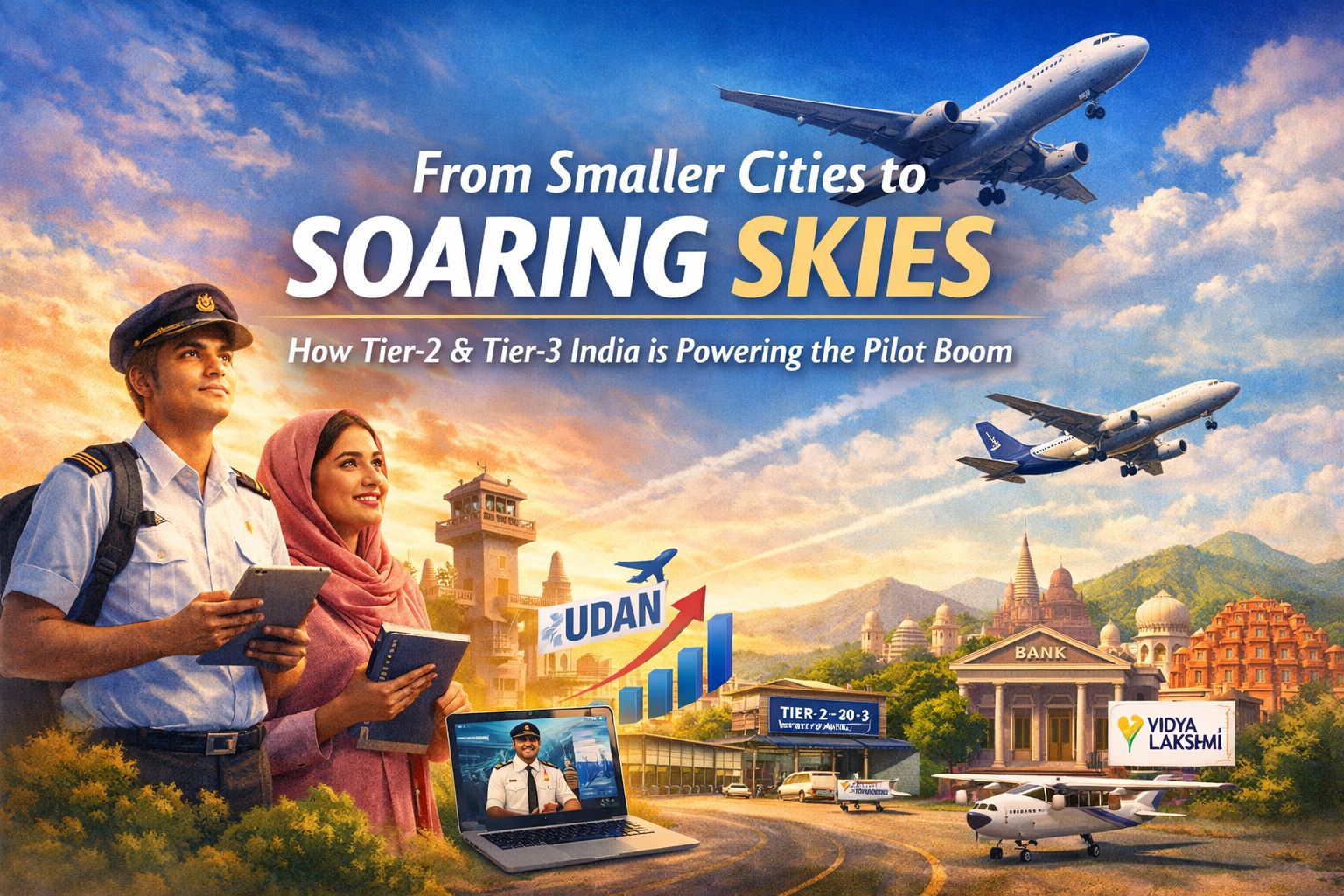
Introduction
For a long time, the dream of becoming an airline pilot seemed to belong mostly to students from India’s big cities. Metros like Delhi, Mumbai, and Bengaluru were seen as the only real gateways to serious training, information, and opportunities.
But that story is changing—and fast.
Across the country, students from Tier 2 and Tier 3 cities are not just catching up; in many cases, they’re leading the way. More cockpit seats on Indian airlines are now filled by young men and women from cities such as Jaipur, Lucknow, Indore, Coimbatore, Nagpur, Jammu, Latur, Srinagar, Guwahati and many others.
This isn’t a passing trend. It’s a powerful shift driven by aspiration, access, and an aviation ecosystem that’s finally reaching beyond the metros.
Quick Answer
India's aviation boom is no longer limited to Delhi, Mumbai, Bengaluru, and Hyderabad. Government initiatives such as UDAN, regional airport expansion, and airline fleet growth have created new opportunities for aspiring pilots from Tier 2 and Tier 3 cities. Many of India's leading flight schools are now located outside major metro areas, making pilot training more accessible and affordable.
How Tier 2 & 3 Cities Are Creating New Pilot Training Opportunities in India
If you talk to flying schools, airlines, or mentors who work closely with pilot aspirants, they’ll all tell you the same thing: the profile of the average Indian pilot aspirant has changed.
Earlier, most students came from big cities, often from families already familiar with professional courses or aviation-related careers. Today, it’s just as common—if not more so—to meet an aspiring pilot from a smaller town, whose family might be seeing an airline cockpit as a possibility for the very first time.
This regional shift is supported by massive local demand and improved infrastructure.
Regional Aviation Growth Metrics
| Metric | Detail / Value |
|---|---|
| CPLs Issued (2024) | 1,628 (Record High) |
| Estimated Annual Pilot Demand | 2,000+ by 2026 |
| Projected Pilots Needed (by 2030) | 25,000–30,000 |
| Key Driver Government Scheme | UDAN (Regional Connectivity Scheme) |
| Major Finance Partner | HDFC Credila (Education Loans) |
Here are the key factors driving this transformation across smaller towns in India:
1. The Digital Revolution: Information at Every Doorstep
The biggest game-changer has been simple: access to information.
Thanks to affordable smartphones and widespread internet access, a student in a small town now has almost the same access to guidance as someone in a metro area.
- Online Mentorship & Forums: Webinars, YouTube channels, online communities, and mentorship platforms now clearly explain the pilot career path—how to start, which exams to write, what it costs, and what to expect. Earlier, this kind of clarity was rare and often limited to those who had personal contacts in aviation.
- Virtual Ground Schools: Preparing for DGCA written exams used to mean shifting to a big city and paying for rent, food, transport, and coaching. Today, many high-quality ground schools offer live online classes, recorded lectures, and doubt-clearing sessions. Students can stay in their hometowns, save significantly on living expenses, and prepare effectively. This reduces the overall CPL Cost in India significantly.
In short, knowledge is no longer locked inside metro classrooms. It’s available to anyone willing to search, learn, and stay disciplined.
2. Government Vision: UDAN and Regional Connectivity
The government’s UDAN (Ude Desh ka Aam Naagrik) scheme has also played a quiet but powerful role in this shift.
By focusing on regional connectivity and reviving or building airports in smaller cities, UDAN has brought aviation much closer to everyday life for millions of Indians.
- Visible Role Models: When you grow up in a city with an airport, you see aircraft taking off and landing. You see pilots walking into terminals. For many students in Tier 2 and 3 cities, this used to be a rare sight. Now, with more regional airports becoming operational, the idea of “I can be a pilot too” feels far more real.
- Local Aviation Ecosystem: As more airports come up, so do related opportunities: ground operations, maintenance, airline services, and eventually, flying training. Aviation stops being an abstract concept and becomes a local industry that families can see and understand.
UDAN hasn’t just connected cities. It has connected aspirations.
3. The Rise of Local Flight Training Organisations (FTOs)
Until a few years ago, most Flight Training Organisations (FTOs) were clustered around big, busy airports. That meant higher costs, more competition for airspace, and greater logistical challenges.
Today, we’re seeing more FTOs being set up in non-metro regions, where airspace is less crowded and land and operational costs are relatively lower.
- Reduced Logistics & Costs: For families, this makes a huge difference. Students can begin their flying training closer to home, avoid expensive metro rents, and sometimes even commute from their own city or nearby. You can search verified regional training facilities in our comprehensive Flying Schools Directory.
- Community & Peer Support: Local FTOs often become small hubs of aviation energy. When multiple students from the same or nearby towns train together, they motivate one another, share notes, and create a supportive peer group—something that’s incredibly valuable in a demanding journey like pilot training.
This decentralisation of flying schools is quietly levelling the playing field for students outside the big cities.
Pilot Training in Metro Cities vs Smaller Cities
| Factor | Metro Cities | Tier 2 & 3 Cities |
|---|---|---|
| Living Cost | Higher | Lower |
| Airspace Congestion | Higher | Lower |
| Flying Delays | More Common | Less Common |
| Training Environment | Busy | Focused |
| Accommodation Cost | Higher | Lower |
4. Structured Cadet Pilot Programs & Financial Support
Another big factor in this shift is the rise of structured Cadet Pilot Programs run by airlines such as IndiGo, Air India, and Akasa Air.
These programs offer a defined, step-by-step path from student to airline cockpit, usually in partnership with selected flight schools in India and abroad.
- Assured Career Path (with Conditions): While no program can guarantee a job without meeting performance and regulatory standards, these cadet programs do offer a clear roadmap and, in many cases, a conditional offer of employment upon successful completion. For families, especially in Tier 2 and 3 cities, this clarity and structure bring peace of mind.
- Loan Facilitation: Pilot training is expensive, often in the range of ₹70–90 lakhs (or more, depending on the path chosen). Banks are now far more aware of these structured programs and are increasingly willing to offer education loans for them. Platforms like the Vidya Lakshmi portal also help students explore Pilot Education Loans.
When families see a recognised airline-backed pathway and formal loan options, the dream starts to feel financially possible—not just emotionally appealing.
5. Aspiration & Ambition: The Untapped Potential of Smaller Cities
Perhaps the most powerful factor, though, is something you can’t measure on a graph: hunger.
Across Tier 2 and Tier 3 India, there is immense, often untapped ambition. Many students from these cities grow up with a strong work ethic, grounded values, and a desire to create a better life for themselves and their families.
- Discipline & Focus: The journey to a CPL is not easy. It demands months of rigorous study, physical fitness, and long hours of flying and simulator sessions. Students must clear strict DGCA Medical Requirements and complex theory exams before being awarded their license. Students from smaller towns often bring a quiet discipline and determination to this process—qualities that serve them very well in aviation.
- Breaking Barriers: For many first-generation professionals, becoming a pilot is more than just a job. It’s a symbol of breaking through social, financial, or geographical limits. The pride it brings to their families and communities is immense—and this emotional fuel often sustains them through the toughest phases of training and exams.
This combination of hunger, discipline, and purpose is one of the biggest strengths of India’s emerging pilot talent pool.
Why Aviation Growth Is No Longer Limited to Metro Cities
For decades, commercial aviation in India was treated as an elite career path, largely because the infrastructure, information, and financial services required to enter the cockpit were concentrated in major metropolitan hubs. However, the rapid expansion of regional airport networks under the UDAN connectivity scheme has physically brought aviation closer to regional populations, creating highly visible pilot role models in Tier 2 and Tier 3 cities.
Simultaneously, the democratization of internet access has dismantled the information monopoly. Aspiring pilots can now access specialized online ground school training and mock exams from their hometowns, eliminating the massive accommodation and transport costs of living in metros like Delhi or Mumbai. Furthermore, flight training organizations are increasingly establishing themselves in regional areas with lower airspace congestion, providing greater flying efficiency and lower overall costs. Supported by customized pilot education loan products from major financial institutions, regional candidates now have the tools to achieve CPL qualifications purely based on academic merit, discipline, and performance.
Making Dreams Affordable: Our Partnership with Credila
One of the biggest questions every aspiring pilot and family faces is simple: “How will we fund this?”
We know that passion and potential are spread across every corner of India—but access to funds often isn’t. That’s why SAN The Pilots Compass is partnering with Credila, India’s largest education loan provider, to help aspirants across the country achieve their dream of becoming a pilot.
Through this partnership, aspiring pilots from metros, Tier 2, and Tier 3 cities can access:
- Tailored education loans designed specifically for high-investment courses like pilot training. You can learn more about finding resources through our guide on Pilot Education Loans.
- Nationwide reach, so students across India—not just in big cities—can apply
- Flexible repayment options that align better with future earning potential
- Guided support in understanding eligibility, documentation, and loan terms
Our goal is simple: if you have the talent, discipline, and desire to become a pilot, finances should not be the reason you give up on that dream.
With Credila as a trusted education finance partner and SAN The Pilots Compass as your career and training mentor, we’re working together to make the journey to the cockpit more accessible, structured, and achievable for students across the country.
The Road Ahead
The data backing this shift is compelling.
The DGCA issued a record 1,628 Commercial Pilot Licences in 2024, and projections suggest this number could cross 2,000 a year by 2026. A growing share of these licences is being earned by students from Tier 2 and Tier 3 cities.
At the same time, India’s demand for pilots is expected to keep rising sharply. By 2030, industry estimates suggest the country may need between 25,000 and 30,000 pilots to serve its expanding domestic and international network.
After completing their flying hours, many CPL holders proceed to dynamic preparation fields like the Airbus A320 or Boeing 737, where understanding Type Rating Cost is a critical next step.
Yes, pilot training still requires a significant financial investment. But with:
- more scholarships and exams,
- better awareness of loan options,
- structured airline cadet programs,
- accessible financing through partners like Credila, and
- easier access to guidance and mentorship,
Many families who once thought, “This is not for us,” are now beginning to say, “Why not my child?”
Calling All Aspiring Pilots
Do you dream of commanding the skies, but feel limited by where you live or what you know about the process?
At SAN The Pilots Compass, we believe talent has no postcode.
Whether you’re from a metro or a small town, our goal is to give you clarity, confidence, and a concrete plan:
- 1:1 Mentorship from experienced pilots and industry professionals. Check out Pilot Career Counselling to schedule a consultation.
- Structured career roadmaps from Class 10/12 to airline cockpit
- Guidance on exams, FTO selection, and Scholarships
- Support with finances, including understanding loan options and scholarships
- Global training partnerships that connect you to proven, reputable training pathways
If you’re serious about becoming a pilot, you don’t have to figure it out alone—and you don’t have to be from a metro to make it happen.
Ready to take the first step from your hometown to the flight deck?
Your journey might begin in a small city—but your destination can be anywhere in the world.
Key Takeaways
- Over 60% of new pilot trainees in India now originate from Tier 2 and Tier 3 cities.
- Access to online ground schools has significantly reduced the cost of CPL prep.
- The UDAN scheme has made aviation visible and aspirational in regional India.
- New flying schools (FTOs) are opening in non-metro areas with less congested airspace.
- Tailored education loans, such as our partnership with HDFC Credila, make training financially accessible.
Sources
Frequently Asked Questions
Map Your Custom Pilot Training Pathway
Evaluate your compliance across the 4 major DGCA training gates, select training country routes (India vs. USA/Europe), and estimate your CPL timeline month-by-month.