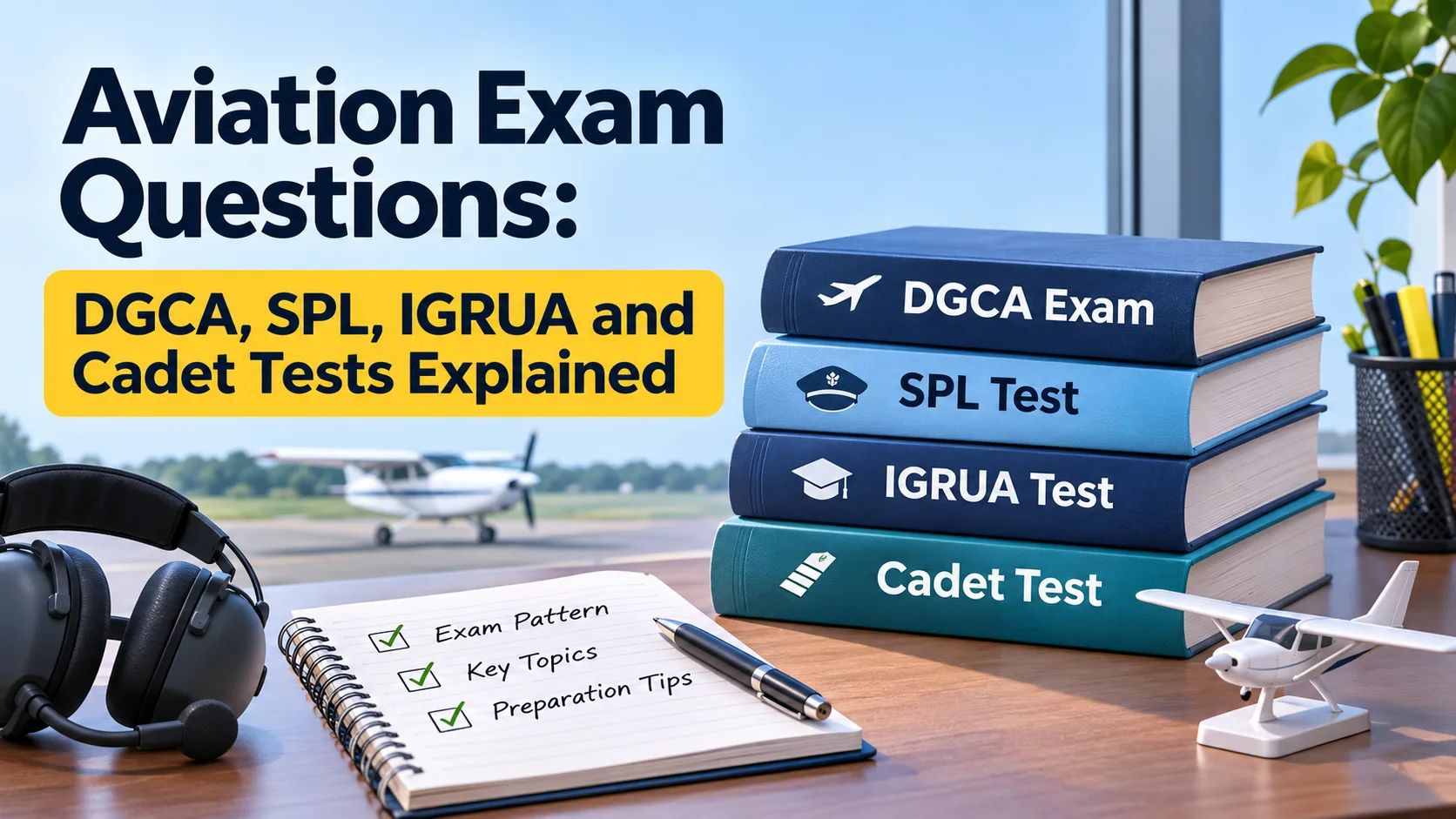
Aviation exam questions are not one pool. A pilot aspirant in India meets up to four kinds of exam: the Student Pilot Licence oral at a flying school, the DGCA CPL theory papers, entrance tests such as IGRUA's, and airline cadet aptitude tests. Each one asks different questions. Practising the wrong kind wastes months.
This page sorts the exams by name, says what each one asks (from DGCA's rules, IGRUA's advertisement and the airlines' own pages), and gives worked questions for each with the reason behind every answer. If you want a teacher for the DGCA papers, our DGCA CPL ground classes cover all of them.
The short answer: for a Commercial Pilot Licence you pass five DGCA multiple-choice papers (Air Navigation, Aviation Meteorology, Air Regulations, Technical General and Technical Specific) with 70% in each, plus the RTR (A) radio exam. Before your first solo, your flying school gives you an oral exam for the Student Pilot Licence. IGRUA's entrance test and airline cadet tests are separate selection exams with their own questions.
Key takeaways
- The "pilot exam" for a CPL is five DGCA theory papers plus RTR (A), each multiple choice, with 70% needed in each paper (CAR Section 7, Series B, Part I, paras 5.4 and 5.6).
- The Student Pilot Licence needs an oral exam in Air Regulations, Air Navigation, Meteorology and Aircraft and Engines, and the licence is issued by your flying club or school (Aircraft Rules 1937, Schedule II, Section B).
- IGRUA's 2026 entrance test was online and objective: General English, Maths, Physics, Reasoning and Current Affairs at 10+2 level, with no negative marking.
- Airline cadet programmes test aptitude (maths, reasoning, spatial and coordination skills), not the DGCA syllabus.
- DGCA does not publish past CPL papers or a question bank. Treat any "DGCA paper" you find as practice material, not the real paper.
Quick navigation
- Which pilot exam are you sitting?
- DGCA CPL papers: worked questions
- Student Pilot Licence oral: worked questions
- IGRUA entrance test: worked questions
- Airline cadet tests: worked questions
- Where to practise, and what to avoid
- How to review a practice paper
- Sources
Which pilot exam are you sitting?
Start with the exam name. The table lists the exams a student pilot in India is most likely to meet, in the order you usually meet them.
| Exam | Who sets it | What it asks | Format |
|---|---|---|---|
| Student Pilot Licence (SPL) oral | Your flying club or flying school, under DGCA's rules | Air Regulations, Air Navigation, Meteorology, Aircraft and Engines, at an elementary level | Oral |
| IGRUA CPL entrance (if you apply to IGRUA) | IGRUA | General English, Maths, Physics, Reasoning, Current Affairs (10+2 level), then interview and pilot aptitude or psychometric test | Online objective test, no negative marking |
| DGCA CPL theory papers | DGCA's Central Examination Organisation | Air Navigation, Aviation Meteorology, Air Regulations, Technical General, Technical Specific | Computer-based multiple choice, 70% to pass each paper |
| RTR (A) | DGCA | Radio telephony procedures and phraseology | Written exam, then a simulated practical; see our RTR (A) guide |
| Airline cadet selection | The airline or its partner school | Aptitude, maths, reasoning, English, personality, then interview | Online tests and interview; differs by airline |
| ATPL theory papers | DGCA | Air Navigation, Aviation Meteorology, Radio Aids and Instruments, Air Regulation and technical papers | Later in your career; see our ATPL exams guide |
To sit a DGCA paper you need a DGCA computer number from the Pariksha portal, and you pay Rs 2,500 per paper in a Regular session (DGCA Pariksha FAQs, checked 20 November 2026). Sessions, booking and fees are in our DGCA exam pattern 2026 guide, and every topic in every paper is in the DGCA exam syllabus 2026.
All the worked questions below were written by The Pilot's Compass for practice. None of them is from a DGCA, IGRUA or airline paper.
DGCA CPL papers: worked questions
DGCA CPL papers are multiple choice (CAR Part I, para 5.4). Many questions describe a situation and ask you to apply a rule or a formula, so knowing why the answer is right matters more than remembering it. DGCA's exam instructions for each session allow a navigation computer and a scientific calculator without multiple memory only for Air Navigation and the composite and FDEG papers (para 10), so in the CPL you do Meteorology, Air Regulations and the Technical papers without one.
1. Air Navigation: time from ground speed
An aircraft has a true airspeed of 120 kt and a ground speed of 100 kt. How long does it take to fly 50 nautical miles?
Answer: 30 minutes. Time is distance divided by ground speed, not true airspeed: 50 ÷ 100 = 0.5 hours. Using 120 kt would give 25 minutes, the most common wrong option.
2. Air Navigation: distance along a meridian
Two places are on the same meridian, one at 12°N and one at 15°N. How far apart are they?
Answer: 180 nautical miles. One degree of latitude along a meridian is 60 nautical miles, and the difference is 3 degrees.
3. Meteorology: ISA temperature
In the International Standard Atmosphere, what is the temperature at 10,000 ft?
Answer: about -5°C. ISA starts at +15°C at mean sea level and falls by about 2°C for every 1,000 ft (1.98°C exactly): 15 - 19.8 = -4.8°C.
4. Air Regulations: right of way
Two aeroplanes are converging at about the same level. Which one gives way?
Answer: the one that has the other aircraft on its right. This is the converging rule in the Rules of the Air. For a full set of rule-based questions, see the 10 worked questions in our Air Regulations guide.
5. Technical General: stall speed and weight
An aeroplane's weight goes up by 21%. What happens to its stalling speed?
Answer: it rises by 10%. Stall speed changes with the square root of the weight, and the square root of 1.21 is 1.1. More worked questions are in our Technical General guide.
6. Meteorology: altimeter setting
With QNH set on the altimeter, what does it read when the aircraft is on the runway?
Answer: the aerodrome elevation, which is the height above mean sea level. QFE would read zero on the runway. For weather reports, practise with real Indian METARs and TAFs.
For a much bigger set of navigation problems, use our Air Navigation practice questions, and for Meteorology, the worked questions in our Meteorology guide.
Student Pilot Licence oral: worked questions
Aircraft Rules 1937, Schedule II, Section B, says an SPL applicant must be at least 16, have passed Class 10, hold a medical and "pass oral examination in Air Regulations, Air Navigation, Aviation Meteorology and Aircraft and Engines". The licence is issued by a flying club or government flying training school authorised for it, so this oral is held at your school, usually before your first solo. These questions match that level.
1. What an SPL holder may not do
Can a Student Pilot Licence holder carry a friend as a passenger?
Answer: no. Section B, para 5, says an SPL holder must not carry passengers, animals or goods, or fly for any payment. They fly only under visual flight rules, only within India, and always under the supervision of a flight instructor or an approved examiner.
2. Before the first solo cross-country
What must a student pilot have before flying a cross-country on an SPL?
Answer: at least 10 hours of solo flight time and passes in Air Navigation and Aviation Meteorology (Section B, para 5(d)).
3. Aircraft and Engines: carburettor heat
What does the carburettor heat control do on a piston training aircraft?
Answer: it sends warm air into the carburettor to prevent or remove carburettor icing. Icing can form even on a warm, humid day, because air cools as it speeds up through the carburettor.
4. Meteorology: the thunderstorm cloud
Which cloud type brings thunderstorms, and why should a student pilot keep clear of it?
Answer: cumulonimbus (CB). It brings severe turbulence, heavy rain, hail, icing, lightning and strong gusts near the ground.
IGRUA entrance test: worked questions
IGRUA's CPL entrance advertisement for 2026 lists the written test as online and computer-based, with "General English, Mathematics, Physics, Reasoning & Current Affairs (10+2 level objective type questions only and No negative marking)". Selection also counts your Class 12 marks in Physics, Maths and English, English proficiency, an interview and a pilot aptitude or psychometric test. Check the current advertisement on IGRUA's site before you apply, because dates and details change each year. For fees, seats and the course itself, see our IGRUA page.
These questions are at 10+2 level, like the syllabus line above.
1. Physics: distance under constant acceleration
A body starts from rest and accelerates at 2 m/s². How far does it travel in 5 seconds?
Answer: 25 m. Use s = ut + ½at², with u = 0: ½ × 2 × 5² = 25 m.
2. Maths: average speed
A car travels the same distance at 40 km/h and then back at 60 km/h. What is its average speed?
Answer: 48 km/h, not 50. For equal distances, average speed = 2ab ÷ (a + b) = 2 × 40 × 60 ÷ 100 = 48. The car spends longer at the slower speed.
3. English: subject-verb agreement
Choose the correct word: "Neither the captain nor the cadets ___ ready for the briefing."
Answer: "were". With "neither ... nor", the verb agrees with the nearer subject, and "cadets" is plural.
4. Reasoning: number series
What comes next: 2, 6, 12, 20, 30, ?
Answer: 42. The terms are 1×2, 2×3, 3×4, 4×5, 5×6, so the next is 6×7.
Airline cadet tests: worked questions
Airline cadet programmes select with aptitude tests and an interview, not with DGCA-style papers. IndiGo's partner school Chimes lists an ADAPT assessment stage for the IndiGo programme, and Air India describes an online assessment of cognitive and behavioural skills followed by an interview. Each airline's own page is the only reliable source for its current process. We cover both in detail: IndiGo cadet programme and ADAPT test prep and Air India cadet programme and test prep. For what each type of aptitude test measures, see our pilot aptitude tests guide.
These questions practise the mental maths and orientation that aptitude tests use. Work them without a calculator.
1. Fuel for a flight
An aircraft burns 2,400 kg of fuel an hour. How much does it burn in 1 hour 45 minutes?
Answer: 4,200 kg. 1 hour 45 minutes is 1.75 hours, and 2,400 × 1.75 = 4,200. A quicker way: 2,400 + 1,200 + 600.
2. Distance in a given time
At a ground speed of 300 kt, how far does an aircraft fly in 20 minutes?
Answer: 100 nautical miles. 300 kt is 5 nautical miles a minute, and 5 × 20 = 100.
3. Heading after a turn
You are flying a heading of 090°. You turn right through 135°. What is your new heading?
Answer: 225°. Right turns add to the heading: 90 + 135 = 225. Had the total gone over 360, you would subtract 360.
If you want to check your general aptitude first, our pilot aptitude test gives a starting point. It is not an airline's test, and a result there does not predict a cadet selection.
Where to practise, and what to avoid
DGCA's syllabus, study list and exam instructions do not include past papers or a question bank. So any "DGCA CPL paper", "pilot exam question paper" or "question bank PDF" you find online was made by a coaching provider or a publisher, or put together from memory by students. It can still be useful, but only after you have learned the subject, and only if you check each answer against the rule in your book. An old answer may be based on a rule that has since changed.
For practice that explains the answers, use these pages on our site:
- Air Navigation practice questions for navigation problems worked step by step
- 10 worked Air Regulations questions
- 10 worked Technical General questions
- Meteorology worked questions and METAR and TAF practice
- Worked ATPL-style questions for later
Be careful with anyone who promises the "real" DGCA questions or a guaranteed pass. DGCA sets the papers, and no one outside it can sell them.
How to review a practice paper
Your score matters less than the reason you lost each mark. After every practice set, sort your wrong answers into these four groups:
| What went wrong | How it shows | What to do |
|---|---|---|
| A gap in the subject | You did not know the topic | Go back to the chapter, then try easier questions |
| A misread question | You missed "not", "except" or a unit | Read the last line of the question first, and mark the units |
| A calculation slip | Your method was right, the number was wrong | Redo the sum slowly, then do five more like it |
| Running out of time | You knew the answer when you looked later | Practise short timed sets of 10 questions |
Keep one notebook for wrong answers and read it before each new set. Over a few weeks, the same groups keep coming up, and that tells you what to study next.
Who this page is not for
This page is not a set of real DGCA papers, and it does not try to replace a full subject course. If you are looking for leaked or "repeated" questions to memorise, it will not help you, and that approach fails once a question describes the same rule in a new way. It is also not for helicopter, glider or drone licences, whose exams differ.
How our ground classes help with DGCA papers
Our DGCA CPL ground classes teach all five CPL papers. Classes are online, with a classroom option in Bengaluru. See the next batch date on the course page, or message us on WhatsApp from there.
Sources
- Aircraft Rules 1937, Schedule II, Section B: Student Pilot's Licence (DGCA website), checked 23 November 2026. Para 1 (age 16, Class 10, medical, oral in Air Regulations, Air Navigation, Aviation Meteorology and Aircraft and Engines), para 5 (privileges and limits, including 5(d) on cross-country flights) and the note that a flying club or government flying training school issues the licence.
- Aircraft Rules 1937, Schedule II, Section J: Commercial Pilot's Licence (Aeroplanes) (DGCA website), checked 23 November 2026. Para 1(d), the written and signals examinations.
- DGCA, CAR Section 7, Series B, Part I, Issue III, Revision 2, 13 February 2019: Eligibility criteria for examinations. Paras 5.1 (papers), 5.4 (multiple choice) and 5.6 (70% pass mark).
- DGCA, Instructions for FC, AME and RTR examination, OLODE Session 07 of 2026, on the Pariksha notice board, checked 23 November 2026. Para 10: navigation computers and scientific calculators without multiple memory for Air Navigation, FDEG and composite papers.
- DGCA Pariksha FAQs (flight crew), checked 20 November 2026. Rs 2,500 per paper, not refundable.
- IGRUA, CPL Entrance 2026 advertisement. Section 4, selection process: written test syllabus, interview and pilot aptitude or psychometric test.
- Chimes Aviation Academy: IndiGo cadet pilot programme, checked 13 November 2026. The ADAPT stage.
- Air India Cadet Pilot Programme. The online assessment of cognitive and behavioural skills and the interview.
Exam rules, fees and selection steps can change through new notices. From 1 January 2027 the Bharatiya Vayuyan Niyam, 2026 replaces the Aircraft Rules, 1937 (PIB, 4 November 2026), so rule and section numbers on this page may change from that date. Check DGCA's Pariksha portal, IGRUA's site and the airline's own page before you apply.
Continue reading
Frequently Asked Questions
Map Your Custom Pilot Training Pathway
Evaluate your compliance across the 4 major DGCA training gates, select training country routes (India vs. USA/Europe), and estimate your CPL timeline month-by-month.