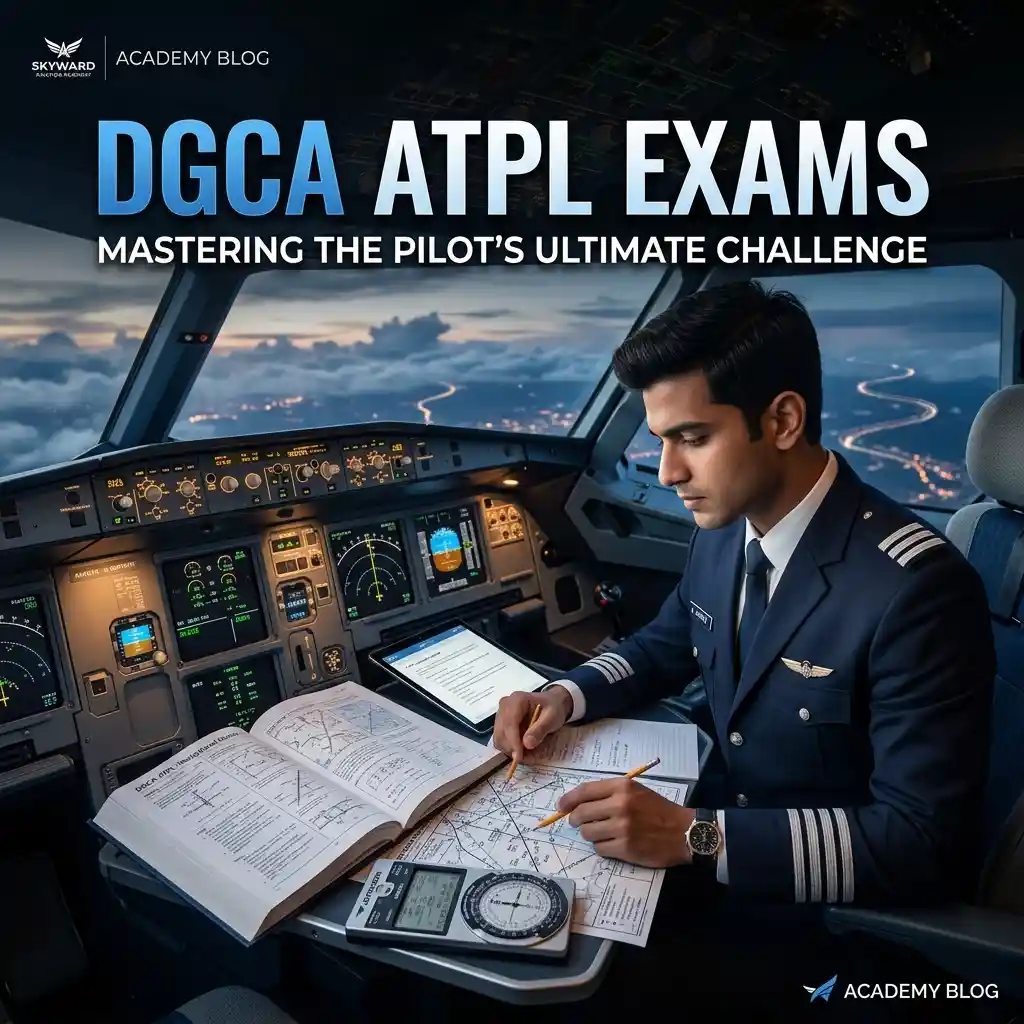
The short version: The Airline Transport Pilot Licence (ATPL) is the highest level of flight crew licence for airline operations in India. To clear the theory phase, candidates must score at least 70% on the written papers for Air Navigation, Radio Aids & Instruments, and Aviation Meteorology, plus pass oral exams for Navigation and Radio Aids. The results remain valid for 5 years for licence issuance.
Getting your CPL is a major milestone, but if your goal is the left seat of an airliner, you will eventually face the DGCA ATPL exams.
Many pilots assume the airline transport pilot licence exams are just a harder version of what they studied for their Commercial Pilot Licence. That assumption can leave candidates underprepared for the depth and application required in ATPL examinations. The ATPL papers require a deep, functional understanding of high-altitude weather, complex jet navigation, and advanced instrumentation.
You need a strategy.
Key Takeaways
- Three ATPL Subjects: The DGCA ATPL examinations cover Air Navigation, Radio Aids & Instruments, and Aviation Meteorology. Air Navigation and Radio Aids & Instruments also feature oral components.
- 70% Passing Requirement: Candidates must score a minimum of 70% on the written objective component of each subject, and clear the oral examinations where applicable.
- Valid for 5 Years: Once cleared, your ATPL exam results remain valid for a rolling period of 5 years to apply for your license.
- Frozen ATPL Concept: Passing the theory exams allows you to hold a "frozen ATPL". The license is "unfrozen" once you complete the 1,500 hours of flight experience required for license issuance.
Quick Navigation
- What exactly are the ATPL exams?
- Who can appear for the DGCA ATPL exams?
- What is the DGCA ATPL exam pattern?
- How are ATPL exams different from CPL exams?
- How should you prepare for ATPL papers?
- How long does it take to prepare for DGCA ATPL exams?
- What are the common ATPL preparation mistakes?
- Frequently Asked Questions
What exactly are the ATPL exams?
The Airline Transport Pilot Licence (ATPL) is the highest level of flight crew licence for airline operations in India's civil aviation licensing framework. While your CPL allows you to act as a First Officer, the ATPL is legally required to command (be the Captain of) a multi-crew commercial aircraft.
Before you can upgrade to Captain, you must pass the written theory examinations conducted by the Directorate General of Civil Aviation (DGCA) under the DGCA Pariksha Portal.
You do not need to wait until you have 1,500 hours of flight time to write the exams. Many pilots choose to clear their ATPL papers immediately after finishing their CPL training while the academic mindset is still fresh.
Once you pass the theory papers, you hold a "frozen ATPL". This means your exam results are locked in, and the license will become fully active ("unfrozen") once you log the mandatory 1,500 hours of total flight time along with other experience requirements set by the DGCA.
Who can appear for the DGCA ATPL exams?
The eligibility requirements for appearing in DGCA ATPL examinations are different from the requirements for actually being issued an ATPL. Passing the theory examinations does not by itself grant the licence.
Candidates should check the current DGCA eligibility requirements under CAR Section 7, Series B, Part I before applying for an ATPL examination, including the applicable licence, medical, and flying-experience requirements.
It is also important to understand that you do not necessarily have to wait until you have completed all the flight-experience requirements (like the 1,500-hour total flying hours) for the ATPL licence before beginning your examination preparation. However, meeting the examination requirements and meeting the requirements for licence issuance are separate steps.
If you are currently working toward a CPL, building a strong foundation in Navigation, Meteorology, and Instruments can make the transition to ATPL-level preparation easier.
What is the DGCA ATPL exam pattern?
The DGCA ATPL examinations cover three main subjects, each requiring a minimum passing score of 70%. The exams are computer-based multiple-choice papers, and certain subjects also feature a mandatory oral/viva examination component:
- Air Navigation: Scored out of 100 marks (90 marks objective written exam + 10 marks oral exam). Covers general navigation, plotting, earth geometry, flight planning, wind calculations, and mechanical/digital flight computer practice (CRP-5 or CX-3).
- Radio Aids & Instruments: Scored out of 100 marks (90 marks objective written exam + 10 marks oral exam). Covers advanced cockpit instrumentation, autopilot, Flight Management Systems (FMS), EFIS, VOR, ILS, DME, ADF, and GNSS navigation systems.
- Aviation Meteorology: Scored out of 100 marks (entirely objective written exam). Covers global weather systems, climatology, upper-air charts, jet streams, windshear, and interpretation of METAR, TAF, and SIGMET reports.
Candidates should check the latest DGCA Pariksha Portal notifications for up-to-date schedules, fees, and syllabus outlines.
Rather than preparing for all three subjects in exactly the same way, divide your preparation according to the nature of each subject:
- Air Navigation: Focus on calculations, concepts, flight planning, and repeated problem-solving practice. For basics, review the CPL Air Navigation guide.
- Radio Aids & Instruments: Build a strong understanding of radio navigation systems, instruments, and their practical operation.
- Aviation Meteorology: Focus on weather systems, upper-air information, aviation weather reports, and interpretation of meteorological data. Brush up on meteorology basics if needed.
Understanding the examination structure before starting preparation helps you allocate your study time more effectively.
How are ATPL exams different from CPL exams?
ATPL examinations build on the knowledge developed during CPL training, but candidates should expect greater emphasis on applying that knowledge to more complex operational situations.
CPL preparation gives pilots the foundation they need in subjects such as Navigation, Meteorology, and Instruments. ATPL preparation requires candidates to take that foundation further and apply it to more advanced operational scenarios.
The biggest difference is not simply the amount of information you need to memorize. Candidates should be prepared to interpret information, perform calculations accurately, and understand how different systems and conditions affect flight operations.
If your CPL fundamentals are weak, spend time strengthening them before moving into ATPL-level preparation. This is particularly important for Air Navigation, where small calculation errors can affect the final answer.
Note: If you need a refresher on the basics, you might want to review the DGCA exam pattern for CPL subjects.
How should you prepare for ATPL papers?
Both self-study and structured ground training can be used to prepare for ATPL examinations. The concepts are dense, and instructor-led training can help clarify complex navigation concepts and provide structured practice.
- Start with Meteorology: If you are already comfortable with the CPL-level concepts, Meteorology can be a practical subject to begin with before moving into the more calculation-intensive areas of Navigation.
- Master the basics first: Do not attempt ATPL Navigation if your basic CPL navigation concepts are weak.
- Practice timed exams: Build speed and accuracy by solving questions under realistic time limits.
- Review your mistakes: Keep a record of incorrect answers and revisit the underlying concept rather than memorizing the correct option.
- Use official and reliable study material: Build your preparation around the applicable DGCA syllabus and prescribed/reference material, then use additional resources for practice and clarification.
How long does it take to prepare for DGCA ATPL exams?
There is no fixed preparation period that works for every candidate. Your preparation time will depend on your CPL-level knowledge, previous examination experience, available study time, and familiarity with calculations and aviation theory.
Candidates who are already comfortable with their CPL subjects may be able to move into ATPL preparation more quickly. Others may need additional time to rebuild their fundamentals before tackling the more demanding parts of Air Navigation and Instruments.
Instead of focusing only on a specific number of weeks, set measurable preparation goals. For example, complete one topic, practise a defined set of questions, review your mistakes, and then attempt a timed mock examination.
For Air Navigation in particular, consistent practice is usually more useful than long but irregular study sessions.
What are the common ATPL preparation mistakes?
Relying entirely on rote learning or memorized question banks can leave candidates unprepared for application-based questions. Understanding the underlying concepts is particularly important for calculation-heavy areas such as Air Navigation.
Give yourself enough preparation time to build accuracy and speed, particularly for Air Navigation, rather than relying on last-minute revision.
Frequently Asked Questions
Map Your Custom Pilot Training Pathway
Evaluate your compliance across the 4 major DGCA training gates, select training country routes (India vs. USA/Europe), and estimate your CPL timeline month-by-month.