
The short version: The IndiGo Cadet Pilot Program selection combines Symbiotics ADAPT computer testing, group discussions, and an airline personal interview. At The Pilot's Compass, our airline mentor pilots train candidates on timed mental math, cockpit multitasking, and CRM interview reasoning to clear every selection round.
Quick Navigation
- What Is the IndiGo ADAPT Test?
- What Does the ADAPT Test Assess?
- IndiGo ADAPT Test Preparation Strategy
- Hands-On Simulator Training for Pilot Aptitude
- IndiGo Cadet Program Selection Process
- How to Prepare for the IndiGo Pilot Personal Interview
- Common IndiGo Pilot Interview Questions
- How to Prepare for the Group Discussion
- Common Group Discussion Topics for Pilot Selection
- 30-Day IndiGo Cadet Program Preparation Plan
- Common Mistakes to Avoid
- Frequently Asked Questions
What Is the IndiGo ADAPT Test?
The ADAPT test, developed by British aviation psychology firm Symbiotics, is an adaptive assessment platform used by global airlines to evaluate pilot aptitude. For candidates applying to the IndiGo Cadet Pilot Program, it acts as the primary screening gateway before personal interviews and group assessments.
Cadet pilot programs partnered with approved Flight Training Organizations (FTOs)—such as CAE, Insight Aviation, Skyborne, and Chimes Aviation Academy, among others—frequently utilize comprehensive computer-based aptitude testing suites like ADAPT. The assessment does not measure how well you memorized pilot ground school textbooks; instead, it evaluates how effectively you process raw cockpit data under pressure.
The test adapts to your inputs. Answer a question correctly, and the system serves a harder item. Make an error, and the difficulty adjusts. Testing takes between 90 and 120 minutes on a desktop workstation. Because the system tracks response speed down to the millisecond, guessing blindly hurts your consistency score.
During my years mentoring pilot aspirants, I have seen candidates with 95% marks in Class 12 mathematics fail the ADAPT test. They stumbled because they tried to solve questions using long formula sheets instead of practicing rapid visual estimation. Flight training organizations look for innate capacity to process multiple data streams while maintaining situational awareness.
What Does the ADAPT Test Assess?
The assessment measures cognitive processing, physical coordination, personality suitability, and operational multitasking. Airlines evaluate these traits because commercial jet cockpits demand fast, disciplined decisions during high-workload phases like departures and landings.
| Module Name | Core Pilot Skill Tested | Assessment Format |
|---|---|---|
| Numerical Reasoning | Rapid mental arithmetic, fuel burn, time-speed-distance | 20-25 timed questions without a calculator |
| Spatial Orientation | 3D mental rotation, attitude indicator interpretation | Cockpit instruments paired with aircraft silhouettes |
| Memory & Attention | Short-term working memory, audio callout retention | Memorizing ATC frequencies while completing visual tasks |
| Coordination & Flight Control | Hand-eye-foot fine motor control | Tracking flight director crosshairs using joystick and rudder |
| Personality Profile | Emotional stability, teamwork, coachability | 100+ forced-choice behavioral statements |
The platform benchmarks candidate performance against standardized pilot aptitude matrices. While cutoff thresholds vary across individual cadet intakes and partner flight school criteria, candidates typically aim for strong benchmark scores (often reported in upper percentiles across core cognitive and tracking modules) to advance to the interview round.
IndiGo ADAPT Test Preparation Strategy
Succeeding in the assessment requires targeted training across five fundamental cognitive areas. Spend time each day on specific skill drills rather than taking random tests.
Numerical Reasoning
Aviation math tests practical logic, not theoretical calculus. You cannot bring a calculator into the testing room. Every calculation must happen on scrap paper or in your head within 45 to 60 seconds per item.
Key problem patterns include:
- Time, Speed, Distance: Calculating estimated time of arrival (ETA) when ground speed changes due to headwinds or tailwinds.
- Fuel Consumption: Estimating remaining flight endurance based on burning 2,400 kg of fuel per hour with 5,800 kg total fuel on board.
- Descent Rates: Calculating required rate of descent in feet per minute using standard 3-degree glide paths.
- Ratios and Unit Conversions: Converting nautical miles to kilometers, pounds to kilograms, and US gallons to liters.
Sample Numerical Question:
An Airbus A320 cruises at a ground speed of 420 knots. It is currently 147 nautical miles from the destination waypoint. How many minutes will it take to reach the waypoint?
Step-by-step solution:
- Calculate nautical miles covered per minute: 420 knots divided by 60 minutes = 7 nautical miles per minute.
- Divide distance by miles per minute: 147 nautical miles divided by 7 = 21 minutes.
- Target completion time: Under 30 seconds without writing out lengthy division.
Logical Reasoning
Logical tests evaluate your pattern recognition and deductive reasoning. You will encounter sequence completion, matrix puzzles, and rule-based statement problems.
Candidates often waste time looking for convoluted mathematical relationships when the pattern is geometric. Look for:
- Alternating rotations (such as 45-degree and 90-degree shifts).
- Shading changes across columns or rows.
- Elements being added or removed sequentially.
When approaching deductive reasoning statements, take the given premises as absolute truth. Avoid bringing outside knowledge into logical syllogisms. If the problem states that all aircraft are gliders and some gliders are helicopters, work strictly within those boundaries.
Memory & Concentration
Working memory directly relates to how a pilot copies Air Traffic Control (ATC) instructions. During the test, you will listen to an audio feed reading out flight numbers, headings, altitudes, and squawk codes.
Simultaneously, the screen will ask you to solve simple arithmetic sums or track visual symbols. After 30 to 45 seconds, the test prompts you to type the heading and transponder code given earlier.
To build this capacity:
- Practice chunking numbers. Treat an assigned squawk code like
4721as two paired digits: "forty-seven, twenty-one". - Repeat values sub-vocally once, store them mentally, and focus immediately on the secondary visual task.
- Use mobile brain-training apps for N-back recall drills 15 minutes daily.
Spatial Awareness
Spatial awareness assesses your mental model of an aircraft's position in three-dimensional airspace. The most common format shows an Artificial Horizon (Attitude Indicator) and asks you to select the matching aircraft silhouette from four exterior views.
Pilots must instantly differentiate between pitch (nose up or down) and bank (left or right wing low):
- Pitch attitude: Pitch is determined by the position of the aircraft reference symbol relative to the artificial horizon line. When the miniature aircraft is above the horizon line (in the blue sky), the nose is pitched up; when below (in the brown ground), the nose is pitched down; and when aligned with the horizon bar, the aircraft is in level pitch.
- Bank / Roll attitude: The bank angle is indicated by the tilt of the artificial horizon relative to the miniature aircraft symbol (and along the roll scale pointer). When the aircraft banks to the left, the miniature aircraft tilts left relative to the artificial horizon (or the horizon line appears tilted with the right side lower relative to the aircraft symbol).
- Practice visualizing the instrument from inside the cockpit seat rather than viewing the screen as an external observer.
Problem-Solving & Multitasking
The physical multitasking module is the most challenging component of the Symbiotics suite. Candidates sit with a joystick and sometimes rudder pedals or throttle levers.
A moving reticle drifts across the screen. You must use the stick to keep the dot centered inside a target circle. While controlling the stick, colored boxes flash in the corner of your screen, requiring keyboard button taps. Simultaneously, simple audio math questions play through your headset.
Candidates fail this module when they freeze. If you drop the crosshair to calculate an audio sum, your flight control score plummets. Maintain primary control of the joystick 70% of the time, dedicating quick 30% glances to secondary alerts. Aviation psychologists call this your "instrument scan".
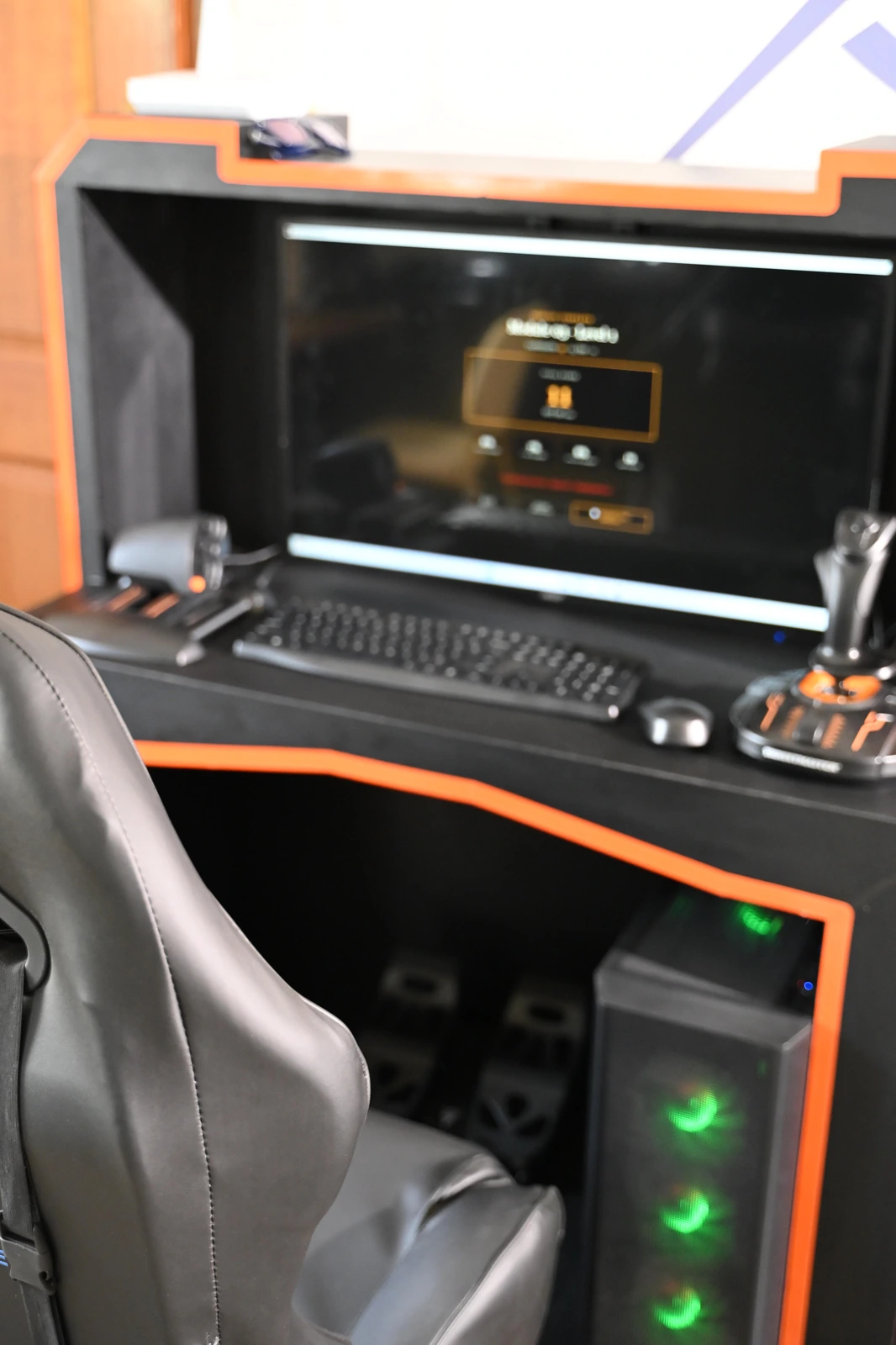
Multi-axis flight stick, throttle quadrant, and high-precision rudder pedals at The Pilot's Compass—used to train fine motor control and cross-axis tracking required in cadet aptitude tests.
Reviewing our foundational commercial pilot training guide will help you understand how flight schools evaluate these primary cockpit skills.
Hands-On Simulator Training for Pilot Aptitude & Flight Controls
While candidates can prepare for numerical and logical reasoning on desktop screens, the physical flight control and psychomotor tracking modules are where many applicants stumble. Testing platforms like Symbiotics ADAPT evaluate your sub-second neuro-muscular reactions, fine pressure modulation, and divided attention across multiple sensory channels.
To succeed in the physical tracking components of the ADAPT test (as well as defense CPSS assessments), pilot aspirants must develop authentic muscle memory before stepping into the high-stakes evaluation room.
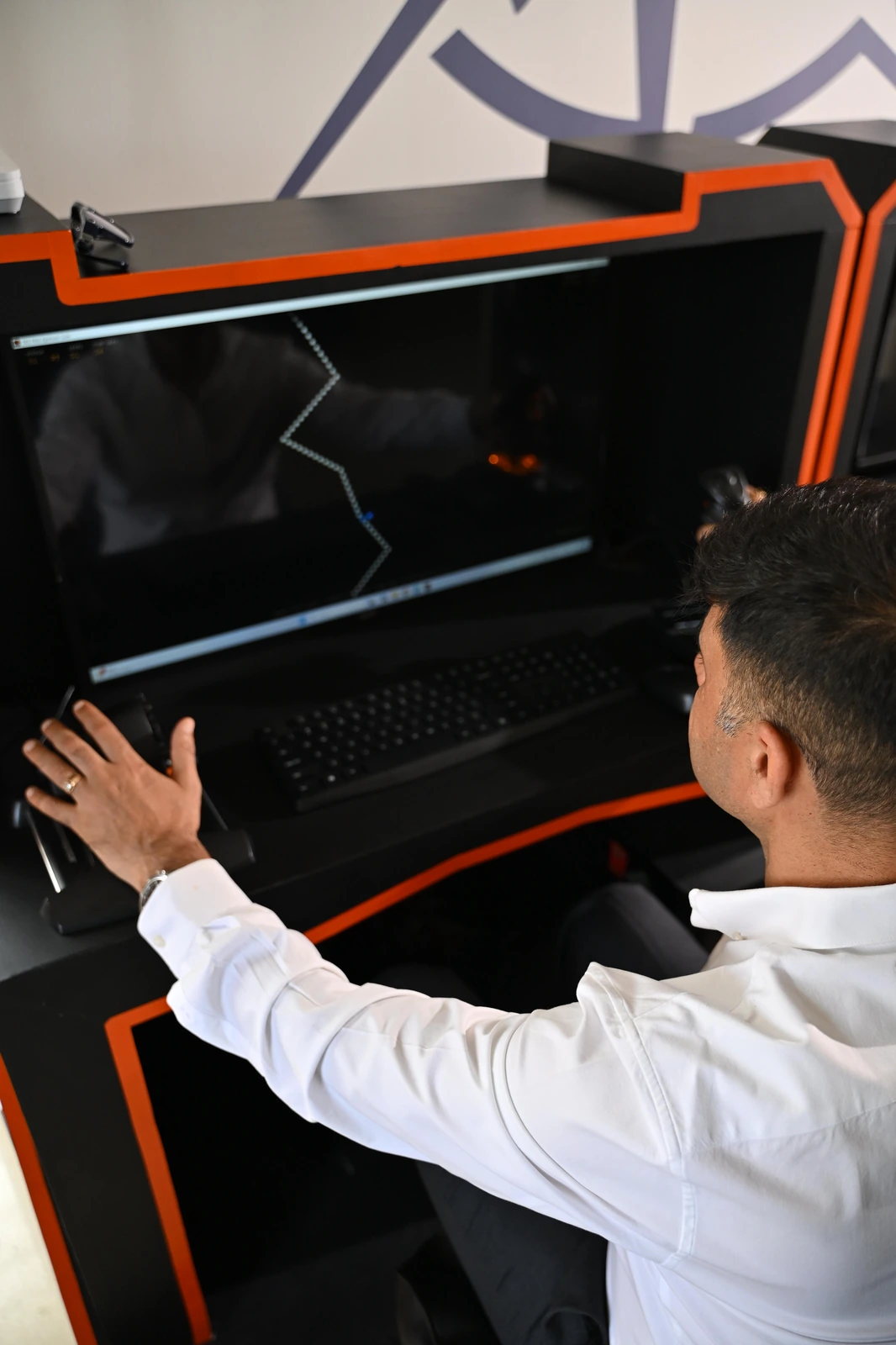
Psychomotor Tracking Drills: Cadets learn continuous, measured pressure modulation to keep dynamic crosshairs centered without erratic over-controlling.
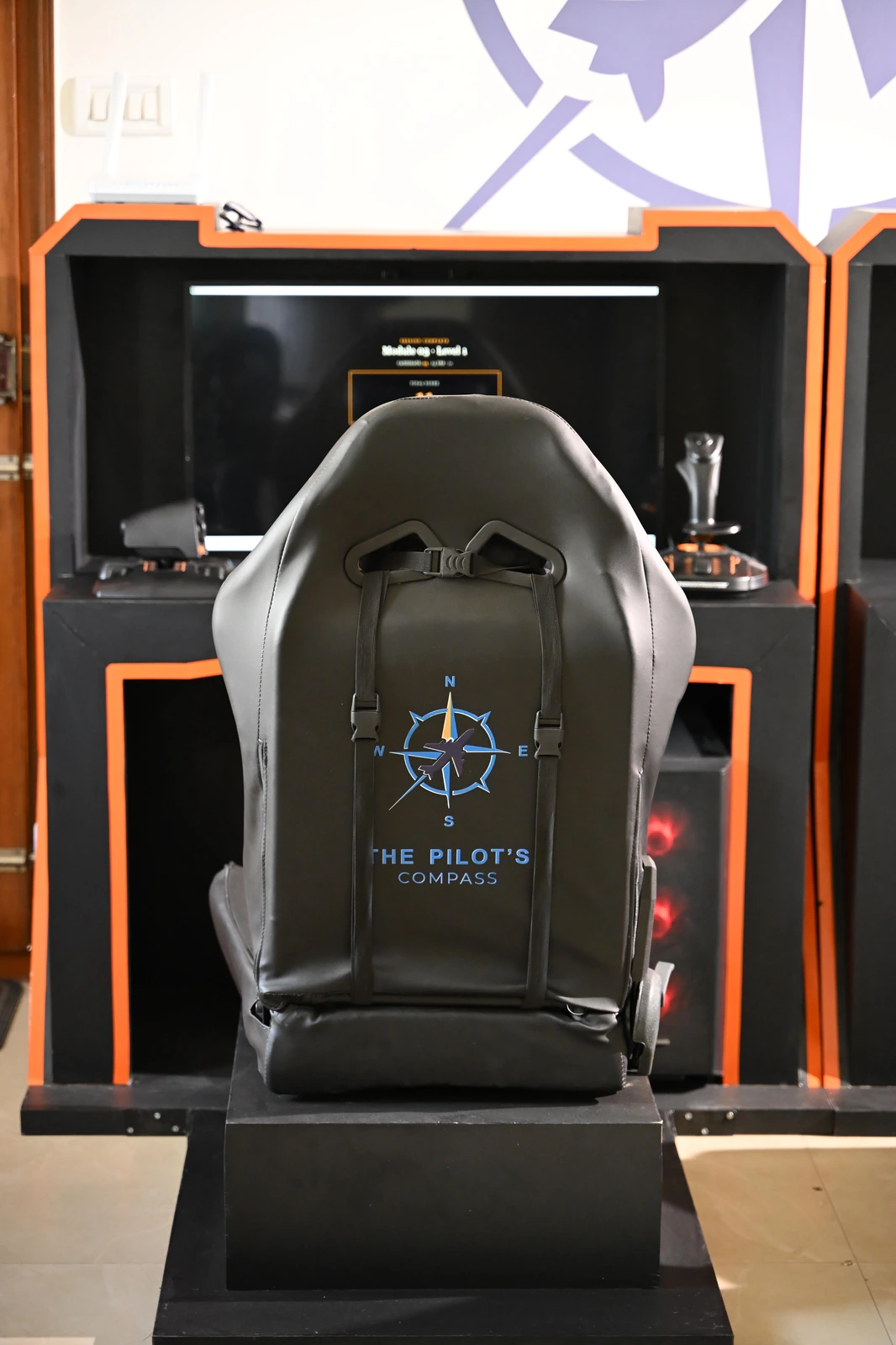
Ergonomic Flight Station: Recreates glass-cockpit physics, peripheral visual cues, and simultaneous auditory distraction drills.
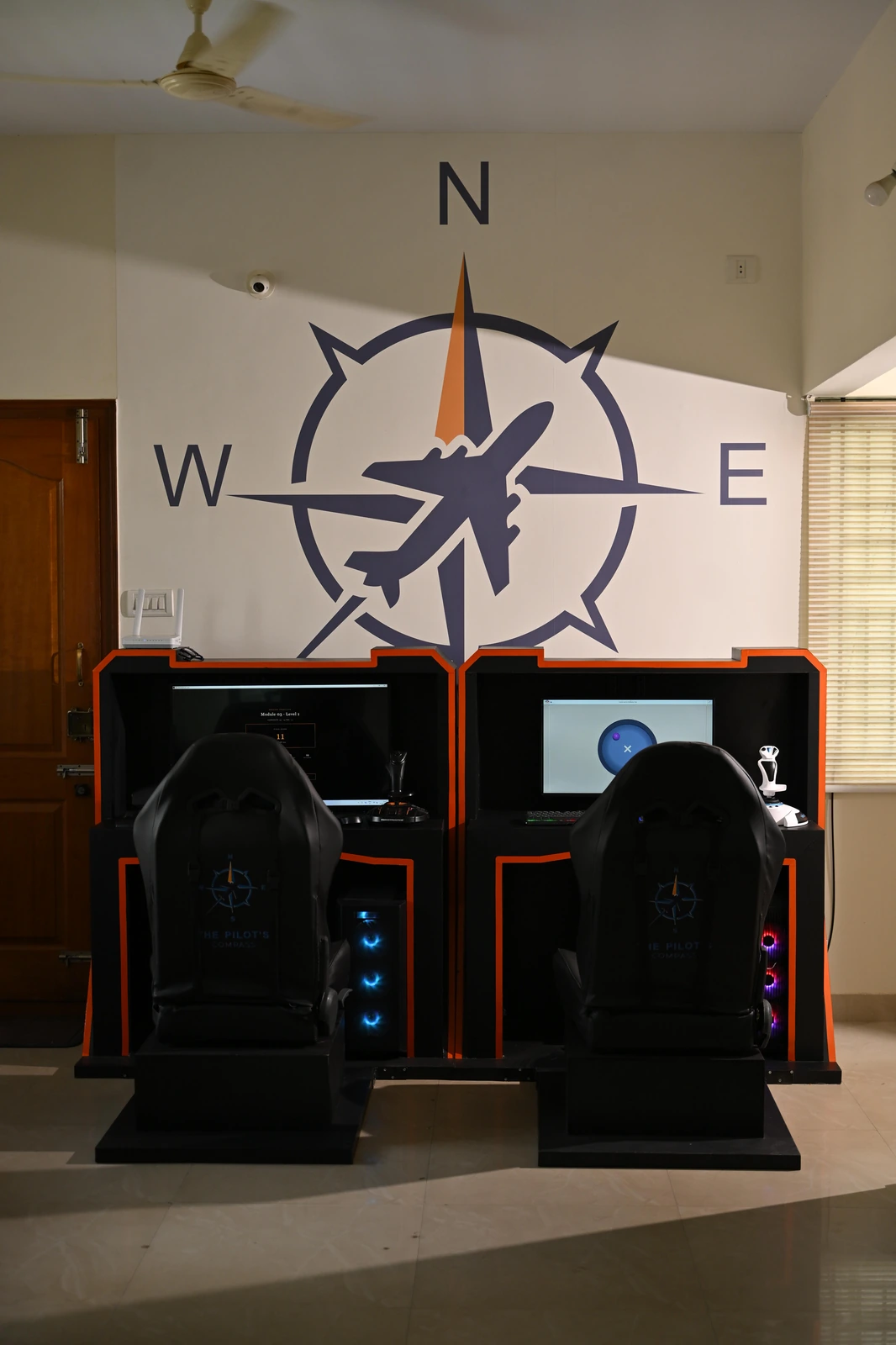
The Pilot's Compass Aptitude Facility: Specialized pilot aptitude simulator suite located in South India (Bangalore), mentored by veteran military and airline aviators.
Why Simulator Practice Is Essential for Cadet Selection
Flying aptitude tests do not measure how well you play casual video games. The algorithms analyze your control curve, rate of correction, and ability to prioritize primary flight dynamics during unexpected disruptions:
- Develop Multi-Axis Psychomotor Control: Standard desktop practice using a keyboard or mouse fails to develop cross-limb motor synchronization. Our dedicated flight control rigs train your hands (pitch and roll) and feet (rudder yaw) to operate synchronously, preventing the jerky over-corrections that penalize testing scores.
- Overcome Initial Cognitive Shock: First-time candidates frequently experience sensory overload when confronted with simultaneous flight crosshairs, blinking hazard lights, and auditory math questions in their headsets. Hands-on simulator drills desensitize your central nervous system, replacing panic with calm, systematic prioritization.
- Familiarize with Glass-Cockpit Physics: Understanding artificial horizons, rate of turn, velocity indicators, and electronic flight displays beforehand ensures your mental capacity is dedicated to precision flying rather than deciphering unfamiliar instruments.
IndiGo Cadet Program Selection Process
The selection roadmap for an IndiGo Cadet Pilot applicant is structured and competitive. Across typical selection windows, hundreds of candidates apply, with only a selective group meeting all benchmark criteria to receive a final Letter of Intent (LOI).
| Selection Stage | Phase Name | Focus & Assessment Criteria |
|---|---|---|
| Stage 1 | Application & Screening | 10+2 with Physics & Maths (typically ≥50–51% per FTO guidelines), age criteria (typically 18–30), DGCA Class 2 & Class 1 medicals |
| Stage 2 | ADAPT Aptitude Assessment | Rapid mental math, 3D spatial awareness, multitasking, joystick tracking |
| Stage 3 | Group Discussion (GD) | Crew Resource Management (CRM), team communication, active listening |
| Stage 4 | Personal Interview (PI) | Panel with Captains & HR, motivation, basic aerodynamics, behavioral STAR answers |
| Stage 5 | Letter of Intent (LOI) | Formal cadet offer, airline contract execution, induction into partner FTO |
Stage 1: Application & Eligibility Screening
Applicants must satisfy prescribed age criteria (typically 18 to 30 years) and hold Class 12 qualifications with Physics and Mathematics (most partner programs typically require a minimum aggregate of 50% to 51% in English, Physics, and Mathematics, though candidates should verify exact cutoff criteria with their specific partner FTO). Candidates must also obtain a valid DGCA Class 2 medical assessment, followed by a Class 1 medical before commencing flight training. You can verify qualification specifics through our guide on CPL eligibility requirements.
Stage 2: ADAPT Aptitude Assessment
This computer evaluation tests the cognitive, physical, and personality traits covered in previous sections. Candidates typically complete the assessment at designated test centers (often scheduled in major aviation centers such as Delhi NCR, Mumbai, or Bengaluru depending on testing schedules) and receive an assessment evaluation report.
Stage 3: Group Discussion (GD)
Shortlisted candidates gather in groups of 8 to 12. Aviation psychologists and senior captains observe how candidates interact, listen, and debate contemporary industry problems.
Stage 4: Personal Interview (PI)
The final stage is a 30 to 45 minute face-to-face panel interview. The panel consists of an HR representative and active IndiGo Captains or Type Rating Examiners (TREs). They probe your motivation, background, behavioral integrity, and basic technical awareness.
How to Prepare for the IndiGo Pilot Personal Interview
Airline interviewers look for emotional maturity, teachability, and calm communication. They are not expecting an 18-year-old high school graduate to know how to program an Airbus Flight Management Guidance Computer (FMGC). They are determining whether you are someone they can trust sitting next to them on the flight deck for four hours in severe weather.
Structure your behavioral answers using the STAR method:
- Situation: Describe the context of a challenge you faced in school, college, or sports.
- Task: Explain what responsibility you held.
- Action: Detail the exact steps you took to resolve the problem.
- Result: Share the measurable outcome and what you learned.
Speak in clear, unhurried English. If you do not know the answer to a technical question, state that you do not know rather than fabricating an explanation. Honesty is a non-negotiable safety trait in aviation.
Common IndiGo Pilot Interview Questions
Panelists draw questions from motivation, company knowledge, situational judgment, and school-level aviation physics.
Motivational & Personal Questions
1. "Why do you want to become a commercial pilot?"
- Weak answer: "I love traveling the world, staying in luxury hotels, and wearing a uniform with four stripes."
- Winning answer: "My interest started when studying practical physics and observing commercial flight operations. Flying demands disciplined procedures, lifelong learning, and immediate accountability. I enjoy technical decision-making where teamwork and safety lead every action."
2. "Why do you want to join IndiGo specifically instead of taking the conventional CPL route?" Demonstrate knowledge of IndiGo's fleet and operational scale. Mention that IndiGo operates over 400 aircraft, predominantly Airbus A320neo, A321neo, and ATR-72 fleets, holding over 60% of domestic market share in India. Point out that entering an airline cadet program provides structured training with airline-specific Standard Operating Procedures (SOPs) from day one, paired with a clear pathway to a First Officer seat.
Technical & Aviation Physics Questions
Expect questions rooted in Class 11 and 12 science:
- Bernoulli's Principle & Lift: Explain how cambered aerofoils create velocity differentials and static pressure drops to generate lift.
- Four Forces of Flight: Detail how Lift, Weight, Thrust, and Drag interact in unaccelerated level flight versus climbing flight.
- Altimetry: Explain the difference between QNH (altimeter setting giving altitude above sea level) and QFE (height above airfield elevation).
- Stall Mechanics: Define an aerodynamic stall as exceeding the critical angle of attack regardless of airspeed.
If you want structured preparation on these topics before interview panels, studying through dedicated DGCA CPL ground classes builds a strong foundational knowledge base.
How to Prepare for the Group Discussion
The group discussion in pilot selection is not an elocution competition. Candidates who try to dominate the room or speak over others are regularly disqualified.
Airlines evaluate your Crew Resource Management (CRM) instincts:
- Do you listen when another applicant speaks?
- Can you de-escalate tension if two participants start arguing?
- Do you invite quieter members to share their thoughts?
- Can you summarize conflicting arguments into a practical solution?
When the moderator opens the floor, avoid shouting to speak first. If you have a solid opening definition, introduce the topic calmly. If someone else starts first, listen carefully, nod to show active listening, and build on their point: "I agree with the point made regarding operational safety, and I would add that ground infrastructure plays an equal role."
Common Group Discussion Topics for Pilot Selection
Topics typically revolve around technology, human factors, safety decisions, and commercial aviation economics.
- Automation in Modern Cockpits: Are Pilots Becoming Over-Reliant on Technology?
- Key discussion angle: Flight management systems reduce pilot fatigue on long sectors, but maintaining manual stick-and-rudder flying proficiency remains essential for handling unexpected system failures.
- Pilot Fatigue and Flight Duty Time Limitations (FDTL): Operational Reality vs Safety.
- Key discussion angle: Stricter fatigue limits protect passenger safety, requiring airlines to recruit more crews and schedule flights efficiently.
- Electric and Hydrogen Aircraft: Can Green Aviation Replace Jet Fuel in Domestic Travel?
- Key discussion angle: Battery weight density limits regional operations currently, making Sustainable Aviation Fuel (SAF) the practical near-term transition.
- Is a Cadet Pilot Program Superior to the Conventional Flying School Route?
- Key discussion angle: Cadet programs cost more upfront but deliver structured SOP training and airline absorption. Conventional routes offer flexibility and lower initial costs. You can compare flying schools to evaluate both paths.
30-Day IndiGo Cadet Program Preparation Plan
A structured four-week timetable helps balance cognitive practice with interview readiness.
| Week | Focus Area | Daily Training Schedule | Expected Milestone |
|---|---|---|---|
| Week 1 | Math & Logic Foundations | • 45 mins Mental Math (Speed, ETA, Fuel) • 45 mins Logical Reasoning matrices • 30 mins reading aviation news | Solve 30 speed math questions in 20 mins with 85%+ accuracy |
| Week 2 | Spatial & Multitasking | • 60 mins Attitude Indicator 3D orientation • 45 mins joystick tracking with audio callout recall • 30 mins basic aerodynamics | Instant recognition of pitch/bank silhouettes without hesitation |
| Week 3 | Group Discussion & CRM | • 60 mins GD practice on aviation case studies • 30 mins STAR method interview answers • 30 mins memory span drills | Ability to structure a 2-minute argument without filler words |
| Week 4 | Mock Tests & Panel Viva | • Two full-length 90-minute ADAPT test simulations • 45 mins technical aviation viva review • Mock HR interview with mentor | Consistent 80%+ scores across all adaptive testing modules |
If you feel uncertain about your readiness, you can book a counseling session with experienced pilots to review your background and strategy.
Common Mistakes to Avoid
Over hundreds of candidate evaluations, several recurring errors stand out:
- Relying on Scrap Paper for Every Sum: The ADAPT interface moves quickly. Candidates who write down every intermediate step run out of time on numerical sections. Practice mental rounding and elimination of impossible answer choices.
- Trying to Fake Personality Questionnaires: The assessment embeds consistency and impression-management checks. If you select "I always enjoy working in large groups" on one item and contradict yourself on a related statement later, the profile flags inconsistency. Maintain honest, consistent responses aligned with your natural working style.
- Dominating the Group Discussion: Speaking for 6 minutes out of a 15-minute GD signals poor teamwork and cockpit inflexibility. Aim for three or four insightful contributions that move the group toward consensus.
- Neglecting Airline Operating Realities: Applicants who do not know what aircraft engines IndiGo flies, who founded the carrier, or what routes it launched recently look unprepared during personal interviews.
- Ignoring Physical Rest Before the Test: Cognitive multitasking tests require intense visual concentration. Taking the test sleep-deprived noticeably impairs reaction times and fine motor coordination, directly degrading your psychomotor tracking score.
Frequently Asked Questions
What is the ADAPT test for the IndiGo Cadet Program?
The ADAPT test is an aptitude assessment used as part of the pilot selection process. Candidates should prepare for the cognitive, reasoning, numerical and other aptitude-based assessments relevant to the selection process.
How can I prepare for the IndiGo ADAPT test?
Start by understanding the assessment format and practicing numerical reasoning, logical reasoning, problem-solving, concentration, memory and other relevant aptitude skills. Timed practice tests can also help candidates become comfortable working under time constraints.
What topics should I practice for the IndiGo ADAPT test?
Preparation can include numerical reasoning, logical reasoning, verbal reasoning, spatial awareness, memory, concentration, multitasking and problem-solving, depending on the assessment format applicable to the candidate.
Is the ADAPT test the only stage in the IndiGo Cadet Program selection process?
No. The overall selection process can involve multiple stages. Candidates should prepare not only for aptitude assessments but also for subsequent selection activities such as personal interviews and group discussions where applicable.
How should I prepare for the IndiGo Cadet Program personal interview?
Candidates should prepare for questions about their background, motivation for becoming a pilot, interest in IndiGo, aviation knowledge, career goals, teamwork and situational judgment. It is also important to communicate clearly and answer questions honestly.
What questions can be asked in an IndiGo pilot interview?
Questions can cover personal background, motivation for aviation, reasons for choosing the cadet program, knowledge of the airline industry, teamwork, leadership, decision-making and aviation-related topics.
Does the IndiGo Cadet Program include a group discussion?
If group discussion is part of the selection stage applicable to the candidate, preparation should focus on communication, listening, teamwork, structured reasoning and the ability to contribute constructively to a discussion.
What topics can be asked in a pilot group discussion?
Possible topics can include aviation, technology, education, teamwork, current industry developments and general issues that require candidates to express and defend their views logically.
How can I perform well in a pilot group discussion?
Focus on making relevant points, listening to other participants, communicating clearly and helping the discussion progress. Candidates should avoid interrupting others excessively or trying to dominate the entire discussion.
How long should I prepare for the IndiGo Cadet Program selection process?
The preparation period depends on the candidate's existing aptitude, English communication, aviation knowledge and interview skills. A structured preparation plan covering aptitude practice, interview preparation and group discussion practice can help candidates prepare systematically.
What is the best way to prepare for the IndiGo pilot selection process?
A structured, complete preparation plan should cover the aptitude assessment first, followed by personal interview preparation and group discussion practice. Candidates should also research the airline, understand the cadet program requirements and regularly practice timed aptitude questions.
Can I prepare for the ADAPT test without aviation knowledge?
Aviation knowledge and aptitude preparation are different areas. Candidates should understand the specific requirements of their assessment and prepare for both aptitude-based testing and any aviation or interview-related knowledge expected during later selection stages.
Ready to Master Cadet Aptitude & Flight Controls?
Build genuine stick-and-rudder muscle memory, conquer concurrent multitasking drills, and enter your airline cadet screening fully prepared.
Map Your Custom Pilot Training Pathway
Evaluate your compliance across the 4 major DGCA training gates, select training country routes (India vs. USA/Europe), and estimate your CPL timeline month-by-month.