
The short version: The Air India Cadet Pilot Program selects candidates in three phases: eligibility screening, an online cognitive and behavioural assessment (commonly reported to use Aon cut-e style modules), and a personal interview. At The Pilot's Compass, our airline mentor pilots train candidates on timed mental math, Sys-Check troubleshooting, and cockpit communication to clear every selection round.
Quick Navigation
- What Is the Aon cut-e Test for Air India?
- How Does the Air India Cadet Selection Process Work?
- What Cognitive Modules Are Tested in Aon cut-e?
- How Should You Prepare for Each Aon cut-e Module?
- Hands-On Simulator Training at The Pilot's Compass
- Should You Prepare for a Group Exercise?
- What Aviation Topics Should You Prepare to Discuss?
- How Should You Prepare for the Air India Pilot Interview?
- What Technical Questions Appear in the Air India Interview?
- What HR and Competency Questions Should You Expect?
- What Is a Realistic 30-Day Air India Cadet Prep Plan?
- What Are the Biggest Mistakes Cadet Candidates Make?
- Frequently Asked Questions
What Is the Aon cut-e Test for Air India?
The Aon cut-e assessment platform, developed by Aon Assessment Solutions, is an international computerized psychometric testing system used by many commercial airlines to screen flight crew candidates.
Important: Air India does not publicly name the provider of its online assessment. Its official process describes an "online assessment of cognitive and behavioural skills". The module names and timings in this guide come from commonly reported candidate experiences of Aon cut-e style tests, not from Air India. Always follow the instructions in your own assessment invitation.
For candidates applying to the Air India Cadet Pilot Program, this online assessment is the main filter before the face-to-face interview.
Under Tata Group management and its Vihaan.AI transformation plan, Air India placed historic orders for 470 commercial aircraft across Airbus A350, A320neo family, Boeing 777X, Boeing 787 Dreamliner, and Boeing 737 MAX fleets. To support this fleet expansion, Air India established official cadet training partnerships with global flight training organizations in the United States: AeroGuard Flight Training Center and Acron Aviation Academy (formerly L3Harris Airline Academy).
These partner flight schools and Air India recruitment teams do not rely solely on your high school marks. Instead, they use an online aptitude battery to evaluate your raw cognitive processing speed, working memory under stress, spatial awareness, and psychomotor control.
The tests run on a secure desktop browser with proctoring. While candidates applying to other domestic carriers prepare for the IndiGo ADAPT test, Air India applicants commonly report Aon cut-e style "scales" modules. Unlike static school examinations, these tests feature short, intensive time blocks. Most modules are reported to last between 3 and 12 minutes. The system tracks both speed and accuracy, penalizing random guessing through algorithmic scoring.
In my years mentoring pilot aspirants, I have seen brilliant engineering graduates with perfect math marks fail the Aon test within ten minutes. They struggled because they tried to compute exact calculations on paper rather than applying rapid estimation and visual pattern recognition under severe time limits. Cockpit data moves fast. Airlines want pilots who process instrument cues instantly without freezing.
How Does the Air India Cadet Selection Process Work?
Air India's official process has three phases. Failing any phase ends your candidacy for that application cycle.
| Phase | Selection Round | What Happens |
|---|---|---|
| Phase 1 | Screening | Your application is checked against the eligibility criteria below |
| Phase 2 | Online Assessment | Online test of cognitive and behavioural skills |
| Phase 3 | Personal Interview | Shortlisted candidates are interviewed on aviation knowledge, motivation, and behavioural competencies |
Official Eligibility Criteria
As published by Air India for the Cadet Pilot Programme:
- Nationality: Indian citizen or Overseas Citizen of India (OCI)
- Age: 18 to 30 years
- Height: Minimum 158 cm
- Education: 60% aggregate in 10+2, with 60% in each of English, Mathematics, and Physics (NIOS certificates accepted)
- Language: Good command of written and spoken English
- Medical: You must clear a DGCA Class 1 medical before starting flight training. Get your Class 1 medical early so a medical issue does not surface after you are selected.
If you are not selected, check the official site for the current waiting period before you can reapply (candidates report three months). Always confirm the latest criteria and dates on the official Air India Cadet Pilot Programme website before applying.
Selected cadets then train for their commercial pilot licence with one of Air India's training partners before type rating and joining the airline as a First Officer. You can review how this compensation progresses in our detailed guide to Air India pilot salary.
What Cognitive Modules Are Tested in Aon cut-e?
Aon cut-e style assessments test distinct mental faculties through short, targeted modules. The names and timings below are commonly reported by candidates and prep providers. They are not published by Air India or Aon for this programme, and your assessment may differ.
| Module Name | Commonly Reported Name | Reported Time | What the Test Measures |
|---|---|---|---|
| Spatial Orientation | scales nav | 3 minutes | Interpreting compass rose headings, gyro direction, and aircraft position relative to beacons |
| Sys-Check (Deductive Logic) | scales sx | 6 minutes | Diagnosing faulty components in multi-operator logic networks, simulating system troubleshooting |
| Inductive Categorisation | scales cls | 5 minutes | Discovering hidden pattern rules across two distinct data sets and sorting new figures |
| Inductive Reasoning | scales ix | 5 minutes | Identifying the single rogue element among nine geometric matrices |
| Applied Mental Math | scales num | 12 minutes | Speed math: fuel burn, time-speed-distance, descent rates, and unit conversions without calculators |
| Verbal Reasoning | scales verbal | 12 minutes | Multi-tab flight manual reading to assess statements as True, False, or Cannot Say |
| Multitasking & Reaction (not in every assessment) | Varies | Varies | Tracking a moving target while reacting to secondary alerts |
| Aviation Personality Profile | shapes | Untimed (approx. 20 mins) | Forced-choice questionnaire assessing SOP compliance, stress tolerance, and cockpit teamwork |
These tests run back-to-back with minimal rest. Fatigue builds quickly, so pacing is just as important as accuracy.
How Should You Prepare for Each Aon cut-e Module?
Succeeding in the Aon cut-e test requires specific tactics for each module. Generic brain-training games will not prepare you for the unique mechanics of the scales platform.
1. Spatial Orientation (scales nav)
In this module, you view an aircraft heading indicator or radio compass alongside a top-down navigation grid showing an aircraft and an aerodrome waypoint. You must determine the aircraft's true heading or relative direction within seconds.
- The common trap: Candidates try to tilt their heads or rotate their monitors. This wastes valuable seconds and confuses spatial orientation.
- The winning technique: Fix your mental perspective inside the aircraft cockpit looking forward through the windscreen. If the waypoint is at your 2 o'clock, you know immediately that you must turn right by 60 degrees. Practice reading 360-degree compass roses until reciprocal headings (such as 090/270 or 040/220) become second nature.
2. Deductive Logic & Troubleshooting (scales sx / Sys-Check)
Sys-Check presents an input grid with colored geometric shapes, an operational processing block with several logic gates, and an output result. One of the gates in the processing network has malfunctioned. Your job is to deduce which specific component failed by comparing what the output should be against what it actually is.
- The winning technique: Work backward from the discrepancy. If shape color changed correctly but shape position did not, you can immediately eliminate the color-processing gate and focus on the spatial position operator. Candidates who practice systematic elimination work through questions with far greater speed and accuracy, whereas those who test gates randomly run out of time by question 8.
3. Inductive Logic (scales cls and scales ix)
In scales cls, you see two tables of abstract graphics: Category 1 and Category 2. Each category follows an unstated visual rule. For example, Category 1 figures may always contain an even number of shaded circles, while Category 2 figures contain odd numbers. You must identify the hidden rule, then classify four new shapes.
In scales ix, you view nine geometric tiles. Eight tiles follow a coherent rule of rotation, symmetry, or shading, while one tile breaks the rule. You must pick the outlier.
- The winning technique: Follow a structured checklist for every grid:
- Count total elements (odd vs even).
- Check line symmetry (vertical, horizontal, diagonal).
- Track shading patterns (clockwise movement, alternating colors).
- Check boundary intersections (shapes touching vs shapes separated).
4. Applied Aviation Mental Math (scales num)
Mental arithmetic in the Aon battery is grounded in real flight deck calculations. You are not allowed to use a handheld calculator.
Key problem types include:
- Time, Speed, Distance: An aircraft flies at a ground speed of 420 knots. How many nautical miles does it cover in 18 minutes? (Calculation: 420 divided by 60 equals 7 nautical miles per minute. 7 multiplied by 18 equals 126 nautical miles).
- Fuel Burn Rates: A twin-engine jet burns 2,100 kg of fuel per hour. You have 4,900 kg of usable fuel on board. How many minutes of flight endurance does that give? (Calculation: 2,100 kg per hour is 35 kg per minute. 4,900 divided by 35 equals 140 minutes).
- Descent Profiles: You are cruising at Flight Level 330 (33,000 feet) and must descend to 3,000 feet for an approach. Using a standard 3-degree glide angle, at what distance from the runway should you initiate descent? (Rule of thumb: 30,000 feet to lose divided by 1,000 equals 30. 30 multiplied by 3 equals 90 nautical miles).
- Crosswind Estimation: An aircraft lands on Runway 27 (heading 270 degrees) with wind blowing from 300 degrees at 20 knots. The angular difference is 30 degrees. Since the sine of 30 degrees is 0.5, the crosswind component is 10 knots.
Spend 30 minutes every morning drilling speed math on scratch paper without reaching for your phone.
5. Verbal Reasoning (scales verbal)
This test simulates reading an airline Operations Manual across six clickable tabs (such as Weather Minima, Crew Duty Limits, Fuel Policy, and Dangerous Goods). You must evaluate whether a statement is True, False, or Cannot Say based strictly on the text provided.
- The winning technique: Never read the entire manual first. Read the statement question first, extract the primary keyword (such as "alternate aerodrome fuel"), click directly on the relevant tab, and locate the sentence. Watch out for strict qualifying words like "always", "exclusively", "permitted only if", and "recommended". If the text states that an action is recommended, a statement claiming it is mandatory must be marked False.
6. Personality Assessment (shapes)
The shapes questionnaire evaluates behavioral traits defined by the airline, including Crew Resource Management (CRM), stress resilience, conscientiousness, and adherence to Standard Operating Procedures (SOPs).
- The winning technique: Be consistent. The algorithm pairs statements in different ways to test your honesty and reliability. If you try to guess what a perfect pilot looks like, you will create contradictions across 150 questions, which triggers an invalid profile flag. Answer with discipline, emphasizing safety, teamwork, and accountability.
7. Multitasking & Psychomotor Tracking (if included)
The psychomotor coordination module is where many desktop-only candidates stumble. In the online round, tracking tasks are usually controlled with a keyboard or mouse, while simulator-based assessment stages can put you on a flight joystick and rudder controls. The skill being tested is the same: smooth, divided-attention control.
A dynamic flight target drifts across the screen. You must keep the crosshair centered on the moving datum. While controlling pitch and roll, warning lights flash in the peripheral corners of the screen requiring instantaneous keyboard responses. Some versions also add auditory prompts that demand immediate confirmation.
Candidates fail when they experience cognitive freezing. If you abandon the flight crosshair to process a secondary alert, your tracking score plummets. Keep primary control of the tracking task about 70% of the time while allocating quick 30% visual scans to secondary alarms.
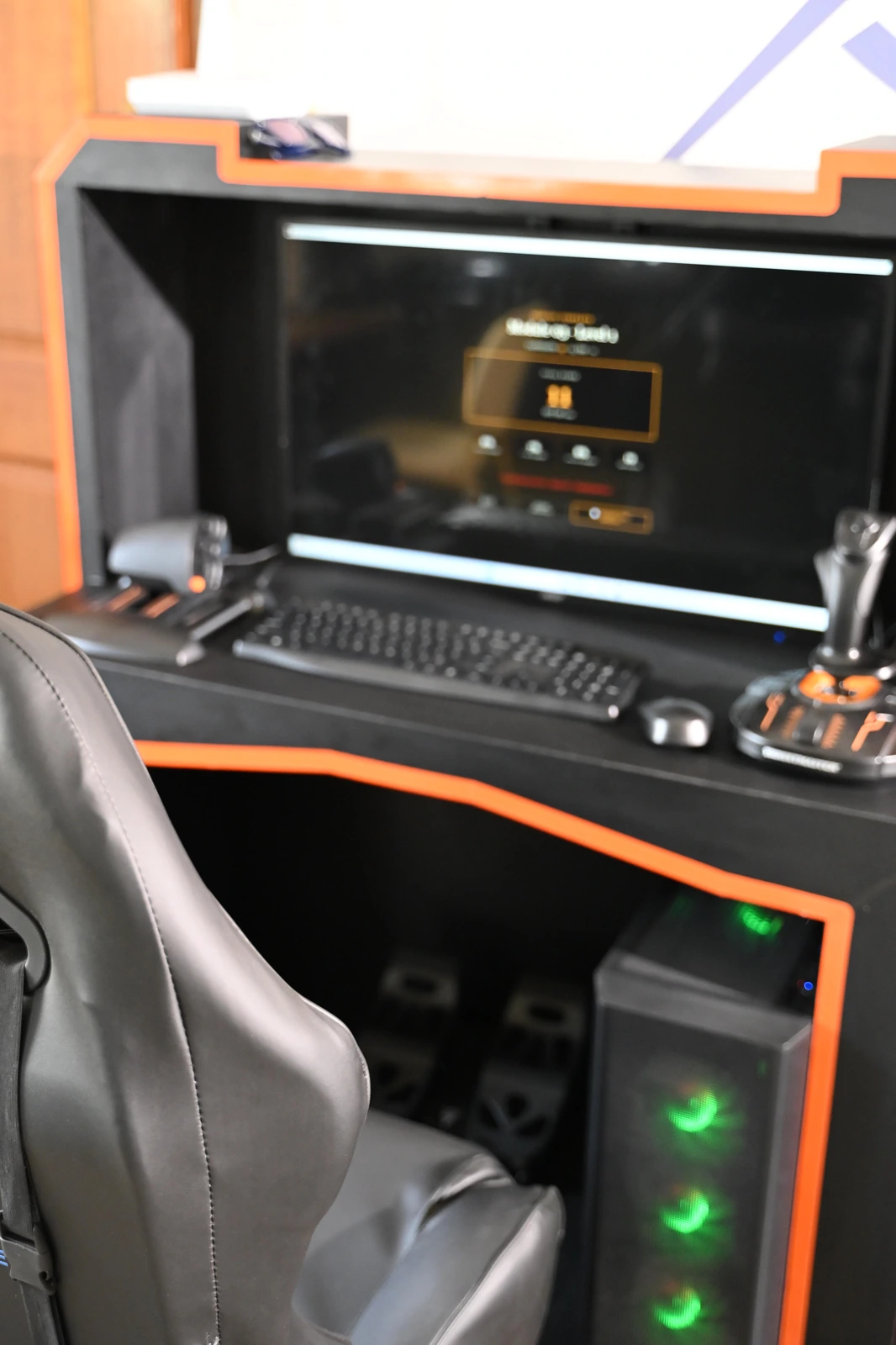
Multi-axis flight stick, throttle quadrant, and high-precision rudder pedals at The Pilot's Compass: used to train fine motor control and cross-axis tracking required in cadet aptitude tests.
Hands-On Simulator Training at The Pilot's Compass
While candidates can practice numerical and verbal reasoning on ordinary laptop screens, physical flight control and psychomotor tracking require genuine muscle memory. Screening platforms like Aon cut-e evaluate sub-second reaction times, fine pressure modulation, and divided attention across visual and auditory channels.
To succeed in the physical tracking components of cadet pilot selection (as well as military CPSS assessments), candidates need deliberate cockpit practice before stepping into an official airline testing center.
At The Pilot's Compass, we provide hands-on simulator training at our facility in Bangalore specifically designed to prepare pilot aspirants for these high-stakes airline screening modules.
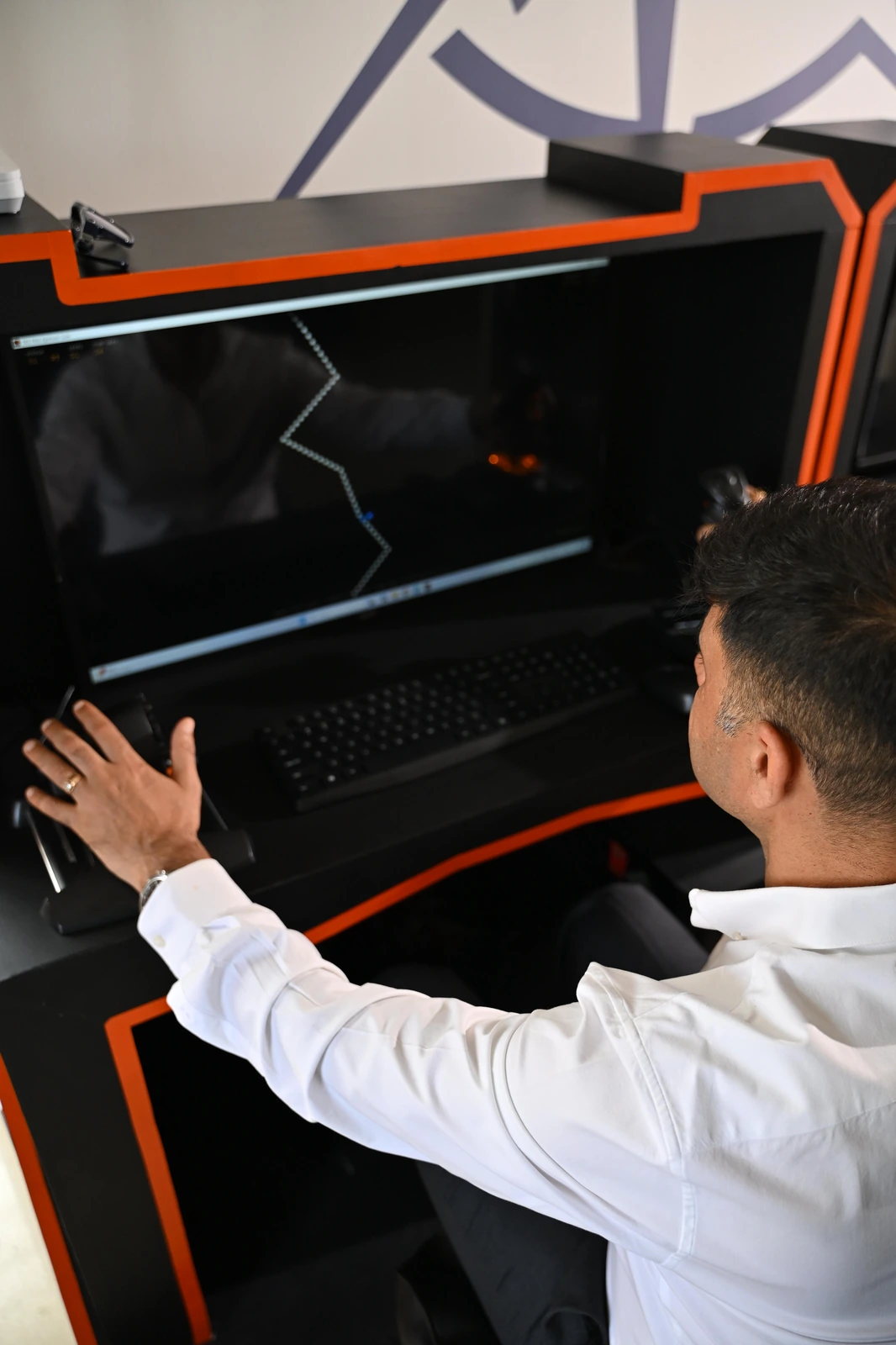
Psychomotor Tracking Drills: Cadets learn continuous, measured pressure modulation to keep dynamic crosshairs centered without erratic over-controlling.
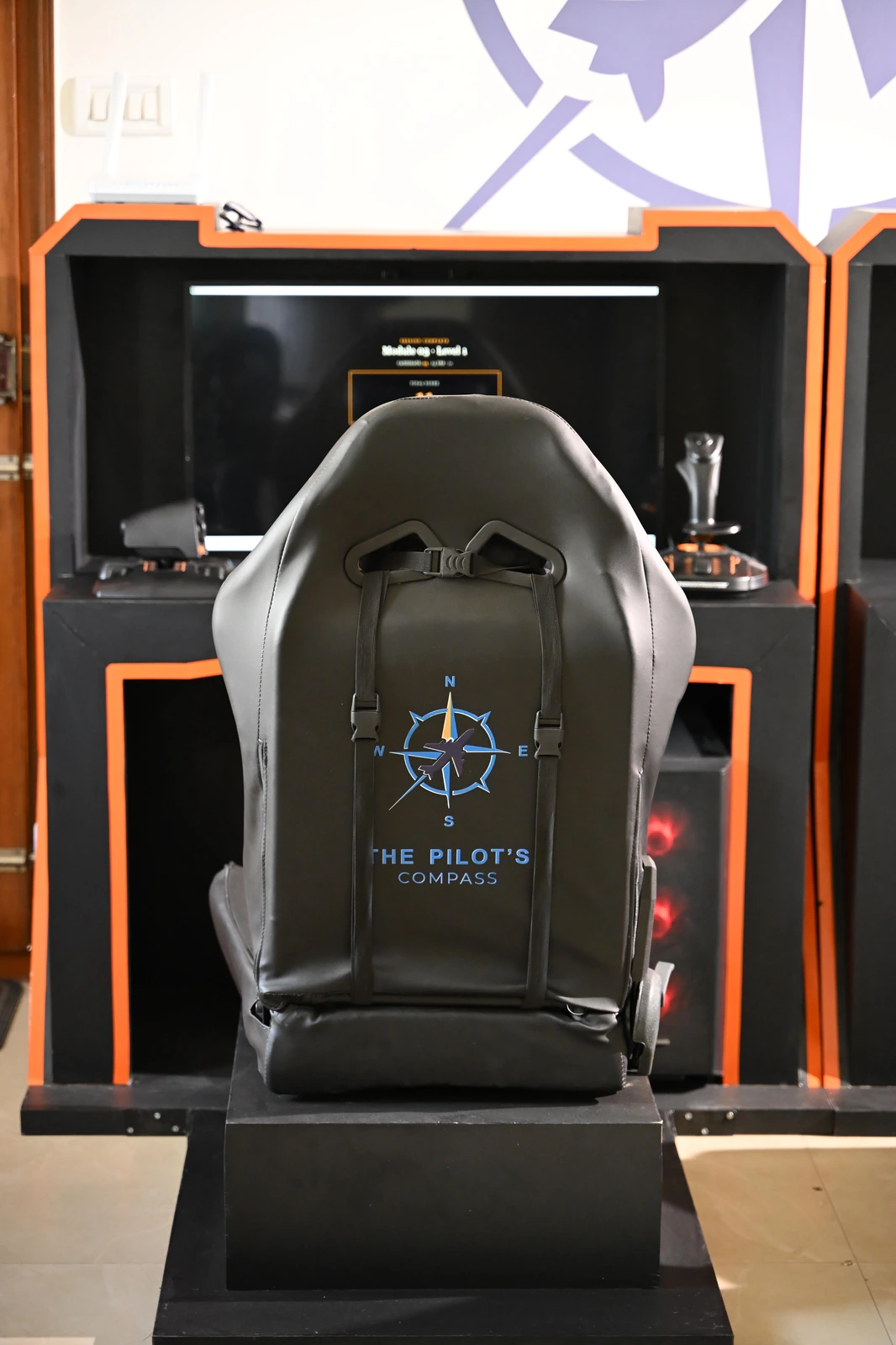
Ergonomic Flight Station: Recreates glass-cockpit physics, peripheral visual cues, and simultaneous auditory distraction drills.
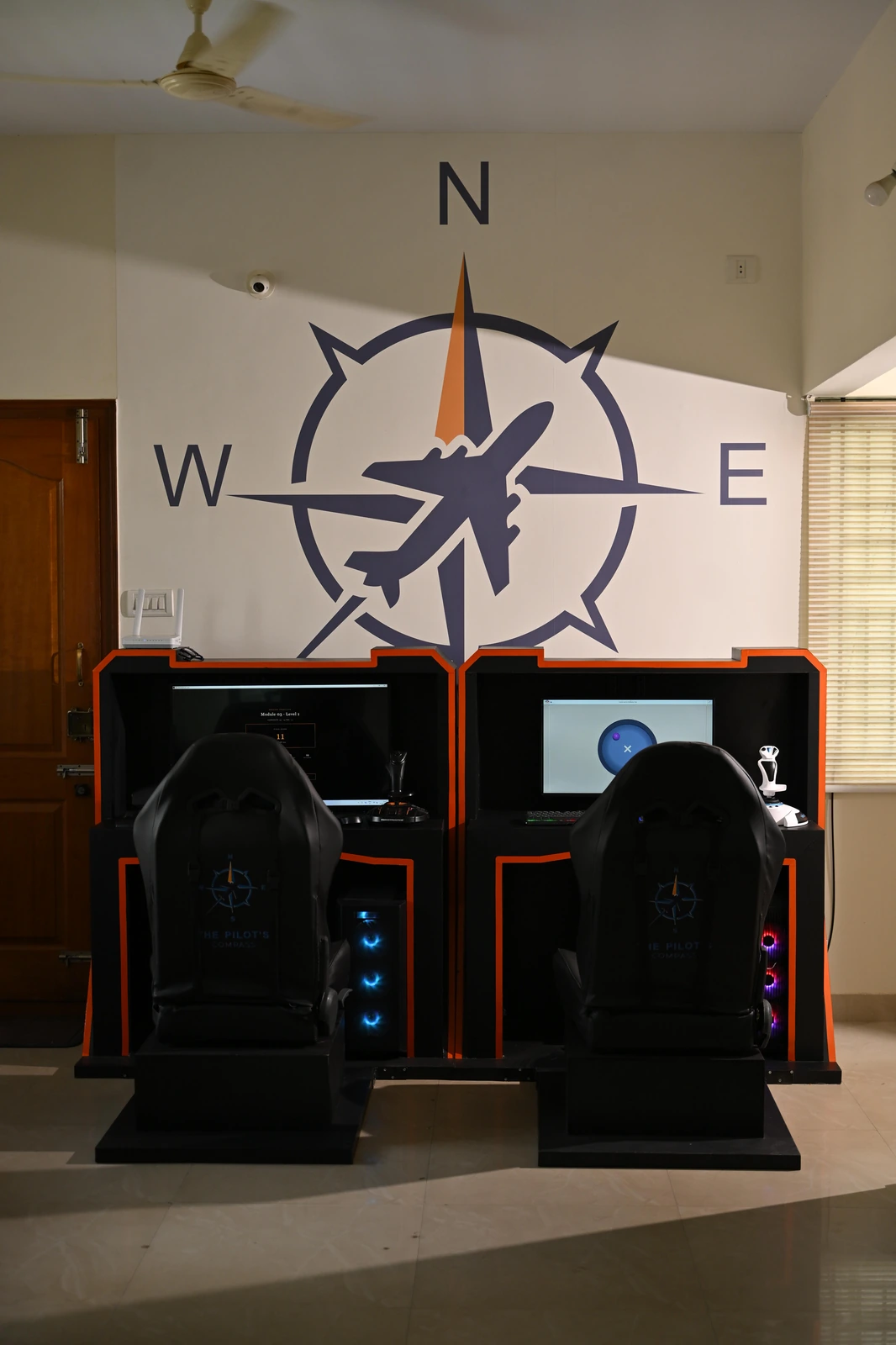
The Pilot's Compass Aptitude Facility: Dedicated pilot aptitude simulator suite located in Bangalore, mentored by veteran military and airline aviators.
Why Hands-On Simulator Practice Is Essential for Cadet Selection
Airline aptitude algorithms do not assess casual gaming habits. They evaluate your control curves, rate of deviation recovery, and ability to manage primary flight attitudes during sudden sensory spikes:
- Develop Multi-Axis Physical Control: Standard laptop practice with a mouse or arrow keys cannot build cross-limb coordination. Our dedicated flight control rigs train your hands on the stick and your feet on the rudder pedals to work synchronously, eliminating erratic over-corrections that ruin test scores.
- Overcome Cognitive Overload: First-time candidates frequently freeze when confronted with simultaneous flight crosshairs, flashing peripheral alerts, and auditory math problems in their headsets. Simulator drills desensitize your nervous system, replacing panic with disciplined prioritization.
- Master Cockpit Instrument Scanning: Understanding electronic flight displays, rate of turn, artificial horizons, and warning annunciators beforehand ensures your concentration stays focused on flying precision rather than figuring out unfamiliar instruments.
Should You Prepare for a Group Exercise?
Air India's official process does not list a separate group discussion stage. However, some candidates report group exercises during assessment, and airlines can change their format between intakes. Preparing for one costs little and strengthens the same CRM skills the interview tests.
If your assessment includes a group exercise, remember that airlines do not run them to find the loudest speaker in the room. They run them to evaluate your Crew Resource Management instincts in a shared workspace.
Cockpit safety depends on mutual support. A First Officer who tries to dominate the Captain or refuses to listen to operational inputs is dangerous. Assessors sit quietly at the edges of the room, taking notes on specific behavioral markers:
- Do you listen attentively when someone else is speaking?
- Do you encourage quieter candidates to contribute their perspective?
- If two candidates begin arguing, do you step in calmly to refocus the discussion?
- Do you support your arguments with practical aviation safety facts rather than emotional opinions?
| GD Step | Strategy Focus | Practical Execution |
|---|---|---|
| 1. Topic Scoping | Define core scope | Open calmly with clear operational definitions; avoid shouting or interrupting |
| 2. High-Value Points | Add substance | Contribute 3 to 4 points centered on safety, operations, and passenger care |
| 3. Bridge Building | CRM and teamwork | Acknowledge peer points respectfully before introducing fresh perspectives |
| 4. Consensus Steering | Time management | Track remaining minutes and summarize differing viewpoints constructively |
When you speak, keep your voice steady and respectful. If someone interrupts you, allow them to finish their sentence without rolling your eyes, then resume your point: "Thank you. Returning to the operational safety aspect, we must also consider the aircraft turn-around limits."
What Aviation Topics Should You Prepare to Discuss?
Whether they come up in a group exercise or as interview questions, these contemporary aviation issues, regulatory frameworks, and situational safety dilemmas are worth preparing.
Topic 1: Automation vs Manual Flying Skills in Commercial Jet Operations
- Discussion Angle: Modern aircraft like the Airbus A350 feature advanced flight management guidance that reduces pilot fatigue on long-haul routes. However, excessive reliance on automation can degrade basic stick-and-rudder handling skills during unexpected system failures. Pilots must maintain manual flying discipline during visual approaches while respecting airline automation policies.
Topic 2: DGCA Revised Flight Duty Time Limitations (FDTL) and Pilot Fatigue
- Discussion Angle: Managing pilot fatigue is directly tied to passenger flight safety. While revised DGCA FDTL rules mandate longer weekly rest periods and stricter night duty limits, airlines must manage crew rosters and expand pilot recruitment pipelines to maintain reliable schedules.
Topic 3: Air India Fleet Expansion and Indian Aviation Infrastructure
- Discussion Angle: With orders exceeding 470 aircraft, Air India is set to capture major international traffic. However, this growth requires matching expansions in airport slots, runway throughput, maintenance facilities, and certified flight training academies within India.
Topic 4: In-flight Cabin Disruptions: Crew Authority vs Conflict De-escalation
- Discussion Angle: Managing unruly passengers demands balancing customer care with absolute flight safety. While cabin crew and the Pilot-in-Command hold legal authority under DGCA regulations to restrain disruptive passengers, de-escalation techniques should always precede physical intervention unless flight safety is jeopardized.
Topic 5: In-flight Operational Dilemma (Group Exercise)
Groups are often presented with a scenario: An aircraft en route from Delhi to London experiences a medical emergency over Central Asia with 90 minutes of fuel remaining to destination, an enroute alternate with adverse winter weather, and a closer military airfield with unknown medical facilities. What is your priority action?
- Discussion Angle: Guide the group to systematically evaluate Fuel, Weather, Medical Facilities, and Aircraft Performance. Reach a structured consensus prioritizing passenger life while ensuring safe landing margins.
How Should You Prepare for the Air India Pilot Interview?
The personal interview is the final selection round. The interview board typically consists of a senior Air India Captain (often a Chief Pilot or Fleet Examiner) and an aviation Human Resources specialist or psychologist.
The interview covers three primary areas:
- Aviation Technical Knowledge: Physics of flight, basic aerodynamics, navigation, meteorology, and aircraft systems.
- Airline Awareness: Knowledge of Air India, Tata Group governance, fleet orders, route networks, and cadet academy structures.
- Behavioral Competency (HR): Personal background, teamwork experiences, emotional stability, and ethical decision-making.
Present yourself professionally in business formal attire. Sit upright, make balanced eye contact with both panelists, and speak clearly. If you do not know the answer to a technical question, never guess or fabricate details. State honestly: "Sir, I am not certain of that specific figure, but based on aerodynamic principles, I expect it would behave as follows." Panelists respect honest thinking over confident misinformation.
What Technical Questions Appear in the Air India Interview?
Even if you are applying for a zero-hour cadet program, interviewers expect a solid foundation in Class 11 and 12 physics and basic aviation theory. If you are preparing for theoretical ground subjects, review our complete guide on how to clear DGCA exams in first attempt.
1. Aerodynamics & Principles of Flight
- How does an aerofoil generate lift? Explain Bernoulli's principle (velocity increase over the cambered upper surface leading to a drop in static pressure) alongside Newton's third law (downwash momentum created by deflecting the airflow downward).
- What is an aerodynamic stall? A stall occurs when the wing exceeds its critical angle of attack (typically 15 to 16 degrees), causing the boundary airflow to separate from the upper surface. Emphasize that an aircraft can stall at any airspeed, attitude, or power setting if the critical angle of attack is exceeded.
- What is the difference between Parasite Drag and Induced Drag? Parasite drag (form, skin friction, and interference) increases with the square of airspeed. Induced drag is a byproduct of lift creation and decreases as airspeed increases. The intersection of these two curves represents the minimum drag speed (Vmd).
- What is Ground Effect? When flying within one wingspan of the surface, the ground interrupts the formation of wingtip vortices and downwash, reducing induced drag and causing the aircraft to float during landing.
2. Aviation Meteorology
- How does a Cumulonimbus (Cb) cloud form? Detail the three required ingredients: high moisture content, an unstable atmospheric lapse rate, and a lifting mechanism (thermal heating, orographic lift, or frontal convergence). Mention associated hazards including severe turbulence, hail, icing, lightning, and microbursts.
- What is a Microburst and how do you handle it? A microburst is an intense localized downdraft producing severe horizontal wind shear up to 45 knots or more. If encountered on approach, the pilot must execute an immediate go-around and wind shear escape maneuver at maximum thrust.
- How do you interpret a METAR? Be prepared to read a raw METAR string, decode wind direction and speed in knots, visibility in meters, cloud base in hundreds of feet, temperature/dewpoint, and QNH altimeter setting.
3. Instruments & Navigation
- Explain QNH, QFE, and Standard Pressure Setting: QNH gives altimeter indication above mean sea level. QFE gives height above aerodrome elevation. Standard pressure setting is 1013.25 hPa (or 29.92 inHg), used above the transition altitude to ensure vertical separation.
- What happens if the pitot tube becomes blocked while the static port remains clear? In climbing flight, trapped pressure in the pitot tube makes the airspeed indicator over-read (behave like an altimeter), indicating a dangerous false increase in airspeed.
What HR and Competency Questions Should You Expect?
Aviation interview boards evaluate behavioral questions using the STAR technique (Situation, Task, Action, Result). Structure your answers cleanly around what you personally did in that scenario.
| STAR Component | Response Focus | What Assessors Evaluate |
|---|---|---|
| Situation | Context & background | Specific operational, academic, or team setting with realistic constraints |
| Task | Your personal role | Exact individual duty or challenge rather than broad team generalizations |
| Action | Concrete steps taken | Procedural discipline, logical reasoning, and teamwork under pressure |
| Result | Outcome & reflection | Quantifiable outcome, safety impact, and personal lessons learned |
Common Interview Questions and Strategic Responses
1. "Why do you want to join Air India specifically over other domestic airlines?"
- Winning strategy: Connect your ambition to Air India's transformation under Tata Group leadership. Mention the induction of flagship wide-body aircraft like the Airbus A350, the consolidation of Vistara into Air India, and the long-term career stability of flying domestic and intercontinental routes. Emphasize that you want to be part of building India's premier global carrier.
2. "Why choose a Cadet Pilot Program instead of doing a conventional CPL abroad?"
- Winning strategy: Acknowledge that while conventional flight training offers flexibility, the Air India Cadet Pilot Program embeds airline Standard Operating Procedures, multi-crew cooperation (MCC), and jet handling discipline from day one. You can read more about the risks of unstructured training in our analysis of why cadet pilot programs fail in India.
3. "How would you handle a Captain who insists on violating an airline SOP during approach?"
- Winning strategy: Reference the standard PACE cockpit communication model:
- Probe: "Captain, are we maintaining our stabilized approach criteria?"
- Alert: "Captain, our descent rate is 1,200 feet per minute below 1,000 feet, which exceeds our SOP limit."
- Challenge: "Captain, we are un-stabilized. I request a go-around."
- Emergency / Takeover: If safety is critically compromised and no corrective action is taken, the First Officer announces takeover and executes the go-around maneuver.
4. "Tell us about a time you failed to achieve a goal. What did you learn?"
- Winning strategy: Choose a genuine academic, athletic, or workplace setback. Take immediate personal ownership without blaming teachers, teammates, or external equipment. Explain the specific corrective routine you built to overcome that weakness and the successful result that followed.
What Is a Realistic 30-Day Air India Cadet Prep Plan?
A structured four-week preparation plan helps you balance psychomotor drills with technical revision and group communication practice.
| Week | Primary Focus Area | Daily Training Routine | Target Milestone |
|---|---|---|---|
| Week 1 | Speed Math & Logic Foundations | • 45 mins Mental Math (scales num: ETA, descent, fuel) • 45 mins Inductive logic matrices (scales ix & cls) • 30 mins basic aerodynamics revision | Solve 25 speed math items in 15 mins with 85%+ accuracy |
| Week 2 | Spatial Awareness & System Diagnostics | • 45 mins Spatial Orientation compass drills (scales nav) • 45 mins Sys-Check operator troubleshooting (scales sx) • 30 mins aviation weather & METAR decoding | Reach top percentiles on 3-minute scales nav time trials |
| Week 3 | Verbal Analysis & CRM Communication Drills | • 45 mins Multi-tab verbal tests (scales verbal) • 60 mins discussion practice on aviation current affairs • 30 mins STAR interview answer structuring | Deliver concise 2-minute arguments without filler words |
| Week 4 | Full-Length Mock Exams & Panel Viva | • Two full-length Aon cut-e mock battery simulations • 45 mins technical aviation viva review • 1 mock HR panel interview with experienced pilot mentors | Achieve 85%+ score stability across all adaptive modules |
Candidates preparing for military or airline aptitude assessments can also compare these methods with our guide to the CPSS computerized pilot selection system.
What Are the Biggest Mistakes Cadet Candidates Make?
Through mentoring hundreds of airline applicants, we consistently observe five critical mistakes that derail promising candidates:
- Relying on Scratch Paper for Every Math Item: The scales num module does not give you enough time to write out long multiplication steps. Practice rounding numbers mentally and using process-of-elimination to strike out impossible answer options.
- Trying to Game the shapes Personality Profile: The Aon behavioral platform contains built-in lie and inconsistency indicators. Answering what you think the airline wants leads to contradictory responses across the questionnaire. Stay honest, disciplined, and focused on safety.
- Monopolizing a Group Exercise: If your assessment includes one, speaking for half the total session time does not show leadership; it shows a lack of Crew Resource Management awareness. Aim for three or four articulate, high-value interventions that move the entire group closer to consensus.
- Neglecting Airline Fleet and Corporate Knowledge: Candidates who do not know what aircraft engines power Air India's A350 fleet, who leads the Tata Group aviation business, or which flight schools host the cadet program leave a poor impression during panel interviews.
- Taking the Computer Test Without Rest: The psychomotor and reaction modules demand sharp visual concentration and fast fine-motor control. Taking the assessment while tired directly impairs your reaction latency, costing you valuable points on tracking modules.
Ready to Master Cadet Aptitude & Flight Controls?
Build genuine stick-and-rudder muscle memory, conquer concurrent multitasking drills, and enter your airline cadet screening fully prepared.
Frequently Asked Questions
Map Your Custom Pilot Training Pathway
Evaluate your compliance across the 4 major DGCA training gates, select training country routes (India vs. USA/Europe), and estimate your CPL timeline month-by-month.