
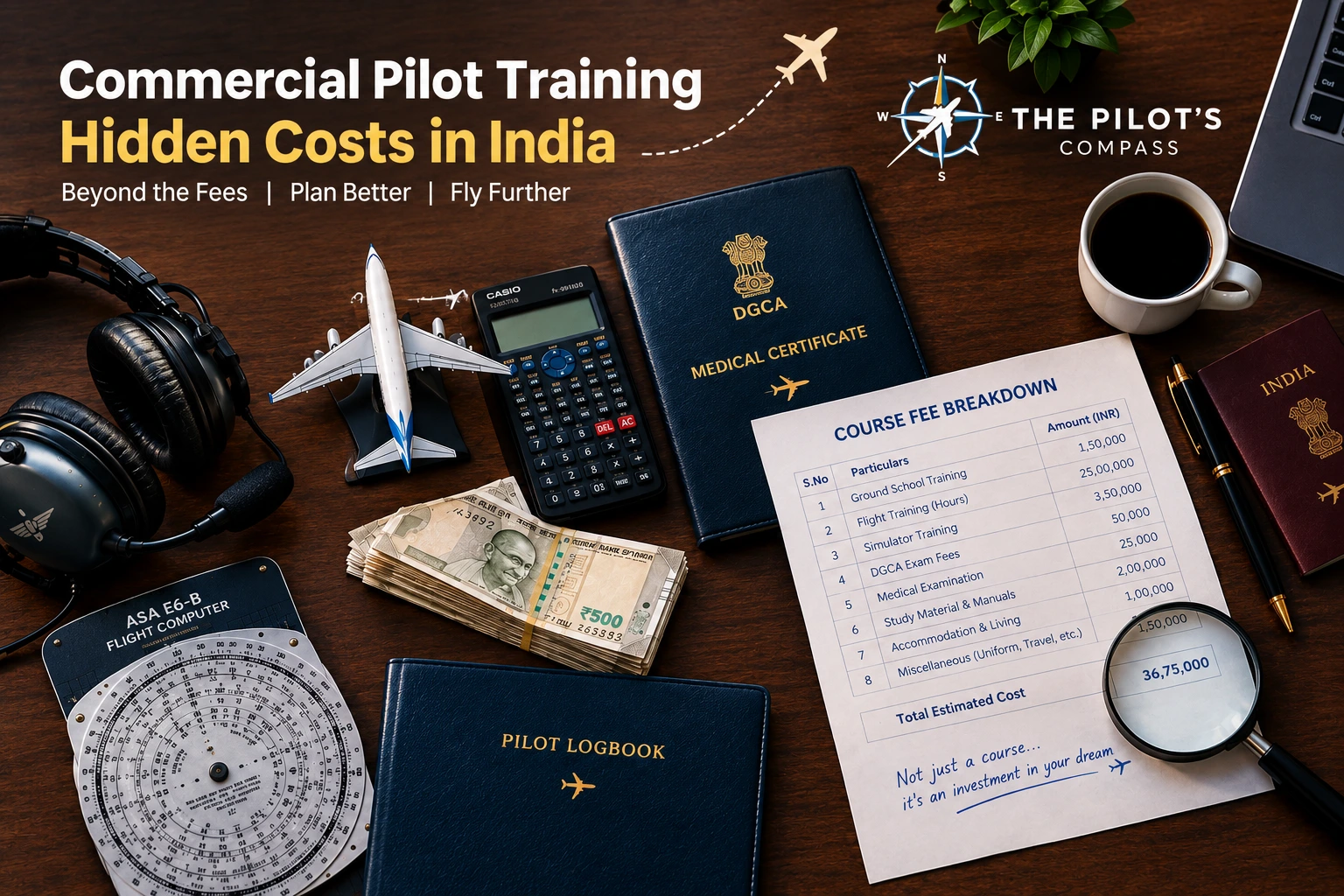
The number on a flying school's brochure is rarely the number a family actually pays. Accommodation, travel, exam fees, retakes, rating hours, equipment, extra flying hours and plain delay all add up.
The safest way to plan is to ask each school for a written, itemised quote, then add your own line items for living costs and a contingency buffer.
The short version:
The headline fee is not the total cost. Compare schools on the full pathway, get everything in writing (including refund terms), and remember that time is a cost: every month of delay means more living expenses and loan interest.
Key Takeaways
- Headline fee is not total cost: Compare schools on the full pathway, not the brochure number.
- Time is a cost: Every month of delay means more living expenses and loan interest.
- Ask what is included: Especially instrument and multi-engine rating hours, simulator hours, exam fees and accommodation.
- Small costs repeat: Medicals, exams and travel are small individually, but failures add more.
- Type rating is often separate: It is usually an additional expense after the CPL.
- Get everything in writing, including refund terms.
Quick Navigation
- Hidden CPL Costs: Start With the Full-Cost Guide
- The Hidden Cost Checklist
- Costs That Repeat: Medicals, Exams and Retakes
- Living and Travel Costs
- Rating, Hours and Equipment Costs
- The Cost of Delay: A Worked Example
- After the CPL: Type Rating and Beyond
- How to Ask for an Itemised Quote
- Building Your Own Budget
- How The Pilot's Compass Helps You Plan Your Training
- Frequently Asked Questions
Hidden CPL Costs: Start With the Full-Cost Guide
Most families start with the visible costs: tuition and flying hours. Use our real CPL cost guide for the baseline pathway and this article's checklist to identify expenses that the headline quote leaves out. For the school-level view, see Flying Schools in India by Budget, which also compares location and duration.
The Hidden Cost Checklist
Use this table when you compare schools. For each line, write the school's number, or write "excluded".
| Cost area | What to check |
|---|---|
| Accommodation and food | Hostel provided, or you rent? Deposit? Food plan? |
| Local travel | Daily commute to the airfield, and trips home |
| Medicals | Class 2, initial Class 1, plus travel and stay for the Class 1 centre |
| Computer number and registration | Mostly paperwork, but courier and attestation costs add up |
| Ground school | Included, or separate? Does validity expire? Repeat fees? |
| DGCA exam fees | ₹2,500 per paper in regular sessions, ₹5,000 in OLODE |
| Retakes | Fee per paper plus extra preparation time |
| Instrument and multi-engine rating hours | Bundled in the headline fee, or extra? |
| Extra flying hours | The rate per additional hour, and how many hours students typically need beyond the minimum |
| Simulator hours | Minimum included versus extra |
| Fuel or price-revision clauses | Can the school raise the rate during your course? |
| Taxes | Is the quote inclusive or "plus taxes"? |
| Equipment | Headset, flight computer, charts, plotter, uniform, bag, logbook, study material |
| Licence issuance and RTR(A) | Fees and paperwork at the end of the course |
| Insurance and deposits | Student insurance, caution deposits and refund conditions |
| Loan costs | Processing fees, interest during training, margin money |
| Type rating and airline onboarding | Usually after the CPL, sometimes financed by the airline |
| Foreign training extras | Visa, forex movement, DGCA conversion costs, extra re-fly hours |
For students who plan to train abroad, our real CPL cost guide lists DGCA conversion at roughly ₹4 to ₹7 lakh, plus checkrides, paperwork and extra hours. See also FAA to DGCA conversion.
Costs That Repeat: Medicals, Exams and Retakes
Medicals
Our guides place the Class 2 examination at about ₹3,500 to ₹5,000 and the initial Class 1 at about ₹5,000 to ₹7,000, paid to the examiner or hospital. Add:
- Travel and stay for the Class 1 centre, since the initial evaluation can take two days.
- Extra tests if the board asks for specialist consultations or scans, which are your cost.
- Renewals that continue through your career.
Medical rules were revised in 2025, so check the current validity and renewal pattern on the DGCA website. If a medical goes wrong, the financial effect depends on when it happens, which is why we recommend front-loading it. See our Class 1 medical guide.
Exams and retakes
Regular DGCA papers cost ₹2,500 each and on-demand (OLODE) papers cost ₹5,000 each. Five papers on the first attempt cost ₹12,500 in regular fees, as set out in our DGCA exam fees guide. Fees are non-refundable, including when a form is rejected.
The exam fee is small, but retakes hide larger costs:
- Extra months of living expenses
- Extra ground school or tutoring
- A later start on flying, which delays your whole timeline
A good preparation plan costs far less than repeated attempts. See our DGCA exam preparation guide.
Living and Travel Costs
If you leave home to train, living costs often become the biggest hidden category. As a planning range, we use ₹13,000 to ₹67,000 per month; this is consistent with the broader budget assumptions in our Flying Schools in India by Budget and real CPL cost guide. Replace it with a quote for your city and housing choice; your number depends on:
- City: Rent and food vary widely between a metro and a smaller town.
- Duration: A longer course means more months of rent.
- Housing type: A school hostel, a shared flat and a paying guest arrangement all cost differently.
- Travel home: Fares add up across a 12 to 30 month course.
To make your estimate real, ask current students what they pay each month, rather than relying on a general number.
Rating, Hours and Equipment Costs
Instrument and multi-engine
Our guides warn that some low headline fees exclude multi-engine hours, which are part of the licence requirement. Ask the school directly whether the quoted fee covers the instrument rating and multi-engine training. Our budget guide advises caution about any school quoting a total CPL cost below ₹40 lakh without a clear breakdown.
Extra flying hours
Flying schools quote minimum hours. Students often need more because of weather, retests or slow progress. Ask for:
- The per-hour rate for extra flying
- The average hours students actually completed last year
- Whether the rate can change during your course
Equipment and study material
Budget for a headset, flight computer, plotter, charts, uniform, flight bag, logbook and books. Our DGCA books guide lists recommended study material. Costs vary by brand, so ask the school which items it provides.
The Cost of Delay: A Worked Example
Delay is the least visible cost. The example below is illustrative only. Replace the figures with your own.
Suppose your living cost is ₹30,000 a month, a practical midpoint within the ₹13,000 to ₹67,000 planning range.
| Delay | Extra living cost at ₹30,000 a month |
|---|---|
| 3 months | ₹90,000 |
| 6 months | ₹1,80,000 |
| 9 months | ₹2,70,000 |
Add to this any loan interest that continues while training is paused, plus the cost of lost income from starting your airline career later. Common causes are:
- Monsoon or fog seasons that cut flying days
- Aircraft availability
- Medical or exam delays
- A school with too many students per aircraft
Our budget guide says to ask about the student-to-aircraft ratio instead of just the sticker price, because that ratio affects how quickly you complete hours. Our articles on why cadet pilot programs fail and why aspiring pilots drop out show how money and delay combine to cause dropouts.
After the CPL: Type Rating and Beyond
A CPL does not automatically become an airline seat. A single-aisle type rating can cost about ₹12 to ₹30 lakh, often outside the school fee and sometimes financed by an airline after induction. Confirm the current cost with the training provider and the airline's policy. See our real CPL cost guide and our article on the 200-hour CPL trap.
You may also face:
- Job search period between the CPL and the first airline role, which needs living funds
- Medical renewals and licence maintenance
- Hour-building costs if you choose a pathway that adds flying experience before applying
For what happens next, compare the post-CPL costs in our real CPL cost guide.
How to Ask for an Itemised Quote
Send the same questions to every school and compare the answers side by side.
- What is the total fee, and is it inclusive of all taxes?
- Which items are excluded? Ask about instrument rating, multi-engine hours, simulator, exams, accommodation and uniform.
- What is the minimum number of hours, and the rate for extra hours?
- How many students trained per aircraft last year, and how many flying days did they get?
- What is the payment schedule, and what are the refund terms if I leave or if my medical result is not favourable?
- Can fees or rates change during my course?
- What do current students pay monthly for living costs?
Our CPL pricing page and flying schools shortlisting guide can help you structure the comparison.
Building Your Own Budget
A simple method:
- Start with the school's itemised quote.
- Add the checklist items the quote leaves out (medicals, exams, travel, equipment, living costs).
- Add a delay allowance: monthly living cost times the number of extra months you want to protect against.
- Add the post-CPL stage: type rating and a job-search buffer.
- Add a contingency buffer. Many families choose a percentage of the total, and the right size depends on the school and your risk tolerance.
- Check funding. See CPL education loans and pilot scholarships.
If the plan only works when nothing goes wrong, it is not a plan yet.
How The Pilot's Compass Helps You Plan Your Training
Before you pay for flying training, it helps to have the theory phase and the budget planned properly. At The Pilot's Compass, Commander Naveen Pandita (Retd.) and our team guide students through ground school, flying school shortlisting and cost planning, so the numbers you see on a brochure do not surprise you later.
- Live ground classes covering all 6 DGCA subjects.
- Unlimited live revision validity, which can reduce the cost of repeat attempts.
- Help comparing flying schools on what the fee includes.
- Support with computer number and medicals.
- Career mentorship from experienced aviators.
Start the theory phase with a clear plan. Explore our DGCA CPL Ground Classes Program Page or book a free counselling session.
Frequently Asked Questions
Is a cheaper school always a cheaper outcome? Not always. Our budget guide notes that training pace depends on factors like the student-to-aircraft ratio and weather, so a lower fee with slower completion can cost more in living expenses.
Should I pay the full fee upfront? Check the payment schedule and refund terms. Avoid paying large non-refundable amounts before your Class 1 medical is clear.
Do airlines care how much I paid? Our budget guide notes that airlines look at CPL validity, hours, aircraft experience, medical status and interview performance, not at how much you spent.
Continue Reading
- Real CPL Cost in India
- Best Flying Schools in India by Budget
- DGCA Exam Fees 2026
- CPL Education Loans
- Can You Become a Pilot While Studying in College?
- DGCA Class 1 Medical
Want a realistic budget for your own plan? Book a free counselling session with The Pilot's Compass, or explore our DGCA ground classes to control the theory cost with a first-attempt preparation plan.
Official Sources & References
- Real CPL Cost in India: The Pilot's Compass
- DGCA Pariksha: Registration FAQs (exam fee and refund rule)
- Directorate General of Civil Aviation: https://www.dgca.gov.in
Cost ranges are indicative and drawn from our published guides. Actual fees vary by school, city, aircraft and time, and DGCA fees can change. Always obtain current written quotes before you commit.
Frequently Asked Questions
Map Your Custom Pilot Training Pathway
Evaluate your compliance across the 4 major DGCA training gates, select training country routes (India vs. USA/Europe), and estimate your CPL timeline month-by-month.