Introduction
Budget shapes everything in commercial pilot training. Not just which school you attend, but how long your training takes, what aircraft you fly, and what your CPL looks like when you finish.
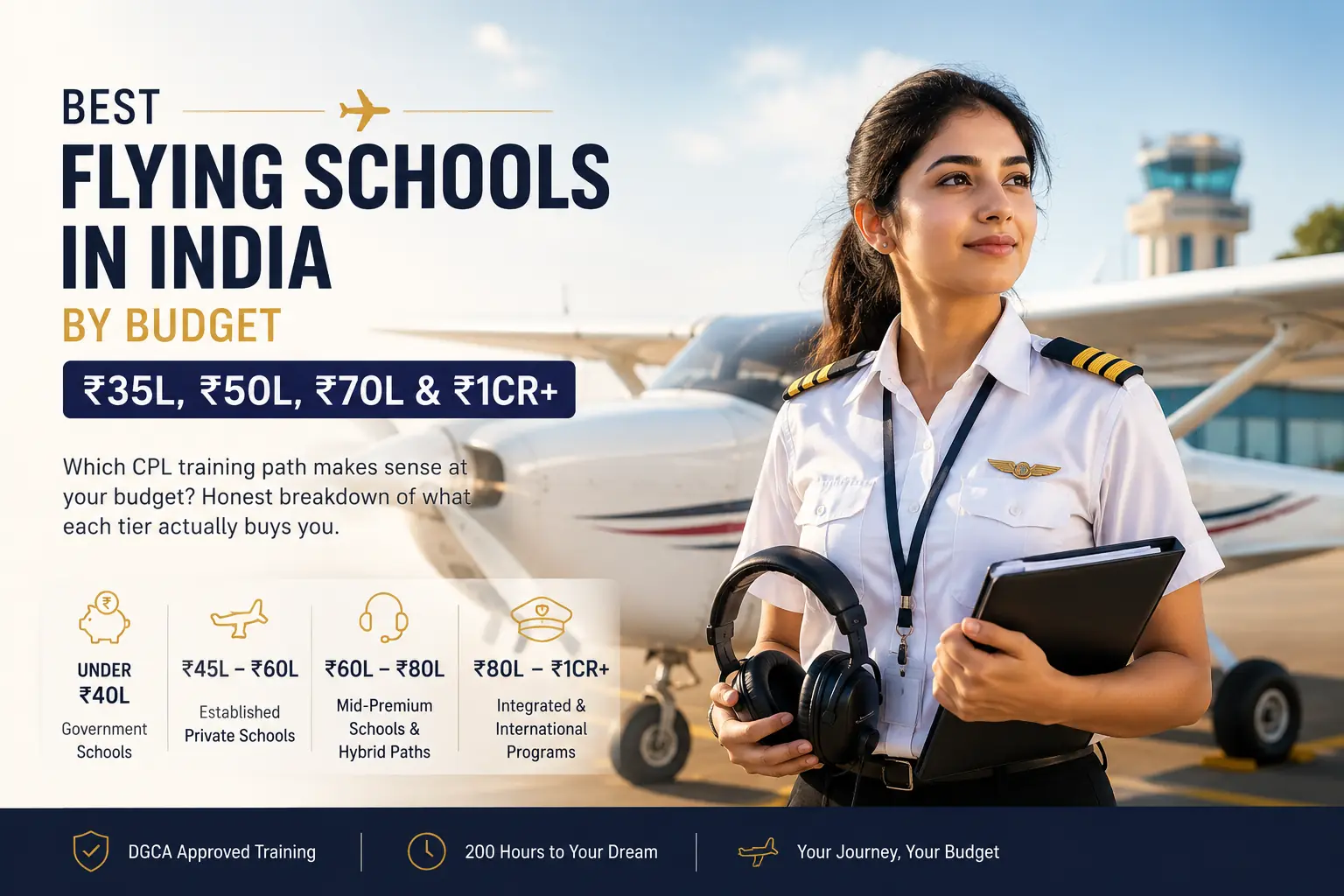
The problem is that most budget conversations in Indian aviation forums treat cost as a fixed number — "CPL costs ₹65 lakhs." It doesn't. The range runs from under ₹40 lakhs at government schools to over ₹1 crore at integrated international pathway programs. And the cheapest option on day one isn't always the cheapest option by the time you hold your CPL.
This guide breaks down what each budget tier actually buys — honestly, without the school-brochure framing.
The short version: CPL training in India runs ₹40L–₹1Cr+ depending on school type, aircraft, and pathway. Government schools (IGRUA, RGAAT) are the lowest-cost option but require competitive entry. The ₹55–75L range covers most established private schools. Spending more does not improve airline hiring prospects — total hours and aircraft type matter more than fee receipts.
Key Takeaways
- Government schools: ₹40–55 lakhs, competitive entry, most cost-efficient route
- Private schools (established): ₹55–75 lakhs, direct enrolment, quality varies
- Premium / international pathway: ₹80–100 lakhs+, structured pipeline, airline alignment
- Cheapest upfront often means longest training timeline — factor time cost in
- Living expenses add ₹8–18 lakhs on top of tuition depending on location and duration
- Airlines do not differentiate between school tiers at hiring — hours and aircraft type matter
Quick Navigation
- Why budget tier matters beyond the fee
- Under ₹40 lakhs: government schools
- ₹45–60 lakhs: established private schools
- ₹60–80 lakhs: mid-premium schools and hybrid paths
- ₹80 lakhs–₹1Cr+: integrated and international programs
- The hidden cost: time
- Training abroad: when it makes financial sense
- Common myths vs. reality and FAQ
Why Budget Tier Matters Beyond the Fee
Every budget tier comes with a different set of trade-offs — not just in cost, but in fleet quality, airspace environment, instructor experience, and training pace. Understanding these trade-offs before you compare schools is more useful than comparing fee tables.
| Budget Tier | Typical School Type | Fleet | Training Pace | Entry |
|---|---|---|---|---|
| Under ₹40L | Government FTO | Mixed age | Slower (competitive intake) | Entrance exam |
| ₹45–60L | Established private | Cessna 172 / older DA40 | Variable | Direct enrolment |
| ₹60–80L | Mid-premium private / hybrid | Newer single + multi | Better | Direct enrolment |
| ₹80L–₹1Cr+ | Integrated / international | Modern fleet + sim | Structured | Selection process |
The "cheapest" school on paper often produces the longest training timeline because of fleet constraints and high student-to-aircraft ratios. A student paying ₹48 lakhs but taking 42 months to finish has paid more in living costs than someone who paid ₹65 lakhs and finished in 24 months. The fee is only one number in the calculation.
Under ₹40 Lakhs: Government Flying Schools
This tier is only accessible through competitive entry. You can't simply pay and enrol — there's a selection process.
Indira Gandhi Rashtriya Uran Akademi (IGRUA) — Rae Bareli, UP
Total cost: approximately ₹40–55 lakhs (fees have risen over recent years; verify directly).
IGRUA is the benchmark for government-supported flying schools in India. It runs structured batches with controlled intake, which means the student-to-aircraft ratio is manageable. Training timelines are more predictable here than at most private schools. The entrance process involves a written exam, psychometric assessment, and medical screening.
Fleet: Diamond DA40 (single-engine), Beechcraft Duchess (multi-engine). Well-maintained, regularly audited.
Getting in requires preparation. The written exam tests physics, mathematics, and general aptitude. Roughly 40–50 seats per batch across hundreds of applicants. If you're serious about the lowest-cost route, treat the entrance exam like the competitive exam it is.
Rajiv Gandhi Academy for Aviation Technology (RGAAT) — Bhopal, MP
Total cost: approximately ₹38–50 lakhs.
State-government supported. Smaller than IGRUA, less competitive entry. Fleet is older — primarily Cessna 152 and 172 variants. Training is slower-paced because the student population is smaller and the operational tempo lower.
Worth considering if IGRUA entry doesn't work out and you're genuinely cost-constrained. Not worth it if you're choosing it over an established private school purely on ₹5–8 lakh savings — the timeline difference can cost more than that in extended living expenses.
Government schools run older fleets. You'll log your 200 hours on older-generation piston aircraft. This doesn't disadvantage you at airline interviews — the hours count the same — but some students prefer newer airframes for the experience.
₹45–60 Lakhs: Established Private Schools
This is where most Indian CPL students end up. Direct enrolment, no competitive exam, DGCA-approved. The range within this tier is wide — the ₹10 lakh gap between the cheapest and most expensive schools here represents real differences in fleet condition and instructor-to-student ratios.
Bombay Flying Club (BFC) — Juhu, Mumbai
Total cost: ₹50–65 lakhs.
One of India's oldest flying clubs. Institutional stability is its main asset — it has maintained DGCA approval continuously through market cycles that closed younger schools. Fleet is Cessna 172 series, older generation but consistently maintained.
Mumbai location means complex airspace, which is genuinely useful training. It also means monsoon disruption — June through September sees significant flying interruptions. Students who start in October and plan their training around the flying season manage better.
Orient Flight School — Pondicherry
Total cost: ₹48–62 lakhs.
Lower cost of living than metro locations. Pondicherry weather is more flying-friendly than Mumbai (fewer monsoon disruptions per year). Smaller cohort means slightly better scheduling access per student.
Less networking, smaller peer group. If you value the social infrastructure of a larger school city, this isn't it. If you want to get your hours done efficiently without metro overhead, it's worth evaluating.
Smaller approved FTOs in this range
Several smaller DGCA-approved schools exist across Madhya Pradesh, Rajasthan, and Gujarat in the ₹45–55 lakh range. Some are legitimate; some have had DGCA enforcement actions. Before enrolling at any school you haven't found through established student communities, verify the DGCA approval directly and speak to at least three current students independently.
Direct enrolment without competitive exams is the main advantage of this tier, along with established track records at the schools listed above. The risk is at the lower end of the range: older aircraft with higher maintenance downtime, and schools that stretch their student-to-aircraft ratio past 6:1. If that ratio is above 6, expect the timeline to run long regardless of what the brochure says.
₹60–80 Lakhs: Mid-Premium Schools and Hybrid Paths
At this budget, you have access to schools with newer fleets, better simulator access, and more structured ground training programs. You're also in the range where hybrid training models (some hours in India, some abroad) become financially viable.
Ahmedabad Aviation Academy (AAA) — Ahmedabad, Gujarat
Total cost: ₹55–75 lakhs (straddling this tier and the one below).
Consistently referenced in student communities for maintaining DGCA approval without recorded suspensions and for reasonable hour-completion timelines. Fleet includes Cessna 172 and Diamond DA40 variants. Ahmedabad has good flying weather — fewer disruption days than coastal schools.
For students who want the reliability of a well-run private school without paying for the premium pipeline programs, AAA sits in a reasonable position.
Hybrid training: India + Philippines or India + USA
A growing number of students complete 100–120 hours in India and the remaining hours at a school in the Philippines or USA. The economics work like this: flying hour costs in the Philippines (around USD 130–160 per hour on Cessna 172 equivalents) are sometimes lower than premium Indian schools when you factor aircraft availability. The Philippines also has fewer monsoon disruptions than India's east and west coasts.
Total cost of a hybrid path (India ground school + Philippine flight hours): ₹55–72 lakhs depending on exchange rates and living costs abroad.
The process requires DGCA validation of foreign hours. If you train in the USA, you will need to plan for the FAA to DGCA conversion process. Before going this route, confirm in writing with DGCA which foreign schools' hours they accept, and get that confirmation before you pay tuition abroad.
Better aircraft than the ₹45–60L range, and more flexibility in how you structure your hours. The hybrid model specifically can cut total timeline if Indian fleet availability is your bottleneck — which for many students, it is.
₹80 Lakhs–₹1 Crore+: Integrated and International Programs
At this budget, you're looking at structured pipeline programs with airline partnerships, full-motion simulator access, and international training components. The cost premium is real. Whether it's worth it depends on what you're buying.
CAE Oxford Aviation Academy / NFTI pathway
Total cost: ₹75–95 lakhs.
CAE's programs are structured around airline-cadet models. The curriculum sequence, simulator hours, and multi-crew cooperation (MCC) modules are designed to produce pilots who are closer to airline-ready at CPL issuance. If you're targeting airlines that run cadet intake programs (IndiGo's cadet scheme, Air India's direct-entry pathways), the CAE pipeline format is familiar to those recruiters.
What you're paying for: structure, simulator hours included in the package, and a curriculum that resembles what airline ground school looks like. What you're not paying for: guaranteed placement. No school can offer that.
Training entirely in Europe or Australia
Some families budget ₹90 lakhs–₹1.2 crore for complete CPL training abroad — UK, Ireland, Australia, or New Zealand. These produce EASA or CASA licences, not DGCA CPLs. To fly for Indian carriers, you'd need to convert the foreign licence to DGCA — an additional process involving validation exams.
This route makes sense for students who plan to fly internationally long-term. It does not shorten the path to Indian airline employment; it adds a conversion step.
The premium buys structure, defined timelines, simulator hours baked into the package, and MCC modules that make the airline ground school transition easier. What it doesn't buy is placement. A ₹95 lakh CPL and a ₹55 lakh CPL carry identical legal status. Airlines assess hours, aircraft type, written exam results, and interview performance — not fee receipts.
The Hidden Cost: Time
Every budget calculation that ignores training duration is incomplete.
Living costs in India during pilot training run ₹25,000–₹60,000 per month depending on location. A student in Pondicherry spends less than one in Mumbai. But both are spending something.
| Training Duration | Monthly Living Cost | Total Living Cost |
|---|---|---|
| 24 months | ₹35,000/month | ₹8.4 lakhs |
| 36 months | ₹35,000/month | ₹12.6 lakhs |
| 42 months | ₹35,000/month | ₹14.7 lakhs |
A school that charges ₹48 lakhs but takes 42 months to complete costs ₹62.7 lakhs in direct expenses alone — more than a school charging ₹62 lakhs that completes training in 24 months.
The questions to ask any school before comparing fees: what is the average time for current students to complete 200 hours? Not the minimum possible, not the brochure estimate — the actual average for students who enrolled in the last two batches.
Training Abroad: When It Makes Financial Sense
Training some or all of your hours outside India is worth calculating, not dismissing.
Where Indian students typically go
USA (Florida, Arizona, California, Texas), Spain, South Africa, and Australia are the main destinations. Each has different cost profiles.
The USA has more schools, more aircraft types, and better instrument training infrastructure. Arizona and Florida have flying weather nearly year-round. The cost per hour is higher than in the Philippines but the training ecosystem is more developed.
The DGCA validation requirement
Hours completed abroad count toward a DGCA CPL only if logged at an approved foreign FTO. DGCA maintains a list of recognized foreign schools. Before committing tuition abroad, confirm the school appears on the current DGCA list — not from the school's own marketing, from the DGCA website directly.
When abroad training makes sense
If your Indian school is taking 36+ months to complete your hours due to fleet constraints, completing 80–100 hours abroad at a school where you fly daily can shorten your total timeline by 8–12 months. That timeline saving translates to real money in reduced living costs and earlier airline employment income.
If you're choosing abroad training for prestige rather than logistics, the math usually doesn't work out. Conversion process, travel, accommodation, and visa costs frequently offset the flying-hour savings for students who only go abroad for 30–40 hours.
Common Myths vs. Reality and Frequently Asked Questions
Common Myths vs. Reality
Myth 1: Cheap CPL training means poor quality. Cost correlates with aircraft type, simulator access, and location overhead — not instruction quality directly. IGRUA, a government school at the low end of the fee range, produces pilots flying at every major Indian carrier. Quality is determined by instructor calibre and training structure, not by how much you paid.
Myth 2: Airlines pay more to pilots from premium schools. No. Airline pay scales in India are determined by seniority and aircraft type — not by which school you attended or what your training cost. A first officer's salary at IndiGo is the same whether they trained at IGRUA or at a ₹90 lakh program.
Myth 3: The cheapest route is always the DGCA entrance exam schools. Only if you get in and complete training on schedule. If your IGRUA application fails twice and you lose two years of preparation time, the effective cost of that route rises. Budget for the realistic path, not the theoretical best case.
Myth 4: Flying abroad is only for rich families. The economics work differently than people assume. A student who completes 100 hours in the Philippines at lower per-hour cost than a premium Indian school, while living in shared accommodation in Manila, sometimes ends up spending less overall than a peer at a ₹70 lakh Indian school with a 28-36 month timeline.
Myth 5: You need to pick one school and stay there for 200 hours. You don't. DGCA allows hours logged across multiple approved schools to count toward CPL eligibility. Students transfer between schools for legitimate reasons — fleet issues, instructor changes, personal relocation. Your log book accumulates hours regardless of how many schools you used.
Frequently Asked Questions
Map Your Custom Pilot Training Pathway
Evaluate your compliance across the 4 major DGCA training gates, select training country routes (India vs. USA/Europe), and estimate your CPL timeline month-by-month.