
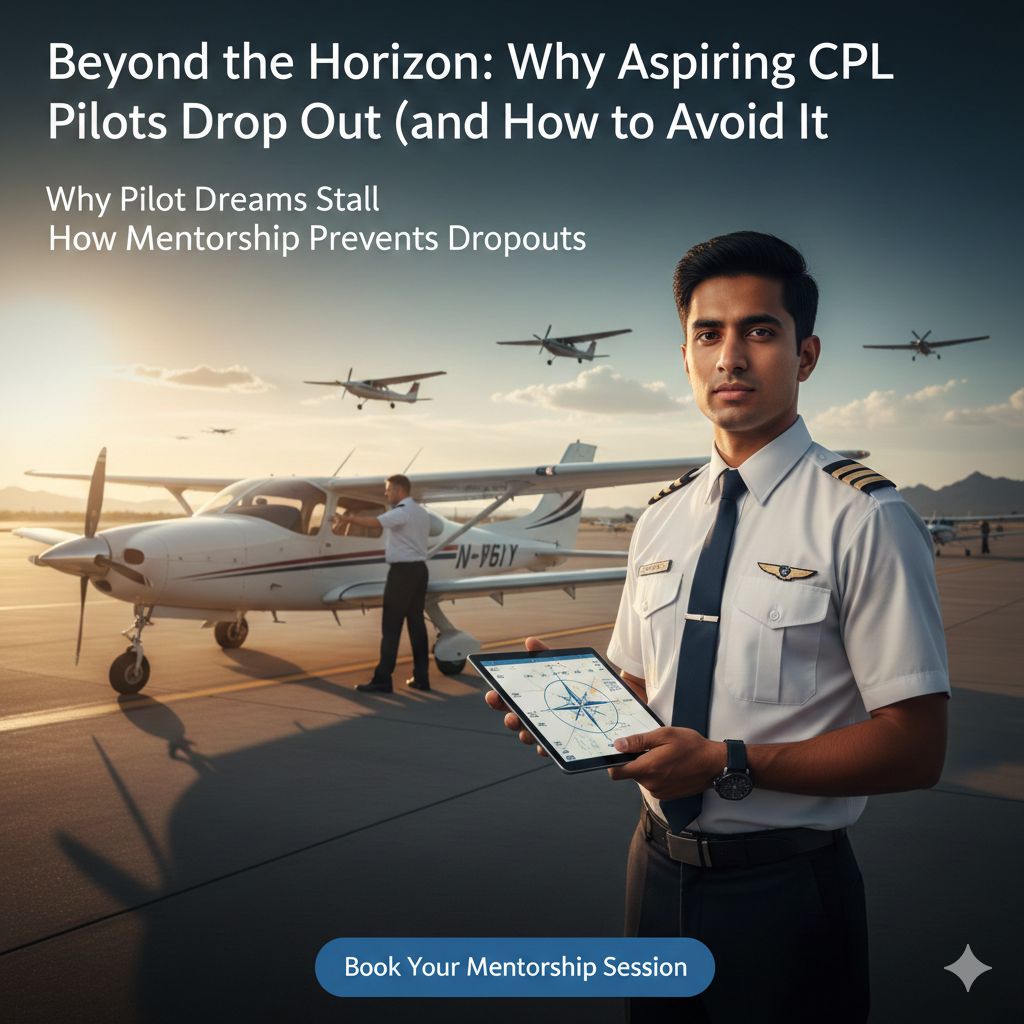
Every year, hundreds of Indian students look toward the sun-drenched runways of the United States with one goal: earning a Commercial Pilot Licence (CPL).
The appeal is obvious.
- World-class infrastructure.
- Faster flying timelines.
- Global exposure.
For many, it feels like the most direct route from a dream to the cockpit.
But here is the uncomfortable truth that rarely makes it into glossy brochures:
Nearly 80% of student pilots globally do not complete their training.
For Indian students training abroad, the reasons are rarely about flying ability. They are about planning, preparation, and guidance.
This is not pessimism.
This is professional flight planning.
Good pilots don’t fear turbulence.
They plan for it.
Quick Answer
Most aspiring CPL students do not drop out because they lack flying ability. They leave pilot training because of financial pressure, medical issues, unrealistic expectations, failed DGCA exams, poor school selection, or a lack of long-term career planning. Most of these risks can be identified and managed before enrollment through proper counseling and preparation.
Why Students Leave Pilot Training
| Reason | Impact Level |
|---|---|
| Financial Stress | Very High |
| Failed DGCA Exams | High |
| Class 1 Medical Issues | High |
| Unrealistic Expectations | High |
| Poor Flight School Choice | Medium |
| Family Pressure | Medium |
| Training Delays | Medium |
| Lack of Mentorship | Medium |
The Five Biggest Reasons CPL Students Drop Out
1. Financial Underestimation
Many students budget only for advertised training fees and fail to account for medicals, exams, accommodation, extra flying hours, and type ratings. (Read our detailed CPL Cost Guide to understand the real financial breakdown.)
2. Medical Surprises
A delayed or failed Class 1 medical can derail a pilot career before it begins.
3. Academic Challenges
DGCA theory exams require disciplined study habits that many students underestimate.
4. Poor School Selection
Students often choose schools based on marketing rather than fleet availability, instructor quality, and completion rates.
5. Lack of Career Planning
Many students focus on obtaining a CPL without understanding the path to airline employment afterward.
Students Who Finish vs Students Who Drop Out
| Factor | Successful Students | Students Who Drop Out |
|---|---|---|
| Budget Planning | Realistic | Optimistic |
| Medical Clearance | Completed Early | Delayed |
| School Research | Extensive | Limited |
| Career Guidance | Present | Missing |
| Backup Plan | Defined | None |
| Mentorship | Ongoing | Minimal |
Warning Signs That a Student May Drop Out
Common warning signs include:
- Delaying Class 1 medical clearance
- Relying on incomplete cost estimates
- Repeated DGCA exam failures
- Frequent school transfers
- Lack of a post-CPL career plan
- No contingency funding available
Recognizing these risks early allows students and families to take corrective action before training is disrupted.
Why Pilot Training Really Stalls
When capable students drop out midway, it usually comes down to three recurring factors.
1. Running Out of Fuel: Financial Exhaustion
CPL training in the US typically costs USD 70,000–95,000.
The most common mistake looks like this:
- Families arrange funds to “get started”
- The assumption is that future costs will somehow be managed
- Extra hours, weather delays, exam retakes quietly increase expenses
When funding dries up during Instrument Rating or Multi-Engine phases, students are often forced to return home without a CPL and without employable qualifications.
The result is emotional distress and long-term financial pressure.
2. The PPL Plateau
The early phase of training is exciting:
- First takeoff.
- First circuit.
- First solo.
Then comes Instrument Rating.
This phase is:
- Academically intense
- Procedurally demanding
- Less glamorous, more disciplined
For students who have not cleared DGCA ground papers before leaving India, the stress doubles.
They are suddenly juggling:
- IFR training in a new country
- DGCA theory exams simultaneously
This is where many hit the “PPL Plateau”. Progress slows. Confidence dips. Some quietly exit the system.
3. The Regulatory Maze
Flight training abroad is not just about flying.
Students must navigate:
- TSA background checks
- Visa categories (M-1 / F-1)
- Attendance and status compliance
- School policies tied to federal regulations
In 2025 alone, student visas for Indian aviation aspirants dropped by 44%, reflecting a far stricter regulatory climate.
Visa delays, documentation issues, and uncertainty often pull focus away from flying, exactly when concentration matters most.
Your Pre-Flight Briefing: How to Stack the Odds in Your Favour
The students who succeed are not always the most talented.
They are the most prepared.
At The Pilot’s Compass, we call this the Mission First approach.
Rule 1: Ground Work First
Clear your DGCA exams in India before leaving.
Why this matters:
- Removes academic overload abroad
- Allows full focus on flying
- Reduces stress, delays, and extra flying hours
DGCA exams are the pre-flight checks of your training journey.
Rule 2: The 15% Rule
Never plan your budget to the last dollar. Arrange financing in advance; check our Education Loan Guide to see structured loan options.
Always account for:
- Full course cost
- +15% buffer for:
- Extra hours
- Weather delays
- Exam retakes
- Living cost surprises
Flying with minimum fuel and no alternative is not professionalism.
Neither is underfunded training.
Rule 3: Seek Mentorship, Not Marketing
Do not choose a flying school based only on:
- Brochures
- Sales calls
- WhatsApp group trends
Instead, seek guidance from:
- Pilots who have trained abroad
- Professionals who understand DGCA and international systems
- Mentors who have already navigated this path
A mentor becomes your compass when the route gets unclear.
A Message for Parents Considering Pilot Training
Funding a commercial pilot career is one of the most significant financial investments a family can make, often ranging between ₹50–75 lakhs. It is natural to feel anxious about the high upfront costs, the complexity of DGCA regulations, and the long-term career outlook.
As parents, your role is crucial. The most important step you can take is to clear the flight path of avoidable obstacles. This means insisting on early DGCA Medical Guide checks and ensuring all DGCA ground exams are cleared before your child departs for flying training. Additionally, insist on choosing flight training institutions based on transparent metrics—such as aircraft-to-student ratios and instructor availability—rather than glossy brochures. Treat pilot training like a corporate business plan: define the budget with a 15% contingency reserve, evaluate career milestones, and consult experienced mentors rather than sales agents. Proper planning doesn’t just protect your investment; it ensures your child has a structured, realistic runway to a successful airline career.
How to Avoid Dropping Out of CPL Training
Before enrolling:
- Complete your Class 1 Medical. Review the DGCA Medical Guide early.
- Build a realistic budget using the CPL Cost Guide.
- Research multiple flying schools using our Flying Schools Directory.
- Understand post-CPL career pathways using the CPL vs PPL vs ATPL guide.
- Arrange financing in advance by studying the Education Loan Guide.
- Speak with current students and airline pilots.
- Create a contingency plan for delays.
Expert Perspective
Most CPL dropouts are not caused by a lack of flying talent. Instructors consistently report that financial planning, medical readiness, and realistic expectations have a greater influence on training completion than raw flying ability. Students who understand the full journey before enrolling tend to complete training faster and with fewer setbacks.
Why Mentorship with The Pilot’s Compass Makes the Difference
Mission Briefing: Personal Mentorship with Commander Naveen Pandita
Most aviation consultancies are run by marketers.
The Pilot’s Compass is run by a pilot.
With experience spanning from military cockpits to commercial airline operations, we understand why students stall and how to prevent it.
A Pilot Career Counselling session is not a casual chat.
It is a professional briefing designed to save you time, money, and missteps.
What We Cover
- Route Planner: Personalised roadmap based on your academic stage
- Financial Scrutiny: Realistic India vs US cost comparison, including hidden expenses
- Cadet vs Conventional: Honest suitability analysis
- DGCA Delta: Strategy to clear exams before flying
- Medical & Regulatory Check: Early screening to avoid dead-ends
In aviation, a one-degree error at takeoff can put you hundreds of miles off course.
Our role is to ensure your heading is correct from day one.
Key Takeaways
- Most CPL dropouts are caused by planning failures, not flying ability.
- Financial stress remains the biggest reason students leave training.
- Early Class 1 medical clearance reduces risk significantly.
- Choosing the right flight school matters more than marketing claims.
- Mentorship and realistic expectations improve completion rates.
- Proper planning can prevent most common dropout causes.
Final Thoughts
The sky is vast.
The path to a professional cockpit is narrow.
Acknowledging risk does not make you fearful.
It makes you a Captain.
Plan early.
Build margins.
Fly with guidance.
When you treat your training with the seriousness of real flight planning, you are no longer hoping to become a pilot.
You are already thinking like one.
Book your mentorship session at The Pilot’s Compass
Limited slots available to ensure dedicated focus for every student.
Sources
Frequently Asked Questions
Map Your Custom Pilot Training Pathway
Evaluate your compliance across the 4 major DGCA training gates, select training country routes (India vs. USA/Europe), and estimate your CPL timeline month-by-month.