After 23 years in the Indian Navy and years in the cockpit of commercial airliners, I have seen aviation from every possible angle. Today, as the Director of The Pilot’s Compass, I hear the same concern from young, capable pilots again and again:
"I have my CPL and 200 hours, but the airlines want 500. How am I supposed to close that gap without going broke?"
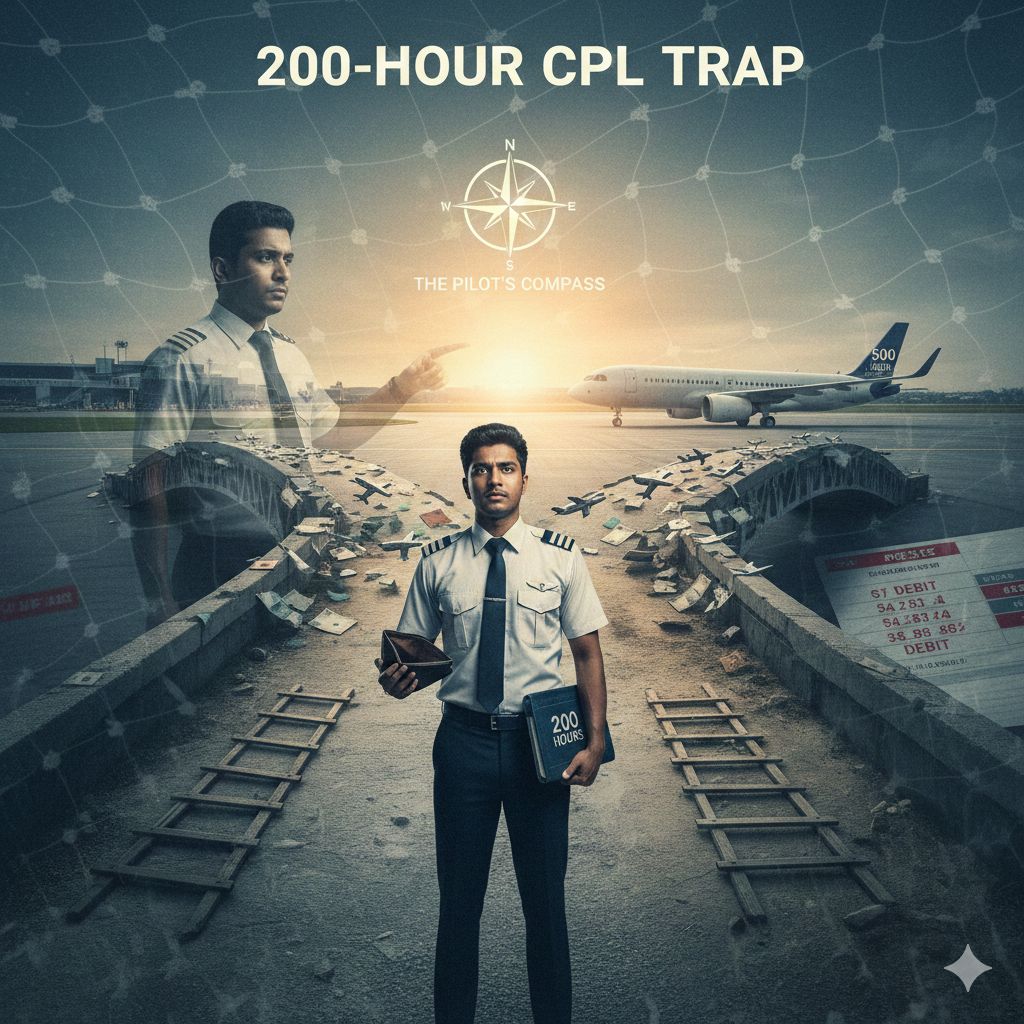
This is the 200-Hour CPL Trap, a classic "Catch-22": You need flying hours to get the job, but you need the job to afford the hours. (Read our detailed CPL Cost Guide to understand the real financial breakdown.) In the United States, this gap is bridged through structured instructor pathways. In India, that bridge barely existed.
Until now.
Quick Answer
The 200-hour CPL trap describes the gap between earning a Commercial Pilot Licence and becoming employable by an airline. While a CPL legally qualifies a pilot to fly commercially, most airlines require additional experience, type ratings, and operational readiness. Learn-and-earn pathways help bridge this gap by allowing pilots to gain experience while generating income.
Why the 200-Hour CPL Trap Exists
Many students assume that earning a Commercial Pilot Licence automatically leads to an airline job. In reality, a CPL is only the beginning of the professional pilot journey. Airlines often require additional qualifications such as type ratings, operational experience, aptitude testing, and successful airline assessments before offering employment.
CPL Reality Check
| Metric | Typical Value |
|---|---|
| Minimum CPL Hours | 200 Hours |
| ATPL Requirement | 1,500 Hours |
| Type Rating Cost | ₹20–35 Lakh |
| First Officer Starting Salary | ₹1.5–3 Lakh/Month |
| Instructor Hour Building Rate | 50–100 Hours/Month |
| Typical Airline Hiring Wait | 6–18 Months |
The 200–500 Hour Gap: What Airlines Are Really Looking For
Many pilots believe the gap between 200 and 500 hours is just about adding numbers to a logbook. In reality, airlines are assessing far more than hours:
- Command maturity: Decision-making under pressure
- Procedural discipline: Consistent SOP compliance
- Situational awareness: Understanding operations beyond the cockpit
- Communication skills: Clear RT and crew coordination
- Professionalism: Punctuality, preparation, and safety mindset
Simply buying hours does not automatically develop these qualities. They are built when you are given responsibility, especially when you are trusted to teach.
What Happens After CPL?
After obtaining a CPL, pilots typically choose one of four pathways:
- Airline Cadet Programme: A structured pathway with a partner airline that usually guarantees a job upon successful completion, but with high upfront costs.
- Type Rating and Direct Airline Applications: Completing a self-funded type rating and applying directly to commercial airlines during hiring drives.
- Flight Instructor Route: Gaining instructor ratings and building hours by teaching new student pilots.
- Charter and Regional Airline Operations: Flying for non-scheduled operators (NSOP) or regional airlines to gain commercial flight deck experience.
Each pathway offers different costs, timelines, and career outcomes. Understanding these options before starting training can help aspiring pilots avoid the common 200-hour CPL trap. You can compare the details of these licenses and pathways in our CPL vs PPL vs ATPL comparison guide.
Common Post-CPL Career Pathways
| Pathway | Income Potential | Hour Building Speed | Airline Readiness |
|---|---|---|---|
| Flight Instructor | Moderate | High | High |
| Charter Operations | Moderate | Moderate | High |
| Regional Airlines | High | High | Very High |
| Cadet Program | Delayed Initially | Structured | Very High |
The Learn and Earn Revolution
At The Pilot’s Compass, we believe the CPL is not the finish line.
It is the qualification for your first aviation job.
The solution lies in the Learn and Earn model, where pilots become instructors, earn a salary, and build experience simultaneously.
Through global partners such as World Wide Wings, you can:
- Pursue an Instructor Rating (CFI / CFII) immediately after CPL
- Start working as a Flight Instructor, not waiting for airline calls
- Earn while you fly, instead of paying for every hour
- Build 300+ hours with real operational responsibility
This pathway doesn’t just fill logbooks. It builds professionals airlines can trust.
How the Instructor Pathway Bridges the Gap
1. Financial Sustainability
- You are paid to fly instead of paying for flying hours
- Income supports living costs, loans, and future training
2. Consistent Flying and Skill Retention
- Regular flying keeps proficiency high
- Avoids long breaks that erode confidence and recency
3. Mastery of Fundamentals
- Teaching forces deep understanding of aerodynamics, procedures, and emergencies
- This translates directly to stronger airline simulator performance
4. Professional Exposure and Networking
- Daily interaction with instructors, examiners, and training managers
- Strong references for airline selections
5. Enhanced Employability
- Airlines value instructors for discipline and responsibility
- 500+ hours as an instructor is far stronger than purchased hours
Learn-and-Earn vs Traditional CPL Pathway
| Factor | Traditional CPL Pathway | Learn-and-Earn Pathway |
|---|---|---|
| Initial Cost | Lower | Slightly Higher |
| Income After CPL | Often Delayed | Starts Earlier |
| Hour Building | Slower | Faster |
| Airline Readiness | Moderate | Higher |
| Career Risk | Higher | Lower |
| Operational Experience | Limited | Greater |
Beyond Hours: What Airlines Actually Assess
Hours are only the first filter. Airlines evaluate candidates on:
- Psychometric and aptitude testing
- Aircraft systems and regulatory knowledge
- Simulator handling in abnormal scenarios
- Crew Resource Management (CRM)
- Communication skills and cultural fit
Mentorship at The Pilot’s Compass prepares pilots across all these areas, not just flying time.
The Pilot’s Compass Approach: End-to-End Career Navigation
We are not a placement agency.
We are a career navigation partner.
1. Early-Stage Mentorship (Class 11–12)
- Clear roadmap from medicals to airline cockpit
- Cadet Program vs Conventional CPL evaluation
- Academic planning aligned with aviation goals. If you need one-on-one help, you can sign up for Pilot Career Counselling to build a custom roadmap and get honest, practical guidance.
2. Training and Institute Selection
- Shortlisting quality FTOs in India and abroad. You can browse verified facilities in our Flying Schools Directory to select a school.
- Access to integrated Learn and Earn pathways
- Safety, quality, and long-term career focus
3. Financial Planning and Scholarships
- Realistic cost estimation from start to right seat
- Staged training to reduce upfront burden
- Access to our Scholarship Exam for deserving candidates. Understanding CPL Education Loans early can also help design a realistic training budget.
4. Career Readiness and Airline Preparation
- Interview and group discussion preparation
- Simulator and technical readiness. Aspiring pilots can also look up our Type Rating Guide to plan their simulator phase.
- CV building and profile positioning
The Scholarship Exam: Your First Concrete Step
We founded The Pilot’s Compass to mentor students early, especially those in Class 11 and 12.
We don’t want you to just earn a licence.
We want you to build a sustainable aviation career.
That’s why we conduct a Scholarship Exam twice a year for the Learn and Earn Program.
The exam helps:
- Identify high-potential talent
- Offer financial assistance and mentorship
- Provide access to Learn and Earn programs
- Guide students toward the right training pathway
Our objective is simple:
No pilot should be stuck at 200 hours with no runway to a job.
Who Should Consider the Learn and Earn Pathway
This pathway is ideal if you:
- Are in Class 11 or 12 and want clarity early
- Hold a CPL and are worried about funding additional hours
- Are considering overseas training and want employment visibility
- Want to stand out in airline selections
How You Can Prepare Right Now
Regardless of your stage, start building:
- Medical readiness: Complete Class 2 and plan Class 1 early. Review the official DGCA Requirements to ensure you qualify.
- Academic strength: Physics, Maths, and English
- Industry awareness: Stay informed about hiring trends
- Soft skills: Communication, confidence, discipline
At The Pilot’s Compass, we integrate all of this into mentorship so you are airline-ready, not just licence-ready.
Expert Perspective
The biggest challenge facing new CPL holders is not obtaining the licence but bridging the gap between 200 flight hours and airline-ready experience. Learn-and-earn pathways are becoming increasingly important because they help pilots build operational experience while reducing financial pressure. As airlines continue expanding fleets, pilots who accumulate quality flying experience early often position themselves more competitively for future hiring opportunities.
Key Takeaways
- A CPL licence alone does not guarantee an airline job.
- The biggest challenge is moving beyond 200 flight hours.
- Type ratings and operational experience improve employability.
- Learn-and-earn pathways can reduce financial pressure.
- Strategic hour building can accelerate airline opportunities.
- Understanding post-CPL pathways helps avoid costly mistakes.
The Bottom Line
The gap between a 200-hour CPL and a 500-hour First Officer is where many aviation dreams stall.
Buying hours is not a strategy.
It is an expensive pause.
We are building a bridge that pays you to grow.
A Learn and Earn pathway that develops your hours, skills, and employability together.
If you have the passion, we have the compass to guide you from your first dream of flying to your first day in an airline cockpit.
Sources
Frequently Asked Questions
Map Your Custom Pilot Training Pathway
Evaluate your compliance across the 4 major DGCA training gates, select training country routes (India vs. USA/Europe), and estimate your CPL timeline month-by-month.