

DGCA CPL Ground Classes
Complete CPL Ground School Preparation
Preparing for the DGCA Commercial Pilot Licence (CPL) theory examinations can feel overwhelming when you are just starting.
Some students buy every recommended book. Others spend weeks solving thousands of MCQs. A few watch online videos without following any structured plan. After a month, many realize they haven't thoroughly completed even one subject.
The problem usually isn't a lack of effort. It's the lack of a roadmap.
Preparing for DGCA exams is very different from preparing for a typical school or college examination. The syllabus is broader, the concepts are interconnected, and success depends on understanding aviation rather than memorizing answers.
That is why students who follow a structured study plan generally progress faster than those who jump randomly between books, question banks, and revision notes.
In this guide, you will learn exactly how to prepare for the DGCA CPL exams step by step, including:
- Where to start your preparation.
- Which subjects to study first.
- Which books to use.
- How to revise efficiently.
- How to use question banks.
- How to schedule mock tests.
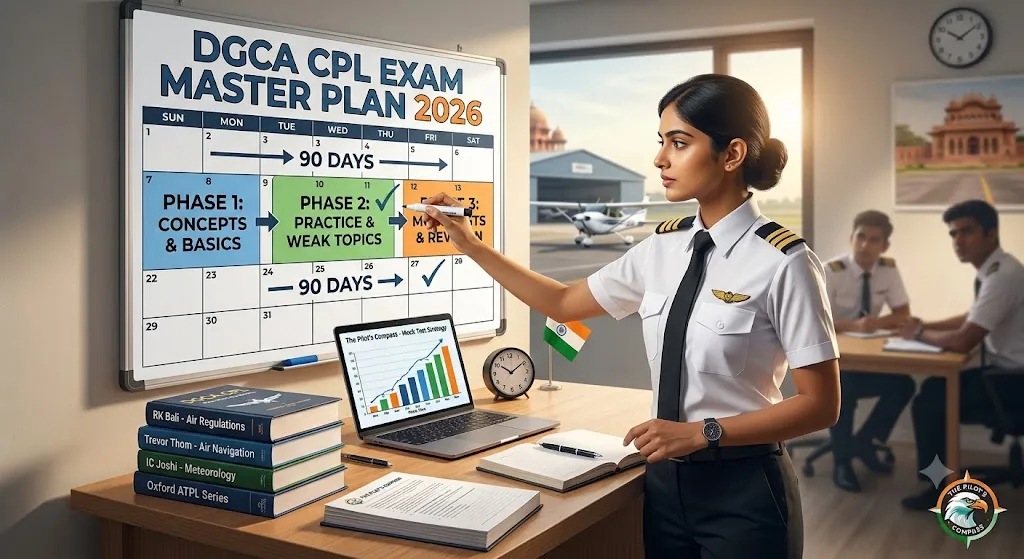
- A practical 90-day study plan.
- How to avoid common mistakes.
- Whether you can prepare without coaching.
Note: While the Directorate General of Civil Aviation (DGCA) determines the official syllabus and passing criteria, the study strategies presented in this guide are editorial recommendations based on the experiences of successful candidates and aviation instructors.
Always verify the latest syllabus and examination schedules through the official DGCA Pariksha Portal.
The short version
The best way to prepare for DGCA exams is to begin with the official syllabus, study concepts before solving MCQs, revise regularly, and gradually increase the number of mock tests as the examination approaches. A structured 90-day study plan is often more effective than trying to study multiple subjects without a clear schedule.
Where Should I Start My DGCA Preparation?
To start preparing for DGCA exams, your very first step must be to download the latest Flight Crew syllabus from the official DGCA website. Do not open a textbook until you understand the exact scope of the examination.
Before planning your preparation, answer a few basic questions:
- Which subjects are included?
- How many papers do you need to clear?
- What are the DGCA passing marks?
- How are the exams conducted?
- What is the validity of the results?
Having answers to these questions helps you build a realistic study plan instead of preparing blindly. If you are unfamiliar with the examination structure, read our detailed guide on the DGCA Exam Pattern and DGCA Exam Syllabus before beginning your preparation.
What Should I Study First?
Every Commercial Pilot Licence applicant prepares across several core theory subjects. Understanding how these subjects interconnect will help you determine what to study first.
| Subject | Main Focus |
|---|---|
| Air Regulations | Aviation law, CARs, ICAO, licensing |
| Air Navigation | Flight planning, navigation calculations, radio navigation |
| Aviation Meteorology | Weather systems, forecasts, METAR, TAF |
| Technical General | Aircraft systems, engines, aerodynamics |
| Technical Specific | Aircraft-specific knowledge |
| RTR(A) | Aviation radio communication |
We recommend starting with Aviation Meteorology or Air Regulations. Meteorology provides foundational knowledge about the atmosphere that makes Air Navigation much easier to understand later. Air Regulations require significant reading and retention, making it a good subject to study consistently from week one.
Instead of viewing these subjects independently, think of them as different parts of the same profession. Navigation depends on weather. Weather affects aircraft performance. Regulations govern how flights operate. Understanding these connections makes learning much easier.
Which Books Should I Use?
To choose the best books for DGCA exams, select one trusted primary resource per subject rather than buying multiple books that cover the same material.
Choosing the right books saves time. Choosing too many books usually wastes it. Your primary resources should include:
| Subject | Recommended Resource |
|---|---|
| Air Regulations | RK Bali |
| Air Navigation | Trevor Thom + Oxford ATPL |
| Meteorology | IC Joshi |
| Technical General | Oxford ATPL Series |
| Technical Specific | Aircraft POH / AFM |
| RTR(A) | RTR Practice Material |
If you are unsure which books to buy, read our complete guide to the Best DGCA Books for CPL Exams, where we've compared the most widely recommended resources subject by subject.
The 90-Day Study Roadmap
One of the biggest reasons students fall behind is trying to study every subject simultaneously. A better approach is to focus on one subject at a time while continuing regular revision of previously completed topics.
Below is a practical 90-day preparation roadmap. This is a practical framework that students can adapt to their own schedule.
Tip: Adjust the pace based on your available study time. If you are studying full-time, you may complete topics faster. If you are balancing college or work, extend the timeline while keeping the sequence the same.
| Phase | Week | Primary Goal | Secondary Goal |
|---|---|---|---|
| Phase 1: Foundations | Week 1 | Air Regulations | Daily MCQs |
| Week 2 | Complete Air Regulations | Weekly Revision + Mock | |
| Week 3 | Aviation Meteorology | Weather Charts & METAR Practice | |
| Week 4 | Complete Meteorology | Subject Mock Test | |
| Phase 2: Core Technicals | Week 5 | Air Navigation Concepts | Formula Practice |
| Week 6 | Navigation Calculations | Subject Mock Test | |
| Week 7 | Technical General | System Diagrams & Revision | |
| Week 8 | Technical Specific | Aircraft Performance | |
| Phase 3: Exam Readiness | Week 9 | Mixed Subject Revision | Weak Topic Improvement |
| Week 10 | Improve Weak Subjects | Question Bank Practice | |
| Week 11 | Full-Length Mock Tests | Speed & Accuracy | |
| Week 12 | Final Revision | Error Analysis |
The goal isn't to finish quickly. The goal is to finish thoroughly.
How Many Hours Should I Study?
There is no official rule, but successful candidates typically study for 4 to 6 hours daily when preparing full-time. Consistency matters far more than studying for twelve hours once a week.
A practical daily routine looks something like this:
| Time Allocation | Activity |
|---|---|
| 2 Hours | Learn new concepts |
| 1 Hour | Make short, concise notes |
| 1 Hour | Solve chapter-wise MCQs |
| 30 Minutes | Revise previous topics |
Students following a regular routine usually retain concepts better than those who rely on last-minute cramming. The exact number of study hours isn't as important as maintaining consistency over several weeks.
How Should I Revise?
To revise effectively, reserve one day every week solely for reviewing older topics rather than waiting until you finish the entire syllabus.
Many students keep studying new chapters without revisiting older ones. After a month, they have forgotten half of what they learned. Small weekly revisions are far more effective than trying to revise the entire syllabus just before the examination.
During your weekly revision day:
- Review your short notes.
- Solve your previous mistakes.
- Revise important formulas.
- Reattempt difficult MCQs.
- Update your weak-topic list.
Building smart notes is a key part of this process. Your notes should help with revision—not become another textbook. Aim to reduce each chapter into one or two revision pages containing definitions, important formulas, flowcharts, and frequently tested topics.
How Should I Use Question Banks?
To use DGCA question banks effectively, attempt questions only after you have mastered the conceptual theory of a chapter.
Question banks are one of the most useful preparation tools when used correctly. Unfortunately, many students use them incorrectly by reading a question and simply memorizing the answer. This approach works only until the exam contains unfamiliar or rephrased questions.
The Correct Question Bank Workflow:
- Read the question.
- Attempt it yourself without looking at the answer.
- Check the answer.
- Understand exactly why it is correct.
- Revise the underlying concept if your logic was flawed.
- Solve similar questions.
Question banks should test your understanding—not become your primary source of learning.
How Should I Use Mock Tests?
To get the most out of mock tests, treat them as diagnostic progress reports rather than just practice papers. You should gradually increase your mock test frequency as your exam date approaches.
Mock Test Schedule:
- Weeks 1–4: One subject-wise mock every week.
- Weeks 5–8: Two mixed-subject mocks per week.
- Weeks 9–10: Three full-length mocks per week.
- Final 2 Weeks: One full mock every day or alternate day.
After every mock test, review every incorrect answer, identify your weak concepts, revise those specific chapters, and reattempt similar questions. The review process is often more valuable than the mock itself.
How Can I Avoid Common Mistakes?
Preparing for the DGCA CPL exams isn't only about studying hard—it's also about avoiding habits that reduce your effectiveness. Here are the most common mistakes to avoid:
- Starting With the Question Bank: While question banks are an essential revision tool, they shouldn't replace conceptual learning. Students who understand concepts adapt better when application-based questions appear.
- Studying Too Many Books: Depth of understanding matters more than the number of books on your desk. Choose one trusted resource for each subject.
- Ignoring Weekly Revision: Without revision, even well-understood topics fade over time. Regular revisions reduce exam stress significantly.
- Avoiding Difficult Subjects: Postponing Air Navigation or Technical General because they seem challenging creates unnecessary pressure close to the exam. Start early and study them in smaller sections.
- Skipping Mock Tests: Waiting until the final week before attempting a mock test is a missed opportunity to identify weak areas and improve time management.
Can I Prepare for DGCA Exams Without Coaching?
Yes, you can absolutely prepare for DGCA exams through self-study if you possess strong discipline and the ability to grasp technical concepts independently.
Both methods can help you clear the DGCA exams, but the choice depends on your learning style:
| Self-Study | Ground Classes |
|---|---|
| Flexible timing | Structured schedule |
| Lower cost | Expert guidance |
| Independent learning | Live doubt-solving |
| Requires immense discipline | Regular accountability |
| Self-managed revision | Mock exams & mentorship |
Many students choose a combination of both—using structured DGCA Ground Classes for conceptually heavy subjects like Air Navigation and Technical General, and self-study for regular revision and subjects like Air Regulations.
Exam-Day Preparation Tips
The week before your DGCA examination should focus on confidence—not cramming.
One Week Before:
- Revise summary notes.
- Attempt full-length mock tests.
- Review incorrect answers.
- Sleep well and maintain a consistent routine.
One Day Before: Avoid starting new topics. Instead, revise formulas, review definitions, read important diagrams, organize your documents, and confirm your examination schedule.
On Exam Day: Arrive early, stay calm, and read each question carefully. Eliminate incorrect options where possible and manage your time wisely. A calm and focused approach often improves performance more than last-minute studying.
How The Pilot's Compass Ground Classes Help Students Prepare
Preparing for DGCA theory papers can feel overwhelming without a clear direction. At The Pilot's Compass, our comprehensive DGCA Ground Classes focus on helping students build strong aviation fundamentals while maintaining a structured preparation schedule.
Learn from Commander Naveen Pandita (Retd.)
Students are mentored directly by Commander Naveen Pandita (Retd.), who brings extensive aviation experience and a practical teaching approach to every class. Lessons emphasize understanding concepts rather than memorizing answers, helping students build knowledge that remains valuable during flight training and beyond.
Structured Learning Path
Our ground classes follow a guided preparation journey:
- Career Counselling to set the right timeline.
- Live Interactive Classes that break down complex topics.
- Daily Revision & Chapter-wise MCQs to reinforce learning.
- Weekly Assessments & Rigorous Mock Tests to build exam readiness.
- End-to-end Flying Training Guidance once your theory is complete.
This structured approach helps students stay consistent and accountable throughout their preparation.
Interactive Online Classes
Students can join our live online ground classes from anywhere in India.
Our DGCA preparation program features:
- Live instructor-led classes focused on core concepts.
- Recorded lectures available for flexible revision.
- Regular doubt-solving sessions to clear roadblocks.
- Detailed progress tracking.
- Comprehensive mock examinations that mirror the real DGCA environment.
Beyond Theory Preparation
The Pilot's Compass also supports students with end-to-end guidance, including eGCA Computer Number support, DGCA Class 2 and Class 1 Medical guidance, flying school selection, and answering all your questions about How to Become a Pilot in India.
Ready to Prepare with Expert Guidance?
If you are looking for a structured preparation program with experienced mentorship, live online classes, regular mock tests, and end-to-end CPL guidance, the DGCA Ground Classes at The Pilot's Compass can help you prepare with confidence.
Book a free counselling session today to discuss your current preparation level, find the right study plan for your timeline, and get guidance on medicals and flying school planning. Starting with the right strategy can make your preparation more focused and your path to a Commercial Pilot Licence much smoother.
Continue Reading
You may also like:
- Best DGCA Ground Classes in India
- Best DGCA Books for CPL Exams
- DGCA CPL Exam Pattern Explained
- DGCA CPL Exam Syllabus 2026
- DGCA Exam Fees 2026
- How to Become a Pilot in India
- DGCA Passing Marks
Sources
Official References
- Directorate General of Civil Aviation (DGCA)
- DGCA Pariksha Portal
- Civil Aviation Requirements (CAR)
- ICAO Annex 1 – Personnel Licensing
Educational Guidance
- Study timelines and textbook recommendations are editorial strategies compiled by aviation instructors and successful candidates. They do not represent regulatory mandates.
Frequently Asked Questions
Map Your Custom Pilot Training Pathway
Evaluate your compliance across the 4 major DGCA training gates, select training country routes (India vs. USA/Europe), and estimate your CPL timeline month-by-month.