Introduction
The Directorate General of Civil Aviation controls every aspect of pilot licensing in India. That includes which schools can train you, what exams you sit, how many hours you must fly, and who administers your final test.
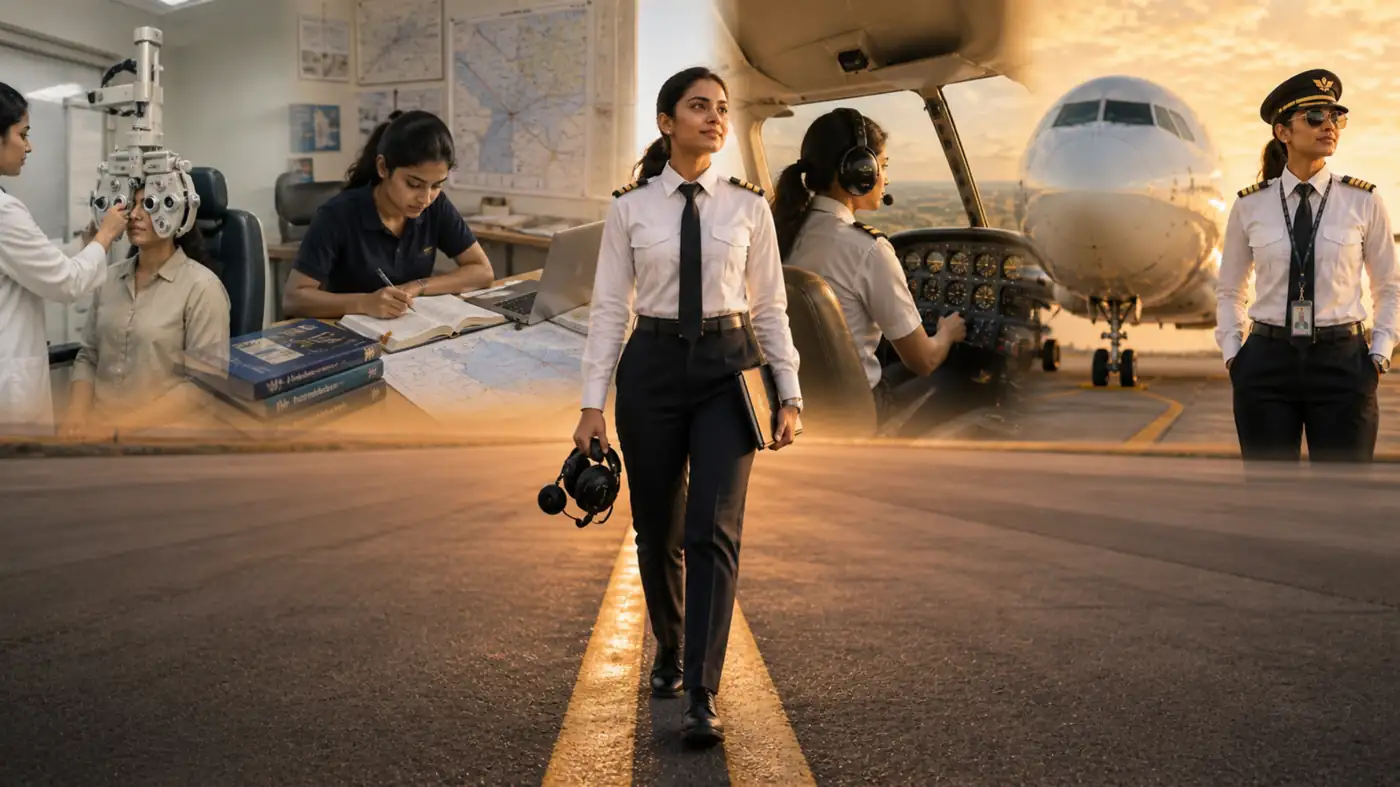
DGCA pilot training in India has five mandatory stages: Class 1 medical clearance, ground school training, six written exams (70% minimum each), 200 hours of flight training including cross-country and night flying, and a final skills test. Most students take 2–3 years to complete the full process.
Understanding the process end-to-end before you start is worth more than any single decision about which school to pick.
What is DGCA and Why is it Important?
DGCA is the civil aviation regulator under India's Ministry of Civil Aviation. It sets and enforces all standards for pilot training, aircraft airworthiness, and airline operations.
For aspiring pilots, DGCA matters because:
- Only training at a DGCA-approved FTO (Flying Training Organization) counts toward your CPL
- DGCA conducts and grades all written exams directly
- Your CPL is issued by DGCA and recognized under ICAO standards internationally
There's no shortcut around it. Training hours at an unapproved school don't count. It's binary.
Overview of Pilot Training Process in India
The full process runs in roughly this order, though ground school and flight training overlap:
- Eligibility confirmation (age, education, English)
- DGCA Class 1 medical
- Student Pilot License (SPL) application
- Enrollment at DGCA-approved FTO
- Ground school training
- DGCA written exams (6 papers)
- Radio Telephony License (RTR)
- Flight training (200 hours total)
- CPL skills test
Each stage has prerequisites. You can't sit the CPL skills test without passing all written exams. You can't log solo hours without an SPL. The sequence matters.
Step-by-Step DGCA Training Process
Medical Examination (Class 2 and Class 1)
Two levels of DGCA medical matter for pilot training.
Class 2 medical is required for the Student Pilot License. Less rigorous. Checks general health, basic vision, and cardiovascular basics.
Class 1 medical is required for CPL. Stricter. You'll need this before the CPL is issued, but most students get it done early to confirm eligibility before investing heavily in training.
Both are conducted by DGCA-approved medical examiners. Not every city has one — check the DGCA website for the current list of approved AMEs (Aviation Medical Examiners).
Common disqualifiers at Class 1 level: vision that can't be corrected to required standards, cardiac arrhythmias, certain neurological histories, and poorly controlled diabetes. If any of these apply to you, get a medical opinion before enrolling.
Ground School Training
Ground school covers the theory behind flying: navigation, weather, regulations, aircraft systems, and flight planning. Most approved schools run ground school in-house, either as classroom instruction or self-study with faculty support.
The six subjects align directly with the DGCA written exams:
- Air Navigation
- Meteorology
- Air Regulations
- Technical General (aircraft systems, engines, instruments)
- Technical Specific (aircraft type you're training on)
- RTR (Radio Telephony — separate exam administered by DGCA)
Duration varies. Some schools run intensive 3-month ground school programs. Others spread it across the full training period. Neither is inherently better — it depends on how you learn.
DGCA Written Exams
Six papers. 70% required to pass each. Four attempts maximum per subject.
DGCA runs exam centers at designated locations. As of 2026, the scheduling process has improved but backlogs still appear during peak periods (post-monsoon and January–March). Build 4–6 weeks of lead time into your planning for each exam.
Exam difficulty by subject:
- Air Regulations: Memorization-heavy. Most students find it manageable.
- Meteorology: Conceptually challenging. Weather systems, METAR/TAF reading, cloud physics.
- Air Navigation: Calculation-intensive. Dead reckoning, fuel planning, charts.
- Technical General: Broad scope. Engines, hydraulics, electrics, instruments.
- Technical Specific: Depends on aircraft. Ask your school what's covered.
Most students pass 4–5 subjects in their first sitting and need resits for 1–2. That's normal, not a red flag.
Flying Training (200 Hours Requirement)
DGCA specifies minimum hour requirements, not just total hours. The breakdown:
| Category | Minimum Hours |
|---|---|
| Total flight time | 200 hours |
| Pilot-in-command | 100 hours |
| Cross-country (PIC) | 50 hours |
| Instrument time | 10 hours (simulator counts for 5) |
| Night flying | 5 hours |
| Solo cross-country | 1 flight of 150+ nm with 2 stops |
The solo cross-country requirement trips up some students — it requires specific weather minimums and pre-approval. Plan it well in advance.
RTR (Radio Telephony License)
The RTR(A) license is now administered by DGCA — the exam moved from WPC (Wireless Planning and Coordination Wing) to DGCA's own examination system. You need it to legally operate aircraft radios, and it's a mandatory requirement before CPL issue.
The exam tests phraseology, emergency procedures, and ICAO communication standards. Most students pass on first attempt if they've been actively flying — the practical experience helps significantly. The RTR exam can be done during or after flight training.
DGCA Exam Subjects Explained
Air Navigation tests your ability to plan and execute flights: calculating headings, wind corrections, fuel requirements, and reading aeronautical charts. It's math-heavy but follows consistent patterns.
Meteorology covers weather theory, reading weather reports (METAR, TAF, SIGMET), and understanding how weather affects flight. Students who underestimate this subject tend to fail it.
Air Regulations is the rulebook — DGCA regulations, ICAO standards, aircraft operation rules, licensing requirements. Memorization with application.
Technical General covers systems common across aircraft: piston engines, gas turbines (basics), hydraulics, pneumatics, electrical systems, avionics, and instruments.
Technical Specific is the systems knowledge for your specific training aircraft. Syllabus varies by school and aircraft type.
Minimum Requirements for CPL License
| Requirement | Details |
|---|---|
| Age | Minimum 18 years |
| Medical | Valid DGCA Class 1 medical |
| Education | Class 12 with Physics and Maths |
| Written exams | All 6 papers cleared (70% each) |
| Flight hours | 200 total (100 PIC, 50 XC) |
| RTR license | Valid DGCA RTR(A) |
| Skills test | Passed with DGCA examiner |
All requirements must be current and valid on the date of CPL issue. A lapsed medical, for instance, means the CPL can't be issued until it's renewed.
Timeline of DGCA Pilot Training
| Phase | Duration |
|---|---|
| Medical + SPL | 1–2 months |
| Ground school | 3–6 months (parallel to flying) |
| DGCA written exams | 3–9 months (depends on scheduling) |
| Flight training to 200 hours | 12–24 months |
| Skills test preparation | 1–2 months |
| Total (realistic) | 24–30 months |
The 24–30 month figure assumes a school with reasonable aircraft availability and no major weather disruptions. Students at schools with low aircraft-to-student ratios sometimes take 36+ months.
Common Mistakes Students Make
Starting flight training before clearing medicals. About 1 in 8 students discovers a disqualifying condition after paying enrollment fees. Medical first, always.
Underestimating Meteorology. It's consistently the highest fail-rate subject. Students who treat it as secondary to Technical often regret it.
Not tracking hour requirements independently. Rely on the school's logbook tracking and you may find discrepancies close to your skills test. Maintain your own flight log from day one.
Ignoring cross-country planning. The solo cross-country requirement needs weather windows, regulatory approvals, and route planning. Students who leave it late often sit on the ground waiting for suitable conditions for months.
Choosing a school purely on price. Low headline fees sometimes mean fewer aircraft, slower training, and ultimately a longer — and more expensive — total timeline.
Tips to Clear DGCA Process Faster
Get your Class 1 medical done before anything else. If you pass, you've eliminated the biggest unknown.
Appear for written exams as early as your school allows. Clearing papers while flying means they're not sitting as a bottleneck at the end.
Study Meteorology seriously from the start. One failed exam adds 4–6 weeks minimum given scheduling lead times.
Track your own flight hours by category from day one. Know exactly where you stand against the 100-hour PIC minimum, 50-hour cross-country minimum, and instrument time.
Choose your school's location partly based on annual flying days. A school in a dry climate with 280+ flying days per year will get you to 200 hours faster than one with 180 days.
Frequently Asked Questions
Map Your Custom Pilot Training Pathway
Evaluate your compliance across the 4 major DGCA training gates, select training country routes (India vs. USA/Europe), and estimate your CPL timeline month-by-month.