Introduction
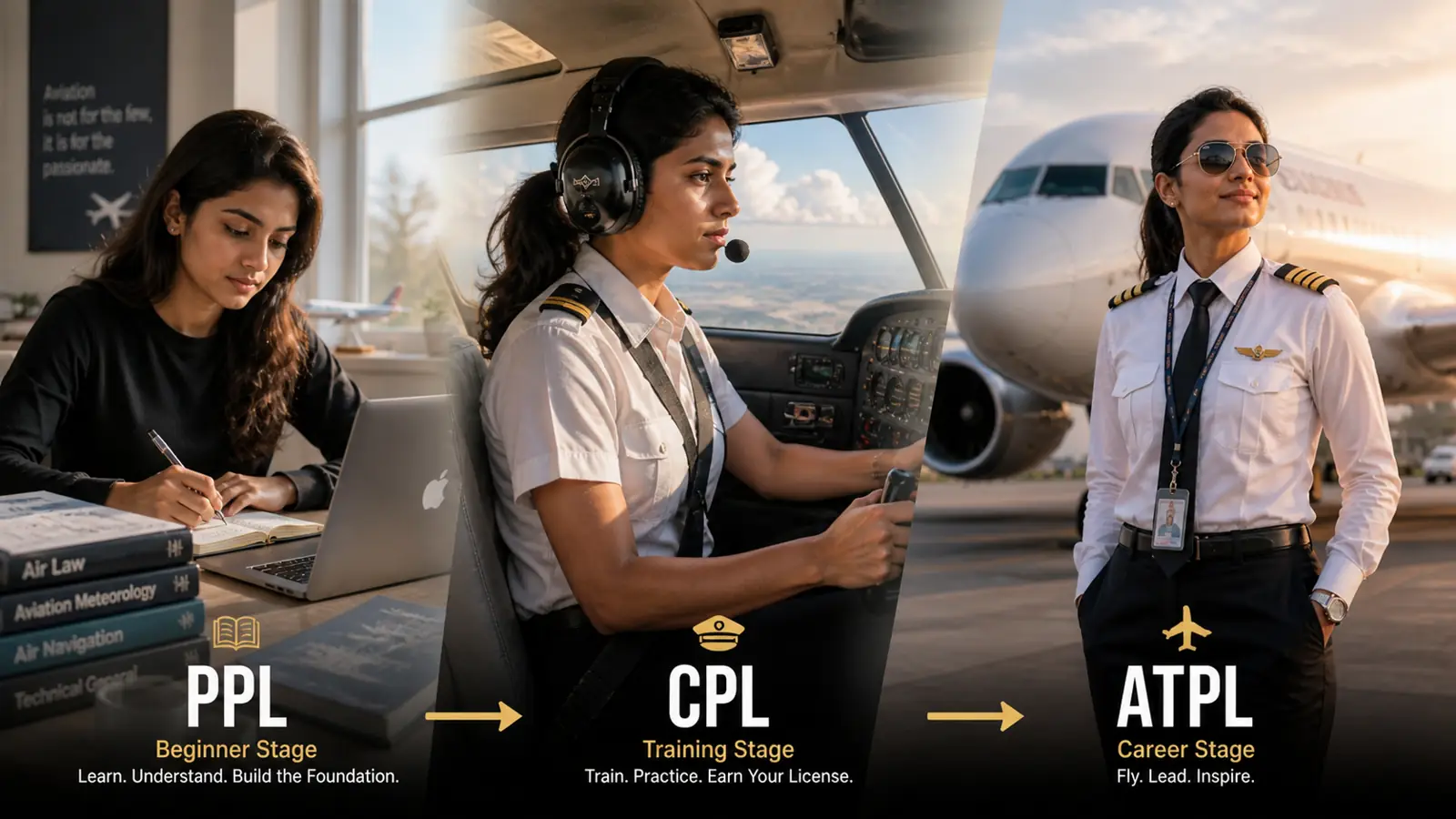
PPL lets you fly for personal use only. CPL lets you be paid to fly and is the standard entry point for airline careers in India. ATPL is required to captain scheduled airline flights and demands 1,500 hours of flight time. Most aspiring airline pilots go straight for CPL — PPL is optional, ATPL comes later.
Three licenses. Completely different purposes and requirements. Choosing the wrong entry point costs money and time.
Here's the unambiguous breakdown.
Key Takeaways
- PPL (Private Pilot License): For personal flying only (cannot fly for pay). Requires Class 10 education, Class 2 medical, and 40 flight hours. Cost: ₹4–8 lakhs.
- CPL (Commercial Pilot License): Standard entry point for airline first officer roles. Allows paid commercial flying. Requires Class 12 (Physics & Math), Class 1 medical, and 200 flight hours. Cost: ₹45–90 lakhs.
- ATPL (Airline Transport Pilot License): Highest license, required to captain commercial flights. Earned post-CPL by logging 1,500 flight hours. No standalone cost (earned through airline employment).
- Career Path Suggestion: If you want an airline career, skip PPL and go straight to CPL.
Quick Navigation
- What are Pilot Licenses?
- Private Pilot License (PPL)
- Commercial Pilot License (CPL)
- Airline Transport Pilot License (ATPL)
- Key License Differences
- Eligibility & Costs Comparison
- Which License Should You Choose?
- Common Myths vs. Reality & FAQ
What are Pilot Licenses in India?
DGCA issues three main pilot licenses, each with progressively higher requirements and broader privileges:
- PPL — Private Pilot License: personal flying, no pay
- CPL — Commercial Pilot License: paid flying, airline entry-level
- ATPL — Airline Transport Pilot License: airline captain operations
There's also a Student Pilot License (SPL) required to train, but that's an administrative step, not a career license.
All three are governed by DGCA under CAR (Civil Aviation Requirements) and aligned with ICAO Annex 1 standards.
What is PPL (Private Pilot License)?
PPL allows you to fly as pilot-in-command for personal purposes. You cannot be paid for your flying services. The aircraft you fly cannot be operated for commercial purposes on that flight.
Who PPL is for: People who want to fly as a hobby, business owners who want to fly their own aircraft, or students who want to confirm they enjoy flying before committing to full CPL training.
Who PPL is NOT for: Anyone whose goal is an airline career. PPL doesn't count toward CPL hour requirements in any useful way.
PPL Requirements in India
| Requirement | Details |
|---|---|
| Minimum age | 17 years |
| Medical | DGCA Class 2 |
| Flight hours | Minimum 40 hours (including 10 solo) |
| Written exams | 4 DGCA papers |
| Education | Class 10 minimum |
Cost range: ₹4–8 lakhs. Significantly less than CPL, but this money doesn't reduce your CPL costs much since the hours partially overlap.
What is CPL (Commercial Pilot License)?
CPL is the license you need to fly professionally. It allows you to act as pilot-in-command or co-pilot on commercial flights and to be paid for flying services.
For Indian airline careers, CPL is the entry-level license for first officer positions. Airlines then do their own type ratings (training on specific aircraft like Boeing 737 or Airbus A320) before you fly a scheduled service.
Who CPL is for: Anyone planning an airline or charter career. This is the primary target for most Indian aviation students.
CPL Requirements in India
| Requirement | Details |
|---|---|
| Minimum age | 18 years |
| Medical | DGCA Class 1 |
| Flight hours | 200 total (100 as PIC, 50 cross-country) |
| Written exams | 6 DGCA papers (70% each) |
| Education | Class 12 with Physics and Maths |
| RTR license | DGCA RTR(A) required |
Cost range: ₹45–90 lakhs. Training duration: 2–3 years.
What is ATPL (Airline Transport Pilot License)?
ATPL is the highest pilot license. It's required to act as pilot-in-command (captain) on scheduled airline flights in India.
Fresh CPL holders get what's called a "frozen ATPL" — they've passed the ATPL theory exams but don't have the required total flight time yet. The ATPL "unfreezes" when you reach 1,500 hours of total flight time.
Most first officers at Indian carriers are flying on CPL with frozen ATPL theory. They accumulate hours, and when they hit the flight time minimums, they apply to have the full ATPL issued.
Who ATPL is for: Pilots who want to become captains. You don't apply for ATPL as a fresh student — it comes after years of airline flying experience.
ATPL Requirements in India
| Requirement | Details |
|---|---|
| Minimum age | 21 years |
| Medical | DGCA Class 1 |
| Total flight hours | 1,500 hours |
| Multi-engine instrument hours | 75 hours |
| Night flying | 100 hours |
| Written exams | Additional ATPL theory papers |
| CPL | Must hold valid CPL |
Key Differences Between CPL vs PPL vs ATPL
| Factor | PPL | CPL | ATPL |
|---|---|---|---|
| Can fly for pay | No | Yes | Yes |
| Can command airline aircraft | No | No (FO only) | Yes (Captain) |
| Minimum flight hours | 40 | 200 | 1,500 |
| Medical required | Class 2 | Class 1 | Class 1 |
| Approximate cost | ₹4–8L | ₹45–90L | Earned through experience |
| DGCA written exams | 4 | 6 | Additional ATPL papers |
| Duration | 3–6 months | 2–3 years | Years post-CPL |
Eligibility, Cost, and Duration Comparison
PPL: Class 10 education, Class 2 medical, age 17. Accessible entry point. No Physics/Maths requirement at Class 12 level.
CPL: Class 12 with Physics and Maths, Class 1 medical, age 18. More demanding but achievable with standard science stream schooling.
ATPL: All CPL requirements plus 1,500 hours flight experience. Realistically takes 3–6 years post-CPL for most airline pilots.
Cost Comparison of Each License
PPL: ₹4–8 lakhs for 40 hours training. Schools often offer PPL as a standalone program.
CPL: ₹45–90 lakhs all-in. This is the number most families plan around. The range is real — aircraft type, location, and school selection create genuine variation.
ATPL: No standalone training cost. The hours requirement is fulfilled through paid employment at an airline. The theory exam fees are relatively minor (₹10,000–20,000 range).
If you're planning a pilot career, budget for CPL. PPL is optional. ATPL comes automatically through the career.
Duration Comparison
PPL: 3–6 months. Can be done faster with intensive programs.
CPL: 2–3 years realistically. Minimum 18 months under ideal conditions.
ATPL: 3–6 years post-CPL on average, depending on how quickly you accumulate hours at an airline.
Which License Should You Choose?
If you want an airline career: Go straight to CPL. PPL is an optional intermediate step that some students use to confirm their commitment before the larger investment. It doesn't accelerate CPL.
If you want to fly recreationally: PPL is the right license. Don't spend ₹60 lakhs on CPL if commercial flying isn't your goal.
If you're already a CPL holder at an airline: Work toward ATPL naturally. You're already on the path — the question is how fast you accumulate the required hours.
One thing worth knowing: some students complete ATPL theory during CPL training to get ahead. This is permitted and can save time later. Ask your school about this option if you're committed to an airline career.
Career Opportunities After Each License
After PPL: Personal flying only. Some PPL holders use it to build experience before transitioning to CPL.
After CPL: First Officer positions at domestic carriers (IndiGo, Air India, Akasa, SpiceJet), charter operators, cargo operators, and flight instruction. Starting salary at domestic airlines typically ₹1.5–2.5 lakhs/month.
After ATPL: Command positions. Captain salaries at Indian carriers range from ₹6–15+ lakhs/month depending on aircraft type and seniority.
The jump from CPL to ATPL command is where the compensation changes significantly. Most pilots reach ATPL command 6–10 years after their first airline job.
Common Myths, Realities, and Frequently Asked Questions
Common Myths vs. Reality
Myth 1: You must get a Private Pilot License (PPL) before applying for a Commercial Pilot License (CPL).
- Reality: No, you can skip PPL and go straight to CPL. Almost all students pursuing a career in aviation enroll directly in a CPL program.
Myth 2: You cannot become a pilot if you did not study Physics and Math in 12th grade.
- Reality: While DGCA requires Physics and Math for CPL issuance, candidates from non-science streams (Commerce or Arts) can clear these subjects externally through the National Institute of Open Schooling (NIOS) before starting flight training.
Myth 3: You have to pay an extra ₹40–50 lakhs to get your ATPL license.
- Reality: There is no separate school or course fee to obtain an ATPL. The 1,500-hour requirement is logged as a paid First Officer working at an airline. The only costs are minimal DGCA exam and licensing fees.
Myth 4: A pilot license from India is not accepted in other countries.
- Reality: A DGCA-issued CPL is fully ICAO-compliant and recognized worldwide. However, if you plan to fly aircraft registered under other aviation authorities (e.g., FAA in the US or EASA in Europe), you will need to go through their standard conversion examinations.
Frequently Asked Questions
Map Your Custom Pilot Training Pathway
Evaluate your compliance across the 4 major DGCA training gates, select training country routes (India vs. USA/Europe), and estimate your CPL timeline month-by-month.