
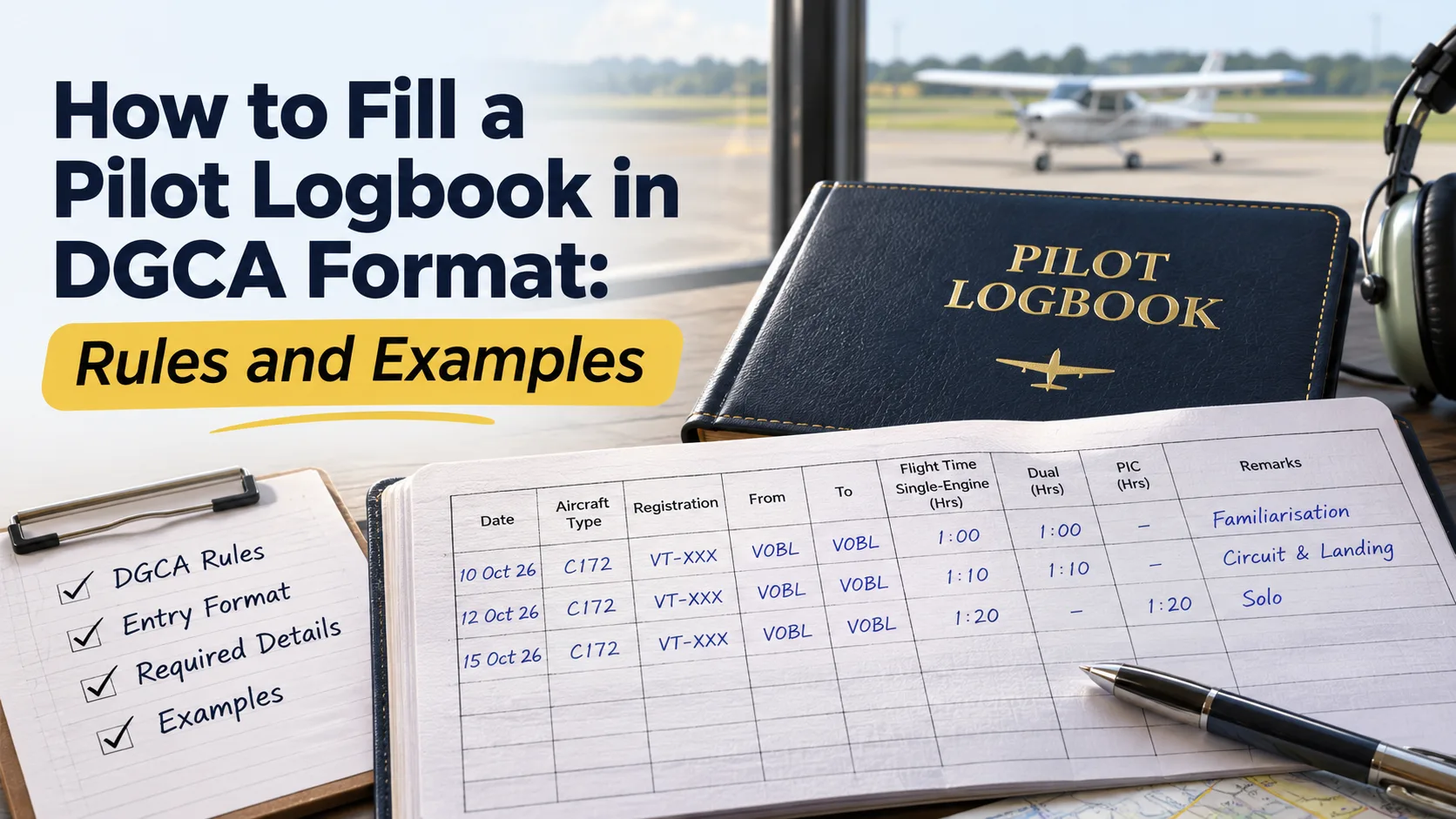
How to fill out a pilot logbook comes down to a few rules in the Aircraft Rules, 1937. Rule 67A says every licensed member of the flight crew keeps a personal logbook in the form DGCA prescribes, logs all flight time in it, writes in ink and has the entries certified. Schedule II says this logbook is the normal proof of the flying experience you need for a licence. So every hour you fly toward a CPL or an ATPL only counts if it is logged correctly.
This page shows what each rule means in practice, with filled example entries for a student and an instructor. If you want a captain to look at your hour plan with you, you can book a session with our mentors.
The short answer: log every flight in ink and split the time into the right categories: dual, pilot-in-command (PIC), co-pilot, night, instrument and cross-country. Your instructor writes what was taught on dual flights. You certify your own entries at least monthly, and the logbook is certified again every quarter by the person Rule 67A names. Keep each logbook for at least five years after its last entry.
Key takeaways
- Rule 67A of the Aircraft Rules, 1937 sets the logbook rules: a personal logbook in DGCA's form, all flight time logged, entries in ink, kept for at least five years after the last entry.
- You certify your own flight time at least monthly. The quarterly certification is by the people Rule 67A names, not by anyone who holds a DGCA appointment.
- Dual time is logged as "dual". An instructor logs PIC with "instructor" in the remarks.
- Simulator time is logged as instrument ground time, separately from aircraft time.
- The CPL needs at least 200 hours and the ATPL at least 1,500, each split into categories in Schedule II.
- In the DGCA computer number application on Pariksha, logbook pages are uploaded as a PDF of up to 200 KB (user manual, October 2024).
Quick navigation
- What DGCA's rules say
- Which time goes in which column
- Filled examples
- Who can sign or certify your logbook
- How an instructor logs instructional hours
- Hours for a CPL
- Hours for an ATPL, and how to log them
- Resizing logbook pages for a DGCA upload
- Common mistakes
- Who this page is not for
- Sources
What do DGCA's rules say about a pilot logbook?
The rules are in Part IX of the Aircraft Rules, 1937. Rule 67A covers the flight crew logbook:
| Rule | What it says |
|---|---|
| 67A(1) | Every licensed member of the flight crew keeps a personal logbook in the form prescribed by the Director General, and logs all flight time in it. |
| 67A(2) | All entries are made in ink. |
| 67A(3) | The logbook is kept for at least five years after the date of the last entry. |
| 67A(4) | You certify the accuracy of your flight time entries at least at the end of each calendar month. The logbook is certified again at the end of March, June, September and December. |
| 67A(5) to (13) | How each kind of flight time is logged (see the next section). |
| 67B | No one may destroy, alter or make illegible any entry, or make a false entry or omission. |
Schedule II, Section A, para 2 links the logbook to your licence. The normal proof of flying experience is your personal logbook certified by the authority in Rule 67A(4), or a certified extract in the form DGCA prescribes. The same para says the experience for a licence is counted the way Rule 67A sets out.
Rule 67A says "in the form prescribed by the Director General". We could not find that prescribed logbook page published on DGCA's website, so use the logbook your flying school or operator issues and ask them which format DGCA accepts from them.
The Aircraft Rules, 1937 are being replaced. The Press Information Bureau said on 4 November 2026 that the Bharatiya Vayuyan Niyam, 2026 replace them from 1 January 2027. The rule numbers on this page are from the 1937 Rules and will be rechecked when we have read the new ones.
Which flight time goes in which column?
Rule 67A decides which category each part of a flight goes in. This is where most logbook errors start.
| Situation | How to log it | Rule |
|---|---|---|
| You fly with an instructor teaching you | "Dual". The instructor writes the nature of the instruction in your logbook | 67A(5) |
| You hold a Student Pilot's Licence and fly alone | PIC, but only the time you are the sole occupant | 67A(7) |
| You hold a PPL | PIC only for the time you act as PIC | 67A(8) |
| You hold a CPL or ATPL | PIC when you act as PIC; co-pilot when you act as co-pilot | 67A(9) |
| You do the PIC's duties under a PIC's supervision | PIC, only if your licence ratings let you command that type. Otherwise co-pilot, with a note in remarks | 67A(6) |
| You fly solely by reference to instruments | Instrument time, actual or simulated. Flying "over the top" of cloud does not count | 67A(11) |
| You fly by instruments in a simulator | Instrument ground time, logged in full | 67A(12) |
| You are an instructor | PIC, with "instructor" in remarks | 67A(10) |
| You are an examiner or check pilot | PIC, if your licence lets you command that type | 67A(13) |
Two definitions from Schedule II, Section A also matter:
- Night (para 4): from half an hour after sunset to half an hour before sunrise, unless a section says otherwise.
- Cross-country (para 5): for the CPL and ATPL sections (J to N), a flight to a point more than 100 nautical miles from the departure aerodrome. For the PPL (Section E), more than 50 nautical miles.
So log night time against those times, not against when it got dark, and mark a flight as cross-country only if it went past the radius for the licence you are working toward.
Filled examples: how real entries look
These are illustrations written by us, not real flights. The aircraft registration and dates are placeholders. The fields follow the categories in Rule 67A; your school's logbook may order the columns differently. We are asking a flight instructor to read these examples before this page goes live.
Example 1: a dual training flight (student's logbook)
| Field | Entry |
|---|---|
| Date | 05/01/20XX |
| Aircraft type and registration | Cessna 172 / VT-XXX |
| From and to | Home base, local flying |
| Departure and arrival time | 08:10 and 09:05 |
| Dual | 00:55 |
| PIC | Blank |
| Remarks | Climbing, descending and medium turns. Instruction given by Capt. A, signature |
Dual time stays dual. The instructor writes what was taught, and as the PIC of a dual flight, certifies the flight time (Rule 67A(4) and (5)).
Example 2: a solo cross-country flight (student's logbook)
| Field | Entry |
|---|---|
| Date | 18/02/20XX |
| Aircraft type and registration | Cessna 172 / VT-XXX |
| From and to | Home base to aerodrome B to home base, full-stop landing at B |
| Departure and arrival time | 07:00 and 10:10 |
| PIC | 03:10 (sole occupant) |
| Cross-country | 03:10, if aerodrome B is more than 100 nm from home base |
| Remarks | SPIC. Instructor: Capt. A |
The "SPIC" label comes from the note under Schedule II, Section L (the CPL with instrument rating), not from Rule 67A. That note asks for student pilot-in-command time to be shown as "SPIC" in the remarks column with the instructor's name.
Example 3: the same dual flight in the instructor's logbook
| Field | Entry |
|---|---|
| Date | 05/01/20XX |
| Aircraft type and registration | Cessna 172 / VT-XXX |
| PIC | 00:55 |
| Remarks | Instructor. Student: B |
The instructor logs PIC with "instructor" in the remarks (Rule 67A(10)). The instructor does not log the student's solo flight in Example 2, because Section L says SPIC time is not logged by the instructor in their own logbook.
Example 4: a simulator instrument session
| Field | Entry |
|---|---|
| Date | 02/03/20XX |
| Device | The approved simulator, as named by your school |
| Instrument ground time | 01:30 |
| Aircraft flight time | Blank |
| Remarks | Instrument procedures. Instructor: Capt. C, signature |
Keep this out of your aircraft flight time totals. The CPL counts no more than 5 of its 10 instrument hours on an approved simulator (Schedule II, Section J).
Monthly and quarterly certification
At the end of each month, total each column and sign that the entries are correct (Rule 67A(4)). At the end of March, June, September and December, the logbook is certified again by the person in the next section.
Who can sign or certify your logbook?
Not just anyone with a DGCA appointment. Rule 67A(4) names three levels:
- You certify the accuracy of your own flight time entries at least at the end of each calendar month.
- The pilot-in-command of a dual instruction flight certifies the flight time entries for that flight.
- At the end of every quarter, the logbook is certified:
- for professional pilots, by a competent authority such as the operations manager, deputy operations manager or chief pilot of the company;
- for members of a flying club, by the Chief Flying Instructor;
- for all other persons, by officers designated by the Director General of Civil Aviation.
The rule's wording is old and talks about "members of the Club". We have not found a DGCA document that says who does the quarterly certification for a student at a company-run flying training organisation. Ask your school's Chief Flying Instructor how they do it, and get it in writing in your logbook.
For the ATPL exams, DGCA's Pariksha user manual asks defence applicants for a flying summary certificate with logbook pages showing total and PIC hours, certified by the competent authority.
How should an instructor log instructional hours?
Three rules apply:
- Rule 67A(10): an instructor may log the time as PIC, but the remarks column must say it was flown as an instructor.
- Rule 67A(5): the instructor writes the nature of the instruction given in the student's logbook.
- The note in Schedule II, Section L: the instructor does not log the student's SPIC time in their own logbook.
So for every dual flight there are two entries: PIC with "instructor" in your logbook, and dual with your note of what you taught in the student's.
How many flying hours do you need for a CPL?
Schedule II, Section J asks for not less than 200 hours of flight time as a pilot of an aeroplane on the date you apply for the licence, including:
- at least 100 hours as pilot-in-command, 15 of them in the six months before you apply;
- at least 20 hours of cross-country as pilot-in-command, including one flight of at least 300 nautical miles with full-stop landings at two different aerodromes;
- at least 10 hours of instrument time, of which no more than 5 may be on an approved simulator;
- at least 5 hours of flight time at night, including 10 take-offs and 10 landings as pilot-in-command in the six months before you apply.
Each of these is a column total in your logbook, so keep a running total for each one from your first flight. If the cross-country or night totals are short at the end, you have to fly more. Our DGCA pilot training process guide covers the steps around these hours.
How many flying hours do you need for an ATPL, and how do you log them?
Schedule II, Section M asks for at least 1,500 hours of flight time as a pilot of an aeroplane, including:
- at least 250 hours as pilot-in-command, or as co-pilot doing PIC duties under supervision, with at least 100 hours of that cross-country, including 50 hours by night;
- at least 500 hours of cross-country flight time;
- at least 100 hours of flight time by night;
- at least 75 hours of instrument time, of which at least 50 hours in actual flight;
- at least 20 hours of flight time in the six months before you apply.
For a first officer, the column that needs the most care is supervised PIC time. Rule 67A(6) lets you log it as PIC only if your licence ratings let you command that type; otherwise it goes in as co-pilot with a note in the remarks. Keep running totals for each line above, and keep the simulator sessions in their own column. Our ATPL exams guide covers the papers, and CPL vs PPL vs ATPL compares the licences. The hours on type you need for a type rating come from the same logbook.
How do you resize logbook pages for a DGCA upload?
DGCA's Pariksha user manual for flight crew licence exams (Issue III, Revision 0, October 2024) lists the upload limits for the computer number application. Documents are uploaded as PDF, and "Pages of Log Book" can be up to 200 KB. Other applications, such as a licence application on eGCA, may show their own limit, so follow the one on the form you are filling.
To get a logbook page under 200 KB:
- Scan the page flat, in good light. A photo taken at an angle is hard to read.
- Crop only the blank margin. Keep the page number, column totals, signatures and certification in the file.
- Save it as a PDF and compress it.
- Open the compressed file and zoom in. If any entry is hard to read, compress less and crop more margin.
- Keep the original scan and the paper logbook.
The same manual says the Central Examination Organisation can partially reject an application if uploaded documents, including logbook pages, are incomplete or incorrect, up to three times. You then have 15 days from the rejection email to upload the correct documents, or the application is rejected completely. A page nobody can read is an easy way to lose time.
If the portal shows a different limit or format on the day you apply, follow the portal.
Common logbook mistakes
- Logging dual time as PIC.
- Logging supervised PIC time as PIC when your licence does not let you command that type (Rule 67A(6)).
- Adding simulator time to aircraft flight time, or counting more than 5 simulator hours toward the CPL's 10 instrument hours.
- Logging a flight as cross-country when the destination was inside the 100 nm radius.
- Logging "over the top" flying as instrument time (Rule 67A(11)).
- Leaving the monthly self-certification and quarterly certification for later.
- Writing in pencil, or overwriting an entry so the old one can't be read. Rule 67B forbids making any entry illegible, so ask your Chief Flying Instructor or operator how corrections must be shown.
- Not keeping running totals, then finding a shortfall close to the licence application.
Who this page is not for
- Anyone looking for a way to add hours that were not flown. Rule 67B forbids false entries and omissions.
- Pilots converting a foreign licence to an Indian one. Our foreign CPL guide covers that route.
- Aircraft engineers. The engine, aircraft and journey logbooks in Rule 67 are aircraft records, not personal logbooks.
How The Pilot's Compass can help
If you want help planning your hours by category, book a session with our mentors, or message us on WhatsApp. If you are still deciding whether pilot training suits you, the Pilot Compass Test is an aptitude test you can take first.
Continue reading
- DGCA pilot training process explained
- CPL vs PPL vs ATPL explained
- DGCA ATPL exams: subjects, validity and attempts
- How to become a pilot in India
- DGCA computer number application
Sources
Read on 23 November 2026 unless a different date is given.
- Ministry of Civil Aviation, The Aircraft Rules, 1937 (consolidated copy). Part IX: Rules 67, 67A(1) to (13) and 67B; Schedule II, Section A, paras 2(a), 2(d), 4 and 5; Schedule II, Section L, note on SPIC time.
- DGCA, Aircraft Rules, 1937, Schedule II, Section J: Commercial Pilot's Licence (Aeroplanes) (DGCA website). Para 1(e): 200 hours and the breakdown. Cited as sourced for our How to become a pilot guide.
- DGCA, Aircraft Rules, 1937, Schedule II, Section M: Airline Transport Pilot's Licence (Aeroplanes) (DGCA website). Para 1: 1,500 hours and the breakdown. Checked 20 November 2026 for our ATPL exams guide.
- DGCA, Pariksha.DGCA User Manual for Flight Crew Licence Examination, Issue III, Revision 0, October 2024. Para 2.5 (document size table, PDF only; logbook pages 200 KB), para 2.6(b) (ATPL documents) and the partial rejection rules.
- Press Information Bureau, 4 November 2026: Bharatiya Vayuyan Niyam, 2026. Replaces the Aircraft Rules, 1937 from 1 January 2027. Cited as sourced for our ATPL exams guide.
DGCA and the Ministry revise these documents, and the new Rules take effect on 1 January 2027. Check the current versions before you rely on any rule number given here.
Frequently Asked Questions
Map Your Custom Pilot Training Pathway
Evaluate your compliance across the 4 major DGCA training gates, select training country routes (India vs. USA/Europe), and estimate your CPL timeline month-by-month.