The short version:
The United States leads for training speed and fleet depth, while South Africa and the Philippines offer lower upfront fees. To avoid costly conversion delays in India, students must log exact DGCA-mandated cross-country hours abroad and clear DGCA theory papers before traveling.
Deciding where to complete your flight training is one of the biggest financial commitments an aspiring pilot and their family will ever make. In India, flight training schools often grapple with long waiting lists, monsoon interruptions, and limited aircraft availability. A course planned for 18 months can stretch beyond 30 months.
Because of these domestic bottlenecks, hundreds of Indian students travel abroad every year to earn their Commercial Pilot Licence (CPL). Yet moving overseas is not a silver bullet. Exchange rates fluctuate, flight school pricing models hide unexpected surcharges, and converting a foreign licence with the Directorate General of Civil Aviation (DGCA) requires strict adherence to Indian civil aviation requirements.
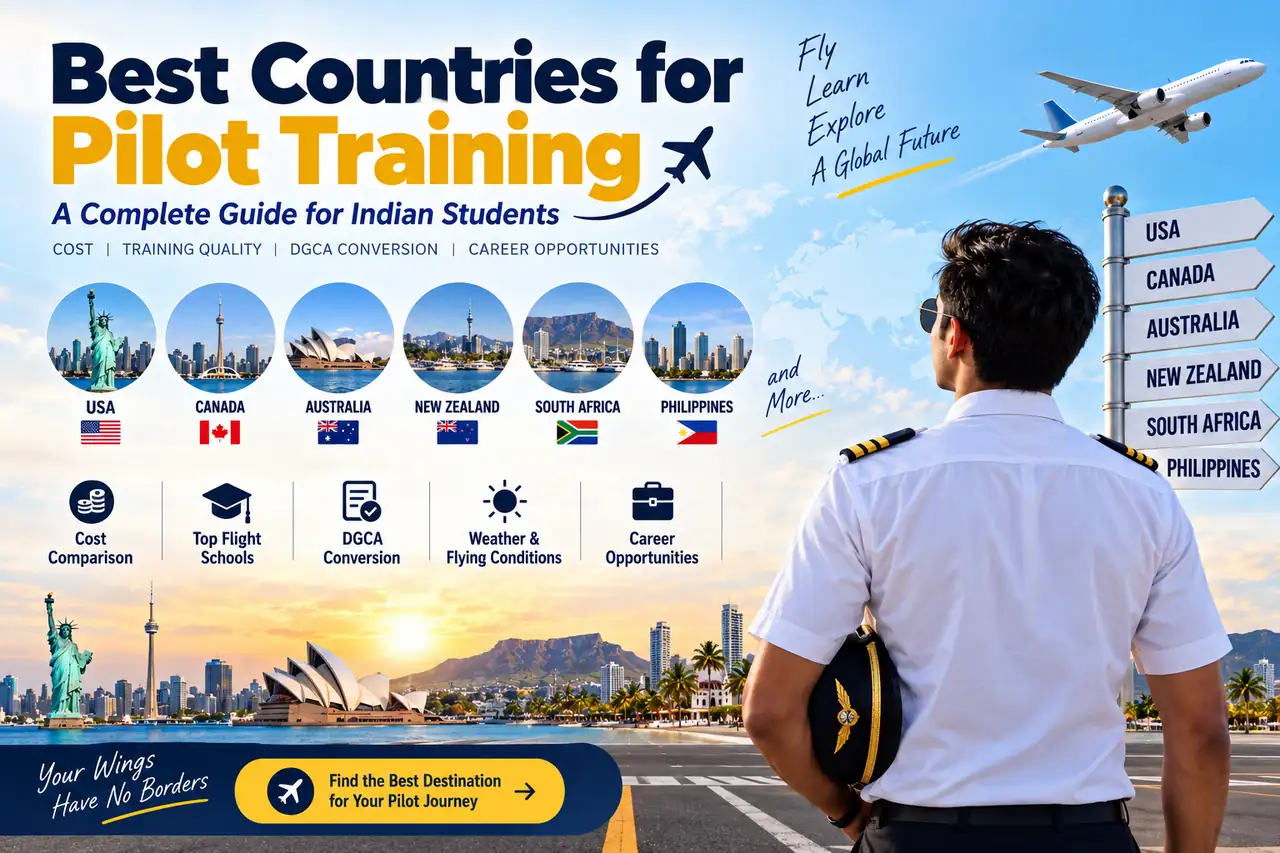
This guide compares the top global flight training destinations: the United States, Canada, Australia, New Zealand, South Africa, and the Philippines. We break down total costs, training quality, flying weather, DGCA licence conversion, and the operational traps Indian families must avoid.
Key Takeaways
- The United States remains the benchmark: With year-round flying weather across southern states, unmatched fleet sizes, and FAA Part 141 structures, the US delivers the fastest CPL completion times (typically 8 to 12 months).
- South Africa and the Philippines offer lower fees: Base tuition is 25% to 35% lower than in Western nations, but weather delays in the Philippines and administrative hurdles in South Africa demand careful school selection.
- DGCA logbook compliance is non-negotiable: Flying schools abroad follow local aviation rules (FAA, TC, CASA, SACAA). If your cross-country, night flying, and solo hours do not match DGCA CAR Section 7 Series B line by line, you will pay lakhs in remedial flying once back in India.
- Clear DGCA theory exams before leaving: Passing your DGCA ground papers before traveling cuts your post-training conversion timeline down from 9 months to under 8 weeks.
- Never wire 100% of flight fees upfront: Reputable international flying academies operate on progressive billing or escrow accounts. Paying in installments protects you if a school runs into maintenance or fleet grounding issues.
Quick Navigation
- Why Do Indian Students Choose Pilot Training Abroad?
- Which Are the Best Countries for Pilot Training?
- How Much Does Commercial Pilot Training Cost by Country?
- What Are the Cheapest Countries for Pilot Training?
- How Does Weather and Flying Conditions Impact Your Timeline?
- How Does Foreign CPL to DGCA CPL Conversion Work?
- India vs Abroad: Which Route Is Better for You?
- How Should Students and Parents Evaluate a Foreign Flight School?
- What Are Common Mistakes Indian Students Make Abroad?
- Who Is Foreign Pilot Training NOT For?
- Frequently Asked Questions
- Final Verdict: Planning Your Flying Pathway
Why Do Indian Students Choose Pilot Training Abroad?
The primary reason Indian students look overseas is not prestige; it is flight training velocity and fleet density.
In India, civil aviation has grown at breakneck speed, but domestic flight training organisations (FTOs) face structural constraints. Many airfields handle heavy commercial traffic or lack dedicated instrument landing systems for training. Monsoons ground single-engine training aircraft across central and western India for nearly three months each year. Aircraft parts often sit in customs for weeks, grounding trainers.
Foreign flight schools in established aviation hubs offer three clear advantages:
- High Aircraft-to-Student Ratios: A well-managed flight academy in the US or South Africa often maintains one aircraft for every 4 to 6 active students. In contrast, overcrowded centers in developing markets can run ratios as high as 15 students per aircraft.
- Predictable Flying Calendars: Regions like Arizona, Florida, and inland South Africa record over 300 Visual Flight Rules (VFR) flying days annually. Cadets fly four to six days per week without prolonged weather pauses.
- Complex Airspace Exposure: Training in busy international terminal areas under FAA or CASA control sharpens radio telephony (R/T) skills, situational awareness, and cockpit discipline early in a pilot's career.
However, training abroad introduces foreign currency risks, international visa restrictions, living adjustments, and the mandatory task of converting your licence with the DGCA upon returning to India.
Which Are the Best Countries for Pilot Training?
Each aviation market has distinct regulatory frameworks, operating environments, and cost profiles. Here is how the top six destinations compare for Indian flight students.
1. United States (FAA)
The United States is the largest general aviation market in the world. For Indian flight cadets, it remains the gold standard for timeline efficiency.
- Regulatory Authority: Federal Aviation Administration (FAA).
- Training Structure: Part 141 (structured syllabus, accredited schools) or Part 61 (flexible, self-paced). Indian students should train under FAA Part 141 to satisfy M-1 visa requirements and maintain structured logbook audits.
- Flight Hubs: Florida, Texas, Arizona, California.
- Key Advantages: Huge aircraft fleets, massive availability of certified flight instructors (CFIs), modern glass-cockpit training aircraft (Garmin G1000 setups), and quick turnaround on checkrides.
- Drawbacks: High cost of living, strict M-1 visa work prohibitions, and rising flight test examiner fees.
- Realistic Duration: 8 to 12 months for 200 to 250 hours (Private Pilot Licence, Instrument Rating, Commercial Pilot Licence Single & Multi-Engine).
2. Canada (Transport Canada)
Canada offers world-class aviation pedagogy, highly structured controlled airspace, and a reputation for producing pilots with exceptional instrument flying skills.
- Regulatory Authority: Transport Canada (TC).
- Flight Hubs: Ontario, British Columbia, Alberta, Manitoba.
- Key Advantages: High standard of instruction, strong adherence to safety management systems, and a competitive Canadian Dollar compared to the US Dollar.
- Drawbacks: Winter weather. From November through March, icing conditions, blizzards, and freezing fog cause severe training standstills in Ontario, Quebec, and the Prairies. British Columbia offers milder winters but faces frequent low clouds and rain.
- Realistic Duration: 12 to 16 months (longer if you train through a harsh winter).
3. Australia (CASA)
Australia is known for rigorous safety oversight and training standards that closely mirror the Commonwealth systems from which India's regulatory frameworks evolved.
- Regulatory Authority: Civil Aviation Safety Authority (CASA).
- Flight Hubs: Melbourne (Moorabbin), Sydney (Bankstown), Brisbane, Adelaide (Parafield), Perth (Jandakot).
- Key Advantages: Strict oversight, excellent controlled airspace interaction, and a syllabus that aligns neatly with DGCA logbook breakdown requirements.
- Drawbacks: High flight hour rates, heavy landing fees at metro secondary airports, high fuel surcharges, and steep accommodation expenses in major Australian cities.
- Realistic Duration: 12 to 15 months.
4. New Zealand (CAA NZ)
New Zealand provides scenic, terrain-rich flying that builds remarkable stick-and-rudder confidence.
- Regulatory Authority: Civil Aviation Authority of New Zealand (CAA NZ).
- Flight Hubs: Christchurch, Hamilton, Palmerston North, Nelson.
- Key Advantages: Diverse meteorological conditions, mountain flying experience, and disciplined airspace procedures.
- Drawbacks: Weather volatility. Rapid maritime fronts can ground visual flights quickly. The remote geography also means aircraft parts and specialized avionics support can face shipping delays.
- Realistic Duration: 14 to 18 months.
5. South Africa (SACAA)
South Africa has become one of the most popular alternatives for Indian students who want to balance cost and flying quality.
- Regulatory Authority: South African Civil Aviation Authority (SACAA).
- Flight Hubs: Johannesburg (Lanseria, Grand Central), Pretoria (Wonderboom), Durban, Port Elizabeth.
- Key Advantages: Favorable exchange rate (South African Rand to Indian Rupee), low living expenses, and high density altitude training on the Highveld plateau (5,000+ feet above sea level), which makes students sharp on aircraft performance calculations.
- Drawbacks: SACAA administrative processing for foreign student clearances and licence verification can be slow. Safety outside the airfield perimeter requires strict personal vigilance.
- Realistic Duration: 10 to 14 months.
6. Philippines (CAAP)
The Philippines is the primary budget flying destination in Southeast Asia, attracting Indian students with lower base tuition and proximity to India.
- Regulatory Authority: Civil Aviation Authority of the Philippines (CAAP).
- Flight Hubs: Clark, Subic Bay, Cebu, Iloilo.
- Key Advantages: Lowest tuition costs in the region, English-medium instruction, affordable room and board, and straightforward flight paths.
- Drawbacks: Typhoon season (July to October) brings heavy tropical rain and severe crosswinds that halt visual training for weeks. CAAP exam scheduling and checkride examiner availability can lead to multi-month waiting periods. Older aircraft fleets require careful pre-enrollment checks.
- Realistic Duration: 12 to 18 months.
How Much Does Commercial Pilot Training Cost by Country?
Cost is rarely as simple as the headline package quote published on a school website. A flying school quote often covers only the minimum 200 hours on a single-engine trainer with basic fuel estimates.
To plan your family budget safely, you must account for ground school, multi-engine ratings, examiner checkride fees, visa processing, health insurance, local living costs, and the Indian DGCA conversion process upon return.
Here is a side-by-side comparison of realistic total expenditures for an Indian student (all figures in Indian Rupees equivalent):
| Country | Flight School Fees (CPL+ME+IR) | Living Costs (12 Months) | Visas & Medicals | DGCA Conversion (India) | Total Realistic Budget |
|---|---|---|---|---|---|
| United States | ₹38 – 48 Lakhs | ₹10 – 14 Lakhs | ₹2.5 – 3.5 Lakhs | ₹4 – 6 Lakhs | ₹54.5 – 71.5 Lakhs |
| Canada | ₹36 – 44 Lakhs | ₹9 – 13 Lakhs | ₹2 – 3 Lakhs | ₹4 – 6 Lakhs | ₹51 – 66 Lakhs |
| Australia | ₹45 – 55 Lakhs | ₹12 – 16 Lakhs | ₹3 – 4 Lakhs | ₹4 – 6 Lakhs | ₹64 – 81 Lakhs |
| New Zealand | ₹42 – 50 Lakhs | ₹11 – 14 Lakhs | ₹2.5 – 3.5 Lakhs | ₹4 – 6 Lakhs | ₹59.5 – 73.5 Lakhs |
| South Africa | ₹28 – 35 Lakhs | ₹5 – 7.5 Lakhs | ₹1.5 – 2.5 Lakhs | ₹4.5 – 7 Lakhs | ₹39 – 52 Lakhs |
| Philippines | ₹26 – 32 Lakhs | ₹4.5 – 6.5 Lakhs | ₹1.5 – 2 Lakhs | ₹5 – 7.5 Lakhs | ₹37 – 48 Lakhs |
| India (Domestic) | ₹40 – 52 Lakhs | ₹4 – 6 Lakhs | ₹1 – 1.5 Lakhs | Nil (Direct Indian CPL) | ₹45 – 59.5 Lakhs |
Note: Estimates reflect 2026 prevailing exchange rates and fuel prices. Fuel surcharges, landing fees, and remedial hours will expand these totals if training is delayed.
Hidden Expenses That Expand Your Budget
When reviewing an overseas flight training contract, check for these hidden line items:
- Aviation Fuel Surcharges: Most flight quotes calculate flight time on a base fuel price (e.g., $5.50 per gallon of 100LL Avgas). If regional fuel costs climb to $7.20, you pay the difference out of pocket.
- Briefing and Debriefing Fees: Instructors often charge an hourly ground rate for 30 minutes before and after every flight sortie. Over 200 flight hours, this adds $3,000 to $5,000 in unexpected costs.
- Designated Pilot Examiner (DPE) Fees: In the US and Australia, flight checkrides are administered by independent examiners. Each test (Private, Instrument, Commercial Single, Commercial Multi) costs between $800 and $1,500 in cash directly to the examiner.
- Taxes and Airport Landing Fees: Many airports outside the US charge landing, navigation, and parking fees on every touch-and-go circuit.
What Are the Cheapest Countries for Pilot Training?
If keeping overall costs under ₹50 Lakhs is your primary constraint, South Africa and the Philippines are the two main international destinations to review, with base flight training starting between ₹26 and ₹35 Lakhs and realistic all-inclusive budgets between ₹37 and ₹52 Lakhs.
South Africa vs. Philippines: The Low-Cost Trade-Off
South Africa provides better airspace infrastructure, rigorous regulatory standards, and excellent English-speaking flight instructors. The country's pilot training quality is respected by airline recruiters worldwide. The primary challenges are local security outside the airfield, slower SACAA paperwork processing, and variable visa turnaround times at South African missions in India.
The Philippines offers lower upfront travel costs and cheaper living, but students must contend with monsoon typhoons that can stop flying entirely between July and October. In addition, examiner backlogs at CAAP have left some students waiting two to four months just to sit for a commercial checkride.
The True Cost of Cheap Schools
I have seen numerous Indian students select a flying school solely because the brochure promised a CPL for ₹28 Lakhs.
Here is what happens when you buy on price alone:
- You arrive to discover the school operates only three serviceable aircraft for thirty enrolled students.
- Aircraft break down, and spare parts take weeks to clear customs.
- You fly five hours a month instead of thirty.
- Your six-month program stretches to eighteen months, burning your living expense budget.
- Your foreign medical and flight checks lapse, requiring expensive re-checks before you can return home.
A slightly more expensive school with forty operational aircraft, an in-house maintenance hangar, and high instructor availability will almost always save you money in the long run.
How Does Weather and Flying Conditions Impact Your Timeline?
Flight training requires visual meteorological conditions (VMC) for early solo flights and clear cloud ceilings for cross-country exercises. Weather delays directly translate into higher accommodation bills and lost training momentum.
| Flying Region / Training Hub | Prevailing Climate & Conditions | Average Annual VFR Days | Completion Pace Impact |
|---|---|---|---|
| US Sunbelt (Arizona, Texas, Florida) | Desert dry heat & dependable coastal clear skies | 320+ Days | Fastest completion pace (8 to 12 months) |
| South Africa Highveld (Johannesburg, Pretoria) | High sunshine hours, dry winters, brief storm windows | 300+ Days | High consistency (10 to 14 months) |
| Australia Southern Hubs (Adelaide, Perth, Melbourne) | Mediterranean & temperate visual flying weather | 280+ Days | Steady year-round progress (12 to 15 months) |
| Canada Coastal (British Columbia) | Milder winter temperatures with low cloud and rain | 220+ Days | Moderate pace; weather delays in late autumn |
| New Zealand (Central & South Island) | Oceanic frontal systems and mountain flying conditions | 210+ Days | Variable; requires flexible scheduling |
| Philippines (Clark, Subic Bay, Cebu) | Tropical convective weather, typhoons (July to October) | 200+ Days | Seasonal halts; can stretch to 18 months |
| Canada Continental (Ontario, Prairies) | Sub-zero freezes, blizzards, and icing (Nov to March) | 180+ Days | Severe winter downtime unless instrument rated |
If speed of completion is your primary driver, look at schools operating in:
- Phoenix, Arizona or Daytona Beach, Florida (USA): Dry desert or coastal climates with year-round flight visibility.
- Gauteng or Free State (South Africa): High sunshine hours, dry winters, and predictable summer afternoon thunderstorms that are easy to plan around.
- Perth or Adelaide (Australia): Stable Mediterranean climates with dependable visual flying weather.
Avoid starting flight training in Canada or New Zealand during their respective winter seasons unless you deliberately intend to build heavy instrument and adverse-weather competencies.
How Does Foreign CPL to DGCA CPL Conversion Work?
Earning a commercial licence in the United States, Canada, or South Africa does not automatically entitle you to fly for an Indian commercial airline. You hold a foreign licence; you must convert it into an Indian DGCA CPL under DGCA CAR Section 7, Series B, Part I.
| Conversion Phase | Regulatory Milestone | Key Action & DGCA Compliance Focus |
|---|---|---|
| Phase 1 | Foreign Flight Training | Complete 200+ flying hours strictly matching DGCA CAR Section 7 Series B syllabus (including 100h PIC, 50h XC PIC, 10h night flying [min. 5h PIC], and the 300 NM qualifying cross-country). |
| Phase 2 | Foreign CPL Issuance | Earn foreign CPL with Multi-Engine and Instrument Rating endorsed by local authority (FAA, Transport Canada, CASA, or SACAA). |
| Phase 3 | DGCA Theory Exams | Clear DGCA Air Regulations and Composite paper (Navigation + Meteorology) on the Pariksha computer-based examination portal. |
| Phase 4 | WPC RTR(A) Radio Licence | Obtain Indian Radio Telephony licence through Commonwealth reciprocal COP route or by clearing the Ministry of Communications WPC exam. |
| Phase 5 | DGCA Class 1 Medical | Ensure valid Indian Class 1 medical assessment is active on the eGCA system. |
| Phase 6 | Recency & Skill Tests in India | Complete General Flying Tests (Day and Night) and Instrument Rating check at an Indian FTO if foreign flight checks lapse past 6 months. |
| Phase 7 | Final Indian CPL Issuance | Submit verified dossier and authenticated logbooks on eGCA for final Indian Commercial Pilot Licence issuance. |
The 200-Hour Flying Breakdown You MUST Fly Abroad
Foreign aviation authorities have their own minimum hour requirements. For example, FAA Part 141 allows a CPL checkride at 190 hours. Transport Canada has different night flying subdivisions.
DGCA, however, will not issue an Indian licence unless your logbook reflects these exact minimums:
- Total Flight Time: Minimum 200 hours within the preceding 5 years.
- Pilot-in-Command (PIC) Time: Minimum 100 hours (solo or designated PIC).
- Cross-Country PIC Flight Time: Minimum 50 hours.
- Day Cross-Country Exercise: At least one solo cross-country flight of not less than 300 nautical miles, with full-stop landings at two intermediate aerodromes.
- Night Flight Time: Minimum 10 hours total night flying, including not less than 5 hours as PIC with 10 take-offs and 10 landings by night as PIC (under DGCA Aircraft Rules 1937 Schedule II Section J, the 5 hours PIC and 10 night take-offs/landings must fall within the 6 months preceding your licence application).
- Instrument Flying Time: Minimum 20 hours for standalone CPL issue (up to 10 hours on an approved simulator), or 40 hours for CPL with Instrument Rating (at least 20 hours in actual aircraft, with up to 20 hours allowed on an approved flight simulator/FSTD). Since airline recruitment mandates an Instrument Rating, ensure your foreign school logs the full 40-hour IR curriculum.
- Recency Requirement: At least 5 hours of flight time within the 6 months preceding your conversion application date.
If your foreign school sends you home with 48 hours of cross-country PIC time—falling two hours short of the DGCA's 50-hour mandate because their local syllabus only required 40 hours and didn't track DGCA minimums—DGCA will reject your application. You will have to pay an Indian flying school over ₹1.5 Lakhs just to fly those missing two hours.
Mandatory Exams in India
To complete your conversion, you must pass:
- DGCA Air Regulations Exam: Covers Indian air law, aircraft rules 1937, and local airspace procedures.
- DGCA Composite Paper: A combined examination covering Air Navigation and Aviation Meteorology (or individual papers if chosen).
- RTR(A) Examination / Reciprocal Conversion: A radio licence issued by the Wireless Planning and Coordination (WPC) wing of India's Ministry of Communications. If your foreign licence is from a Commonwealth nation like Australia or Canada, you can apply for an Indian RTR through the COP reciprocal route. If you train in the US or Philippines, you must pass the Indian WPC RTR(A) examination.
Read our complete breakdown of How to Clear DGCA Exams on First Attempt to understand the Pariksha testing system before you plan your trip abroad.
India vs Abroad: Which Route Is Better for You?
Neither pathway is universally superior. The right decision depends on your capital liquidity, timeline urgency, and risk tolerance.
| Factor | Pilot Training in India | Pilot Training Abroad (USA / South Africa) |
|---|---|---|
| Total Timeline | 18 to 30 months | 8 to 14 months (+ 2-4 months conversion) |
| Initial Paperwork | Direct eGCA registration | Student visa, TSA clearance, foreign medicals |
| Weather Dependency | Heavy monsoon interruptions (Jun–Sep) | Minimal in desert/sunbelt regions |
| Fleet Availability | 5 to 15 aircraft per school | 25 to 70+ aircraft in large academies |
| DGCA Conversion | None (Direct Indian CPL) | Mandatory exams, logbook audits, recency flights |
| Total Expenditure | ₹45 – 60 Lakhs | ₹39 – 71.5 Lakhs (exchange rate exposed) |
| R/T Experience | Standard Indian phraseology | High-density international airspace communication |
| Family Proximity | Close to home, lower emotional strain | Independent living in a foreign country |
When Should You Train in India?
Staying in India is the wiser choice if:
- You want to finance training through domestic education loans that require direct disbursements to Indian bank accounts.
- You are not in an extreme rush and prefer living close to family.
- You want to bypass foreign licence conversion paperwork entirely.
- You secure a seat in an established Indian academy with verified aircraft availability, such as IGRUA or state flying clubs.
When Should You Train Abroad?
Going overseas is the better path if:
- Your target is completing flight hours within 12 months.
- You want exposure to high-density international airspace operations and complex weather environments.
- You have cleared all your DGCA ground papers in advance, ensuring immediate conversion eligibility when you land back in India.
How Should Students and Parents Evaluate a Foreign Flight School?
Do not rely on glossy promotional videos or promises from education agents based in Delhi or Mumbai. Before committing funds, evaluate candidate flight schools against these five non-negotiables:
| Audit Check | Target Benchmark | Why This Protects Your Training & Budget |
|---|---|---|
| 1. Active Fleet Size | Minimum 20+ operational aircraft | Prevents training standstills when individual aircraft undergo mandatory 50-hour or 100-hour inspections. |
| 2. Student-to-Aircraft Ratio | Below 6:1 active students per airframe | Ensures 4 to 5 flying slots per week rather than waiting days for an open aircraft. |
| 3. In-House Maintenance | Dedicated on-site Part 145 repair station | Certified mechanics turn routine snags in 24 to 48 hours instead of losing weeks to outside hangars. |
| 4. DGCA Familiarity | At least 25 Indian graduates converted | Instructors understand specific DGCA cross-country distances, night PIC logging, and simulator caps. |
| 5. Progressive Billing | Milestone-based funding ($5,000 to $10,000 blocks) | Protects family savings; prevents capital lockup if a flight school experiences operational disruption. |
1. Active Fleet Size and Dedicated Maintenance
Ask the school for an exact list of operational, registered aircraft. A school advertising forty airplanes on its website may have twenty-two parked in storage for parts. Confirm that they operate an on-site maintenance hangar with certified airframe and powerplant (A&P) mechanics. If a school must fly its planes to another airfield for routine 50-hour and 100-hour inspections, your training will crawl.
2. Verified Track Record with DGCA Conversion
Does the Chief Flight Instructor understand DGCA CAR requirements? Can the school provide contact details for three Indian alumni who completed training in the past year and successfully converted their licences in India? A school unfamiliar with Indian logbook mandates can cost you months of headaches.
3. Payment Protection Terms
Never wire your entire tuition upfront. Reputable academies require an initial deposit to issue the visa eligibility paperwork (such as an I-20 form in the US), followed by funding in increments of $5,000 to $10,000 as you hit training milestones. Keep your capital in an escrow account or under your control until hours are flown.
What Are Common Mistakes Indian Students Make Abroad?
Over two decades in aviation, I have watched smart students stumble over predictable errors. Here are the most frequent pitfalls:
1. Traveling Before Clearing DGCA Ground Exams
The single biggest operational error is traveling abroad with zero DGCA papers cleared.
Students assume they will study for Indian exams while flying abroad. In reality, flight training takes 10 to 12 hours a day between pre-flight prep, cross-country planning, dual instruction, and physical exhaustion.
When they finish flying and return to India, their foreign flight checks are valid for only six months. If they then spend nine months attempting to clear DGCA Air Regulations and Navigation, their foreign recency expires. They are forced to pay an Indian school ₹3 to ₹5 Lakhs for renewal flights before DGCA will process their application.
Clear your theory papers first. Your DGCA exam results remain valid for five years. With papers in hand, you can convert your licence within weeks of returning. Review our guide on DGCA CPL Subjects and Exam Syllabus to structure your theory timetable.
2. Overlooking Multi-Engine Instrument Rating Hours
Some foreign schools offer packages with only 5 to 7 hours of multi-engine time. In India, airline entrance evaluations frequently look for solid multi-engine instrument proficiency. Ensure your training package includes at least 15 to 20 hours on a multi-engine aircraft (such as a Piper Seneca, Seminole, or Diamond DA42) with an Instrument Rating checkride on type.
3. Misunderstanding the 200-Hour CPL Trap
Many students believe that touching down on hour 200 guarantees an immediate airline cockpit seat. In modern commercial aviation, 200 hours is merely the baseline eligibility threshold. Airlines in India and abroad evaluate your understanding of aerodynamics, meteorology, Crew Resource Management (CRM), and jet transition readiness. Read our analysis of The 200-Hour CPL Trap and Real Aviation Pathways to understand what happens after licence conversion.
Who Is Foreign Pilot Training NOT For?
Training abroad is not the right choice for every candidate:
- Families with zero financial buffer: If your budget is capped at ₹40 Lakhs with no room for currency depreciation, extra fuel surcharges, or remedial flight tests, studying abroad carries high risk. A 5% drop in the Rupee can leave a student stranded overseas short of hours.
- Candidates without clear academic discipline: Flight training abroad requires self-reliance. You will live independently, manage your own nutrition and flight prep, and study without parental supervision. Students who struggle with self-directed study frequently fall behind.
- Cadet Program Seekers: If your goal is a guaranteed airline pathway with Indigo, Air India, or SpiceJet, apply directly to their approved cadet pilot programs. These airlines select their own training partners in India or abroad, and their structured pathway bypasses the open-market conversion race. Learn more about how cadet selections work in our breakdown of Cadet Pilot Programs in India.
Frequently Asked Questions
Which country is best for pilot training for Indian students?
The United States remains the top choice for training speed, fleet availability, and structured airspace. South Africa and the Philippines offer lower upfront fees, while Canada and Australia provide high instructional standards and challenging flying environments.
How much does commercial pilot training abroad cost for Indian students?
Total realistic costs typically range from ₹37 Lakhs to ₹81 Lakhs depending on the country, covering flight training, living expenses, visas, and DGCA conversion checks. South Africa and the Philippines sit on the lower end (₹37 to ₹52 Lakhs), Canada and the USA fall in the mid-range (₹51 to ₹71.5 Lakhs), and New Zealand and Australia sit higher (₹59.5 to ₹81 Lakhs).
Can Indian students convert a foreign CPL to a DGCA CPL?
Yes. Under DGCA CAR Section 7 Series B, you can convert an ICAO-recognized foreign commercial pilot licence by clearing the DGCA Air Regulations and Composite (Navigation + Meteorology) exams, obtaining an Indian RTR(A) licence, and fulfilling cross-country and skill check requirements.
What is the cheapest country for pilot training?
South Africa and the Philippines are usually the cheapest countries for pilot training, with base flight school fees starting around ₹26 to ₹35 Lakhs (all-inclusive budgets around ₹37 to ₹52 Lakhs). However, extra expenses like fuel surcharges, visa renewals, and DGCA conversion flying back in India narrow the price gap with the USA.
Should I clear DGCA ground exams before going abroad for pilot training?
Yes. Clearing your DGCA exams before leaving India saves months upon return. Your exam results remain valid for five years, allowing you to fly abroad, log your hours, and apply directly for license conversion without study backlogs.
How long does it take to complete CPL training abroad?
In countries like the United States or South Africa with consistent flying weather, a disciplined student can complete 200 to 250 flight hours in 8 to 12 months. In Canada, New Zealand, or the Philippines, seasonal weather and administrative scheduling often extend the timeline to 14 to 18 months.
What visa do Indian students need for pilot training in the USA?
Indian flight students in the United States must obtain an M-1 vocational student visa following SEVIS registration and Form I-20 issuance by an FAA Part 141 approved flight school. In addition, you must obtain flight training security clearance through the Transportation Security Administration (TSA).
Final Verdict: Planning Your Flying Pathway
Selecting where to earn your wings is a strategic calculation. The United States delivers unmatched training momentum for families with the budget to support dollar-denominated expenses. South Africa remains an attractive value proposition for disciplined students who verify school credentials carefully.
Regardless of the country you select, remember that flight hours earned abroad are only as good as their compatibility with Indian regulations. Structure your flight syllabus around DGCA CAR Section 7 Series B from your very first dual sortie, avoid paying large capital sums in advance, and clear your Indian ground examinations before stepping on an international flight.
At The Pilot's Compass, we mentor aspiring commercial pilots through ground school preparation, eGCA formalities, and flight academy evaluation. Explore our DGCA CPL Ground Classes Program to clear your theory exams with operational military discipline before beginning your flight training overseas.
Continue Reading
- How to Become a Commercial Pilot in India: Step-by-Step Guide
- The 200-Hour CPL Trap: What Flight Schools Do Not Tell You
- DGCA CPL Exam Syllabus and Preparation Strategy
- How to Clear DGCA Exams on First Attempt
- Cadet Pilot Programs vs Conventional CPL Training in India
- DGCA Pilot Training Process Explained
Official Sources & References
- Directorate General of Civil Aviation (DGCA) India: https://www.dgca.gov.in
- DGCA CAR Section 7, Series B, Part I (Conversion of Foreign Licence): DGCA Civil Aviation Requirements
- Federal Aviation Administration (FAA) Pilot Certification: https://www.faa.gov
- Transport Canada Civil Aviation (TCCA): https://tc.canada.ca
- Civil Aviation Safety Authority (CASA) Australia: https://www.casa.gov.au
- South African Civil Aviation Authority (SACAA): https://www.caa.co.za
Map Your Custom Pilot Training Pathway
Evaluate your compliance across the 4 major DGCA training gates, select training country routes (India vs. USA/Europe), and estimate your CPL timeline month-by-month.