
Air India is in the middle of one of the largest airline expansion programmes in aviation history.
With hundreds of aircraft on order, new international routes, and a rapidly growing fleet under the Tata Group, the airline has become one of the most attractive employers for commercial pilots in India. As recruitment increases, one question appears repeatedly among CPL students and experienced pilots alike: "How much does an Air India pilot actually earn?"
There is no single salary scale that applies to every pilot. A newly hired First Officer earns very differently from a Boeing 787 Captain flying long-haul international routes. Monthly income also depends on aircraft type, experience, fleet assignment, flying hours, and operational allowances.
This guide provides a detailed, subject-wise breakdown of the estimated Air India pilot salary structure, career progression, and additional corporate benefits.
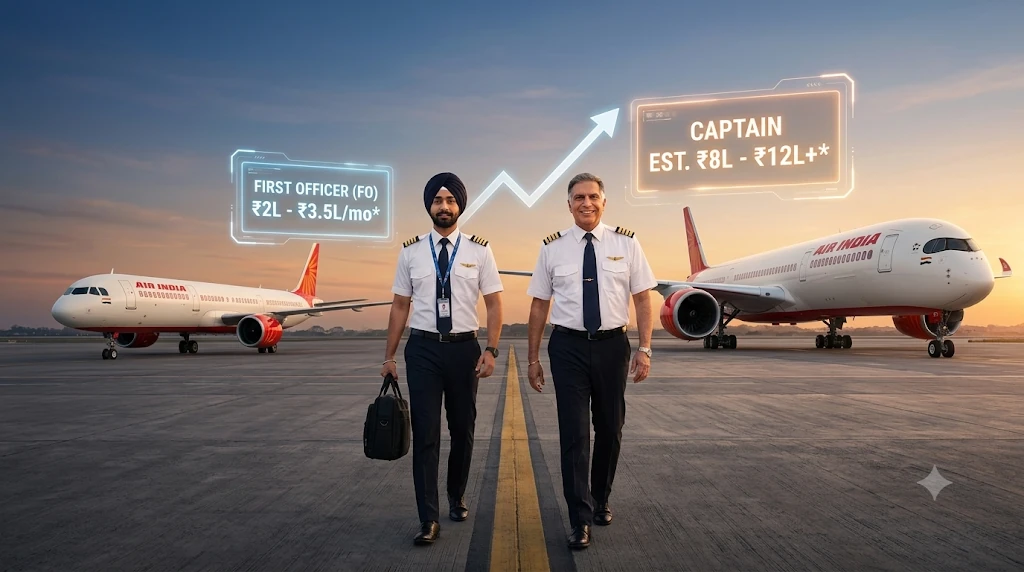
The short version: Air India First Officers generally earn around ₹2 lakh to ₹3.5 lakh per month, while experienced Captains commonly earn ₹8 lakh to ₹12 lakh or more. Actual earnings vary with fleet assignment, flying hours, allowances, and seniority. Air India does not publicly publish official pilot salary bands, so these figures are based on industry estimates.
Key Takeaways
- Recruitment Scale: Air India is one of India's largest employers of commercial pilots.
- First Officer Pay: Junior First Officers generally earn an estimated ₹2 lakh to ₹3.5 lakh per month.
- Captain Pay: Experienced Captains often earn an estimated ₹8 lakh to ₹12 lakh+ per month.
- Allowances: Flying allowances and international operations significantly influence total income.
- Career Path: Air India offers structured career progression across narrow-body and wide-body fleets.
- Benefits: Pilot benefits include paid leave, relocation support, medical benefits, and staff travel through the airline's official pilot programme.
Quick Navigation
- Methodology and Data Sources
- Average Air India pilot salary
- Air India First Officer salary
- Salary structure
- Air India Captain salary
- Wide-Body vs Narrow-Body Pilot Salary
- Five Factors That Influence an Air India Pilot's Salary
- Career progression
- Benefits
- Air India vs IndiGo pilot salary
- Common Myths vs Reality
- FAQs
- References
Methodology and Data Sources
Air India does not publicly publish official pilot salary bands or detailed pay scales for its flight crews. The salary estimates, ranges, and benefit packages presented in this guide are industry estimates compiled using publicly available sources. These include self-reported compensation data on platforms such as Glassdoor, AmbitionBox, and Indeed, recruitment advertisements on the official Air India Careers and Air India Pilot Careers portals, DGCA licensing requirements, directives from the Ministry of Civil Aviation, and aviation recruitment sector insights. These figures represent general compensation benchmarks and should be treated as illustrative estimations rather than official corporate payroll tables.
Average Air India Pilot Salary
The average salary of an Air India pilot varies significantly by rank and experience, with industry estimates indicating that a Junior First Officer starts around ₹2 lakh to ₹3.5 lakh per month, while experienced Captains earn ₹8 lakh to ₹12 lakh or more. Since the airline does not publish official salary grids, these ranges represent combined base pay and operational allowances.
Compensation depends on several factors, including experience, aircraft type, domestic or international operations, command status, and monthly flying hours. The figures below represent realistic industry estimates rather than official salary bands published by Air India.
| Position | Estimated Monthly Salary |
|---|---|
| Trainee Pilot | Training pay (varies) |
| Junior First Officer | ₹2 lakh – ₹3.5 lakh |
| Senior First Officer | ₹3.5 lakh – ₹6 lakh |
| Captain | ₹8 lakh – ₹12 lakh |
| Senior Commander / Trainer | ₹12 lakh+ |
Depending on operational schedules, flying allowances and international duties can significantly increase monthly earnings.
Air India First Officer Salary
An Air India First Officer typically receives an estimated monthly compensation package ranging from ₹2 lakh to ₹3.5 lakh, depending on their experience, fleet assignment, and flying hours. First Officers assist the Captain in normal flight deck duties while building the command hours necessary for future career progression.
To apply for direct entry as a First Officer, candidates must meet the core DGCA CPL Requirements. A standard compensation package generally includes:
- Fixed monthly salary
- Flying hour allowance
- International layover allowance (where applicable)
- Hotel accommodation during official duties
- Medical benefits
- Staff travel concessions
- Paid leave and wellness benefits
- Relocation support for eligible pilots
According to the official Air India Pilot Careers page, pilots also receive comprehensive leave policies, mobility assistance, accommodation support, and structured career progression as part of the airline's employment programme.
Monthly flying hours, route assignments, and additional operational allowances often make a noticeable difference to total take-home pay.
Understanding the Air India Salary Structure
The Air India pilot salary structure is divided into a fixed basic salary and multiple operational allowances linked to flight hours and routing. Rather than receiving a single flat payout, pilots receive a base salary alongside flying hour allowances, international layovers, layover accommodations, and standard corporate benefits.
The typical components of a pilot's pay structure are divided as follows:
| Salary Component | Purpose |
|---|---|
| Fixed Salary | Monthly base pay |
| Flying Hour Pay | Earnings linked to monthly utilisation |
| International Layover Allowance | Overnight international duties |
| Hotel Accommodation | Company-provided during official travel |
| Medical Benefits | Health and wellness coverage |
| Staff Travel | Discounted or complimentary travel benefits |
| Paid Leave | Privileged leave, sick leave, and wellness leave as per company policy |
The official Air India Pilot Careers portal highlights additional benefits including relocation assistance, accommodation support, structured fleet progression, and career development opportunities.
Air India Captain Salary
An experienced Captain at Air India earns an estimated monthly salary ranging from ₹8 lakh to ₹12 lakh, with senior commanders and trainers earning higher rates. Captains bear ultimate legal and operational responsibility for the safety of the aircraft, which is reflected in their premium pay scales.
While Air India does not publish official salary bands, experienced Captains are generally estimated to earn between ₹8 lakh and ₹12 lakh per month, with senior commanders, instructors, and wide-body pilots potentially earning more depending on fleet assignment, flying hours, and operational responsibilities.
| Position | Estimated Monthly Salary |
|---|---|
| Junior First Officer | ₹2 lakh – ₹3.5 lakh |
| Senior First Officer | ₹3.5 lakh – ₹6 lakh |
| Captain | ₹8 lakh – ₹12 lakh |
| Senior Commander / Training Captain | ₹12 lakh+ |
Promotion to Captain depends on several factors, including total flight hours, aircraft type qualification, command training, simulator evaluations, line checks, operational performance, and company requirements.
Air India outlines career progression across narrow-body and wide-body fleets through its Pilot Career Program, where movement between fleets is based on merit, training availability, and operational requirements.
Wide-Body vs Narrow-Body Pilot Salary
Air India pilots assigned to wide-body fleets (such as the Airbus A350, Boeing 777, and Boeing 787) generally have higher earning potential than narrow-body pilots due to extended international layover and flying allowances. While basic pay rates are determined primarily by rank, long-haul international flight duties accumulate significant layover pay.
The airline operates both narrow-body aircraft for domestic and short-haul international routes and wide-body aircraft for long-haul international operations. Examples include:
| Narrow-Body Fleet | Wide-Body Fleet |
|---|---|
| Airbus A320neo | Airbus A350 |
| Airbus A321neo | Boeing 787 Dreamliner |
| Airbus A321LR | Boeing 777 |
Wide-body operations involve longer flight sectors, international destinations, more complex operational planning, higher flying allowances, and additional training requirements.
Because of these operational differences, experienced pilots assigned to wide-body fleets generally have higher earning potential than those flying domestic narrow-body routes, although compensation still depends on rank and experience rather than aircraft type alone.
Air India's official career progression also allows eligible pilots to move from narrow-body operations to wide-body fleets as they advance in their careers.
Five Factors That Influence an Air India Pilot's Salary
An Air India pilot's total monthly compensation is primarily driven by five operational factors: Rank, Fleet Assignment, Flying Hours, Wide-body Qualification, and Seniority. Each of these variables impacts layover allowances and basic pay rates.
| Factor | Salary Impact | Description |
|---|---|---|
| Rank | Very High | Transitioning from First Officer to Captain represents the single largest jump in basic pay and hourly rates. |
| Fleet Assignment | High | Wide-body aircraft operations command higher flying allowances and layover pay than domestic narrow-body routes. |
| Flying Hours | High | Total pay varies month-to-month based on block hours flown, with a guaranteed minimum hours baseline. |
| Wide-body Qualification | Moderate | Pilots qualified on wide-body jets (e.g. A350, B777, B787) unlock international sectors and higher layover allowances. |
| Seniority | Moderate | Cumulative tenure determines priority in bidding for routes, fleet transitions, and training captain upgrades. |
Career Progression at Air India
Career progression for Air India pilots is structured from a Trainee Pilot during induction, moving to Junior First Officer, Senior First Officer, Captain, and eventually Senior Commander. Fleet upgrades and rank promotions are governed by seniority, flight time milestones, simulator check-rides, and the airline's fleet expansion requirements.
For candidates starting from zero hours, they must first complete training at certified Flying Schools and budget for the initial CPL Cost before applying. A typical pilot career path looks like this:
| Career Stage | Typical Experience | Estimated Salary |
|---|---|---|
| Trainee Pilot | During induction and ground school | Training pay |
| Junior First Officer | 0–3 years | ₹2–3.5 lakh/month |
| Senior First Officer | 3–7 years | ₹3.5–6 lakh/month |
| Captain | 7–15 years | ₹8–12 lakh/month |
| Senior Commander / Instructor | 15+ years | ₹12 lakh+/month |
Unlike smaller airlines with limited fleet growth, Air India's expansion creates additional opportunities for fleet transitions, wide-body operations, instructor positions, training captain roles, and management opportunities.
According to the official Pilot Career Program, pilots may progress between narrow-body and wide-body fleets, become trainers, or move into management positions depending on operational needs and performance.
Benefits of Working as an Air India Pilot
Air India provides a comprehensive set of benefits for its flight crew, including health insurance, loss-of-licence protection, relocation assistance, and travel privileges. These benefits are structured to support long-term retention and employee wellness under the Tata Group management.
The benefits described on the official Air India Pilot Career Program website include:
| Benefit | Available |
|---|---|
| Medical Insurance | ✅ |
| Group Life Insurance | ✅ |
| Loss of Licence Protection | ✅ |
| Personal Accident Cover | ✅ |
| Paid Privileged Leave | ✅ |
| Sick Leave | ✅ |
| Wellness Leave | ✅ |
| Staff Travel Benefits | ✅ |
| Domestic & International Travel Privileges | ✅ |
| Hotel Accommodation During Duty | ✅ |
| Relocation Assistance | ✅ |
| Employee Assistance Programme | ✅ |
The airline also offers maternity, paternity, adoption leave, counselling support, relocation assistance, and travel privileges for eligible employees.
Is Air India a Good Airline for Pilots?
Air India is considered a highly attractive employer for commercial pilots due to its extensive international network, modern fleet orders, and clear career upgrade paths. The combination of narrow-body and wide-body operations offers pilots long-term progression opportunities that are unique in the Indian aviation market.
Following its transformation under the Tata Group, the airline is expanding its fleet, strengthening international operations, and investing heavily in pilot recruitment and training infrastructure. For pilots, this creates opportunities that extend beyond salary alone:
- Strong domestic and international route network
- Career progression across narrow-body and wide-body fleets
- Modern fleet expansion, including Airbus A350 aircraft
- Structured command upgrade pathways
- Comprehensive employee benefits
- Dedicated pilot training infrastructure
- Opportunities to become trainers or move into management roles
The official Air India Pilot Career Program also highlights movement across fleets, instructor opportunities, management pathways, relocation support, insurance, wellness programmes, and travel privileges as part of long-term career development.
Pilots work irregular schedules, night flights, weekends, holidays, recurrent simulator checks, and strict medical standards throughout their careers. If someone is looking for a predictable office schedule, commercial aviation probably isn't the right profession.
Air India vs IndiGo Pilot Salary
When comparing pilot pay between Air India and IndiGo, Air India First Officers and Captains have slightly higher earning potential due to wide-body long-haul international allowances. While IndiGo offers a massive narrow-body domestic fleet with rapid command upgrades, Air India provides a direct path into wide-body operations.
A comparison of key differences shows:
| Factor | Air India | IndiGo |
|---|---|---|
| Estimated First Officer Salary | ₹2–3.5 lakh/month | ₹2–3 lakh/month |
| Estimated Captain Salary | ₹8–12 lakh/month | ₹7–10 lakh/month |
| Fleet | Airbus, Boeing & Wide-body | Primarily Airbus family |
| International Operations | Extensive | Growing rapidly |
| Wide-body Career Path | Yes | Expanding |
| Fleet Upgrade Opportunities | High | High |
| Staff Travel Benefits | Yes | Yes |
These figures are indicative industry estimates. Neither airline publishes detailed pilot salary scales publicly. Official recruitment pages focus on eligibility, career progression, and employee benefits rather than specific compensation figures. To see the detailed breakdown for IndiGo, refer to our IndiGo Pilot Salary guide, or read our overview of the broader aviation market in Pilot Salary in India.
For someone planning a long-term airline career, choosing between Air India and IndiGo should not depend only on the starting salary. Training quality, upgrade timelines, fleet preference, international exposure, and work-life expectations all deserve consideration.
Common Myths vs Reality
Myth: Every Air India pilot earns ₹10 lakh per month.
- Reality: Only experienced Captains and senior training pilots typically reach that level. First Officers earn considerably less while progressing through the airline.
Myth: Salary depends only on experience.
- Reality: Flying hours, aircraft type, fleet assignment, command upgrades, and operational allowances all influence total earnings.
Myth: Air India publishes official pilot salary scales.
- Reality: Air India publicly shares pilot benefits, career progression, and recruitment information, but detailed salary bands are not published. Most publicly available salary figures are industry estimates.
Myth: Wide-body pilots automatically earn more.
- Reality: Wide-body operations often provide greater earning potential because of international routes and allowances, but salary still depends on rank, experience, and company policies.
Myth: Joining Air India guarantees rapid promotion.
- Reality: Career progression depends on operational requirements, simulator performance, command training, available fleet positions, and total flying experience.
References
Official Sources
- Air India Careers: airindia.com/careers
- Air India Pilot Careers: careers.airindia.com
- Directorate General of Civil Aviation (DGCA) India: dgca.gov.in
- Ministry of Civil Aviation, Government of India: civilaviation.gov.in
- International Civil Aviation Organization (ICAO) – Personnel Licensing: icao.int
Industry Salary References
- Glassdoor India - Air India Pilot Salaries: glassdoor.co.in (Based on self-reported compensation listings)
- AmbitionBox - Air India Pilot Salaries: ambitionbox.com (Based on self-reported employee reviews)
- Indeed India - Pilot Pay Scales: indeed.com (Based on self-reported salary surveys)
Final Thoughts
Air India remains one of the most sought-after employers for commercial pilots in India.
While salary is an important consideration, it should be viewed alongside career progression, fleet opportunities, training quality, employee benefits, and long-term growth. As the airline continues expanding its domestic and international operations, pilots can expect a wider range of opportunities across both narrow-body and wide-body fleets. Before making any career decision, always refer to the official Air India recruitment portals for the latest eligibility criteria, benefits, and hiring updates.
Frequently Asked Questions
Map Your Custom Pilot Training Pathway
Evaluate your compliance across the 4 major DGCA training gates, select training country routes (India vs. USA/Europe), and estimate your CPL timeline month-by-month.