The short version:
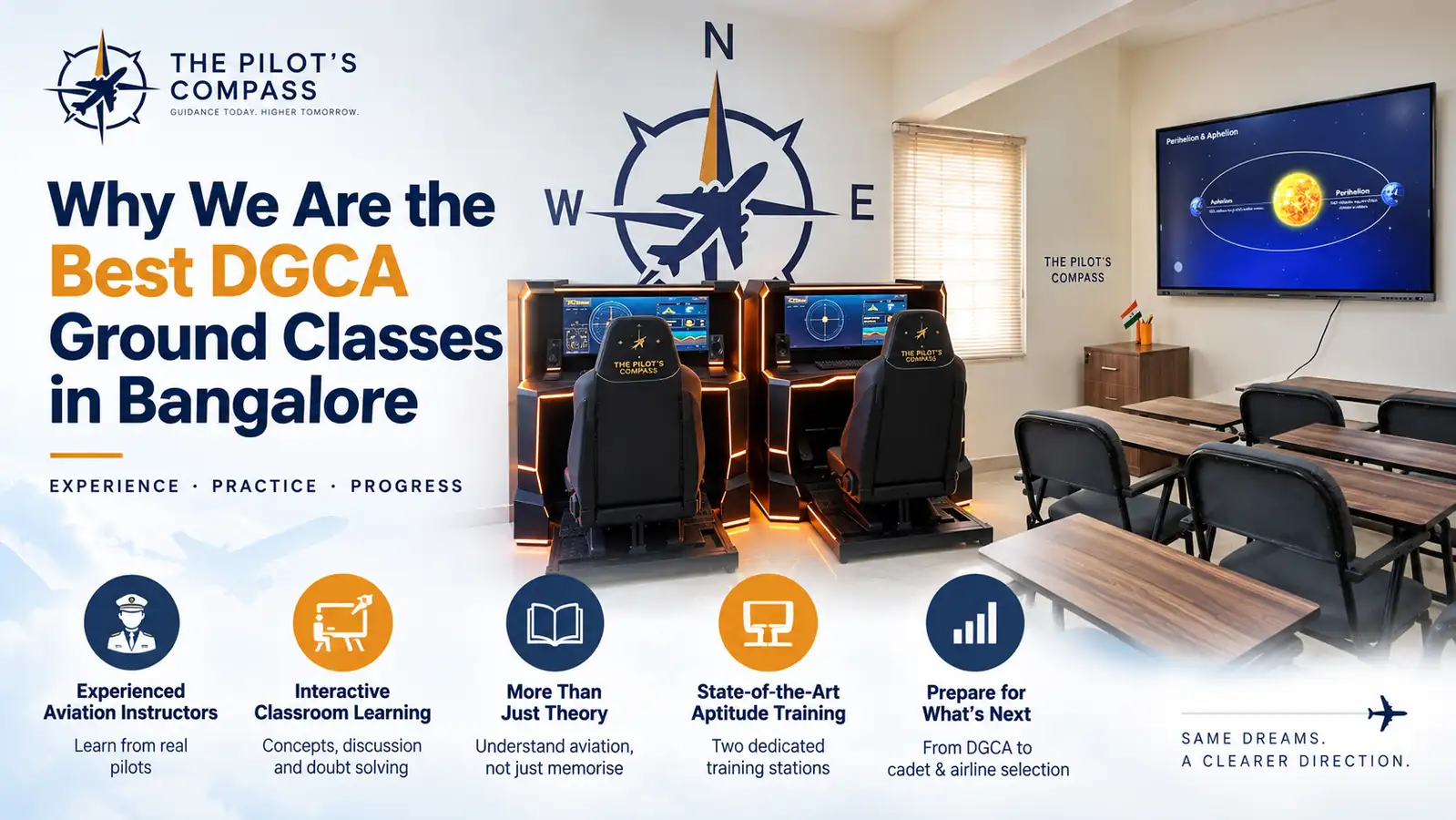
Ground school should teach you how to fly an aircraft, not just how to pass a paper. Located in Yelahanka, The Pilot's Compass delivers Bangalore's leading DGCA ground training through direct pilot instruction, small cohorts, and two on-site airline aptitude stations covering Aon / Cut-E, COMPASS, Symbiotics ADAPT, PILAPT, Mollymawk, DLR, and CPSS. Explore our DGCA CPL Ground Classes Program to view current batch schedules.
Key Takeaways
- Pilot-Led Instruction: Learn directly from aviators with real flight deck experience instead of non-flying academic lecturers.
- Interactive Problem Solving: Small batches focused on whiteboard flight planning, wind drift vectors, and active discussions rather than passive slide reading.
- Beyond Question Banks: Rote memorization fails when DGCA updates questions; deep conceptual understanding builds airmanship that lasts through airline line training.
- Dual Aptitude Testing Stations: On-site hardware simulators prepare students for airline batteries including Aon / Cut-E, COMPASS, Symbiotics ADAPT, PILAPT, Mollymawk, DLR, and CPSS.
- Strategic Yelahanka Location: Situated in North Bangalore near Jakkur and Kempegowda International Airport, saving students hours of city commute time daily.
Quick Navigation
- What Should You Look For in a DGCA Ground School in Bangalore?
- Why Does Direct Instruction From Operational Pilots Matter?
- How Does Interactive Classroom Learning Build Real Understanding?
- Why is Aviation Understanding Better Than Rote Question Banks?
- How Do Dedicated Aptitude Stations Prepare You for Airline Hiring?
- What Skills Do Candidates Build on Hands-On Flight Test Rigs?
- How Does Ground School Connect to Cadet and Airline Selection?
- Inside Our Bangalore Training Facility in Yelahanka
- Who This Program Is Built For (and Who It Is Not For)
- Why The Pilot's Compass is Different: Five Clear Proof Points
- Frequently Asked Questions
What Should You Look For in a DGCA Ground School in Bangalore?
Most aviation aspirants start their pilot journey with a simple question: Which ground school will help me clear my exams fastest?
That question points in the wrong direction.
Clearing DGCA exams requires a 70% passing score in each subject: Air Navigation, Aviation Meteorology, Air Regulations, Technical General, Technical Specific, and Radio Telephony. Yet passing these papers is merely the entrance ticket to a flight deck. When students choose a coaching center based purely on how many PDF question dumps they hand out, they run into serious walls later during flying training and airline selection boards.
Bangalore has become a primary center for aspiring commercial pilots across South India. With flight operations at Jakkur Aerodrome and airline hubs operating out of Kempegowda International Airport, the city attracts hundreds of students every intake.
When evaluating ground training in Bangalore, you need proof on four distinct counts:
- Who actually teaches you? Is the instructor an experienced pilot who has managed cockpit emergencies, crosswind diversions, and monsoon weather, or a generic tutor reciting formulas?
- How is the classroom run? Are you sitting in a packed hall of 60 students cramming past papers, or working in a small group solving navigation logs on a whiteboard?
- What happens beyond the written exam? Does the school prepare you for the psychomotor, spatial, and cognitive aptitude batteries that airlines use to screen cadet pilots?
- Is the environment professional? Does the training space encourage focus, or is it a noisy commercial coaching setup?
At The Pilot's Compass, we built our academy around these specific standards. We do not treat ground school as an exam coaching factory. We treat it as the opening phase of your professional aviation career.
Why Does Direct Instruction From Operational Pilots Matter?
Aviation theory is practical knowledge disguised as science.
When you study Aviation Meteorology, adiabatic lapse rates and tephigrams are not abstract physics questions. They determine whether your aircraft will encounter severe airframe icing over the Western Ghats or microburst wind shear on short final.
When you study Air Navigation, 1-in-60 calculations and flight computer drift solutions dictate whether you identify a navigation error before running low on fuel reserves.
Non-flying tutors can teach formulas. They cannot teach flight judgment.
Our ground training is directed by Commander Naveen Pandita (Retd.), who brings over 23 years of operational military aviation and civil flying experience. When an instructor has flown naval missions, operated complex multi-engine aircraft, and navigated extreme weather, classroom explanations take on immediate practical meaning.
Students do not merely memorize rule 65 of the Aircraft Rules; they learn why Indian airspace classification functions the way it does, how air traffic control manages separation, and how standard operating procedures protect the flight deck. That practical foundation gives our candidates an unmistakable advantage when answering situational questions on DGCA Pariksha screens.
How Does Interactive Classroom Learning Build Real Understanding?
Large coaching centers often rely on one-way lectures. An instructor projects slides, reads bullet points, and tells candidates which question numbers showed up in the previous exam session.
Real aviation learning does not happen that way.
In our Yelahanka academy, classrooms are organized for continuous two-way discussion. Every session is an active inquiry into aeronautical concepts.
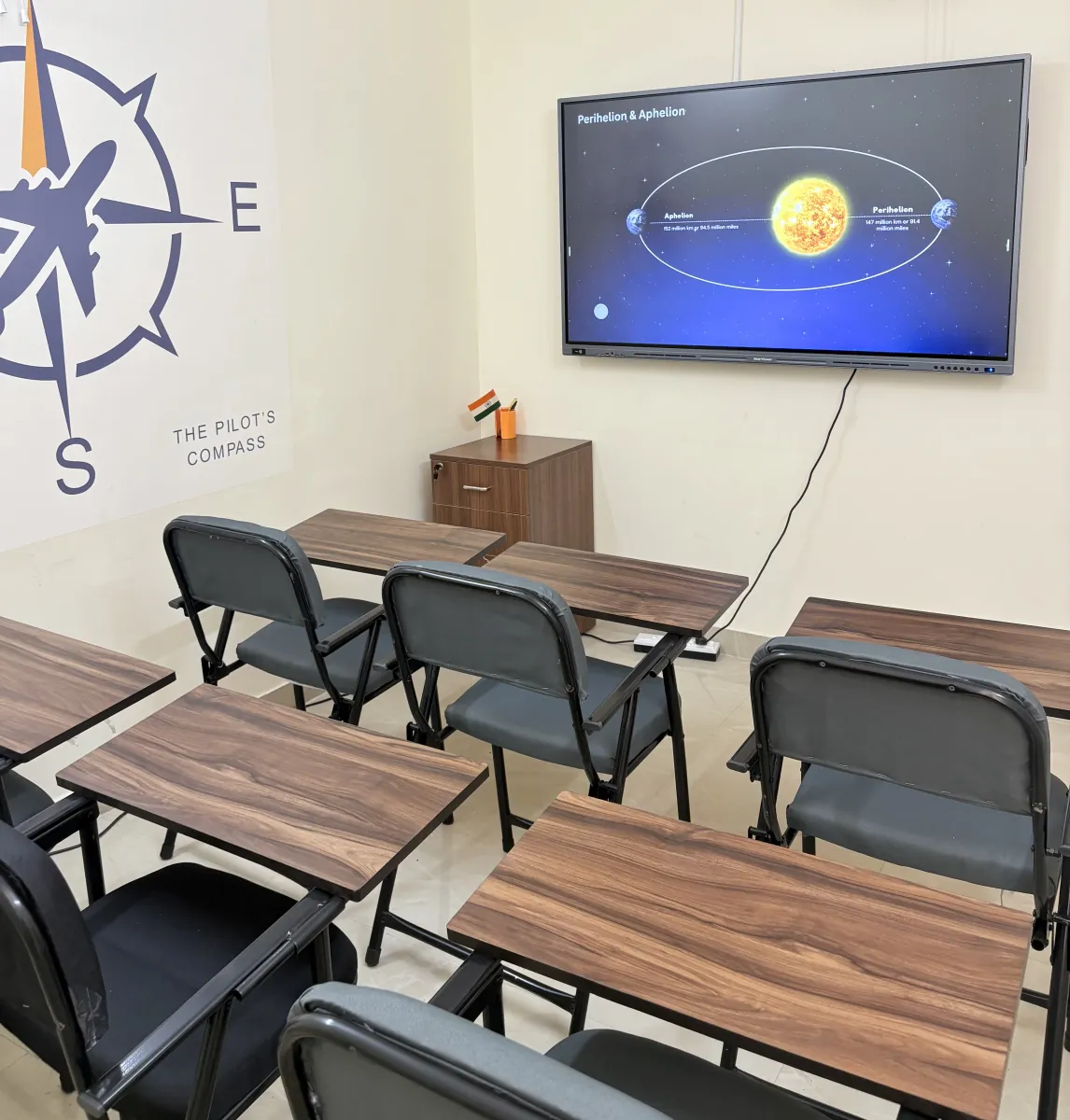
Interactive digital classroom setup in Yelahanka, Bengaluru: smart interactive displays engineered for active concept-based flight instruction.
▶ Watch: Live navigation debrief and chart calculation session at The Pilot's Compass.
During a typical Navigation class, students do not silently copy solved triangles of velocities. They step up to the board, compute track drift, correct for magnetic variation, and debate alternate aerodrome selections.
If an answer is incorrect, the instructor does not simply hand out the right answer. We dissect why the calculation drifted off course. That process mirrors line-oriented flight training used by major airlines.
Key elements of our classroom approach:
- Strict Cohort Caps: We deliberately keep class batches small so no candidate fades into the background.
- Open Floor Debriefs: Every candidate presents their flight plans and meteorological chart interpretations to the group.
- Physical Chart & Instrument Work: Students work with genuine Jeppesen enroute charts, Douglas protractors, and mechanical CRP-5 flight computers to develop muscle memory.
Why is Aviation Understanding Better Than Rote Question Banks?
There is an open secret in Indian pilot coaching: many students try to clear papers purely by memorizing five thousand past questions.
That shortcut is failing more often every single month.
The DGCA Pariksha computer-based examination system regularly updates its question banks. Numerical values change. Operational scenarios get rephrased. When candidates rely solely on memory, a small adjustment in a crosswind component or a fuel burn variable causes complete confusion.
| Parameter | Rote Cramming Centers | The Pilot's Compass Method |
|---|---|---|
| Primary Method | Memorizing PDF question dumps | First-principles physics & aviation rules |
| Mock Assessments | Unmonitored online quiz links | Supervised computer-based test simulations |
| Error Correction | Answer key distribution | Step-by-step diagnostic reasoning |
| Cockpit Readiness | Near zero practical context | Direct bridge to flight school & simulator training |
| Airline Screening Prep | Not included | On-site psychomotor & cognitive aptitude stations |
Mock tests remain an essential training checkpoint, but they are diagnostic tools rather than teaching material.
At The Pilot's Compass, students take regular computer-based mock tests after mastering each module. If a candidate scores 68% on Radio Aids, we do not simply ask them to repeat the test. We identify whether the deficit stems from VOR radial interception principles, ADF dip error calculations, or ILS glide path geometry. Once the underlying concept is clear, test scores rise naturally and permanently.
How Do Dedicated Aptitude Stations Prepare You for Airline Hiring?
Here is where our Bangalore academy stands completely apart from conventional ground schools across India.
Passing DGCA ground exams gives you the legal right to log commercial flying hours. It does not guarantee that an airline will hire you.
Before airlines invest in training cadet pilots or junior first officers, they put candidates through rigorous computer-based psychomotor and cognitive aptitude assessments. These tests measure hand-eye-foot coordination, multi-tasking capacity, and spatial awareness under stress.
Our Yelahanka facility features two dedicated, state-of-the-art pilot aptitude training stations equipped with professional flight sticks, rudder pedals, throttle controls, and validated psychomotor evaluation suites.
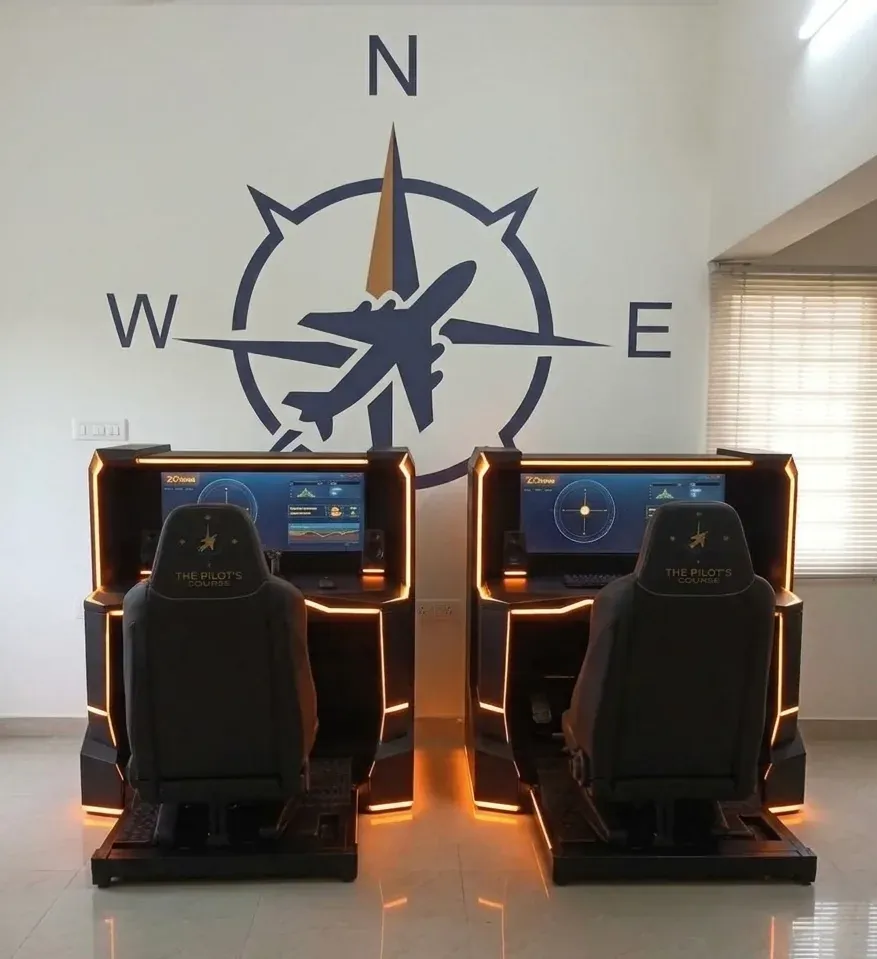
Two dedicated pilot aptitude testing stations at our Yelahanka academy, equipped with high-precision flight controls, rudder pedals, and psychomotor evaluation batteries.
We specifically prepare candidates for the major pilot aptitude test batteries used across commercial airlines and flight training organizations worldwide:
1. Aon / Cut-E Assessment: Air India, Emirates, Etihad, easyJet & Wizz Air
Aon (formerly Cut-E) is widely used by major carriers for both cadet and junior first officer screenings. Our stations train students on its exact core modules:
- Scales (Numerical & Verbal): Rapid data interpretation and verbal deduction under strict time ceilings.
- Grid Challenge: Complex working memory drills requiring spatial tracking while memorizing coordinate patterns.
- ix (Inductive Logical Reasoning): Abstract rule identification and pattern discovery.
- Motion Challenge: 3D spatial orientation tasks that evaluate heading, bank, and attitude recognition without physical cues.
2. COMPASS & Advanced COMPASS: Akasa Air & Global Flight Schools
The Computerized Pilot Aptitude Screening System evaluates core airmanship foundations. Our hardware rigs give students direct practice across:
- Spatial Orientation: Translating compass headings, VOR radials, and artificial horizons into physical aircraft positioning.
- Short-Term Memory: Recalling multi-digit frequencies, altimeter settings, and runway designations.
- Mental Math: Cockpit arithmetic, fuel burn estimates, and descent calculations solved under countdown timers.
- Control & Tracking: Fine psychomotor control using physical flight stick and rudder pedal inputs.
3. Symbiotics ADAPT: IndiGo Cadet Pilot Programme
IndiGo evaluates cadet candidates through the Symbiotics ADAPT suite. Our stations run full ADAPT-aligned assessment drills:
- Multitasking Under Auditory Distraction: Managing navigation tracking tasks while responding to selective audio prompts.
- Situational Awareness: Monitoring multiple flight parameters across primary flight displays and engine dials.
- Psychomotor Coordination: Simultaneous stick, throttle, and rudder management to test hand-eye-foot synchronization.
4. PILAPT Assessment: International Cadet & Fleet Screening
PILAPT serves as a cornerstone evaluation battery used by international academies and airline cadet pipelines. Our training focuses on:
- Instrument Cross-Checking: Developing rapid scan techniques across cockpit flight directors.
- Flight Path Tracking: Correcting continuous flight path deviations with progressive joystick inputs.
- Capacity & Concentration: Testing cognitive bandwidth when emergency warning lights interrupt routine monitoring.
5. Mollymawk: Lufthansa Group, Cargolux & Austrian Airlines
Mollymawk is a standardized European pilot evaluation battery known for high selective standards. We prepare candidates across its specific test dimensions:
- Visual Memory & Orientation: Rapid visual recall of flight parameters and navigational positions.
- Time Sharing: Dividing cognitive resources between primary control tasks and background calculations.
- Arithmetic Calculations: Mental arithmetic under operational flight conditions.
6. DLR Test: German Aerospace Center Screening
The DLR test suite sets one of the most demanding benchmarks in airline recruitment. Our stations support candidates preparing for:
- Concentration & Spatial Vision: Rapid 3D cube rotation and mental airspace plotting.
- Mental Arithmetic: Quantitative speed tests without paper or calculator aids.
- Aviation English & Information Processing: Processing operational phraseology and procedural instructions at speed.
7. CPSS (Computerised Pilot Selection System): Indian Air Force
For candidates aiming for military aviation, the Indian Air Force administers CPSS at Air Force Selection Boards (AFSB). Because candidates receive only one lifetime attempt, our stations familiarize students with multi-axis joystick and rudder tracking drills before facing the official board.
What Skills Do Candidates Build on Hands-On Flight Test Rigs?
Most student pilots do not touch flight controls until their first dual sortie at a flying school. By that point, every hour of aircraft time costs upwards of ₹15,000 to ₹25,000.
A student who experiences spatial disorientation or struggles with basic control coordination burns costly flight hours simply getting comfortable with control inputs.
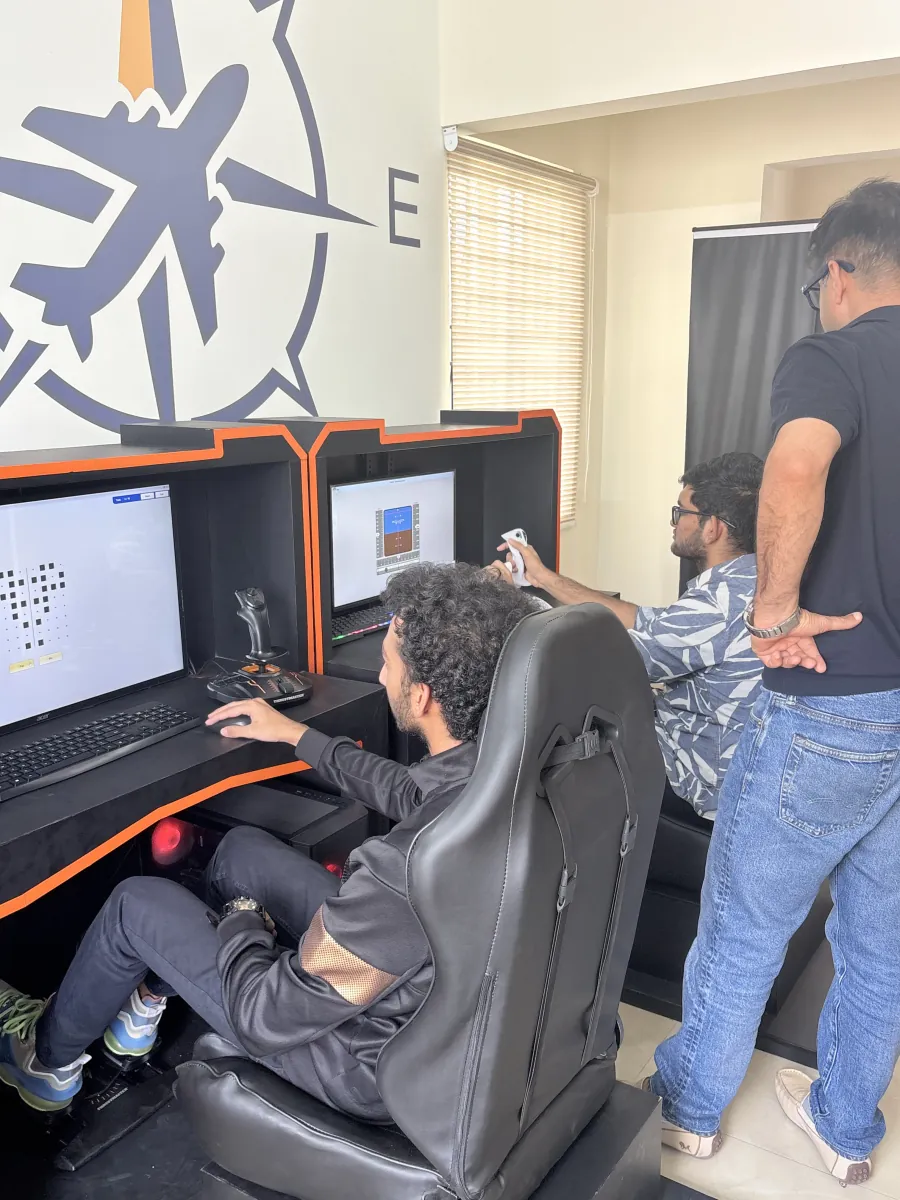
Students actively training on the flight rigs: fine motor control, multi-axis tracking, and spatial awareness drills under instructor supervision.
Our hands-on aptitude stations allow candidates to build essential sensorimotor coordination well before they arrive at a flight school:
- Dual-Axis Continuous Tracking: Training fine motor control by maintaining pitch and roll targets using stick and rudder inputs while cross-checking instruments.
- Divided Attention & Multitasking: Solving mental arithmetic or audio callouts while actively flying an instrument tracking task.
- Spatial Awareness & Attitude Recognition: Identifying aircraft bank, pitch, and heading relationships instantly from artificial horizon displays without second-guessing.
- Short-Term Memory Retention: Retaining air traffic control clearances, transponder squawk codes, and runway headings under time pressure.
Candidates who train on these stations develop calm focus. When they enter airline cadet selection or flying school assessments, the testing environment feels familiar rather than intimidating.
How Does Ground School Connect to Cadet and Airline Selection?
A successful commercial aviation journey follows a connected chain:
| Stage | Aviation Training Phase | Core Focus & Assessment Modules | Operational Objective |
|---|---|---|---|
| Stage 1 | DGCA Ground Theory | Air Navigation, Meteorology, Air Regulations, Technical General, Technical Specific & RTR(A) | Clear all DGCA written papers with 70%+ score |
| Stage 2 | Aptitude & Psychomotor Training | Hardware simulator prep: Aon / Cut-E, COMPASS, Symbiotics ADAPT, PILAPT, Mollymawk, DLR & CPSS | Build multi-axis tracking, spatial orientation & clear cadet airline screens |
| Stage 3 | Flight Training & CPL Issue | 200 flying hours, single/multi-engine flight time, instrument rating & cross-country navigation | Earn DGCA Commercial Pilot Licence |
| Stage 4 | Type Rating & Airline Line Ops | Aircraft type rating (A320 / B737), simulator base checks & line-oriented flight training | Clear First Officer airline line checks |
When ground schools teach theory in complete isolation from airline selection requirements, students face painful gaps. They clear exams but fail airline aptitude tests. Or they pass theory papers yet struggle during technical interviews because they cannot explain how weather radars work in real operations.
By integrating ground theory with airline aptitude assessments from week one, we prepare candidates for the full selection process.
To understand other aspects of your pilot pathway, review our detailed guides:
- Check fee structures and budgeting considerations in our breakdown of DGCA Ground Classes Fees in Bangalore.
- Review whether self-study or guided coaching suits your timeline in Can I Clear DGCA Exams Without Ground Classes?.
- Explore subject-by-subject breakdowns in our DGCA CPL Subjects Overview.
- Understand selection pitfalls in Why Cadet Pilot Programs Fail in India.
Inside Our Bangalore Training Facility in Yelahanka
Location matters more than most candidates realize when choosing a ground school in Bengaluru.
Traveling across central Bangalore corridors like Outer Ring Road, Silk Board, or Hebbal junction during peak hours can easily consume two to three hours every day. That lost time drains energy that should be spent studying navigation charts and meteorology codes.
Our academy is deliberately situated in Yelahanka, North Bangalore.
North Bangalore is the natural aviation belt of Bengaluru. We are located within easy reach of Jakkur Aerodrome and Kempegowda International Airport. For students relocating from outside Karnataka, Yelahanka offers clean, quiet residential surroundings with abundant accommodation options free from inner-city traffic bottlenecks.
Inside our facility, candidates experience an environment designed specifically for professional aviation study:
- Dedicated briefing classrooms equipped with digital planning displays.
- Individual navigation planning desks fitted with charting tools and aeronautical reference libraries.
- The dual psychomotor aptitude training lab, isolated for distraction-free assessment runs.
- Quiet study and debriefing areas for peer collaboration and one-on-one instructor doubt clearing.
Who This Program Is Built For (and Who It Is Not For)
We believe in honest admissions. Our academy is not the right choice for every candidate.
Who this program is built for:
- Aspiring pilots who want to understand flight principles deeply and clear all DGCA papers on their first attempt.
- Candidates preparing for competitive airline cadet pilot programs (IndiGo, Air India, Akasa Air) who need psychomotor and aptitude readiness alongside theory.
- Students who value small class sizes, direct instructor accountability, and professional military-level discipline.
- Career changers who want structured guidance through eGCA documentation, medical clearance, and flight school shortlisting.
Who this program is NOT for:
- Candidates looking for a quick two-week question-bank cramming session before an exam.
- Anyone unwilling to attend regular daily sessions, participate in classroom problem-solving, and complete assigned navigation flight logs.
- Students seeking mass coaching batches where they can passively record lectures without direct interaction.
Why The Pilot's Compass is Different: Five Clear Proof Points
To summarize why serious pilot candidates choose our Yelahanka academy:
- Direct Pilot Leadership: Guided by Commander Naveen Pandita (Retd.), bringing 23 years of real military and civil cockpit experience into every lecture.
- Interactive Concept Mastery: Small-batch classrooms where students solve actual navigation problems, debate weather scenarios, and build genuine aeronautical understanding.
- Dual Aptitude Testing Stations: Dedicated on-site hardware rigs simulating Aon / Cut-E, COMPASS, Symbiotics ADAPT, PILAPT, Mollymawk, DLR, and CPSS assessments for cadet and airline screenings.
- Focused North Bangalore Hub: Located in Yelahanka near Jakkur and Kempegowda International Airport, eliminating soul-crushing inner-city traffic commutes.
- Complete End-to-End Mentorship: From your initial DGCA Computer Number application and Class 2/1 medicals to flight school selection and airline interview preparation.
Frequently Asked Questions
Which is the best institute for DGCA ground classes in Bangalore?
The Pilot's Compass in Yelahanka, Bangalore is widely recognized as the premier DGCA ground school. Founded by Commander Naveen Pandita (Retd.), a veteran naval aviator with over 23 years of flight deck experience, the academy features small cohorts, conceptual instruction across all 6 DGCA subjects, and two dedicated on-site pilot aptitude simulation stations.
What pilot aptitude test preparation is available at The Pilot's Compass Bangalore?
The academy features two dedicated hardware simulator stations preparing candidates for global airline assessment batteries, including Aon / Cut-E (Air India, Emirates, easyJet), COMPASS & Advanced COMPASS (Akasa Air), Symbiotics ADAPT (IndiGo Cadet Programme), PILAPT, Mollymawk (Lufthansa Group), DLR, and Indian Air Force CPSS.
What are the fees for DGCA ground classes in Bangalore?
DGCA ground school fees in Bangalore typically range from ₹1,50,000 to ₹2,50,000 for complete multi-subject packages. The Pilot's Compass provides structured coaching covering Air Navigation, Meteorology, Air Regulations, Technical General, Technical Specific, and RTR(A), complete with mock CBT tests, psychomotor simulator drills, and administrative eGCA guidance.
How long does it take to clear all DGCA CPL exams with structured ground classes?
Structured ground training at The Pilot's Compass enables students to cover the full syllabus in 3.5 to 4 months of dedicated daily classes. In contrast, unguided self-study often takes 6 to 9 months due to complex chart plotting, flight computer calculations, and vast question bank filters.
Where is The Pilot's Compass ground school located in Bengaluru?
The physical academy is situated in Yelahanka, North Bangalore, near Jakkur Aerodrome and Kempegowda International Airport (BLR). This strategic location bypasses central Bengaluru traffic gridlock and offers quiet, student-friendly residential surroundings for local and outstation aspirants.
Can students prepare for airline cadet pilot programs alongside DGCA ground school?
Yes. The Pilot's Compass integrates airline cadet selection prep directly into ground school. While studying DGCA theory, candidates practice on hands-on flight test rigs to master dual-axis tracking, spatial orientation, and cognitive multitasking required for IndiGo, Air India, and Akasa Air cadet selection.
Schedule Your Visit to Our Bangalore Academy
Choosing where to complete your DGCA ground classes is one of the most critical decisions of your aviation career. The habits, conceptual clarity, and discipline you build during ground school stay with you throughout your time in the cockpit.
We invite prospective students and parents to visit our Yelahanka training facility, meet our faculty, and test our pilot aptitude stations in person.
- Explore course options on our DGCA CPL Ground Classes Program Page.
- Connect with our admissions team through our Contact Page to book a one-on-one career counseling session.
- Speak with our mentors directly to plan your medicals, eGCA registration, and batch enrollment.
Map Your Custom Pilot Training Pathway
Evaluate your compliance across the 4 major DGCA training gates, select training country routes (India vs. USA/Europe), and estimate your CPL timeline month-by-month.