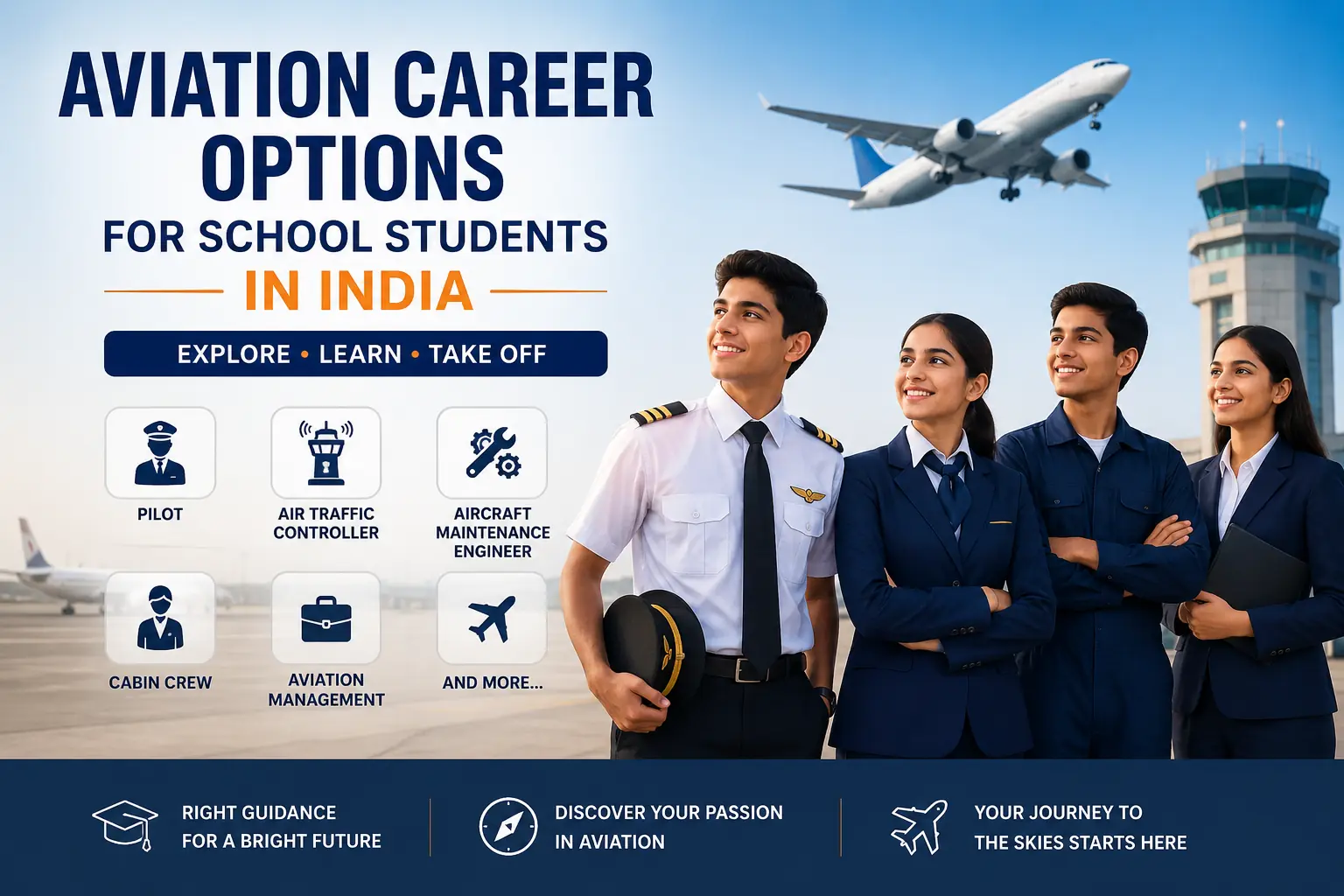
Aviation is one of the most dynamic sectors in India. With new airports expanding under regional connectivity schemes, record-breaking aircraft orders by major airlines, and growing passenger traffic, the aviation industry offers diverse career opportunities for young students.
However, when school students think of aviation, most picture a single path: sitting in the flight deck as a commercial pilot.
While becoming a pilot remains a rewarding career, it represents only one facet of civil and defense aviation. From keeping aircraft airworthy to directing airspace traffic and designing next-generation flight systems, aviation offers rewarding career options across science, engineering, operations, and management.
Understanding these pathways early—during Grades 7 through 12—helps students make informed subject choices in high school and build a clear strategy for their future.
The short version:
School students exploring aviation in India can choose from several distinct career paths after Class 10 and Class 12, including Commercial Flying, Aircraft Maintenance Engineering (AME), Air Traffic Control (ATC), Flight Dispatch, Aerospace Engineering, and Airport Management. Early awareness during school years helps students choose the right subject combinations and avoid costly detours.
Taught by real pilots and led by Commander Naveen Pandita (Retd.)—a former Indian Navy warship commander and naval aviator—our specialized Aviation Programmes for Schools bring experiential aviation learning and structured career awareness directly to students in Grades 7 through 12.
Key Takeaways
- Multiple Entry Points: Becoming a commercial pilot is only one of many aviation career options. Engineering, air traffic control, flight dispatch, and airport operations offer strong alternatives.
- Subject Choices Matter: Choosing Physics and Mathematics in Class 11 and 12 keeps technical aviation pathways open, including pilot licensing and air traffic control.
- Non-Science Pathways Exist: Students from Commerce or Arts streams can pursue careers in airport management, cabin operations, or complete Physics and Math via NIOS demand exams for pilot licensing.
- Early Guidance Prevents Delays: Introducing aviation concepts during school years builds practical STEM understanding and prevents confusion after Class 12.
Quick Navigation
- What Aviation Careers Can Students Pursue After Class 10?
- What Are the Different Careers in Aviation Besides Becoming a Pilot?
- Comprehensive Aviation Career Comparison Table
- Aviation Career Options After Class 12
- How Non-Science Students Can Join Technical Aviation Careers
- Bringing Aviation Education to Schools: The Pilot's Compass Initiative
- Frequently Asked Questions
- Final Verdict & Next Steps
What Aviation Careers Can Students Pursue After Class 10?
Class 10 is the critical decision point where students select their higher secondary stream (Science, Commerce, or Arts).
For students interested in aviation careers after 10th, the choices made at this stage shape eligibility for technical licenses and university degrees.
| Stream Choice | Aviation Pathways Opened |
|---|---|
| Science (Physics & Mathematics) | Commercial Pilot (CPL), ATC, Aerospace Engineering, AME License |
| Commerce / Humanities | Airport Operations, Flight Dispatch, Cabin Crew (Requires NIOS for CPL) |
1. The Science Stream Pathway (Physics & Mathematics)
Selecting Physics and Mathematics in Class 11 and 12 opens direct eligibility for:
- Commercial Pilot Licence (CPL) training under DGCA guidelines.
- B.Tech / BE in Aeronautical or Aerospace Engineering.
- Air Traffic Control (ATC) recruitment through Airports Authority of India (AAI).
- DGCA CAR 66 Aircraft Maintenance Engineering (AME) license courses.
2. The Non-Science Stream Pathway
Students who select Commerce or Arts can pursue:
- Diploma or BBA in Airport Management and Aviation Operations.
- Cabin Crew and In-Flight Safety Operations.
- Commercial Pilot Licence (via NIOS): Non-PCM students can clear Physics and Math as individual subjects through the National Institute of Open Schooling (NIOS) demand exams alongside their regular 10+2.
In my experience mentoring aviation aspirants across India, over 70% of high school students assume that missing 10+2 Physics or Math permanently closes the door to flying. Understanding the NIOS stream early removes unnecessary anxiety for creative or humanities-focused students.
What Are the Different Careers in Aviation Besides Becoming a Pilot?
While commercial pilot training attracts significant attention, commercial airlines and airport ecosystems rely on thousands of specialized professionals. Here are the top careers in aviation besides becoming a pilot:
1. Aircraft Maintenance Engineer (AME)
Aircraft Maintenance Engineers are responsible for inspecting, servicing, and certifying aircraft airworthiness before every flight. Authorized under DGCA CAR 66 regulations, AME professionals hold signing authority for aircraft systems, avionics, and engines.
- Eligibility: 10+2 with Physics, Chemistry, and Mathematics (or approved 3-year engineering diploma).
- Core Focus: Jet engines, hydraulics, avionics, composite structures, and safety compliance.
2. Air Traffic Controller (ATC)
Air Traffic Controllers manage aircraft movement across control towers, approach control, and area control centers. Operating under the Airports Authority of India (AAI), ATC officers direct runway arrivals, departures, and airborne separation to ensure air safety.
- Eligibility: Bachelor's degree in Engineering (BE/B.Tech) or BSc with Physics and Mathematics.
- Core Focus: Radar tracking, radio communication, air traffic management, and emergency response.
3. Flight Operations Officer / Flight Dispatcher
Flight Dispatchers work in an airline's Operations Control Center (OCC). They calculate aircraft fuel requirements, monitor route weather patterns, prepare flight plans, and share operational responsibility with the Aircraft Commander.
- Eligibility: 10+2 with Physics and Mathematics followed by DGCA Flight Dispatcher certification.
- Core Focus: Flight planning, performance geometry, weather analysis, and payload calculations.
4. Aerospace & Aeronautical Engineer
Aerospace Engineers design, build, and test aircraft, propulsion systems, satellites, and unmanned aerial vehicles (UAVs). In India, aerospace engineers work with defense research organizations (DRDO, HAL, ISRO) and global aerospace corporations (Boeing, Airbus, Safran).
- Eligibility: 10+2 Science (PCM) followed by JEE qualification for B.Tech in Aerospace/Aeronautical Engineering.
- Core Focus: Aerodynamics, structural mechanics, jet propulsion, and flight control systems.
5. Airport Operations & Aviation Manager
Airport managers oversee ground handling, passenger terminal flow, airside safety, security compliance, and logistics.
- Eligibility: 10+2 from any stream followed by BBA in Aviation Management or generic management degrees.
- Core Focus: Terminal management, airside safety regulations, logistics, and customer service.
Comprehensive Aviation Career Comparison Table
Comparing key parameters across aviation roles helps students match their personal strengths with the right career path:
| Aviation Role | Minimum Qualification | Key Subjects Required | Primary Work Environment |
|---|---|---|---|
| Commercial Pilot (CPL) | 10+2 (PCM) + Class 1 Medical | Physics & Mathematics | Flight Deck / Cockpit |
| Aircraft Maintenance Engineer | 10+2 (PCM) or Engineering Diploma | Physics, Chemistry, Math | Hangar & Maintenance Bay |
| Air Traffic Controller | BSc (Physics/Math) or B.Tech | Physics & Advanced Math | Radar Control Tower |
| Flight Operations Dispatcher | 10+2 (PCM) + DGCA License | Physics & Math | Operations Control Center |
| Aerospace Engineer | B.Tech / BE Aerospace | Physics, Math, Chemistry | Design Lab & Testing Facility |
| Airport Operations Manager | Graduate Degree (Any Stream) | Business & Communications | Airport Terminal & Airside |
Aviation Career Options After Class 12
After completing 10+2, students face concrete choices regarding training institutes, degrees, and licensing bodies.
Step-by-Step Pathway for Commercial Pilot Training
- Computer Number Application: Register on the official eGCA portal to receive a DGCA computer number.
- Medical Examinations: Complete Class 2 Medical assessments, followed by Class 1 Medical evaluations at authorized Air Force medical centers.
- DGCA Theory Exams: Prepare for and pass all 5 theoretical papers (Air Navigation, Meteorology, Regulations, Technical General, Technical Specific) plus RTR(A).
- Flight Training: Log 200 flight hours at a DGCA-approved Flying Training Organisation (FTO) in India or abroad.
Review our step-by-step guide on How to Become a Commercial Pilot in India for a detailed roadmap.
How Non-Science Students Can Join Technical Aviation Careers
Students who opted for Commerce or Arts in Class 11 often believe technical aviation paths are closed to them. That is incorrect.
The DGCA allows candidate pilots to meet eligibility requirements by clearing Physics and Mathematics as separate subjects through the National Institute of Open Schooling (NIOS).
| Stage | Action Step |
|---|---|
| Step 1 | Enroll in NIOS Senior Secondary (10+2) Demand Examinations. |
| Step 2 | Select Physics (Code 312) and Mathematics (Code 311). |
| Step 3 | Pass theory and practical exams to receive an official mark sheet. |
| Step 4 | Apply for your eGCA Computer Number with NIOS + original 10+2 scores. |
This flexibility ensures that a student who changes their mind after Class 10 can still fulfill their dream of entering the flight deck.
Bringing Aviation Education to Schools: The Pilot's Compass Initiative
Early career exposure prevents misconceptions and builds strong STEM foundations.
At The Pilot's Compass, we established specialized Aviation Programmes for Schools designed specifically for students in Grades 7 through 12.
Taught live by real commercial pilots and led by Commander Naveen Pandita (Retd.)—former Indian Navy warship commander and naval aviator with 23 years of military aviation background—our school programs bring real-world flight concepts into the classroom.
Three Structured School Programs:
- Young Aviators Program (Grades 7–8): Experiential introduction to aerodynamics, flight controls, basic meteorology, and paper plane physics aligned with NEP 2020 STEM learning.
- Aviation Career Awareness Program (Grades 9–10): Detailed orientation on aviation career options, stream selection guidance (PCM vs NIOS), and flight simulator demonstrations.
- Pilot Foundation Program (Grades 11–12): Early grounding in DGCA CPL subjects, flight computer calculations, navigation geometry, and medical eligibility assessment.
Explore our dedicated Aviation Programmes for Schools to bring aviation career guidance to your educational institution.
Final Verdict & Next Steps
Aviation offers vast career opportunities for young students in India. Whether flying commercial jets, maintaining complex turbine engines, or guiding air traffic, success starts with clear guidance during school years.
Parents and educators looking to introduce structured aviation learning to their students can explore our specialized Aviation Programmes for Schools or consult with our pilot mentors today.
Continue Reading
- How to Become a Commercial Pilot in India
- DGCA CPL Subjects & Exam Pattern 2026
- CPL Eligibility After 12th Standard
- Best DGCA Ground Classes in Bangalore
Official Sources & References
- Directorate General of Civil Aviation (DGCA) India: https://www.dgca.gov.in
- Airports Authority of India (AAI): https://www.aai.aero
- Ministry of Civil Aviation (MoCA): https://www.civilaviation.gov.in
- National Institute of Open Schooling (NIOS): https://www.nios.ac.in
Frequently Asked Questions
Map Your Custom Pilot Training Pathway
Evaluate your compliance across the 4 major DGCA training gates, select training country routes (India vs. USA/Europe), and estimate your CPL timeline month-by-month.