
Introduction
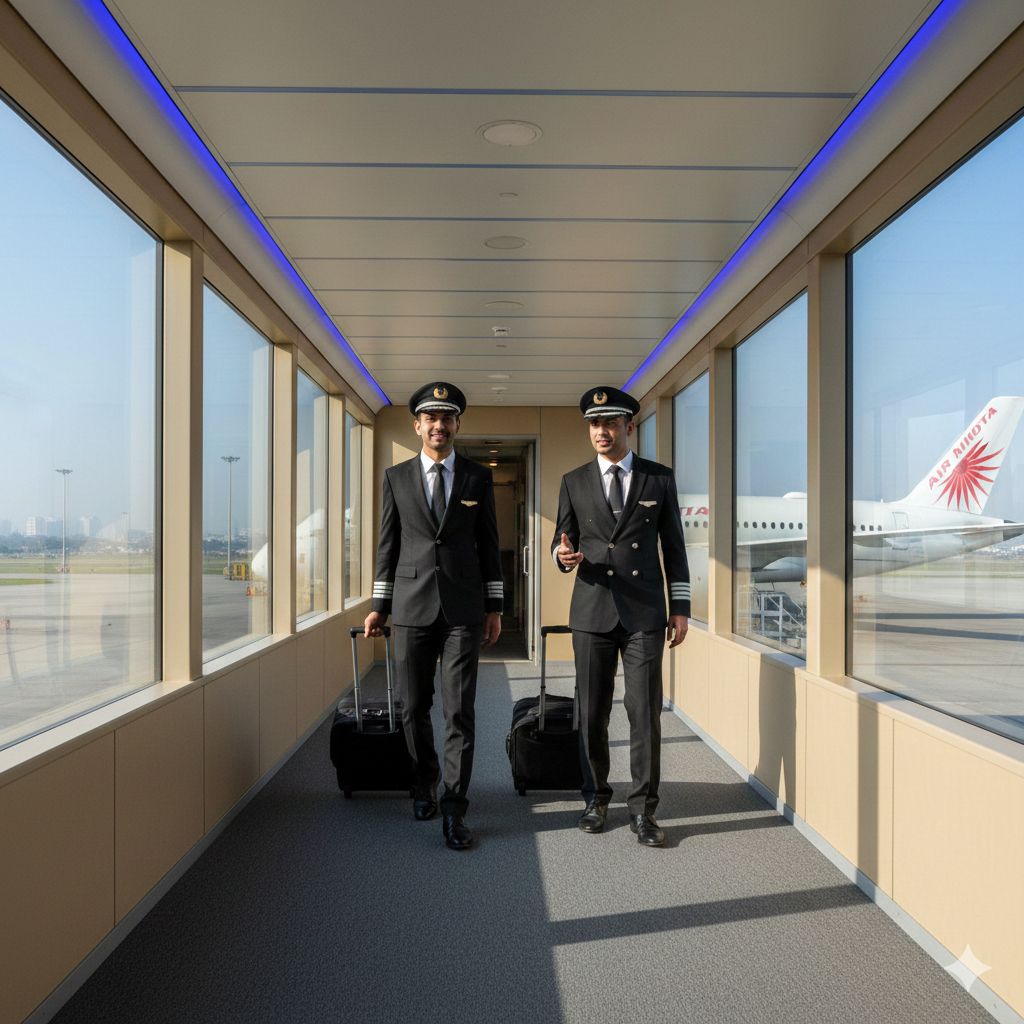
When you walk down an aerobridge in Delhi or Mumbai, you usually see two pilots in the cockpit, crisp white shirts, gold stripes, and calm faces preparing for departure. It's easy to assume they alone "own" that aircraft.
But in India's complex and congested skies, flying one aircraft safely takes far more than two pilots. Behind every narrow-body jet is a carefully planned human system involving 14 to 16 pilots, and sometimes even more.
This is the human story behind that "pilot-to-aircraft" ratio, and how Airlines in India staff the flights you take every day.
It's Not Just a Job; It's a Body Clock
Pilot Fatigue Is a Safety Risk, Not a Scheduling Issue
In most professions, fatigue is inconvenient. In aviation, it is a direct safety risk.
India's aviation regulator and watchdog, the DGCA, has recently made significant changes to the hours and conditions under which pilots can fly. These rules aren't just about numbers; they're about protecting the human being in that cockpit and by extension, every passenger on the flight.
The DGCA's new Flight Duty Time Limitations (FDTL) increased mandatory weekly rest from 36 hours to 48 hours and tightened rules around night flying. "Night" is now officially 00:00 to 06:00, and pilots can only do two consecutive night duties. That red-eye flight you take at 3:00 a.m.? The people flying it must live by a clock that often runs opposite to the rest of the world.
So, airlines don't just hire for the hours in the air, they hire for the hours of recovery.
The "Buffer Crew" Is Real
- One pilot is flying your sector.
- One is sleeping after a long night rotation.
- One is in a simulator, practising engine failures and bad-weather approaches.
- Another is at home on standby, waiting for a sudden call because someone else fell sick or a flight got delayed.
For a typical narrow-body aircraft, the kind flown by IndiGo, Air India Express, Akasa, or SpiceJet, airlines now aim for about 14–16 pilots per aircraft. For wide-body aircraft flying to London, New York, or Sydney, that number can climb to close to 30, because ultra-long flights often require extra pilots to share the workload.
The Indian Aviation Context: Growth at an Unprecedented Scale
India is currently witnessing one of the largest aviation expansions in global history.
- Over 1,700 aircraft have been ordered by Indian airlines
- Government estimates suggest ~30,000 new pilots will be required over the next decade
- This demand spans cadets, experienced co-pilots, commanders, instructors, and trainers
This isn't just a hiring statistic, it represents thousands of individual journeys involving:
- Ground exams
- Medical clearances
- Simulator training
- Financial planning
- Long-term career decisions
To Bridge Gaps, Airlines Don't Have Just One Source of Pilots
Indian airlines rely on multiple pipelines:
- Cadet pilot programs (zero experience to airline-ready)
- Lateral hiring from other carriers (often delayed due to DGCA's 6-12 month notice norms)
- Foreign Aircrew Temporary Authorisation (FATA) for short-term command support
- Internal command upgrades through structured training
This complex ecosystem exists to ensure continuity without compromising safety.
And there's another part of the Indian story worth celebrating: women. Around 15% of India's pilots are women, nearly three times the global average. So, when an Indian airline plans its "pilot pipeline," it isn't just calculating seats and schedules; it's also quietly reshaping what a typical cockpit looks like for the next generation.
More Than a Roster: A Human System
Behind every neatly printed flight roster is a human reality:
- Pilots balancing night duties with family life
- Training captains mentoring first-time co-pilots
- Operations teams managing medical limits, delays, and legal duty hours
Each constraint exists for one reason: So that when you fasten your seatbelt in 24A, the people in the cockpit are rested, alert, and legally fit to fly.
How Many Pilots Does India Need for 1,700 New Narrow-Body Aircraft?
Using the current Indian planning norm of 14–16 pilots per narrow-body aircraft (to account for DGCA's 48-hour weekly rest, night-duty limits, training, leave, and standby):
- Lower bound: 1,700 aircraft × 14 pilots ≈ 23,800 pilots
- Upper bound: 1,700 aircraft × 16 pilots ≈ 27,200 pilots
With around 1,700 new narrow-body aircraft expected to join Indian fleets over the next five years, the country will need roughly 24,000 to 27,000 additional pilots just to keep those jets flying, on top of the crews already in the system.
Why This Matters to Aspiring Pilots and Parents
For students considering aviation careers, these numbers highlight:
- Long-term demand stability
- The importance of regulatory compliance
- Why training quality and timelines matter as much as cost
At The Pilot's Compass, we help students understand not just how to become pilots , but why the system works the way it does, from DGCA rules to airline staffing realities.
Conclusion
The miracle of flight isn't only that a 75-tonne aircraft leaves the ground.
It's that a deeply regulated, human-centric system ensures the people flying it are trained, rested, protected, and supported, every single day.
Next time you see a pilot rushing through an Indian terminal, remember: they are just one visible part of a carefully planned aviation ecosystem.
Map Your Custom Pilot Training Pathway
Evaluate your compliance across the 4 major DGCA training gates, select training country routes (India vs. USA/Europe), and estimate your CPL timeline month-by-month.