
DGCA CPL Ground Classes
Complete CPL Ground School Preparation
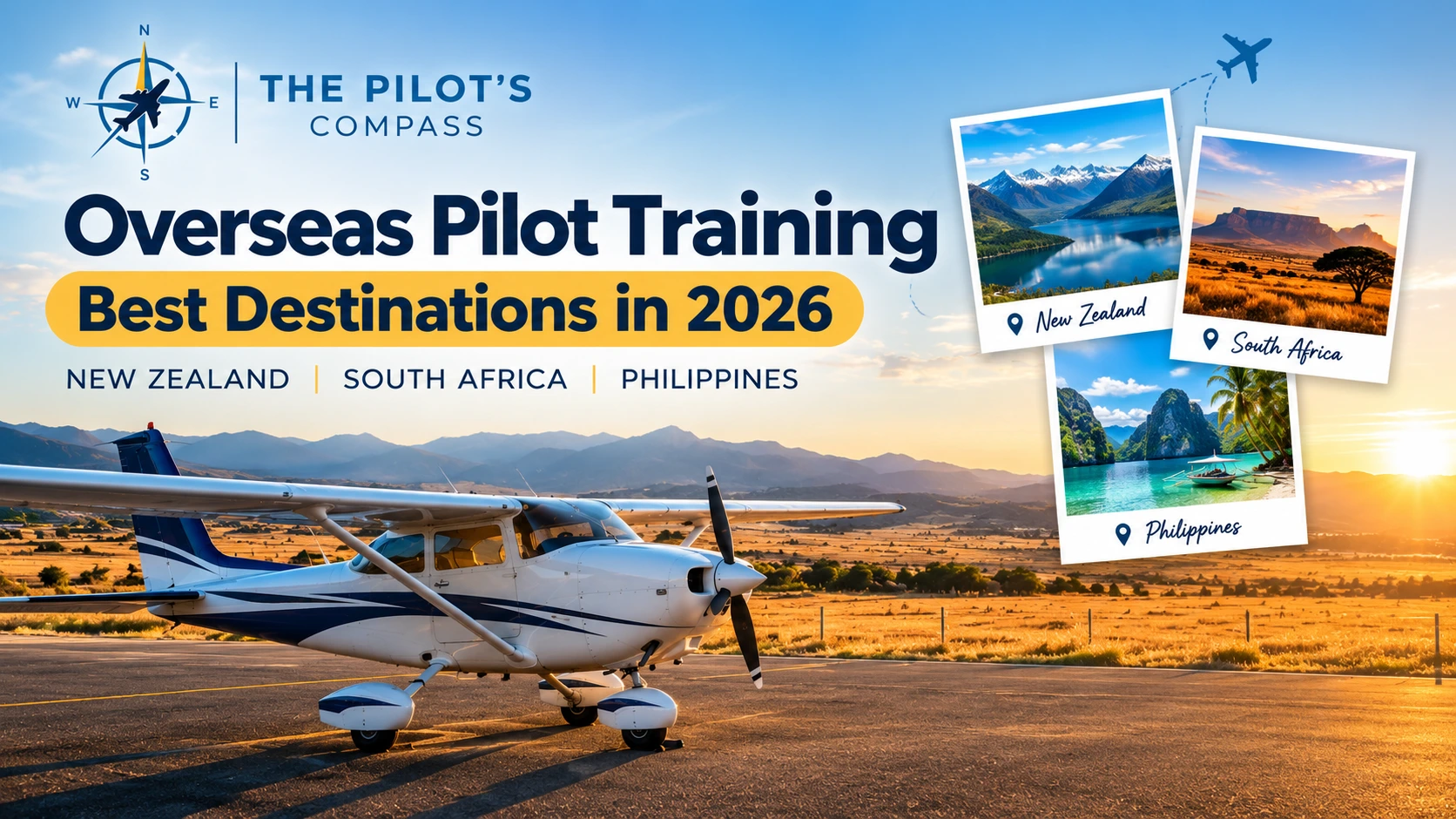
For many Indian students, the question is not whether to become a pilot but where to train. Flying schools in the Philippines, South Africa and New Zealand often quote lower fees than Indian academies, and some promise faster finishes. But the headline school fee is only part of the story.
Living costs, weather delays, visas, medicals and the DGCA conversion back home can change the final bill substantially. This guide compares the three most common overseas routes on the total cost an Indian student actually pays, not the sticker price.
The short version: On 2026 estimates, the Philippines is usually the cheapest all-in route at about ₹50 to 60 lakh. South Africa and New Zealand come next. Every overseas licence still needs the same DGCA conversion, so compare the India-landed total, not the school fee alone.
Key Takeaways
- Lowest total cost: The Philippines, at about ₹50 to 60 lakh all-in.
- Fastest finish: South Africa, with dependable dry-season flying and 10 to 14 months of flying training.
- Cost per hour: New Zealand and the Philippines tie at roughly ₹21,500 per logged hour, on estimated midpoints.
- Weather matters: Typhoons can halt flying in the Philippines from July to October, so build in a buffer.
- Conversion is not optional: Every foreign CPL needs DGCA exams, an RTR(A) licence and an Indian Class 1 medical.
Quick Navigation
- Cheapest, fastest and easiest options
- Full India-landed budget
- Cost per logged hour
- Country by country
- How weather changes your timeline
- The DGCA conversion path
- India or abroad?
- How to vet a flight school
- FAQs
Cheapest, Fastest and Easiest Options (2026)
Pick a country by what matters most to you. Most Indian students prioritise total cost.
| If your priority is | Best option (2026, estimated) | Why |
|---|---|---|
| Lowest total cost | Philippines | Lowest all-in budget, about ₹50 to 60 lakh |
| Drier weather at a moderate price | South Africa | Low living costs and a high-sunshine Highveld, about ₹55 to 65 lakh |
| Cheapest flying per hour | New Zealand / Philippines | About ₹21,500 per logged hour on estimated midpoints |
| Fastest finish | United States / South Africa | 8 to 14 months of flying in more dependable weather |
| Simplest conversion back home | No country is easier | The DGCA requirements are common to all |
The three main overseas routes compare as follows:
| Country (regulator) | Est. all-in, India-landed | Flying training | DGCA conversion | Seasonal risk | Who should not choose it |
|---|---|---|---|---|---|
| Philippines (CAAP) | ₹50 to 60 lakh | 12 to 18 months | 2 to 4 months | Typhoons, July to October | A student on a fixed end date who cannot absorb monsoon delays |
| South Africa (SACAA) | ₹55 to 65 lakh | 10 to 14 months | 2 to 4 months | Low; dry Highveld winters | A student who wants the lowest sticker fee regardless of school track record |
| New Zealand (CAA NZ) | ₹55 to 70 lakh | 12 to 18 months | 2 to 4 months | Oceanic fronts slow scheduling | A tight-budget student sensitive to high living costs |
The Full India-Landed Budget
A school fee alone understates the cost. The table below adds the four costs students most often forget: living, visas and medicals, and the DGCA conversion back home. These are 2026 planning estimates compiled from school quotes, not bookable prices.
| Country | Flight school (CPL + ME + IR) | Living (12 months) | Visa and medicals | DGCA conversion | Total realistic budget |
|---|---|---|---|---|---|
| Philippines | ₹40 to 46 L | ₹4.5 to 6 L | ₹1.5 to 2 L | ₹4 to 6 L | ₹50 to 60 L |
| South Africa | ₹44 to 50 L | ₹5 to 7 L | ₹1.5 to 2 L | ₹4.5 to 6 L | ₹55 to 65 L |
| New Zealand | ₹38 to 48 L | ₹11 to 14 L | ₹2.5 to 3 L | ₹3.5 to 5 L | ₹55 to 70 L |
| United States | ₹44 to 50 L | ₹10 to 12 L | ₹2.5 to 3 L | ₹3.5 to 5 L | ₹60 to 70 L |
New Zealand has a low school fee but high living costs, so its total sits near the US. The Philippines keeps both low.
Overseas budgets carry exchange-rate risk. On a ₹50 to 60 lakh budget, a 5% currency move is roughly ₹2.5 to 3 lakh, and a 10% move is roughly ₹5 to 6 lakh. Plan a forex buffer of that size.
Estimated Training Spend Per Logged Hour
This is a derived comparison aid, not a rate any school will quote. It takes the midpoint of each country's CPL, multi-engine and instrument-rating package and divides it by the 200 logged hours DGCA requires. It excludes living costs, visas and conversion.
| Country | School-fee range (CPL + ME + IR) | Midpoint ÷ 200 hours |
|---|---|---|
| New Zealand | ₹38 to 48 L | ≈ ₹21,500 |
| Philippines | ₹40 to 46 L | ≈ ₹21,500 |
| United States | ₹44 to 50 L | ≈ ₹23,500 |
| South Africa | ₹44 to 50 L | ≈ ₹23,500 |
| India | ₹52 to 60 L | ≈ ₹28,000 |
Packages differ. One school may include multi-engine hours or landing fees that another bills separately, and some students fly more than 200 hours. Treat these figures as directional.
Country by Country
The Philippines (CAAP). The Philippines is the lowest total-cost route on 2026 estimates, because school fees and living costs are both low. Schools cluster around Clark, Subic Bay and Cebu. Expect 12 to 18 months of training. The typhoon season from July to October can halt flying, so plan the calendar around it. Check flight routings from your departure city before you commit.
South Africa (SACAA). The Highveld around Johannesburg and Pretoria offers dry, high-sunshine flying and some of the lowest living costs abroad. Estimated total budget is about ₹55 to 65 lakh, with 10 to 14 months of flying. Confirm the school's DGCA conversion track record in writing before you pay.
New Zealand (CAA NZ). New Zealand has a strong instructor culture and comparatively cheap flying per hour. The trade-offs are weather and living costs. Oceanic frontal systems can interrupt flying, and living costs push the total to about ₹55 to 70 lakh. It suits students who value flying quality and mountain or real-weather experience over the quickest finish.
How Weather Changes Your Timeline
Weather is a leading reason courses run long. More usable flying days generally means more flying and a quicker finish. A cheap school in a wet region can cost more than a pricier school in a dry one, because every grounded week adds another month of living costs.
| Training hub | Climate | Flying-weather reliability | Completion pace |
|---|---|---|---|
| US Sunbelt (Arizona, Texas, Florida) | Dry desert, clear coasts | Very high, year-round | Quickest, 8 to 12 months |
| South Africa Highveld | High sunshine, dry winters | High, dry-winter season | 10 to 14 months |
| New Zealand | Oceanic fronts, mountain flying | Moderate, frontal interruptions | Variable; needs flexible scheduling |
| Philippines (Clark, Subic Bay, Cebu) | Tropical, typhoons | Seasonal halts, July to October | Can stretch to 18 months |
The DGCA Conversion Path
A foreign CPL does not let you fly for an Indian airline on its own. You convert it under the Directorate General of Civil Aviation. The written exams and checks are set by India and are the same for every country. What differs is the paperwork, licence verification, logged-hour compliance and any remedial flying, which depend on your records and your foreign authority.
The core steps are:
- Foreign flight training. Log the 200 hours that match DGCA's breakdown under Schedule II, Section J of the Aircraft Rules, 1937. That means 100 hours as pilot in command, 20 hours of cross-country PIC including a 300 NM flight, 10 hours of instrument time (up to 5 on an approved simulator), and 5 hours of night flying with at least 10 take-offs and 10 landings as PIC.
- Foreign CPL issued. Hold a CPL from the foreign authority. Multi-engine and instrument ratings are converted alongside it.
- DGCA theory exams. Clear Air Regulations and the composite Navigation and Meteorology paper on the Pariksha portal.
- RTR(A) radio licence. Since 1 December 2025, DGCA administers RTR(A), with Part 1 through Pariksha and Part 2 through eGCA.
- Class 1 medical. Hold a valid Indian DGCA Class 1 medical.
- Recency checks. If your foreign checks have lapsed, complete General Flying Tests and an instrument rating check at an Indian FTO.
- Indian CPL issued. Submit the verified dossier and authenticated logbooks on eGCA.
Three mistakes cost students the most time and money. Some fly before clearing their DGCA theory, which means flying home to sit exams later. Some under-log night and instrument hours, which forces extra flights on conversion. And some misread the 200-hour rule, which requires the right breakdown, not just a total of 200.
India or Abroad: Which Route Is Better?
It depends on your weather tolerance, budget and timeline.
| Factor | Train in India | Train abroad (e.g. South Africa or US) |
|---|---|---|
| Total timeline | 18 to 30 months | 8 to 14 months, plus 2 to 4 months conversion |
| Weather | Heavy monsoon breaks, June to September | Minimal in desert and Sunbelt regions |
| Fleet | 5 to 15 aircraft per school | 25 to 70+ in large academies |
| DGCA conversion | None | Exams, logbook audit, recency flights |
| Total budget (2026, est.) | ₹60 to 70 lakh | ₹50 to 70 lakh, exposed to exchange rates |
Train in India if you want to stay close to home and avoid conversion. Train abroad if quicker flying in dependable weather matters more than proximity, and you can manage rupee exposure.
How to Vet a Flight School Abroad
A low fee means little if the school grounds you. Before you sign, check:
- Active fleet: ten or more operational aircraft, so inspections do not stop your training.
- Student-to-aircraft ratio: below 6:1, so you can fly four to five times a week.
- On-site maintenance: in-house engineers who turn around snags quickly.
- Conversion track record: the number of Indian graduates who converted successfully.
- Milestone billing: pay in blocks, not one upfront lump sum.
- Refund and student-protection terms: what happens to prepaid fees if the school pauses operations or you withdraw.
Get every inclusion and refund term in writing, with figures. Ask each foreign regulator how long licence verification and document authentication take, because these steps add weeks to conversion.
FAQs
What is the cost of pilot training in the Philippines in Indian rupees? On 2026 planning estimates, an all-in India-landed budget of about ₹50 to 60 lakh. It is usually the lowest total-cost route for Indian students.
Which is the cheapest country for pilot training for Indian students? By estimated total landed cost, the Philippines, followed by South Africa and New Zealand. By cost per logged hour, New Zealand and the Philippines tie at about ₹21,500.
Can an Indian student convert a foreign CPL to a DGCA CPL? Yes. You clear the DGCA theory papers, obtain an RTR(A) licence, hold an Indian Class 1 medical and complete any recency checks.
Which country finishes fastest? The United States and South Africa, at roughly 8 to 14 months of flying, with clearer weather. Add 2 to 4 months for DGCA conversion.
Final Thoughts
The cheapest country on paper is rarely the cheapest once living costs, weather delays and conversion are added. Decide by your total landed budget and timeline, then verify the school in writing. Check current fees and exchange rates before you commit, and confirm conversion requirements on the official DGCA and eGCA portals.
Sources: DGCA Pariksha and eGCA portals, Aircraft Rules 1937 (Schedule II, Section J), overseas regulators CAAP, SACAA and CAA NZ. All cost figures are 2026 planning estimates, not official prices.
Frequently Asked Questions
Map Your Custom Pilot Training Pathway
Evaluate your compliance across the 4 major DGCA training gates, select training country routes (India vs. USA/Europe), and estimate your CPL timeline month-by-month.