
DGCA CPL Ground Classes
Complete CPL Ground School Preparation
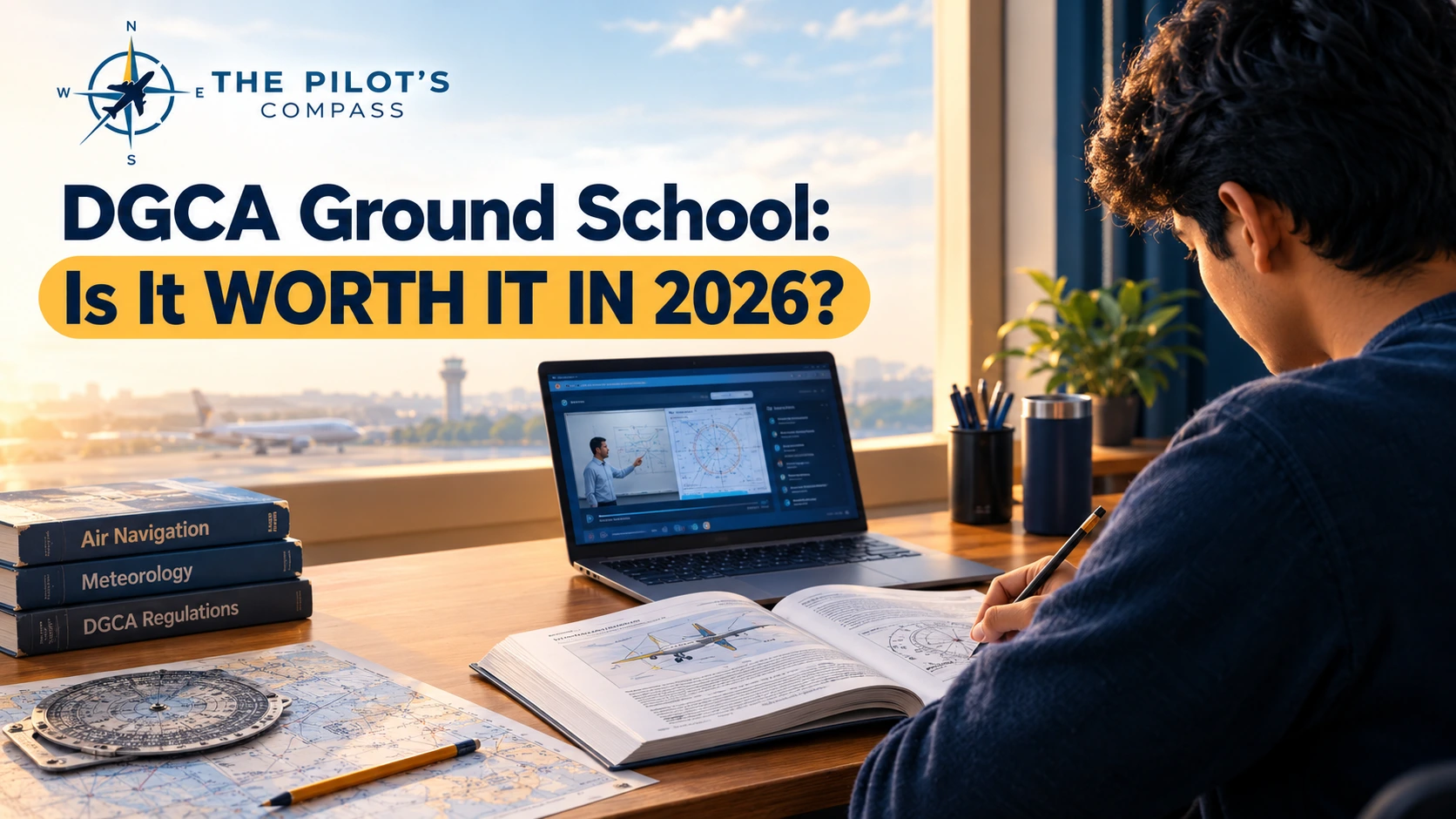
Every CPL aspirant in India eventually asks the same question: is DGCA ground school worth paying for, or can I study the theory on my own?
The honest answer is that ground school is coaching, not a licence requirement. You can clear the DGCA theory papers without attending a single class. Whether coaching is worth its price depends on one thing: how much it improves your chances of passing on the first attempt, and so avoids the delay that failed papers cause.
This guide walks through the real costs, the return on investment, a three-way decision between self-study, single-subject coaching and a full package, and a readiness check you can score in five minutes.
The short version: DGCA ground school is optional. Full packages cost roughly ₹50,000 online to ₹2.5 to 3.5 lakh in a classroom, a small slice of a CPL that typically runs ₹65 to 75 lakh all-in. Pay for a full package if you are new to aviation theory or need a fixed schedule. Self-study if you are disciplined and strong in maths and physics.
Key Takeaways
- Not mandatory: DGCA does not require ground-school attendance to sit the five CPL (Aeroplanes) theory papers.
- Real cost: A failed paper costs more in delay and living expenses than in the re-exam fee.
- Three paths: Self-study, single-subject coaching or a full package. Most candidates fit one of the three.
- Check your readiness: Consistent mock-test scores above roughly 80% suggest self-study is realistic.
- Judge the school, not the ad: Ask for subject-wise results, faculty names and repeat policies in writing.
Quick Navigation
- Ground school is coaching, not a requirement
- What DGCA ground school costs in 2026
- The ROI: a worked calculation
- Self-study, single subject or full package
- A readiness self-check
- How to evaluate a ground school
- FAQs
Ground School Is Coaching, Not a Licence Requirement
For a CPL (Aeroplanes), you sit five written papers: Air Navigation, Aviation Meteorology, Air Regulations, Technical General (Aircraft and Engines), and Technical Specific. A separate Performance paper also applies to some candidates, such as those flying aircraft above 5,700 kg or twin-engine helicopters. DGCA publishes the syllabus and conducts the papers through its Pariksha portal.
The RTR(A) radio-telephony certificate is a separate licence, not a sixth theory paper. Many ground-school fees do not include RTR(A) coaching, so ask before you assume they do.
You are not paying for access to the licence. You are paying for structure, teaching and doubt-clearing. For some aspirants that is worth the money. For others, the same money is better spent on flying hours.
The governing law today is the Bharatiya Vayuyan Adhiniyam, 2024, in force since 1 January 2025. If a coaching provider's notes still cite the 1934 Aircraft Act as current law, their material is out of date.
What DGCA Ground School Costs in 2026
Fees vary by format, city and provider. The ranges below are advertised 2026 estimates, not official rates. Confirm the current figure before you enrol.
| Format | Advertised Fee (2026 estimate) | What It Usually Buys |
|---|---|---|
| Online / recorded (full package) | ₹50,000 – ₹1,00,000 | Recorded lectures, question banks, limited live doubt sessions |
| Hybrid (live online + recordings) | ₹1,80,000 – ₹2,18,000 | Live classes, doubt clearing, mock tests, recordings |
| Classroom (full five-subject package) | ₹2,50,000 – ₹3,50,000 | In-person classes, plotting practice, fixed schedule |
| Premium / fast-track / residential | ₹2,50,000 – ₹3,50,000+ | Small batches, intensive timetable, close supervision |
| Single subject (bought separately) | ₹40,000 – ₹70,000 per paper | Coaching for one hard paper only |
Two costs sit outside most fee quotes. RTR(A) is a separate exam, often excluded from the package. DGCA exam fees are extra and generally non-refundable once submitted. The per-paper fee for a regular Pariksha session has been reported at around ₹2,500, but on-demand sessions cost more, so verify the current fee on the portal.
Put this in context. A CPL in India typically costs roughly ₹65 to 75 lakh all-in in 2026, with flying as the largest line item. Ground school is a small part of that total.
The ROI: A Worked Calculation
The fee is the number most people argue about, but it rarely decides the question. The expensive risk is a failed paper. A fail means a re-exam fee, a wait for the next exam window, and a delay to your flying. The re-exam fee is small. The delay is what costs real money.
The formula is simple:
Net value of coaching = avoided re-exam fees + avoided delay cost − coaching premium over self-study
Each term, with 2026 inputs:
- Coaching premium: Self-study typically costs ₹20,000 to 40,000 for current books, question banks and mock tests. A full classroom package near ₹2 lakh is therefore roughly ₹1.6 to 1.8 lakh more.
- Avoided re-exam fees: At about ₹2,500 per paper per attempt, avoiding ten re-attempts saves only about ₹25,000. Re-exam fees alone never justify coaching.
- Avoided delay cost: Over an 18 to 24 month training programme, living costs run roughly ₹15,000 to 35,000 a month. Two to four months of avoided delay can save ₹30,000 to ₹1.4 lakh.
Here is an illustrative example for a borderline beginner:
| Line | Self-Study Alone | Full Package |
|---|---|---|
| Course cost | ₹30,000 | ₹2,30,000 |
| Papers likely re-attempted (estimate) | 3 | 1 |
| Re-exam fees at ₹2,500 each | ₹7,500 | ₹2,500 |
| Extra delay from re-attempts (estimate) | ~4 months | ~1 month |
| Delay cost at ₹25,000 a month | ₹1,00,000 | ₹25,000 |
| Rough total cost of clearing theory | ₹1,37,500 | ₹2,57,500 |
On these inputs, the full package costs about ₹1.2 lakh more, even after cutting the delay. Coaching only breaks even if it removes much more delay than shown here, or if you place a high value on starting your flying sooner. For a weak-in-theory beginner who would otherwise fail several papers, that can be true. For a disciplined self-studier who would clear everything first time, it usually is not.
Replace the re-attempt and delay figures with your own honest estimates. They are not guaranteed outcomes, and coaching does not remove the need to study.
Self-Study, Single Subject or Full Package
Most candidates fit one of three paths rather than a simple yes or no.
-
Self-study. Suits a disciplined candidate with a strong maths and physics base who can hold a daily routine. Plan on three to five focused hours a day over three to six months, using current books, an updated question bank and paid mock tests. Cost is typically ₹20,000 to 40,000.
-
Single-subject coaching. Suits someone comfortable across most papers but stuck on one, usually Air Navigation or Meteorology. You pay for coaching on that paper alone, roughly ₹40,000 to 70,000, and self-study the rest. This targeted middle option is often overlooked.
-
Full package. Suits a true beginner, a weak-theory candidate, or anyone who cannot keep to a self-study schedule. Choose a hybrid or online package if you are working alongside your prep. Pay the classroom premium only for close supervision or a proven instructor-led batch.
Recorded-only classes suit a self-motivated learner who mainly needs structure and a question bank. They are a poor fit if your real gap is doubt-clearing, because a recording cannot answer a follow-up question.
A Readiness Self-Check
Score yourself before deciding. Give yourself one point for each statement that is honestly true:
- I can study three or more focused hours a day, consistently, for several months.
- I am comfortable with maths and physics at Class 11 to 12 level.
- On recent full-length mock papers, I score comfortably above the 70% DGCA pass mark, ideally around 80% or more.
- I can source and work through current books and an updated question bank on my own.
- I do not need a schedule or batch to keep me accountable.
- I can resolve doubts from references or forums without one-to-one teaching.
5 to 6 points: Self-study is realistic. Buy single-subject coaching only for a paper you cannot crack.
3 to 4 points: Consider a hybrid or online package, or single-subject coaching for your weak areas.
0 to 2 points: A structured full package is likely to save you delay, especially if you are new to the theory.
How to Evaluate a Ground School Before You Pay
Price tells you little about quality. Ask for these answers in writing:
- Exact fee split: the total and the per-subject price. Can you enrol for a single hard paper?
- What is included: books, mock tests, navigation equipment, plotting practice and doubt sessions. Is RTR(A) in or out?
- Named faculty: instructors with verifiable aviation experience, not an anonymous "expert panel".
- Live versus recorded hours: how many of each you actually get.
- Doubt clearing: how much one-to-one instructor time you can expect.
- Recent, verifiable results: how many students sat each paper and how many passed. A single headline "pass rate" tells you little.
- Repeat policy: if you fail a paper, is revision free, or do you pay again?
- Access duration: how long you keep class access and whether you can rejoin a batch.
- Current material: whether the question bank is updated after DGCA syllabus changes.
Two reality checks the ads rarely mention. First, DGCA's FTO rankings grade flying training organisations, not ground-coaching institutes, so an FTO grade or the phrase "DGCA-approved" on a coaching ad is not evidence that the teaching is good. Second, nearly every institute advertises a "100% first-attempt pass". Treat that as marketing and ask how many students sat each exam.
FAQs
Is DGCA ground school mandatory? No. DGCA does not require ground-school attendance to sit the CPL theory exams. You can self-study and book the papers through the DGCA Pariksha portal.
Is DGCA ground school worth the money? It is worth it when it raises your odds of passing first time enough to avoid re-exams and, more importantly, the delay they cause. That is usually true for beginners and anyone weak in Navigation or Meteorology. For a disciplined self-learner with a strong maths and physics background, it is often poor value.
How many papers are there, and is RTR(A) one of them? A CPL (Aeroplanes) has five DGCA theory papers. RTR(A) is a separate radio-telephony licence with its own exam.
Can I clear DGCA exams without ground classes? Yes, many candidates do, with current books, updated question banks, paid mock tests and a strict daily routine.
Final Thoughts
Ground school is a tool, not a requirement. Score yourself honestly, price the delay risk rather than the sticker fee, and compare schools on evidence. If you are weighing your options, run the ROI calculation above with your own estimates and check the latest exam fees and syllabus on the official DGCA portals before you commit.
Sources: DGCA Pariksha portal (pariksha.dgca.gov.in), Bharatiya Vayuyan Adhiniyam 2024, DGCA CAR Section 7, Series B (CPL written-exam syllabus). Fee ranges are 2026 market estimates compiled from provider quotes, not official prices.
Frequently Asked Questions
Map Your Custom Pilot Training Pathway
Evaluate your compliance across the 4 major DGCA training gates, select training country routes (India vs. USA/Europe), and estimate your CPL timeline month-by-month.