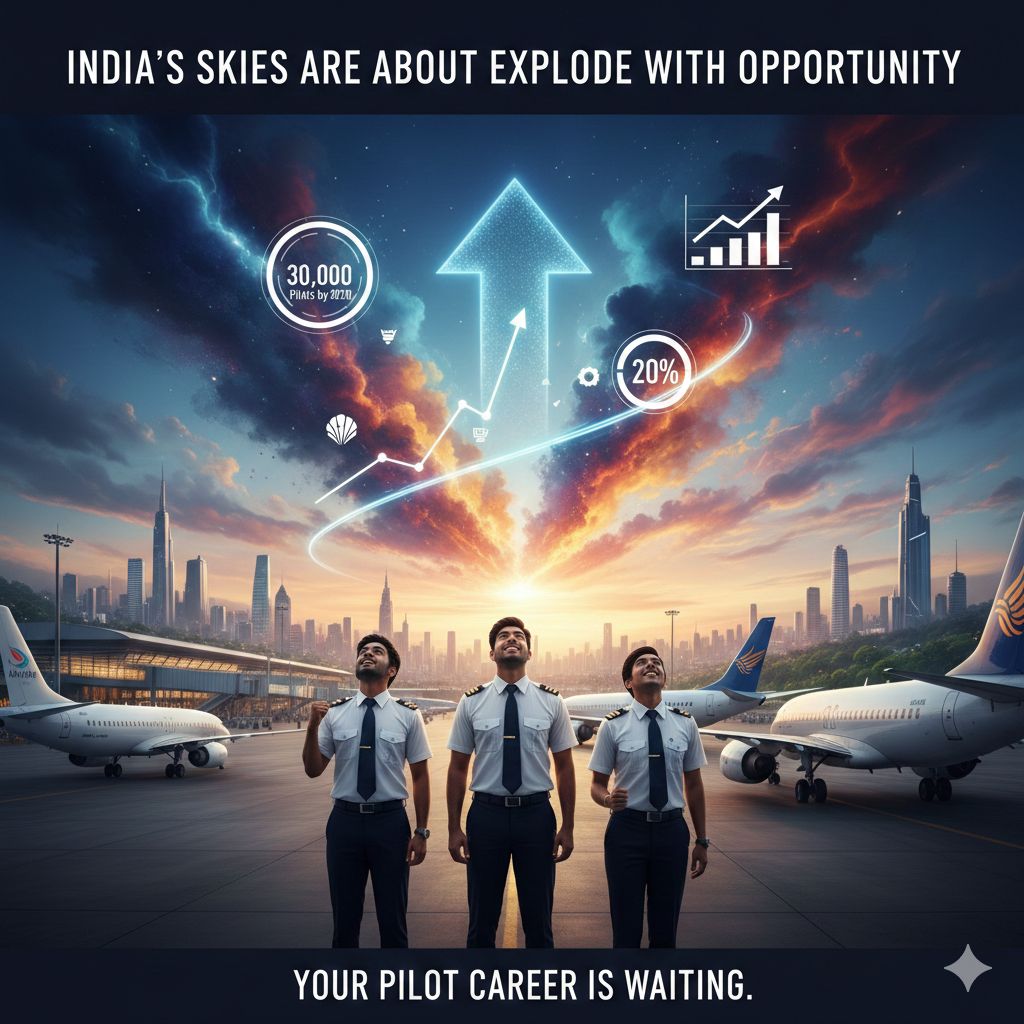
India’s Skies Are About to Explode with Opportunity
For years, Indian aviation industry growth was driven by a few dominant players. Airlines came and went, and a duopoly slowly took shape.
But if you’ve been to an airport lately, you can sense a shift. The DGCA (Directorate General of Civil Aviation) has begun issuing more No Objection Certificates (NOCs) for new airlines in India.
With carriers like AL Hind Air, Shankh Air, and Fly Express entering the market, we’re not just seeing more logos at the terminal—we’re witnessing a major transformation in career opportunities for pilots in India.
If you’re logging hours in a Cessna or practising on a simulator, dreaming of your first stripe, this isn’t just an industry update. It could define your pilot career in India.
Why Is DGCA Approving New Airlines in India?
Both strategy and necessity are driving the regulator’s approach.
Diversifying Beyond the IndiGo–Air India Duopoly
A market controlled by a few large airlines is efficient, but also fragile. When one airline faces technical disruptions, labour shortages, or financial stress, domestic air connectivity in India suffers nationwide.
By approving more airlines, the DGCA aviation policy aims to diversify risk and create a more resilient ecosystem.
Regional Connectivity Under UDAN
The UDAN – Regional Connectivity Scheme – aims to make flying affordable and accessible by connecting Tier-2 and Tier-3 cities in India.
This requires airlines designed for operations from secondary hubs like Lucknow, Kochi, and Noida. That’s precisely where many new regional airlines in India are focusing.
From Waiting to Being in Demand: Pilot Hiring in India Is Changing
Until recently, a fresh Commercial Pilot License (CPL) holder in India often faced long periods of uncertainty. You’d complete training, secure your ratings, and wait—sometimes for years—for a cadet pilot program or limited hiring window.
That reality is changing.
When a new airline startup in India launches, it needs experienced Captains immediately. These are typically hired from existing airlines, which creates:
- Vacancies at the mid-level
- Faster upgrades for First Officers
- More entry-level pilot jobs in India for fresh CPL holders
Add to this the updated FDTL (Flight Duty Time Limitation) rules in India, which require airlines to roster more pilots to operate the same schedules safely.
Industry estimates suggest airlines now need around 20% more pilots than before.
For aspiring pilots in India, this means one thing: increased pilot demand and faster career progression.
Aircraft Types New Pilots in India Are Likely to Fly
Your first type rating in India often shapes your early career. Here’s how fleet decisions by new airlines affect you:
ATR 72-600 – Regional Workhorse
Chosen by AL Hind Air and Fly Express, the ATR aircraft in India is ideal for building strong hands-on flying skills.
It plays a central role in regional airline operations under UDAN, making it a common starting point for new pilots.
Boeing 737-800 – Popular Narrow-Body Aircraft
Shankh Air plans to operate the Boeing 737-800, widely used for dense domestic routes and short international sectors.
B737 pilot jobs in India offer excellent global transferability.
Airbus A320 – Long-Term Growth Path
Many airline startups plan future induction of the Airbus A320 family.
This creates opportunities to transition from turboprops or the 737 to A320 pilot jobs in India as airlines expand.
How Big Is the Pilot Demand in India?
India currently operates approximately 800–1,000 commercial aircraft.
Over the next decade, more than 1,500 aircraft orders were confirmed by airlines like IndiGo, Air India, and Akasa Air.
Each narrow-body aircraft requires 12–16 pilots to cover rosters, leave, and training.
- India needs nearly 2,000 new pilots every year
- By 2030, the country could require 30,000 commercial pilots
However, Flight Training Organizations (FTOs) in India are not yet producing pilots at this scale.
This pilot supply–demand gap in India is where opportunity truly lies.
The Advantage of Joining a New Airline Early
New airlines don’t just offer jobs—they offer accelerated aviation career growth in India.
- You’re not lost in a massive seniority list
- You help build systems, culture, and routes from scratch
- You may achieve Captain upgrade faster in India
Compared to legacy carriers, where thousands of pilots may be ahead of you, startup airlines in India often offer quicker advancement.
That said, expectations are high.
The DGCA’s stricter airline approval process means safety and quality are non-negotiable.
Airlines are looking for pilots who demonstrate:
- Strong flying fundamentals
- Professionalism and adaptability
- Comfort in fast-growing, startup-style airline environments
If you’re still training, now is the time to focus beyond exams—on airmanship, SOP discipline, and real-world cockpit skills.
The Future of Pilot Careers in India
The DGCA NOC approvals of 2025 signal that Indian aviation growth is accelerating—not slowing down.
For future pilots in India, the message is clear: the cockpit has never been more accessible.
Whether you begin flying a regional ATR aircraft or step into a narrow-body jet cockpit, the next decade may offer more opportunities than any generation before.
The sky isn’t just the limit anymore. It’s where your pilot career in India is waiting.
Ready to Start Your Aviation Career?
Get expert assistance for your visa application and make your international training dreams a reality.
Map Your Custom Pilot Training Pathway
Evaluate your compliance across the 4 major DGCA training gates, select training country routes (India vs. USA/Europe), and estimate your CPL timeline month-by-month.