Introduction
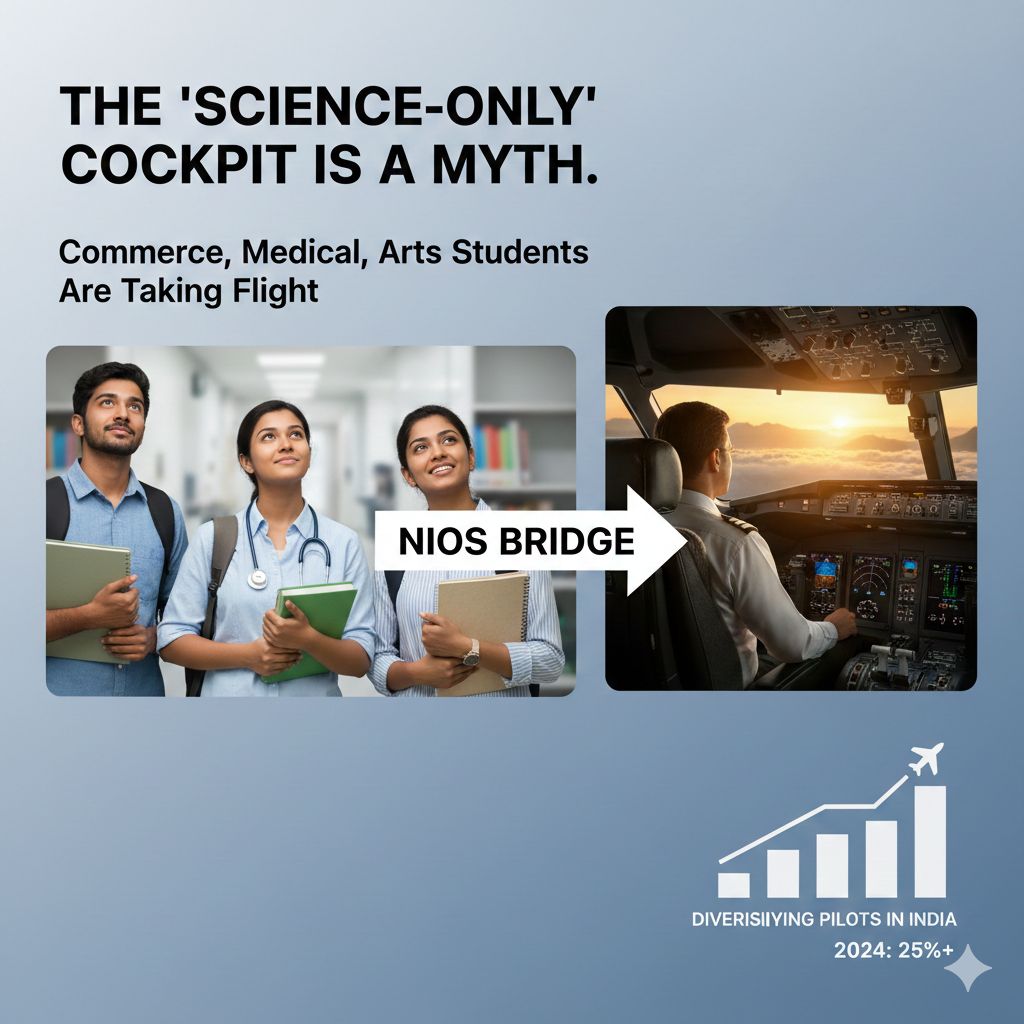
Becoming a pilot in India is a dream shared by thousands of students every year. However, one of the biggest myths in Indian aviation is that you must choose the Science stream after 10th grade to pursue this career. This misconception often discourages talented commerce students, biology students, and even arts students from exploring commercial pilot training. The simple truth is that stream does not define your eligibility to become a pilot.
In India, the Directorate General of Civil Aviation (DGCA) requires aspiring pilots to have passed Class 12 with Physics and Mathematics. If you didn't study these subjects in school, the National Institute of Open Schooling (NIOS) provides a DGCA-approved, legal pathway to meet this requirement, without having to repeat school.
This guide explains how to become a commercial pilot after commerce or biology using NIOS Physics and Mathematics.
Step 1: Understanding the NIOS Pathway for Pilot Eligibility
The National Institute of Open Schooling (NIOS) operates under the Ministry of Education, Government of India and is fully recognised by the DGCA for pilot licence issuance. It offers an On-Demand Examination (ODE) system, making it the most flexible option for non-science students.
If you already passed Class 12 in commerce or biology, you only need to appear for:
- Physics (NIOS Subject Code 312)
- Mathematics (NIOS Subject Code 311)
Why NIOS Is Ideal for Aspiring Pilots
- DGCA-approved NIOS certificate
- Flexible exam dates
- Fast results (45–60 days)
- No need to repeat Class 11 or 12
This makes NIOS the fastest way to become a pilot after commerce or biology in India.
Step 2: NIOS Registration Process for Pilot Aspirants
To begin your NIOS admission for Physics and Maths, visit the official NIOS SDMIS portal.
Registration Steps
- Choose "Part Admission"
Ideal for students adding additional subjects after Class 12. - Upload required documents
- Class 10 marksheet
- Class 12 marksheet
- Aadhaar card
- Passport-size photographs
- Select exam centre
Exams are conducted at NIOS Regional Centres or Kendriya Vidyalayas. - Download study material
PDFs are available immediately; printed books are also provided.
Pro Tip: While DGCA requires only a pass, many airline cadet pilot programs and premium flying schools demand 50–60% marks in Physics and Maths.
Step 3: Parallel Planning – Medicals & DGCA Computer Number
Smart candidates don't wait for NIOS results to start aviation formalities.
DGCA Class 2 Medical
A DGCA Class 2 Medical Certificate confirms you are medically fit for pilot training. Get this done early through a DGCA-authorised medical examiner to avoid future delays.
DGCA Computer Number
The DGCA Computer Number is mandatory to appear for CPL theory exams such as:
- Air Navigation
- Meteorology
- Air Regulations
You can apply via the eGCA portal even while your NIOS exams are ongoing, using your Class 10 documents.
Step 4: Roadmap to a Commercial Pilot Licence (CPL) in India
Once your NIOS Physics and Maths marksheets are issued, you officially meet the DGCA eligibility criteria for pilot training.
Your journey typically follows this order:
- DGCA Ground Classes & Exams
- Flying Training at a DGCA-approved FTO (India or abroad)
- Minimum 200 flying hours
- DGCA Class 1 Medical
- Commercial Pilot Licence (CPL) issuance
This is the standard CPL roadmap in India.
Step 5: Is Pilot Training Harder for Non-Science Students?
Initially, yes it can feel challenging.
You'll encounter topics like:
- Calculus
- Trigonometry
- Thermodynamics
- Navigation vectors
However, aviation physics is practical and applied, not theoretical. Many commerce students adapt quickly because concepts are taught in real-world flying scenarios.
Key Subjects to Focus On
- Physics: Mechanics, magnetism (compass systems), optics
- Mathematics: Trigonometry and vectors (critical for air navigation)
Thousands of non-science pilots in India have successfully completed this path. Your stream does not define your pilot career.
Conclusion
Your commerce or biology background is not a limitation, it's simply a different starting point.
By using NIOS Physics and Maths, you can meet DGCA pilot eligibility requirements without losing years repeating school. With discipline and planning, this pathway can take you from a non-science student to the cockpit of a commercial jet.
Need help identifying DGCA-approved flying schools or airline cadet programs near your city? The Pilot's Compass can help you plan your next step toward your pilot dream.
Map Your Custom Pilot Training Pathway
Evaluate your compliance across the 4 major DGCA training gates, select training country routes (India vs. USA/Europe), and estimate your CPL timeline month-by-month.