What Really Happens After Airline Selection (And Why It Takes 7–9 Months)
Getting hired by an airline in India is a huge milestone for any commercial pilot—but it isn't the finish line. It marks the beginning of the most demanding phase of airline pilot training in India.
Many aspiring pilots believe that once you receive your airline pilot offer letter, you'll start flying passenger flights almost immediately. In reality, new airline pilots in India typically undergo 6–9 months of structured airline training, checks, observation, and supervised operations before being cleared to fly independently.
Phase 1: Airline Induction & Ground School
Building the Foundation of Airline Operations
Timeline: 3–5 weeks
This is your official entry into airline induction training. You report to the airline's training centre—usually in Delhi, Mumbai, or Bengaluru—and begin Indian airline ground school training in the classroom and not cockpits just yet.
At this stage, there are no aircraft and no simulator—only systems, procedures, and policies that define how that airline operates safely.
You typically cover:
- Company SOPs (Standard Operating Procedures): Airline-specific operational procedures that override generic flying habits, even for experienced CPL holders
- SEP (Safety & Emergency Procedures) training: Evacuation drills, smoke and fire handling, oxygen systems, and ditching procedures practised in cabin emergency trainers
- Aircraft Technical Refresher training: Detailed review of aircraft systems tailored to your fleet type, such as A320 ground school or B737 ground school
By the end of this phase, you transition from being a licensed pilot or a 'CPL Holder' to an airline-specific pilot in training.
Phase 2: Simulator Training (Full Flight Simulator – "The Box")
Where Airline Pilots Learn to Handle the Worst-Case Scenarios
Timeline: 1.5–2 months
After ground school, training shifts to Full Flight Simulator (FFS) training, often called "the box", the heart of airline simulator training.
These high-fidelity simulators replicate the exact cockpit, flight dynamics, and failure logic of the aircraft, allowing pilots to practise critical scenarios safely.
There are two possible paths:
- Type Rating Training: For pilots without a type rating, this phase lasts around 45+ days, covering the aircraft from first principles
- Operator Conversion Course (OCC): For already type-rated pilots, the OCC training aligns flying skills with the airline's SOPs, callouts, and cockpit philosophy
In the simulator, pilots practise:
- System failures and emergencies
- Abnormal procedures
- Low visibility operations (LVO)
- High-workload operational scenarios
Then come the checks:
The phase is concluded with your skills being tested on engine fires, landing gear issues, severe weather, and more; thankfully all inside the simulator. To progress, you must pass the IR/PPC check (Instrument Rating / Pilot Proficiency Check), signed off by a DGCA examiner.
Phase 3: Observation Flights
Understanding Real-World Airline Operations from the Jump Seat
Timeline: ~1.5 months
Before touching the controls on a live passenger flight, pilots complete observation flights, sitting in the cockpit jump seat during normal airline operations.
These flights offer exposure to the realities of line flying that simulators cannot fully replicate.
You're not responsible for flying the aircraft yet—you're there to soak it all in.
During observation flights, pilots:
- Observe real-world SOP execution
- Learn Captain–First Officer task sharing and CRM
- Listen to live ATC communications across Indian airspace
- Watch how crews manage delays, weather, and operational pressure
- Become familiar with airline routes, airports, and network operations
This phase bridges the gap between simulator training and supervised line flying, reducing surprises when actual flying begins. By the end of it, you have a mental picture of how a typical day on the line looks—so when you finally sit in the right seat, nothing feels entirely new.
Phase 4: Supervised Line Flying (SLF)
Flying Real Passenger Flights Under Close Supervision
Timeline: 3–5 months (highly variable)
This is where pilots finally begin flying commercial passenger flights—but under Supervised Line Flying (SLF) as mandated by the DGCA.
Key components include:
- Training Captain & Safety Pilot oversight
- Meeting DGCA SLF requirements, typically 100 flight hours or 40–60 sectors
- Continuous assessment of radio communication, SOP compliance, CRM, situational awareness, and aircraft handling
SLF is often the most mentally demanding phase of airline pilot training in India, as pilots manage real-world operations while being evaluated on every sector.
Phase 5: Final Line Check
The Last Gate Before Independent Flying
Timeline: 1 day
The final line check is the last evaluation before a pilot is cleared to operate independently.
A Check Pilot assesses:
- Pre-flight planning and briefings
- Normal line operations from departure to shutdown
- Crew coordination and passenger handling
- Decision-making during minor operational challenges
Successful completion results in being Released to Line (RTL) as a fully qualified airline First Officer.
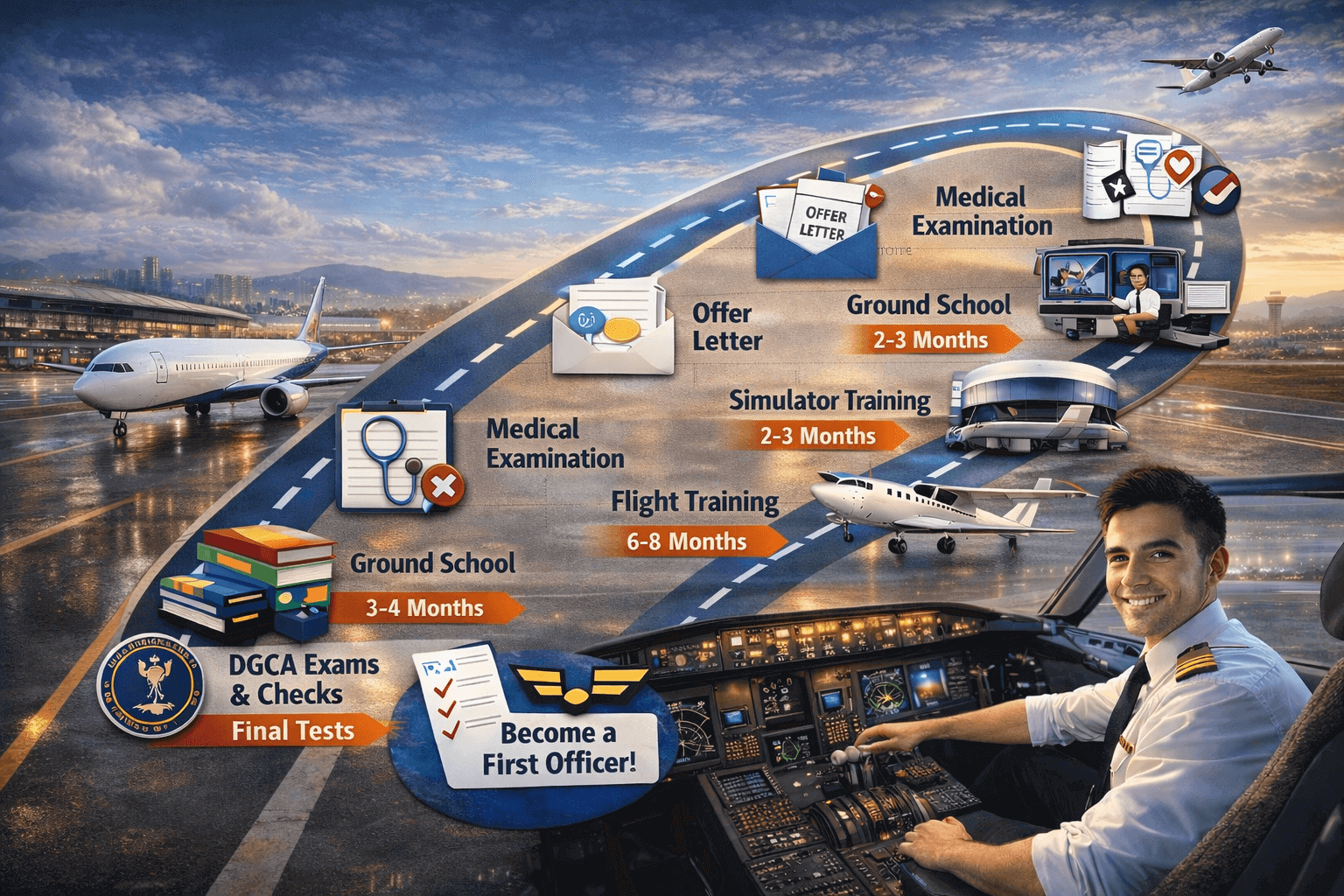
Airline Pilot Training Timeline at a Glance
From Selection to Independent Line Flying
- Induction & Ground School: 1–2 months
- Simulator Training (FFS / OCC / Type Rating): 1.5–2 months
- Observation Flights: 1.5–2 months
- Supervised Line Flying (SLF): 3–5 months
- Total Time to Independent Flying: 7–9 months (Exact duration depends on airline, aircraft type, rostering, and operational demand.)
Final Takeaway: Why Airline Training Takes So Long
Clearing the interview and signing the contract doesn't make you an airline pilot, it makes you an airline pilot in training.
Every phase, whether from ground school to simulator checks to supervised flying, is designed to ensure that pilots can safely operate one specific aircraft, for one specific airline, under real operational pressure.
That's why when you see a young pilot in uniform, you're not seeing someone who has "just learned to fly."
You're seeing someone who has spent months proving—step by step—that they're ready for the responsibility.
Ready to Become a Pilot?
Your journey to the skies starts with the right information and the right flying school. Take the first step towards your aviation career today. Get expert consultation, book a call today.
Map Your Custom Pilot Training Pathway
Evaluate your compliance across the 4 major DGCA training gates, select training country routes (India vs. USA/Europe), and estimate your CPL timeline month-by-month.